




A suitcase used to be a fairly boring purchase. You bought one when the old one broke, when the family needed another, or when a wedding or holiday was coming up. The colour probably mattered, but not enough to make anyone think too hard about it.
That is changing. Luggage is slowly becoming less of a utility product and more of a consumer product, where design, colour and brand can influence what people buy.
Safari Industries is trying to build its business around that change.
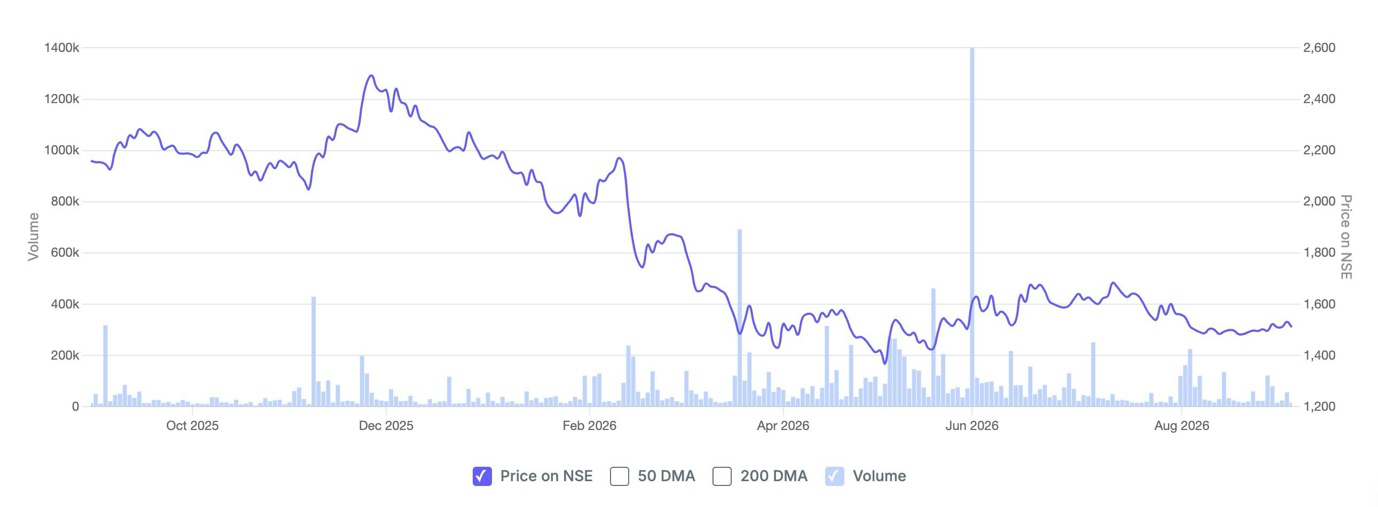
Safari Industries 1-Year Share Price Chart
The Indian luggage market is shifting from a functional utility category to a lifestyle- and fashion-led sector. Younger consumers, particularly Gen Z and millennials, are increasingly treating luggage as a fashion accessory, which could also shorten replacement cycles.
That creates an interesting opportunity. Safari does not necessarily have to wait for the number of people travelling to increase. It can sell more products to existing travellers, sell them more expensive products and reach consumers through more brands and channels.
From suitcases to a portfolio
Safari’s business is still simple at its core. It manufactures and markets luggage and luggage accessories, with products ranging from hard and soft luggage to backpacks, school bags, duffle bags and travel accessories. Hard luggage made from polypropylene (PP) and polycarbonate (PC) is manufactured in-house at its Halol and Jaipur plants, while soft luggage is mainly sourced.
Safari has built a portfolio to target different parts of this market. Its core Safari brand serves the mass and mid-market, while Safari Select offers a premium, semi-formal proposition and Urban Jungle is aimed at younger, affluent consumers with a more casual, digital-first positioning. Genie and Genius cater to women and children respectively, while Carlton is being introduced at the super-premium end.
This premium segment is also becoming more competitive. Newer brands such as Mokobara are targeting younger, design-conscious consumers, putting more pressure on established players such as Safari to differentiate their products rather than compete only on price.
The multi-brand approach gives Safari more ways to address the same broad market. It can compete for the first-time branded luggage buyer while also giving existing customers reasons to move towards more premium products.
The company is also widening its reach. Safari has more than 8,500 customer touchpoints across hypermarkets, e-commerce and quick-commerce platforms, multi-brand outlets, exclusive stores, direct-to-consumer channels, institutional sales and exports.
That combination of brands, products and distribution is central to Safari’s attempt to grow faster than the overall luggage market. To do that, however, it also needs the manufacturing capacity to support higher volumes.
Capacity is being added
Safari has been increasing manufacturing capacity for PP and PC hard luggage at Jaipur and Halol. It has invested in additional machinery and automation, while also working to manufacture more of its premium hard luggage internally.
The company has also been investing in automation at its plants. At the Jaipur facility, for instance, it has installed servo-based injection moulding machines, robotic arms and computer numerical control (CNC) cutting machines. These investments are intended to improve productivity, cycle times, consistency and energy efficiency.
Capacity alone, however, does not create value. The benefit comes if Safari can use that capacity to produce more luggage at a competitive cost, while also selling a greater proportion of higher-value products. The latest quarterly figures reflect this reality.
More sales, less profit
Q1 FY27 consolidated revenue rose 11.6% year-on-year to Rs 589 crore from Rs 528 crore. Operating profit, however, declined from Rs 79 crore to Rs 75 crore, while operating margin fell from 15% to 12.7%. Net profit declined from Rs 50 crore to Rs 48 crore.
So Safari sold more luggage, but made less profit from it. Higher raw material costs were one reason, with PP and PC prices coming under pressure during the quarter. This is particularly relevant for a company that is trying to increase volumes while also moving customers towards higher-value products.
Growth has remained strong, but margins have fallen
| Rs crore | FY23 | FY24 | FY25 | FY26 |
| Revenue | 1,212 | 1,550 | 1,772 | 2,047 |
| Revenue growth | — | 27.9% | 14.3% | 15.5% |
| Operating profit | 197 | 278 | 225 | 271 |
| Operating margin | 16% | 18% | 13% | 13% |
| Net profit | 125 | 176 | 143 | 168 |
| Net profit growth | — | 40.8% | -18.8% | 17.5% |
There was also some demand disruption during the quarter. Weddings remain an important short-term driver for the luggage industry, while domestic travel continues to support underlying demand.
That makes quarterly numbers somewhat uneven. A luggage purchase is not a monthly decision and wedding dates, travel plans and promotional activity can all affect when the purchase happens.
But the bigger question is not whether one quarter was weak. It is whether Safari can make its profits grow faster as the business gets larger.
That brings the focus back to premiumization. If Safari can persuade consumers to pay more for its products, while its manufacturing investments help keep costs under control, revenue growth could eventually translate into better margins.
Premiumization is the bigger opportunity
Safari’s brand strategy is an important part of that effort. The company is trying to move beyond competing mainly on price and durability and capture consumers for whom design, colour, features and brand matter more.
The company describes this shift towards “luggage as lifestyle” and says consumers are increasingly treating luggage as a fashion accessory. That is potentially important for Safari because a consumer buying on design and brand may be less focussed on finding the cheapest suitcase.
But premiumization is not simply about putting a higher price tag on a product. The consumer has to believe the product is worth paying more for.
That makes Urban Jungle and Safari Select important, but it also makes the competitive environment more relevant. Newer brands such as Mokobara have shown that younger, design-conscious consumers can be approached differently, while established luggage companies continue to compete across price points.
Safari therefore has to do two things at the same time. It has to defend its existing business while convincing consumers to trade up.
Safari is not making this transition in an empty market. Established players continue to compete aggressively for market share, while newer direct-to-consumer brands such as Mokobara are targeting younger consumers through design and digital-first marketing.
This competitive intensity is a risk to Safari’s premiumization strategy. If companies respond with lower prices and higher promotions, it could make it harder for Safari to turn higher sales into better operating margins.
The advantage Safari has is scale. Its established brand, manufacturing base and distribution network give it a much larger physical presence than a young digital-first brand.
But scale is useful only if it can be converted into a better consumer proposition.
The balance sheet gives it room to invest
Safari’s balance sheet does not currently look like the biggest constraint. Debt-to-equity is only around 0.11x, while FY26 operating cash flow was positive at Rs 173 crore and free cash flow stood at Rs 105 crore.
Low debt, but working capital needs watching
| FY26 metric | |
| Borrowings | Rs 117 crore |
| Reserves | Rs 1,105 crore |
| Debt-to-equity | 0.11x |
| Operating cash flow | Rs 173 crore |
Working capital is more worth watching. Inventory stood at 116 days at the end of FY26, pushing the cash conversion cycle to 103 days. This is not necessarily a red flag for a luggage business with a wide product range, but as Safari adds brands and products, keeping inventory under control will become increasingly important.
There is also an interesting investor signal in the shareholding pattern. Ashish Kacholia held 9 lakh shares of Safari, equivalent to a 1.84% stake, as of June 2026. His absolute holding has remained unchanged at 9 lakh shares since at least June 2024, although his percentage stake has gradually declined from 2.6% in September 2022 as the company’s share count increased.
That does not tell us where the stock is headed, or what Kacholia’s investment thesis is. But it is notable that he has continued to hold the same number of shares through a period in which the stock has fallen sharply from its 52-week high.
What could make the strategy work?
There are several pieces that need to fall into place. First, the new manufacturing capacity needs to translate into higher volumes. Second, the premium brands need to become meaningful contributors rather than remaining small parts of the portfolio. Third, Safari needs to expand distribution without allowing inventory to build up excessively.
And finally, the company needs to protect margins. The last point is probably the most important.
Safari has already shown that revenue can grow rapidly. The next phase of the story is about whether profit can grow faster than revenue.
If the company can sell more hard luggage, increase the contribution from premium products and use its expanded manufacturing base efficiently, there is a possibility that operating leverage will start working in its favour.
If raw material inflation, discounting and competition absorb those gains, the story becomes considerably less attractive.
Valuation is no longer an afterthought
At around Rs 1,507, Safari trades at around 44.7 times earnings, while return on capital employed (ROCE) is 19.3% and return on equity (ROE) is 15.9%.
The valuation explains why investors need to look beyond the revenue growth number.
A company growing at 15-20% can still be a poor investment if the price already assumes that growth will continue for many years. Safari’s current valuation leaves relatively little room for a prolonged period of weak earnings growth.
The stock is already around 40% below its 52-week high of Rs 2,507. That decline does not necessarily mean the business has broken. It does, however, suggest that the market has become more demanding about what Safari needs to deliver.
The company now has to prove that the investments in capacity, brands and distribution can produce a corresponding increase in earnings.
The real Safari story
The easy way to describe Safari is as a company that benefits when Indians travel more. The more interesting way to look at it is as a company trying to change what Indians buy when they travel.
That is important because the first story is largely dependent on the growth of the luggage market. The second gives Safari several additional levers: premium products, new brands, more SKUs, wider distribution and higher manufacturing capacity.
The Indian luggage industry is already moving in that direction. Safari’s own annual report describes a category where luggage is becoming more design-led, more branded and increasingly connected to lifestyle.
The company has responded by building a wider portfolio, expanding manufacturing and increasing its reach across more than 8,500 customer touchpoints.
The opportunity, then, is fairly clear. Safari can grow by selling more suitcases. It can grow further by selling better and more expensive suitcases. And if it can do both without allowing raw material costs, competition and inventory to eat away the gains, the economics of the business could improve meaningfully.
For investors, however, the question is no longer whether Safari can grow. It is whether the company can turn that growth into higher-quality earnings, while the market is still willing to pay a premium for them.
Disclaimer:
Note: We have relied on data from www.Screener.in throughout this article. Only in cases where the data was not available, have we used an alternate, but widely used and accepted source of information.
The purpose of this article is only to share interesting charts, data points and thought-provoking opinions. It is NOT a recommendation. If you wish to consider an investment, you are strongly advised to consult your advisor. This article is strictly for educative purposes only.
Manvi Aggarwal has been tracking the stock markets for nearly two decades. She spent about eight years as a financial analyst at a value-style fund, managing money for international investors. That’s where she honed her expertise in deep-dive research, looking beyond the obvious to spot value where others didn’t. Now, she brings that same sharp eye to uncovering overlooked and misunderstood investment opportunities in Indian equities. As a columnist for LiveMint and Equitymaster, she breaks down complex financial trends into actionable insights for investors.
Disclosure: The writer and her dependents do not hold the stocks discussed in this article. The website managers, its employee(s) and contributors/writers/authors of articles have or may have an outstanding buy or sell position or holding in the securities, options on securities or other related investments of issuers and/or companies discussed therein. The content of the articles and the interpretation of data are solely the personal views of the contributors/ writers/authors. Investors must make their own investment decisions based on their specific objectives, resources and only after consulting such independent advisors as may be necessary.