




The Illusion of Having Arrived
Few ideas pull in retail investors faster than debt-free stocks. A company that owes nothing cannot be squeezed by lenders when business slows. So, I ran a simple screen for companies with almost zero debt and strong one-year share price returns.
Two names stood out. One is a 43-year-old Hyderabad software company that, as recently as FY24, earned under Rs 1 cr of revenue a year. The other is a 31-year-old Ahmedabad company that now runs a Gujarati streaming app. The first is up 180% over the past year. The other is up 165%. Each is now worth more than Rs 1,500 cr.
However, the screen tells you where a company has arrived, not how it got there. In both cases the answer sits in exchange filings on BSE, and once you read them, the headline numbers look very different. Let us dive in.
#1 Hypersoft Technologies: Growth from a Microscopic Base
Incorporated in 1983, Hypersoft Technologies spent most of its listed life as a tiny Hyderabad software vendor. It sold back-office packages for commodity brokers and accounting software for housing societies. From FY19 to FY24, annual revenue never crossed Rs 1 cr.
That changed when Narra Purna Babu, a Singapore-based entrepreneur and now the Managing Director, folded his businesses into the listed company. Through FY26, Hypersoft bought NX Global, owner of Mindgate Solutions, and Nexus Innovate, paying for both with its own shares rather than cash. The group now sells SAP consulting, cloud, cybersecurity and AI services abroad.
The company has a market cap of Rs 1,656 cr, and promoters hold 59.24%. Its shareholder count nearly doubled in a year, from 875 to 1,680.
Open Offers and Dilution
The NX Global deal triggered a mandatory open offer. Between 20th October and 4th November 2025, Babu offered to buy 26% of the enlarged equity from public shareholders at Rs 11 a share. Over the past year the stock has not traded below Rs 51.2, more than four and a half times that offer price.
The bigger move came on 27th February 2026. To buy Nexus Innovate, Hypersoft allotted 6.82 cr new shares at Rs 29.25 each, lifting its share count from about 1.63 cr to 8.45 cr. That one allotment is roughly 80% of the equity today. Priced at about Rs 200 cr then, those shares are worth over Rs 1,300 cr now.
The old guard has stepped aside. Former promoter Sudhakara Varma Yarramraju, now holding 1.16%, moved to the public category from 28th September 2026, as per a BSE filing.
Numbers Behind the Jump
5-Year Financials For Hypersoft Technologies (Standalone)
| Financial Year | FY21 | FY22 | FY23 | FY24 | FY25 | FY26 | 5Y CAGR |
| Sales (Rs cr) | 0.78 | 0.95 | 0.87 | 0.83 | 8.05 | 36.14 | NM |
| EBITDA (Rs cr) | -0.01 | -0.06 | -0.13 | -0.32 | 0.43 | 3.81 | NM |
| Net Profit (Rs cr) | 0.01 | 0.01 | -0.11 | -0.67 | 0.21 | 2.92 | NM |
Source: Screener.in
EBITDA is operating profit before other income. NM: not meaningful. On paper, standalone sales grew 115% a year over five years. The math is right, but the figure says little, because the base was Rs 0.78 cr. Profit and EBITDA growth rates cannot be worked out sensibly, since the early years were losses or close to zero.
Consolidated accounts exist for just one year. In FY26, consolidated sales were Rs 72 cr and net profit Rs 4.09 cr, with the new businesses on the books for only part of the year.
In results filed with BSE on 31st July 2026, the company reported consolidated revenue of Rs 77.53 cr and net profit of Rs 10.17 cr. One quarter beat all of FY26 on revenue and earned about two and a half times its profit. Operating margin rose to 14%, from 8% in March. The subsidiaries contributed Rs 60.31 cr, or roughly 78% of revenue.
Valuations Divorced from Fundamentals
The share price of Hypersoft Technologies was around Rs 5 in October 2021 and as of closing on 1st October 2026 it was Rs 196. In just the last year, the stock has jumped from Rs 70 to its current price, which is a jump of 180%.
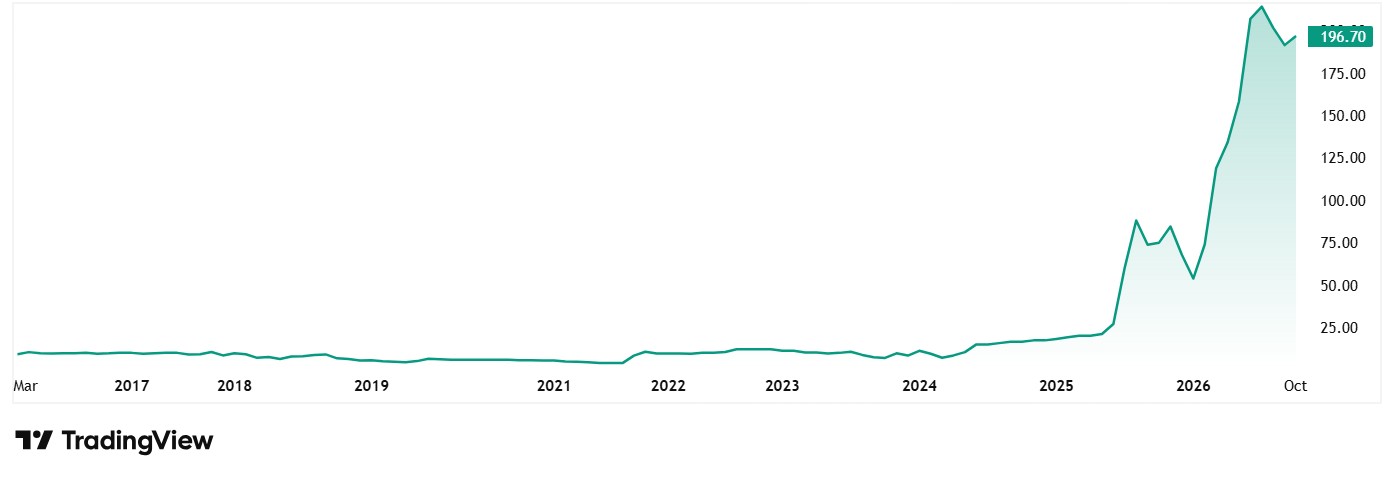
As for the valuation, the stock is trading at a PE of around 405x against the industry median of 20x. This translates to roughly 400 times its FY26 consolidated profit and 7.7 times its book value. TCS, by comparison, trades at a PE of about 14x and Infosys at about 13.5x. A 10-year median PE comparison is of no use, as for most of the decade this business either lost money or earned a few lakhs a year.
Red Flags in Receivables and Reporting
Consolidated debtor days stood at 355 in FY26, implying that it takes about a year to collect the payment for services sold. CFO Lakshman Koduru resigned with effect from 17th August 2026, about two weeks after the June results. The June quarter filing also notes that some subsidiary figures were not reviewed by the auditor and were included as certified by management.
#2 JOJO: A Smallcap with a Blockbuster Premium
Incorporated in 1995, JOJO started life as Toheal Pharmachem, later became Madhuveer Com 18 Network and took its present name in 2026. It runs the JOJO app, which it calls a dedicated Gujarati OTT platform, plus a film studio, ticketing and an ad sales arm. In 2026 the app joined Airtel Xstream, and its BSE disclosures show JOJO TV signing up with JioFastTV and Samsung TV Plus.
With a market cap of Rs 1,553 cr, JOJO is the fourth most valuable of 32 listed film production, distribution and exhibition companies, behind only PVR Inox, Media Matrix and Panorama Studios. PVR Inox is worth about 7.7 times as much, yet its June quarter sales were more than 350 times JOJO’s.
Warrants and Promoter Control
Control changed hands in 2023. Dhruvin Shah, now Managing Director, and Sagar Shah came in through warrants priced at Rs 10 and an open offer at the same price. Promoter holding jumped from 3.91% in December 2023 to 65.08% by March 2024, and is 67.79% today.
More warrants followed. On 7th May 2026, warrants for 90 lakh shares, 27 lakh of them held by Dhruvin Shah, were converted at Rs 40 a share. Adjusted for the August 2026 share split, those entry prices work out to Rs 5 and Rs 20. The stock closed at Rs 225 on 1st October 2026, 45 times the first and over 11 times the second.
A Five-Fold Revenue Spike
5-Year Financials for JOJO (Consolidated)
| Financial Year | FY21 | FY22 | FY23 | FY24 | FY25 | FY26 | 5Y CAGR |
| Sales (Rs cr) | 0.12 | 0.20 | 0.10 | 4.81 | 4.38 | 24.01 | NM |
| EBITDA (Rs cr) | -0.01 | 0.08 | -0.03 | 1.89 | -0.76 | 10.25 | NM |
| Net Profit (Rs cr) | 0.00 | 0.17 | 0.01 | 2.34 | -1.66 | 5.62 | NM |
Source: Screener.in
EBITDA is operating profit before other income. NM: not meaningful. The arithmetic gives a five-year sales CAGR of 189%, built on FY21 revenue of just Rs 12 lakh. FY25 was a loss year. The real story is FY26, when sales rose more than five-fold to Rs 24 cr.
Burst Revenue and Missing Cash
The revenue arrives in bursts. The December and March quarters made up about 86% of FY26 sales. The June 2026 quarter then brought in only Rs 4.52 cr of revenue and Rs 0.90 cr of profit, against Rs 12.60 cr and Rs 4.79 cr a quarter earlier.
Cash has also trailed profit. Free cash flow was negative in each of the last three years, including Rs 20.04 cr in FY25. Debtor days stood at 365. Return on equity has averaged under 6% over three years. Borrowings of Rs 3.20 cr make it almost, not fully, debt-free.
Factoring in the 229x Valuation Multiple
The share price of JOJO was around Rs 1.25 in October 2021 and as of closing on 1st October 2026 it was Rs 225. In the last 1 year, the stock price has jumped by 165% from Rs 85 in October 2021 to its current price.
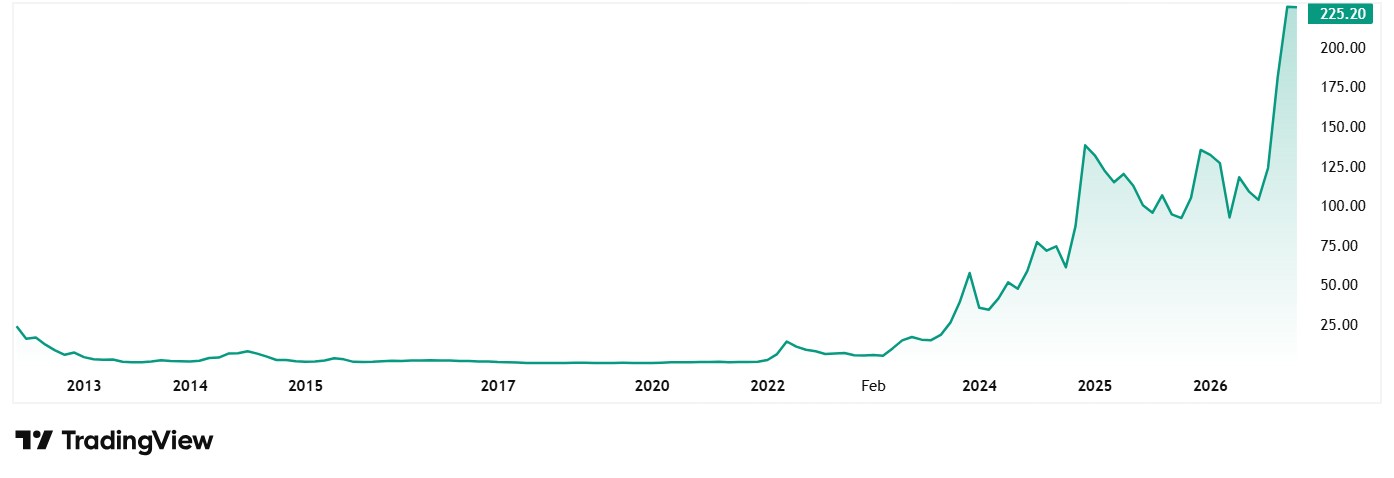
The share trades at a PE of about 229x against the current industry median of 52x. As with Hypersoft, a 10-year median PE comparison does not hold up, since the company earned close to nothing for most of the decade.
The number of shareholders more than doubled in two months, from 1,620 in June to 3,599 in August, around the share split. At the AGM on 29th September 2026, shareholders approved a 1:1 bonus issue that will take the share count to about 13.79 cr. Once the stock turns ex-bonus, its quoted price will roughly halve. The value of each holding will not change, and neither will the business.
The Real Cost of “Debt-Free” Expansion
Strip away the tickers and the two stories rhyme. Both were dormant listed companies for years. Both were taken over by new owners who brought in businesses or capital through share swaps and warrants. And in both cases, those owners paid a fraction of what the market charges today.
That is where the debt-free label needs care. In a mature company, zero debt usually means the business throws off enough cash to fund itself. In a company rebuilt in the last two or three years, it often means something simpler: growth was paid for with new shares rather than loans.
None of this means either business will falter. Hypersoft’s June quarter was strong, and JOJO has signed deals with big distribution names. But the next few quarters must do the heavy lifting. Hypersoft has to collect its receivables, name a new CFO and produce fully reviewed subsidiary numbers. JOJO has to show steady quarterly revenue and turn profit into cash.
Until then, the triple digit multiples price in a future that is still being written. A sensible step would be to add these stocks to a watchlist and track how the numbers evolve.
Disclaimer
Note: We have relied on data from www.Screener.in and www.trendlyne.com throughout this article. Only in cases where the data was not available, have we used an alternate, but widely used and accepted source of information, including filings made available on the BSE website.
The purpose of this article is only to share interesting charts, data points and thought-provoking opinions. It is NOT a recommendation. If you wish to consider an investment, you are strongly advised to consult your advisor. This article is strictly for educative purposes only.
Suhel Khan has been a passionate follower of the markets for over a decade. During this period, He was an integral part of a leading Equity Research organisation based in Mumbai as the Head of Sales & Marketing. Presently, he is spending most of his time dissecting the investments and strategies of the Super Investors of India.
Disclosure: The writer and his dependents do not hold the stocks discussed in this article.
The website managers, its employee(s), and contributors/writers/authors of articles have or may have an outstanding buy or sell position or holding in the securities, options on securities or other related investments of issuers and/or companies discussed therein. The content of the articles and the interpretation of data are solely the personal views of the contributors/ writers/authors.