



High ROCE, Low PE, Still Ignored?
Value for money stocks are easy to find. But such stocks that also earn a high return on the money put into them are much rarer. ROCE, or return on capital employed, shows the profit a company makes on every Rs 100 of capital it uses. PE, or price-to-earnings, shows what the market pays for every rupee of profit.
I ran a screen for profit-making companies with a high ROCE and a low PE this week. Two smallcap names stood out, and each hides in the shadow of a far more famous one. The first is the 163-year-old Wadia Group flagship that controls Britannia. The second is a Kolkata company whose clients have included cable makers such as KEI, Havells and Apar. Both earn a ROCE above 30%. Both trade at a PE much lower than their respective industry medians.
A low PE rarely comes without a reason. The real question is whether that reason still holds. Let us dive in.
#1 Bombay Burmah: The Rs 9,000 Crore Stock Sitting on Rs 59,500 Crore of Britannia
Incorporated in 1863, The Bombay Burmah Trading Corporation began life trading teak in Burma and moved into tea estates in South India in 1913. It is the Wadia Group’s flagship.
With a market cap of Rs 8,966 cr, it runs tea and coffee estates and makes auto electric parts and dental products. It also holds the group’s crown jewel: majority control of Britannia Industries, the maker of Good Day and Marie Gold biscuits.
The Britannia Maths the Market Keeps Ignoring
Britannia’s shareholding filing for the June 2026 quarter shows its promoter group holding 50.55% of the company. Almost all of that block sits with step-down subsidiaries of Bombay Burmah.
At Britannia’s market value of about Rs 1,15,858 cr, that stake is worth over Rs 59,000 cr on paper. Bombay Burmah’s own market value is about 15% of that figure. Put simply, each Bombay Burmah share carries close to Rs 8,500 worth of Britannia stock, and trades at about Rs 1,300.
There are reasons for the gap. The stake is not for sale, so shareholders only see its value through dividends passed up the chain. That is why Indian holding companies almost always trade at a discount. The group also carries the scar of Go First, the airline in which Bombay Burmah held about a third. When the airline collapsed in 2023, the company made provisions of Rs 1,866 cr, and FY23 ended in a consolidated loss of Rs 534 cr.
Half the Profit Belongs to Britannia’s Other Shareholders
| Financial Year | FY21 | FY22 | FY23 | FY24 | FY25 | FY26 | 5-Yr CAGR |
| Sales (Rs Cr) | 13,396 | 14,507 | 16,623 | 17,109 | 18,298 | 19,539 | 8% |
| EBITDA (Rs Cr) | 2,150 | 1,595 | 1,726 | 2,867 | 3,136 | 3,432 | 10% |
| Net Profit (Rs Cr) | 1,278 | 809 | -534 | 1,689 | 2,199 | 2,499 | 14% |
Source: Screener.in (Consolidated)
EBITDA is operating profit before other income. Net profit includes the share of minority shareholders.
Read the net profit row with care. It includes the part of Britannia’s profit that belongs to Britannia’s other shareholders, which is close to half.
In the June 2026 quarter, consolidated profit was Rs 582.67 cr. Profit belonging to Bombay Burmah’s own shareholders was Rs 288.16 cr, up about 20% on the year, as per results filed with BSE.
On that owners’ measure, earnings per share rose from Rs 52.96 in FY21 to Rs 178.10 in FY26, a compound rate of about 27%. The balance sheet has cleaned up too. Borrowings fell from Rs 6,542 cr in FY23 to Rs 1,590 cr in FY26. ROCE stands at 33%, with a return on equity (ROE) of about 19%.
The Rs 249 Crore Block Deal
On 18th September 2026, 18.34 lakh shares, or 2.62% of the company, changed hands in a block deal at about Rs 1,360 apiece. The stock jumped nearly 10% as traders guessed at a big new buyer.
Filings with BSE a few days later told a quieter story. The seller was Nusli Wadia, whose stake fell from 10% to 7.37%. The buyer was Nowrosjee Wadia and Sons, a promoter group company, which now holds 44.57%. It was an inter-se transfer, shares moving from one family pocket to another. The promoter group’s total holding stayed at about 74%. By 6th October, the stock had slipped to a fresh 52-week low.
Valuation: 7x Earnings, and Flat for Five Years
The share price of Bombay Burmah was around Rs 1,152 in October 2021 and as on 7th October 2026 it was Rs 1,285. That is a small gain in five years, and the stock is trading about 40% below its 52-week high of Rs 2,135.
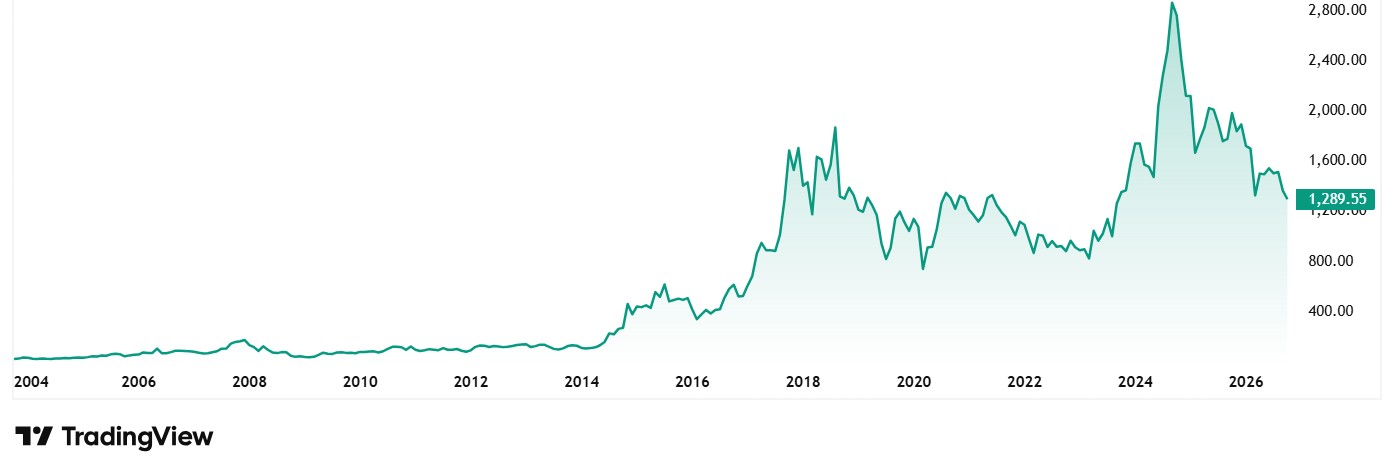
As for valuations, the stock trades at a PE of about 7x, while the current industry median is 44x. The 10-year median PE of the company is 16x, while the industry median for the same period is 47x. Note that the company’s PE history is bent out of shape by FY22 and FY23, when airline losses crushed earnings.
If Britannia, itself near a 52-week low, recovers, or the group simplifies its structure, the gap could narrow. If not, cheap can stay cheap for years. The board’s decision to skip a final dividend for FY26, disclosed to BSE on 13th May 2026, does not help.
#2 DDev Plastiks: The Cable Boom’s Quiet Supplier at 12x Earnings
Incorporated in 2020, DDev Plastiks Industries houses the polymer compounding business that the Surana family’s Kkalpana Industries demerged into it. The shares listed on BSE on 26th July 2022.
With a market cap of about Rs 2,564 cr, the company calls itself India’s largest maker of polymer compounds. These are the PVC and polyethylene materials that form the insulation and outer skin of wires and cables. PVC compounds alone made up 89% of revenue in the June 2026 quarter. Its clients have included KEI Industries, Havells, Apar Industries and KEC International.
Why Every Cable Maker Needs a Compounder
Think of a power cable as copper or aluminium wrapped in plastic layers that keep it safe and slow to burn. Cable makers buy those layers ready-made from compounders like DDev. So, when cable stocks ride India’s power and housing build-out, a supplier like this rides along, with far less attention.
A new 48,000 tonnes a year plant at Bhiwadi in Rajasthan, making XLPE (cross-linked polyethylene) compound for higher-voltage cables, started in April 2026. As per the company’s Q1 FY27 investor presentation, export sales doubled to Rs 312 cr in the quarter, or 32% of revenue.
A 38% Profit CAGR, With a Footnote
The demerger took effect from April 2021, so FY22 is the first full year of numbers and a five-year growth rate is not possible. The table shows four years instead.
| Financial Year | FY22 | FY23 | FY24 | FY25 | FY26 | 4-Yr CAGR |
| Sales (Rs Cr) | 2,227 | 2,504 | 2,431 | 2,603 | 2,948 | 7% |
| EBITDA (Rs Cr) | 106 | 160 | 258 | 270 | 287 | 28% |
| Net Profit (Rs Cr) | 55 | 104 | 182 | 186 | 202 | 38% |
Source: Screener.in (Standalone)
EBITDA is operating profit before other income. FY26 sales and EBITDA are the sum of four reported quarters.
The profit growth flatters a little. FY22 was a thin year, with an operating margin below 5%. Most of the jump came in FY23 and FY24 as margins widened to about 10%. Since then, profit growth has slowed to 2% in FY25 and 9% in FY26.
The June 2026 quarter showed fresh pace. Revenue rose about 29% to Rs 989 cr and net profit about 22% to Rs 63.8 cr, as per results filed with BSE on 10th August 2026.
ROCE stood at 31% in FY26. That is strong, but it is down from 45% in FY22. One reason is cash stuck in the business. Working capital days have climbed from 32 to 78 in four years, so more money now waits with customers and in stock. On the plus side, the company is almost debt-free.
The Battery Bet, and a Clock That Has Slipped
In a filing with BSE on 5th January 2026, the board approved a move into battery energy storage systems (BESS). These are large battery packs that store solar power for use after sunset. Phase 1 was a 5 GWh plant costing Rs 150 cr to Rs 200 cr, with revenue expected from the second half of FY27.
The Q1 FY27 investor presentation pushes that out. Phase 1 is now due by the first quarter of FY28, funded from internal cash. Early operating margins are pegged at about 6% to 8%, below what compounding earns today. Delays are common with new plants, but investors will want proof before paying up for a thinner-margin business.
Valuation: Over 6x Since Listing, but 30% Off the High
The share price of DDev Plastiks was around Rs 39 when it listed in July 2022 and as on 7th October 2026 it was about Rs 248, a rise of about six times. Even so, the stock is over 30% below its 52-week high of Rs 360.
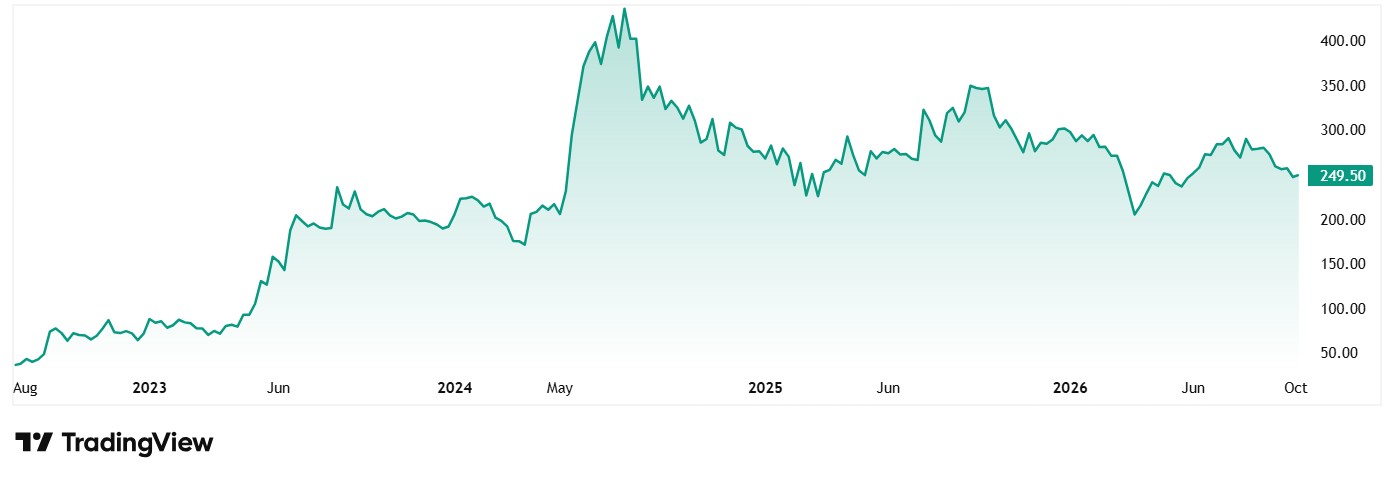
As for valuations, the company trades at a PE of about 12x, while the current industry median is 29x. A 10-year median PE does not exist here, as the company has been listed for just over four years. Promoters hold 75%, the most allowed for a listed company, which keeps the free float small.
Cheap for a Reason, or Simply Ignored?
Both stocks pass the same high ROCE test, yet they are cheap for different reasons. Bombay Burmah’s value is real but locked inside a family structure. DDev Plastiks runs a real business too, but the market is weighing in a slower profit growth, rising working capital and an untested battery venture.
Neither discount has to close. For Bombay Burmah, the triggers would be a Britannia recovery or a simpler group. For DDev, a smooth ramp-up at Bhiwadi, steady margins and a battery plant that arrives on its new timeline.
The next two sets of quarterly results should tell us a lot. A smart way to stay on top of both is to add these stocks to a watchlist and keep a close eye on them.
Disclaimer
Note: We have relied on data from www.Screener.in and www.trendlyne.com throughout this article. Only in cases where the data was not available, have we used an alternate, but widely used and accepted source of information, including filings made available on the BSE website.
The purpose of this article is only to share interesting charts, data points and thought-provoking opinions. It is NOT a recommendation. If you wish to consider an investment, you are strongly advised to consult your advisor. This article is strictly for educative purposes only.
Suhel Khan has been a passionate follower of the markets for over a decade. During this period, He was an integral part of a leading Equity Research organisation based in Mumbai as the Head of Sales & Marketing. Presently, he is spending most of his time dissecting the investments and strategies of the Super Investors of India.
Disclosure: The writer and his dependents do not hold the stocks discussed in this article.
The website managers, its employee(s), and contributors/writers/authors of articles have or may have an outstanding buy or sell position or holding in the securities, options on securities or other related investments of issuers and/or companies discussed therein. The content of the articles and the interpretation of data are solely the personal views of the contributors/ writers/authors.