



How One Product Line Transformed a Legacy Battery Maker
Most retail investors met this company in the same way. Sometime in late 2025, a headline flashed past about a small Hyderabad company that had just posted an over four-fold jump in quarterly profit. The stock had already run hard. It looked like the sort of thing you had missed. The honest question to ask was simple: what actually changed here, and how much of it is real?
The short answer is that this company stopped being only a battery manufacturer and moved to something new and big. For most of its life, the company sold industrial batteries to telecom towers, railways, defence units and power plants. Useful, unglamorous work. Then a single product line, railway signalling, quietly took over the story.
That shift is the reason the share price has done what it has done. It is also the reason the recent numbers need reading with care. So let us go through it properly: the history, the order book, the big financials, and the red flags.
From Industrial Batteries to Railway Tech
HBL Engineering Ltd was set up in 1983 by Dr A J Prasad, who still chairs the company. It started as Sab Nife Power Systems, became HBL Nife Power Systems, then HBL Power Systems, and was renamed HBL Engineering only recently. Through all of it, this was, and largely still is, a maker of specialised batteries.
With a market cap of Rs 22,645 cr, the company has a battery range wider than most people realise. There are lead acid batteries, including the VRLA and pure lead thin plate types used in telecom and data centres. There are nickel cadmium batteries, where HBL is among the largest producers in the world.
There are lithium batteries going into Vande Bharat trains and defence programmes. Add defence and aviation batteries, industrial electronics and an e-mobility line, and you have a genuine engineering house, not a one-product outfit.
But the engine that changed the share price is the rail signalling division, and one product inside it. Kavach.
Why the Kavach Moat Matters
Kavach is India’s home-grown train collision avoidance system. It sits on locomotives and along the track, and if a driver misses a signal or two trains close in, it can brake on its own. Indian Railways has made it a priority, and only a handful of firms are cleared to supply it. HBL is one of them, a small club guarding a very large opportunity. Now that is a moat and a high entry barrier rolled into one.
Talking about scale, Indian Railways is pushing to cover tens of thousands of route kilometres with Kavach, and the total spend has been estimated at close to Rs 50,000 cr. HBL has been building signalling capability since the mid-2000s, so it was ready when the orders began to flow. In the last two years they have made the most of the opportunity.
Analyzing the Financial Volatility
Here is where you have to be careful, because the growth rates look almost too good.
| Financial Year | FY21 | FY22 | FY23 | FY24 | FY25 | FY26 | 5Y CAGR |
| Sales (Rs cr) | 912 | 1,236 | 1,369 | 2,233 | 1,967 | 3,303 | 29% |
| EBITDA (Rs cr) | 67 | 139 | 151 | 423 | 393 | 1,113 | 75% |
| Net Profit (Rs cr) | 14 | 94 | 98 | 280 | 276 | 814 | 126% |
While the striking 5-year CAGR figures look huge, one must consider that they are based on the small base of FY21. Sales actually fell in FY25, from Rs 2,233 cr to Rs 1,967 cr, and profit was roughly flat. But FY26 was the year of turnaround.
That dip however has a clean explanation. A delay in a railway approval held back one large order, and the telecom battery business softened as that industry moved towards lithium. So, the honest reading of these five years is not a smooth climb. It is a solid but lumpy business that recovered strongly from FY22, then hit a soft patch in FY25, right before the fireworks.
Understanding the FY26 Profit Anomaly
About the fireworks. FY26 was the year that made HBL famous. For the September 2025 quarter the company reported net profit of about Rs 387 cr, against roughly Rs 87 cr a year earlier, on revenue near Rs 1,223 cr and operating margins above 44%. The stock, which had been drifting, shot back towards its highs.
What drove it was the electronics segment, which is mostly Kavach. That line jumped roughly eight times over the year before as several large orders hit delivery at once. For the full year to March 2026, consolidated revenue rose to around Rs 3,300 cr and net profit to over Rs 800 cr, both records by a wide margin.
Here is the part most reports miss. The management itself said, in writing, that this quarter was exceptionally good and should not be expected in any single quarter in the coming years. It went further, calling FY26 as a whole an exceptional year that should not be used as a base for the future. That is a rare bit of plain speaking, and it deserves to be taken seriously.
The proof arrived quickly. By the March 2026 quarter, profit had cooled to about Rs 64 cr and the operating margin was back near 12%. Quarter by quarter, the profit line ran from roughly Rs 387 cr to Rs 220 cr to Rs 64 cr. That is the nature of project work, where deliveries are lumpy and one blockbuster quarter can flatter a whole year.
Valuation: Pricing the Railway Growth Story
The share price of HBL Engineering was around Rs 55 in July 2021 and as of closing on 7th July it was Rs 817. That is a jump of 1,385% in 5 years.
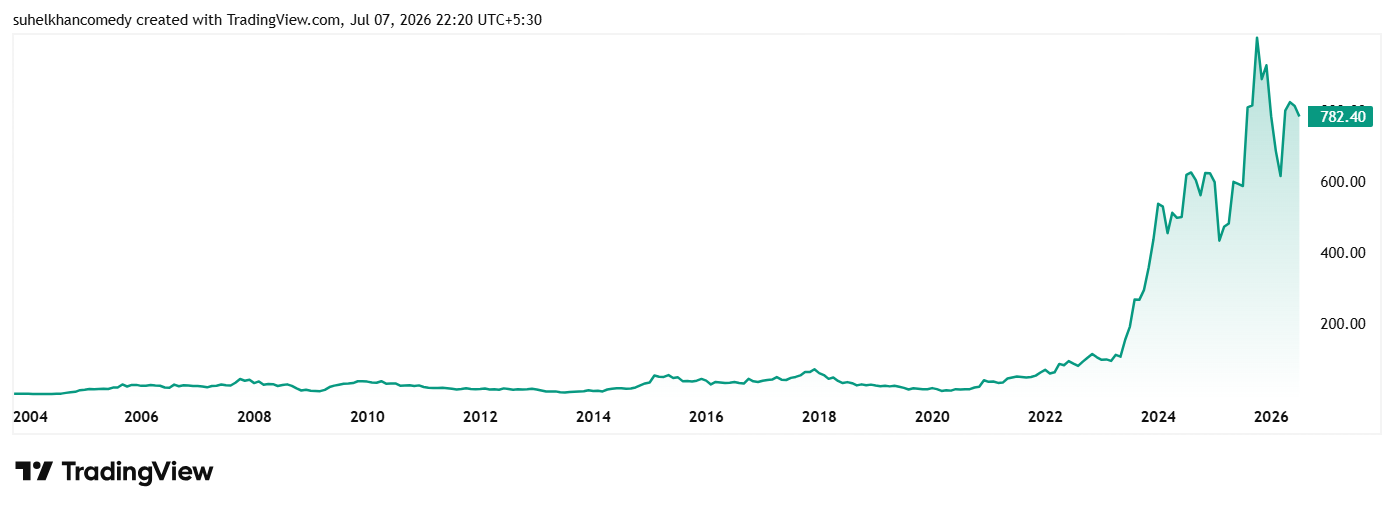
However, at the current price of Rs 817, the stock is still trading at a discount of 27% from its all-time high of Rs 1,122 which it hit in November 2025.
Regarding valuations, the share is trading at a PE of 27x against the industry median of 26x. The 10-Year median PE of the company is 39x while the industry median for the same period is 29x. The market is not pricing HBL as a battery company. It is pricing it as a fast-growing railway technology company, and paying in advance for orders that still have to be built and billed.
But again, all this has to be looked at through the lens of what the management had to say. The Kavach orders kicking in was the reason for the solid quarter, which the management has said not to expect again anytime soon.
Evaluating the Current Order Pipeline
Order book is where the excitement lies, so it is worth being precise. As on 31 July 2025 the company’s total order book stood at about Rs 4,479 cr. By 31 December 2025 it had come down to roughly Rs 2,999 cr. That fall is not a warning on its own. It means HBL was billing faster than it was replacing the work, which is what you want to see for a while.
The replacement has kept coming. Through the year HBL kept winning fresh Kavach contracts from various railway zones and locomotive works, and in May 2026 it landed its single largest order yet, an onboard Kavach package worth roughly Rs 1,710 cr, to be delivered over 18 to 24 months. The pipeline is still being topped up. The question is no longer whether the orders exist, but whether HBL can build fast enough to turn them into cash.
Assessing Balance Sheet Quality and Returns
Strip away the noise and the underlying quality shows itself. HBL is virtually debt free. At the end of FY26 its borrowings were a tiny Rs 67 cr against its net worth, and it holds more cash than debt. That gives it room to fund new capacity without leaning on lenders, which matters when execution, not order wins, is the main constraint.
Return on capital tells a similar story. Return on capital employed (ROCE) or how much profit the company earns on the capital put into the business, was around 27% in FY25 and had been climbing. As of 7th July 2026, the ROCE is 58%, while the industry median is 16%. In simple words for every Rs 100 the company puts in as capital in the business, it generated a profit of Rs 58 on it, while its peers manage only Rs 16.
Key Risks: Concentration and Lumpiness
The first flag is concentration. The growth story rests heavily on one customer, Indian Railways, and one theme, Kavach. Government buyers are reliable but slow payers, and their timelines drive HBL’s quarters more than HBL does.
The second flag is lumpiness. As the FY26 profit path showed, earnings can swing violently from quarter to quarter, and anyone expecting a smooth line will be tested. The third is the battery base itself, where telecom demand is shifting to lithium and capacity use has been uneven.
The fourth is simply price. After a rally of over 1,300% over five years, a lot of good news is already in the stock, and a soft quarter can be punished hard. There have also been one-off write-offs, including unrecoverable costs on a torpedo battery project, that remind you this is real engineering with real dead ends.
Is HBL Priced for Perfection?
HBL Engineering is a genuinely improved business wearing a slightly misleading number. The Kavach pivot is real, the order book is real, the balance sheet is clean and the return ratios are healthy. Those are reasons enough for a place on a serious watchlist.
But the headline FY26 profit is not a base you can build a forecast on, and the company has been unusually honest in saying so. The useful way to think about HBL is to look past the one blockbuster year, ask what the steady earnings power looks like once the lumps smooth out, and decide whether today’s price already assumes the best case.
Disclaimer:
Note: We have relied on data from http://www.Screener.in and http://www.trendlyne.com throughout this article. Only in cases where the data was not available, have we used an alternate, but widely used and accepted source of information.
The purpose of this article is only to share interesting charts, data points and thought-provoking opinions. It is NOT a recommendation. If you wish to consider an investment, you are strongly advised to consult your advisor. This article is strictly for educative purposes only.
Suhel Khan has been a passionate follower of the markets for over a decade. During this period, he was an integral part of a leading Equity Research organisation based in Mumbai as the Head of Sales & Marketing. Presently, he is spending most of his time dissecting the investments and strategies of the Super Investors of India.
Disclosure: The writer and his dependents do not hold the stocks discussed in this article. The website managers, its employee(s), and contributors/writers/authors of articles have or may have an outstanding buy or sell position or holding in the securities, options on securities or other related investments of issuers and/or companies discussed therein.