



India’s expanding metro network is creating fresh opportunities for railway rolling stock manufacturers. As cities invest in new metro corridors and additional trains, demand for domestically manufactured metro coaches could gain momentum.
The latest opportunity comes from Hyderabad. On 16 October 2026, the Delhi Metro Rail Corporation (DMRC) floated a tender worth Rs 923.62 crore for 60 metro coaches. The contract includes design, manufacturing, supply, commissioning and 15 years of comprehensive maintenance. The deadline for submitting bids is 13 January 2027.
However, not every railway company is positioned to benefit directly. Metro coach manufacturing requires specialised production facilities, technical expertise and a proven execution record. Companies with established capabilities and completed deliveries may be better placed to compete for such contracts.
We identified two Indian-listed companies with operational metro coach manufacturing facilities, successful delivery records and existing order pipelines.
While the Hyderabad tender represents a potential opportunity rather than a confirmed order, both companies offer direct exposure to India’s growing metro rolling stock market.
Let’s examine their manufacturing capabilities, existing contracts and financial performance to understand how they are positioned for the next phase of metro expansion.
#1 BEML: Over 2,100 Metro Coaches Manufactured, Rail & Metro Drives Order Book
BEML is an established metro coach manufacturer, supplying trains to networks including Delhi, Bengaluru, Mumbai and Kolkata.
The company crossed the 2,100-coach manufacturing milestone in May 2025. Its portfolio includes driverless metro trains equipped with Grade of Automation 4 (GoA4) technology. This manufacturing track record and completed deliveries support its inclusion among companies positioned to benefit from upcoming metro tenders.
Metro coaches currently have an indigenisation level of around 65%, according to the company’s FY26 annual report. BEML is working to increase domestic sourcing further.
Why Rail & Metro Commands 65% of BEML’s Orders but Only 24% of Revenue
Rail & Metro represented 65% of BEML’s order book in August 2026, against a 24% contribution to FY26 revenue. Management expects to deliver 20–25 trains to Bengaluru Metro during FY27. The company is also pursuing six metro tenders across Chennai, Delhi, Uttar Pradesh, Pune-Nagpur and Mumbai.
The September quarter brought further railway orders. BEML secured a contract exceeding Rs 5,400 crore from NHSRCL for high-speed rolling stock and maintenance on the Mumbai-Ahmedabad corridor. It also received a Rs 180.6 crore order for additional Vande Bharat Sleeper trainsets. These contracts are separate from metro manufacturing but add to its railway order pipeline.
BEML’s Bhopal Expansion: An 18-Month Timeline With Construction Yet to Begin
BEML plans to increase rail coach manufacturing capacity from approximately 250 to 350–400 units annually. Its proposed BRAHMA facility near Bhopal will support this expansion. According to the August earnings-call transcript, civil construction had yet to begin. Management expects the first equipment to roll out 18 months after construction starts.
Exports offer another growth avenue. BEML secured its first metro rolling stock export contract worth Rs 550 crore for Africa. It is also pursuing two overseas metro opportunities estimated at Rs 15,000 crore combined.
In FY26, revenue increased 8.2% year-on-year (YoY) to Rs 4,351 crore. However, net profit declined 50% to Rs 147 crore. The annual report attributed pressure on profitability partly to provisions exceeding Rs 257 crore, including cost escalation and foreign exchange impacts on metro contracts.
BEML is yet to declare its Q2FY27 financial results.
Valuations remain demanding. EV/EBITDA stands at 42.3 times, against a historical median of 29 times and peer multiple of 19.7 times. Return on capital employed (ROCE) of 7.7% and return on equity (ROE) of 4.5% indicate modest capital efficiency. Timely execution, improved margins and working capital management remain important as the order pipeline expands.
BEML Financial Performance
| Metric | FY26 |
| Revenue | Rs 4,351 crore |
| Revenue growth | 8.2% YoY |
| Net profit | Rs 147 crore |
| Profit growth | -50% YoY |
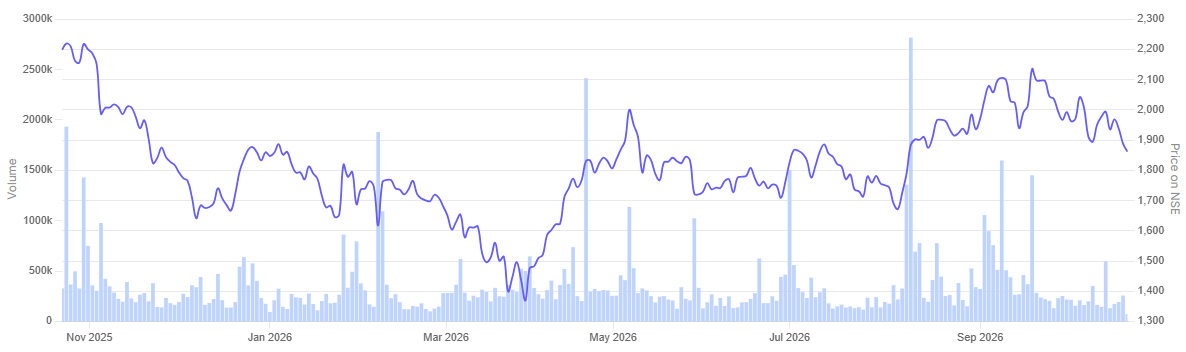
In the past year, the share price of BEML is down 15.3%.
BEML 1-Year Share Price Chart
#2 Titagarh Rail Systems: Passenger Rail Revenue Doubles as Metro Coach Deliveries Accelerate
Titagarh Rail Systems manufactures metro coaches, passenger trains and railway wagons. The company has completed deliveries of 34 trainsets for Pune Metro and supplied driverless metro trains for Bengaluru.
Its operating manufacturing facility at Uttarpara, completed metro deliveries and contracts across Bengaluru, Ahmedabad, Surat and Mumbai support its inclusion among listed companies positioned to benefit from rising metro coach demand.
Passenger Rail Systems (PRS) is becoming a major growth driver. According to its FY26 annual report, PRS revenue increased 111% year-on-year (YoY) to Rs 539.3 crore from Rs 255.5 crore. Coach deliveries rose to 63 from 12 in FY25.
Can Rs 10,395 Crore in Passenger Rail Orders Translate Into Faster Metro Deliveries?
Passenger rail systems represented approximately 77% of Titagarh’s standalone order book as of March 2026, reflecting its shift from freight wagons towards passenger rolling stock.
The company holds a Rs 2,481 crore contract for 132 coaches for Mumbai Metro Line 5. It also has a contract involving 108 coaches for Line 6 and a Rs 430 crore Pune Metro extension order covering 12 trainsets.
Management’s August earnings-call transcript indicated that most Bengaluru and Gujarat Metro deliveries are expected during FY27. Mumbai Metro prototyping is scheduled to begin in the final quarter of FY27.
From Italian Coach Kits to Indian Aluminium Trains: Titagarh’s Uttarpara Expansion
Titagarh plans to expand annual passenger coach capacity from 300 to over 850 units by 2029–30. This capacity will serve metro, Vande Bharat and commuter rail projects.
The company has acquired approximately 40 acres at Uttarpara for expansion. Its aluminium coach manufacturing line is targeted for commissioning in Q1FY28, reducing reliance on imported subassemblies.
On 21 August, Titagarh inaugurated a Design and Operations Centre at Uttarpara. It also signed a non-binding agreement with Siemens on 25 August to explore international metro rolling stock opportunities.
In FY26, standalone revenue declined 16.1% YoY to Rs 3,143.6 crore. However, net profit increased 95.8% to Rs 150.7 crore. The improvement largely reflected lower exceptional charges rather than stronger operating earnings.
Titagarh is yet to declare its Q2FY27 financial results.
Titagarh’s EV/EBITDA stands at 24.5 times, below its five-year median of 27.9 times but above the peer multiple of 21.05 times. However, ROCE of 10.9% and ROE of 6.8% indicate modest capital efficiency. While valuations have moderated relative to historical levels, the premium over peers makes timely metro coach deliveries, margin improvement and stronger returns on capital important for future performance.
Despite growing passenger rail orders, execution remains critical. Slower freight wagon demand, manufacturing ramp-up costs and project timelines could affect earnings. Converting its metro order book into sustained revenue and stronger operating margins will determine future performance.
Titagarh Rail Systems Financial Performance
| Metric | FY26 |
| Revenue | Rs 3,143.58 crore |
| Revenue growth | -16.1% YoY |
| Net profit | Rs 150.70 crore |
| Profit growth | 95.8% YoY |
| Passenger Rail revenue | Rs 539.33 crore |
| Passenger Rail revenue growth | 111% YoY |
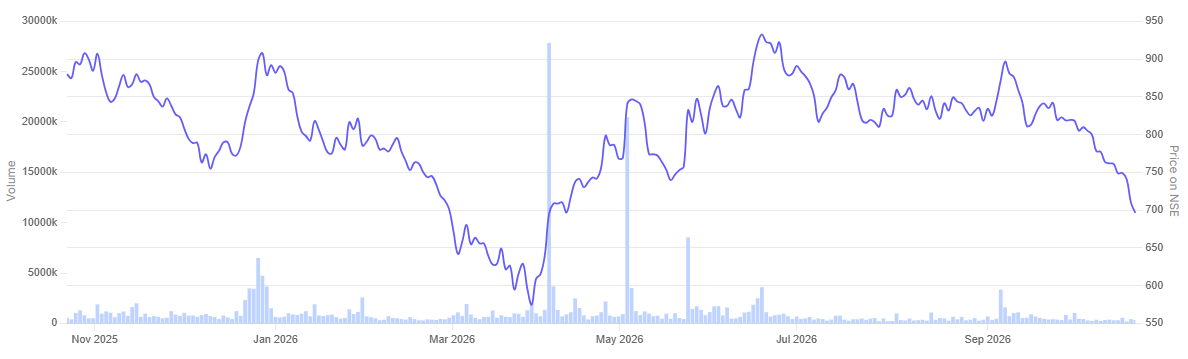
In the past year, the share price of Titagarh Rail Systems is down 21.2%.
Titagarh Rail Systems 1-Year Share Price Chart
Conclusion
India’s expanding metro network presents opportunities for domestic coach manufacturers. BEML and Titagarh Rail Systems have established manufacturing capabilities, completed deliveries and sizeable railway order books. These give them an advantage over companies yet to establish a comparable execution record.
However, their growth strategies differ. BEML is building on its established metro manufacturing base while expanding into high-speed rail and international markets. Titagarh is scaling passenger coach production and reducing dependence on imported components. Both must convert their growing order pipelines into higher revenue and profitability.
The Rs 924 crore Hyderabad Metro tender represents another potential opportunity, but neither company is assured of securing the contract. Competitive bidding, technical approvals, supply chain constraints and delivery schedules could affect future earnings.
Investors should therefore look beyond headline order values. Coach delivery volumes, operating margins, cash flows and returns on capital will be important indicators. Rising metro demand provides a growth opportunity, but sustained profitability will determine which manufacturer benefits more.
You can track how these are progressing by adding stocks to your watchlist.
Disclaimer:
Note: We have relied on data from www.Screener.in throughout this article. Only in cases where the data was not available, have we used an alternate, but widely used and accepted source of information.
The purpose of this article is only to share interesting charts, data points and thought-provoking opinions. It is NOT a recommendation. If you wish to consider an investment, you are strongly advised to consult your advisor. This article is strictly for educative purposes only.
Ekta Sonecha Desai has a passion for writing and a deep interest in the equity markets. Combined with an analytical approach, she likes to deep dive into the world of companies, studying their performance, and uncovering insights that bring value to her readers.
Disclosure: The writer and her dependents do not hold the stocks discussed in this article.
The website managers, its employee(s), and contributors/writers/authors of articles have or may have an outstanding buy or sell position or holding in the securities, options on securities or other related investments of issuers and/or companies discussed therein. The content of the articles and the interpretation of data are solely the personal views of the contributors/ writers/authors. Investors must make their own investment decisions based on their specific objectives, resources and only after consulting such independent advisors as may be necessary.