




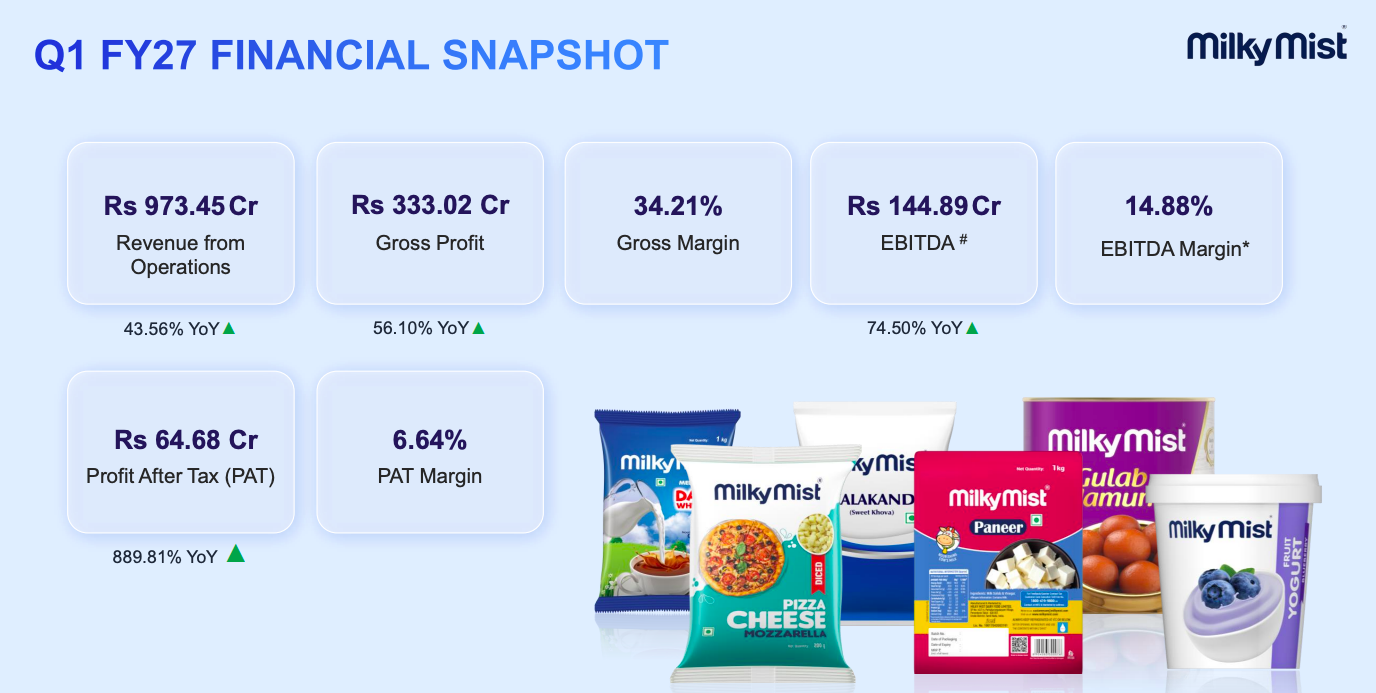
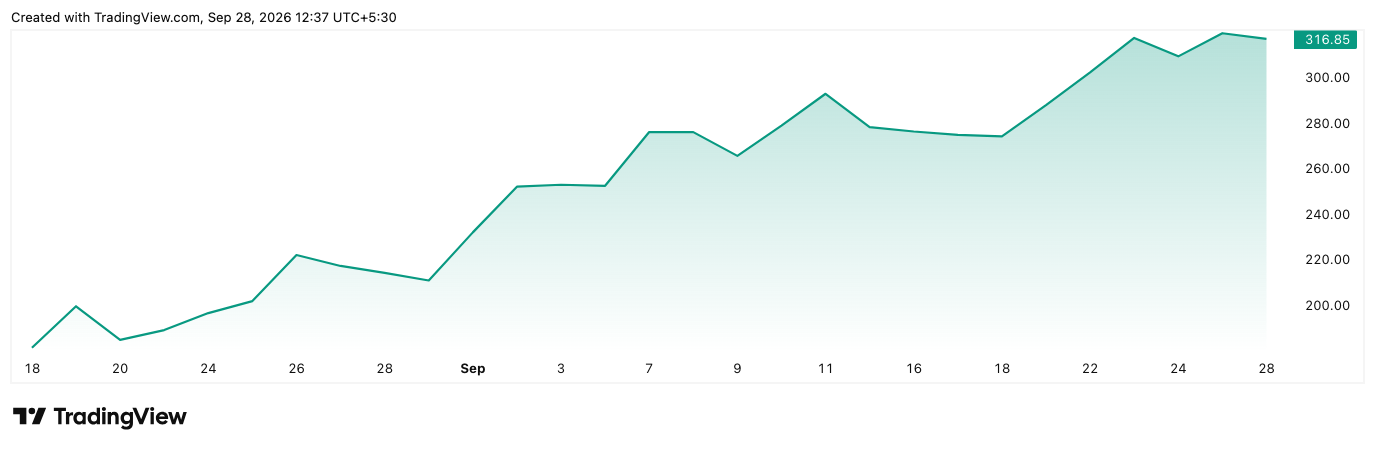
The recent IPO and subsequent meteoric rise in Milky Mist’s stock price has increased investor interest in the food processing sector. Milky Mist listed at Rs 140, and since then the stock has risen to over Rs 300. This is more than 100% price growth within a few weeks. The fundamentals of the company are quite strong, with recent quarterly revenue of Rs 973.45 cr, up 43.56% YoY. EBITDA came in at Rs 144.89 cr, a 74.50% YoY growth. EBITDA is earnings before interest, tax, depreciation and amortisation.
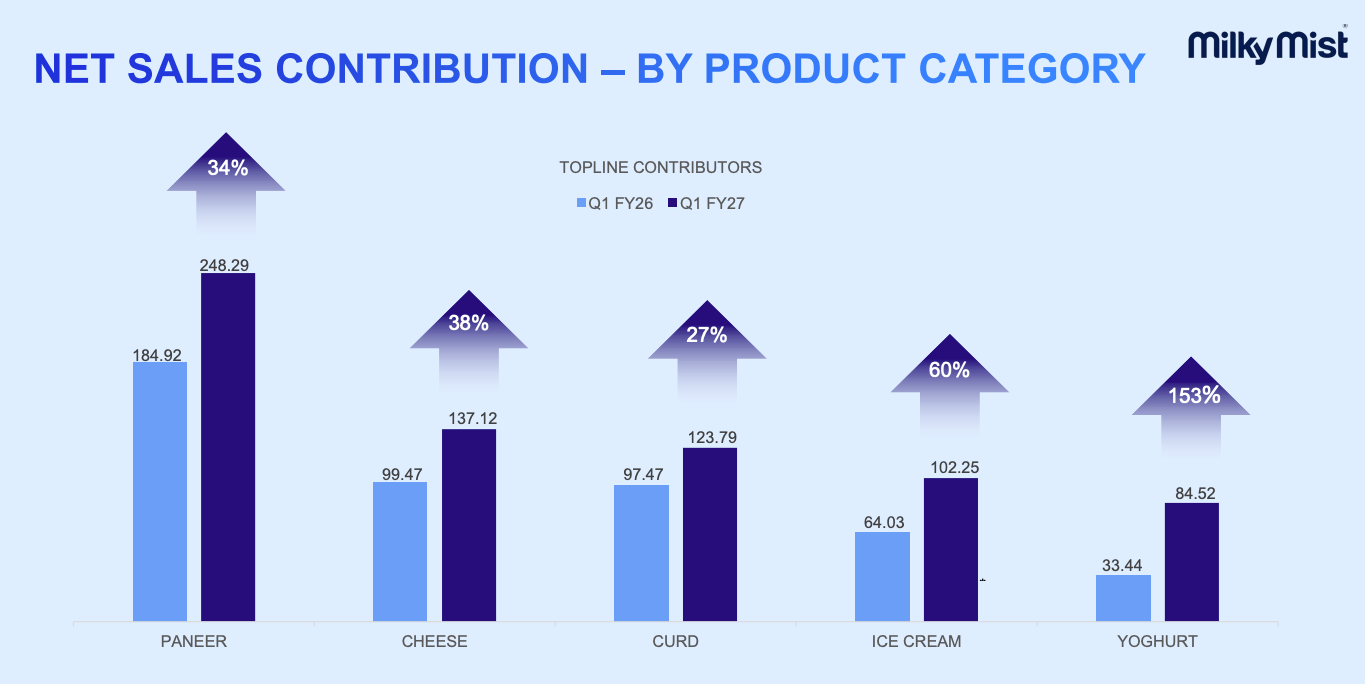
The strong growth in Milky Mist is supported by a shift towards branded products and away from products in the unorganised sector. The company is already showing higher growth rates in value-added products like yoghurts and ice creams compared to traditional product categories of curd and paneer. There has been 153% yoy growth in yoghurt sales from Rs 33.44 cr in Q1 FY26 to Rs 84.52 cr in the recent quarter.
The absolute growth of over Rs 50 cr in the yoghurt category at Milky Mist is greater than the absolute growth of over Rs 25 cr in the curd category, which reported 27% yoy growth. The curd category had Rs 97.47 cr revenue in Q1 FY26 compared to Rs 123.79 cr in Q1 FY27. Improvement in cold chain logistics and a higher share of sales through e-commerce platforms are also improving the sales momentum for the company.
Peer Performance Overview: Growth vs. Margins
Some of the peers of Milky Mist are showing growth momentum along with some challenges. Hatsun Agro has shown a good year-on-year revenue growth in the recent quarter as the company scales its HAP retail concept and expands in new markets. Hatsun Agro’s PAT saw a small decline to Rs 133.69 cr compared to Rs 135.19 cr in the year-ago quarter. One of the primary reasons is higher milk prices, which is a challenge for margins.
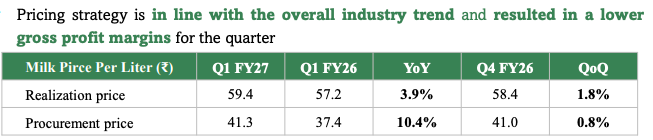
Dodla Dairy reported 19% YoY revenue growth in the recent quarter to Rs 1,197.9 cr. Dodla is facing lower growth of 3.9% in the realisation rate of milk compared to a big jump in procurement rate of 10.4% year-on-year. This has led to a 21.3% decline in EBITDA to Rs 64.9 cr. However, the company should be able to slowly improve the realisation rate as more costs are gradually transferred to customers.
Dodla is also increasing the share of value-added products like curd, paneer, and ghee in its portfolio, which should be a good tailwind for margins in the next few quarters. The company has expanded operations in Africa with operations in Uganda and Kenya. This should improve the runway for growth and increase the ability to deliver higher revenue growth.
Now, let’s look deeper into the performance of each of these three companies
#1 Milky Mist: Sustaining 100% Price Growth Post-IPO
Milky Mist’s recent IPO has shown that the traditional food industry can also deliver good gains for investors. The current stock market cap is already close to Rs 25,000 cr after seeing over a 100% jump since the IPO listing price of Rs 140. The key metrics of the company continue to show improvement, with a 14.88% EBITDA margin and a 6.64% PAT (Profit after Tax) margin. Revenue has increased by 43.56% yoy as the company expands its geographical reach and increases the growth in value-added products.
Source: Milky Mist filings
How Yoghurt and Ice Cream Drove a 3.5x Revenue Shift
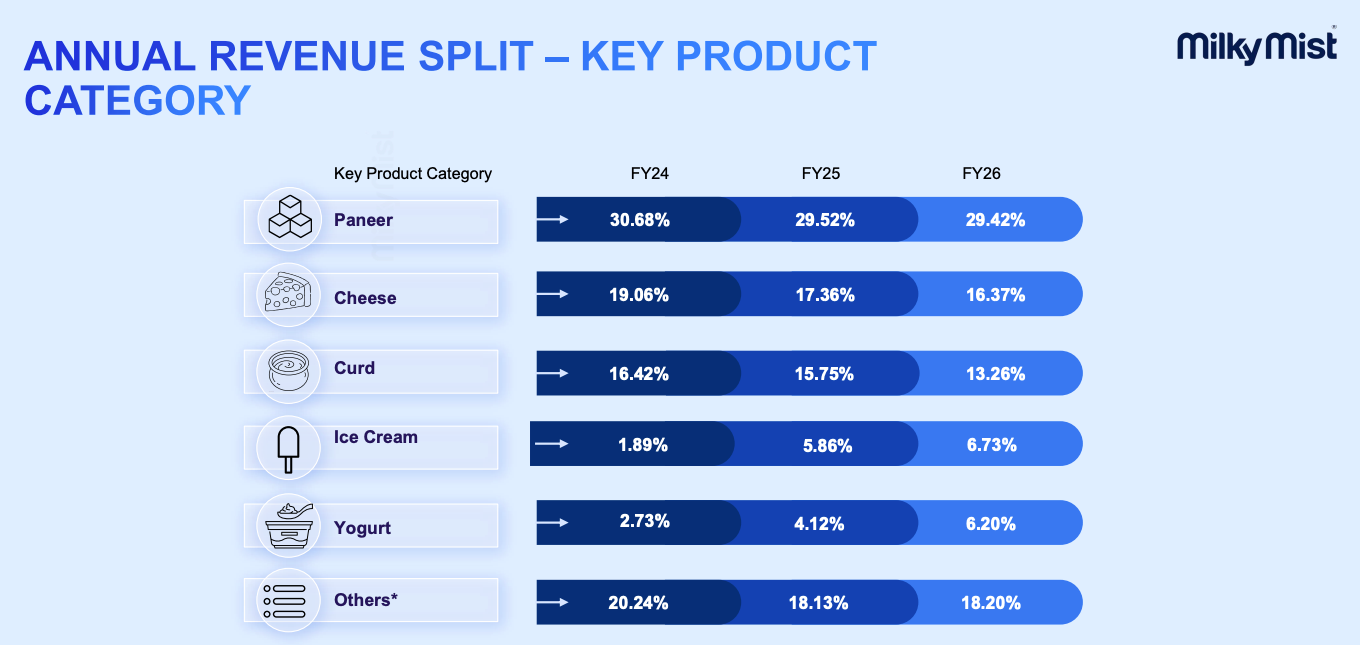
The company reported 60% year-on-year growth in the ice cream category and 153% year-on-year growth in the yoghurt category. The revenue share of these value-added categories has increased rapidly in the last few years. The ice cream category contributed 6.73% of revenue in FY26 compared to 1.89% in FY24. This is close to a 3.5X jump in revenue share within two fiscal years.
The yoghurt category also increased its contribution to revenue to 6.20% in FY26 from 2.73% in FY24. Again, this is over 2X jump in the revenue share from the yoghurt category. On the other hand, traditional categories like curd saw a reduction in revenue share from 16.42% in FY24 to 13.26% in the recent quarter. Similarly, cheese and paneer categories also saw a reduction in revenue share.
Source: Milky Mist filings
It should be noted that despite a reduction in the revenue share, both paneer and curd categories have continued to show good year-on-year revenue growth. In the recent quarter, the curd category showed 27% year-on-year revenue growth, the cheese category showed 38% year-on-year growth, and the paneer category showed 34% year-on-year growth. Due to higher growth rate of the other products, the revenue contribution from these traditional products has fallen.
Source: Milky Mist filings
Capitalizing on Quick Commerce and E-commerce Margin Tailwinds
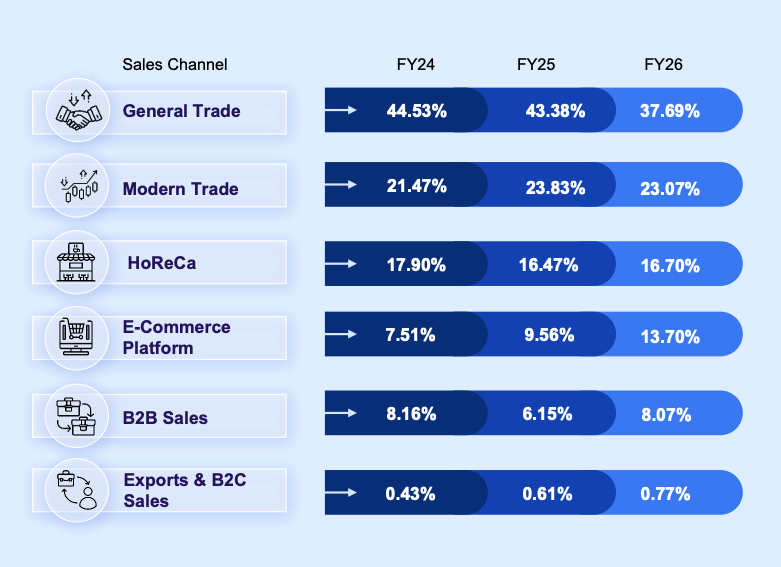
There has also been a significant change in sales channel revenue share over the last few quarters. The general trade sales channel saw its revenue share decline from a high of 44.53% in FY24 to 37.69% in FY26. On the other hand, the e-commerce platform saw a big increase in revenue share from 7.51% in FY24 to 13.70% in FY26. This is reflected in the growing share of quick commerce platforms in the overall retail business. With further increase in dark warehouse penetration by quick commerce companies, we could see a greater revenue share of Milky Mist from this sales channel.
While the logistics required in the general trade sales channel is a lot more diverse, the logistics for modern trade and e-commerce platforms are more streamlined. This should help Milky Mist improve its operating metrics over the next few quarters.
Source: Milky Mist filings
Price chart of Milky Mist since its IPO in August 2026
Source: TradingView
#2 Hatsun Agro: Navigating Margin Pressures with Network Scale
Hatsun Agro’s key strength lies in its ability to directly procure milk at scale from its village-level Hatsun Milk Banks (HABs). This supply chain efficiency has helped Hatsun build a strong network. It reported total revenue of Rs 3,093.38 cr in the recent quarter, up from Rs 2,594.20 cr in the year-ago quarter. However, the profit after tax (PAT) has seen a small decline to Rs 133.69 cr from Rs 135.19 cr in the year-ago quarter.
Monetizing the 4,000-Outlet HAP Daily Retail Network
Hatsun Agro Product’s HAP Daily retail concept has over 4,000 outlets which provide a one-stop option for customers to buy all the products from the company. This also improves the logistics for the company and provides it with a unique touchpoint from which customers can buy products. The management has mentioned that they would focus on improving the scale for this concept which should provide further improvements in the supply chain.
With a robust supply chain as well as a good cold-storage network, the company is looking to expand beyond its stronghold in South India. This should provide new growth opportunities in the near term as the company enters new markets.
Leveraging South Indian Brand Loyalty for VAP Growth
Hatsun continues to increase the sales of ice cream, yoghurt, and other key value-added products. The company has a strong brand portfolio of Arokya milk, Arun Ice creams, Hatsun curd, and others. It might take some time to build the brand presence of these products in new geographies. However, the company has a strong market share in South India and continues to enjoy good brand loyalty.
Hatsun will also gain from the overall tailwinds in this sector, which favors a movement towards higher value-added products and a more brand-conscious customer base. As more customers switch from the unorganised to the organised segment, Hatsun should be able to leverage its massive supply chain network to deliver good quality products and strong growth in key metrics.
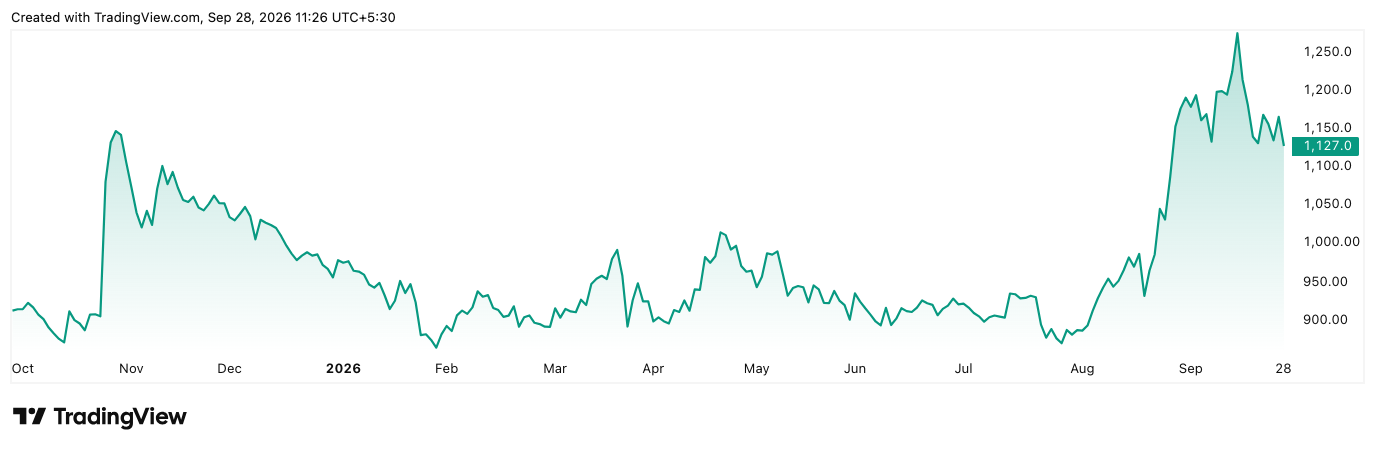
1-year price chart of Hatsun Agro
Source: TradingView
#3 Dodla Dairy: Balancing Solid Revenue Against Margin Contraction
Dodla Dairy has shown a mixed performance in this quarter. While its year-on-year revenue increased by a solid 19% to Rs 1,197.9 cr, its PAT margin declined to 3.4% from 6.2% in the year-ago quarter. This PAT margin decline is due to a 35.4% decline in PAT from Rs 62.9 cr in the year-ago quarter to Rs 40.6 cr in the recent quarter.
The 10.4% Procurement Cost Surge vs. 3.9% Realisation Growth
Dodla’s procurement price of milk per liter increased from Rs 37.4 in the year-ago quarter to Rs 41.3 in Q1 FY27. This is a massive 10.4% year-on-year growth. However, the company could not pass on the entire hike to customers. The realization price for milk increased only by 3.9% from Rs 57.2 in Q1 FY26 to Rs 59.4 in Q1 FY27. If there are headwinds in the core product of the company, it does have a big impact on the margin potential.
There has been some improvement in this key metric in the recent quarter. We can see that the QoQ procurement price increased by a modest 0.8% while the realization price for Dodla increased by 1.8%. If the company can deliver higher realization price growth compared to procurement price growth over the next few quarters, it should certainly improve the margin metrics going forward.
Source: Dodla Dairy Filings
The management is also looking at some key steps to improve its margin profile and increase the revenue growth potential.
Aggressive Volume Expansion in Curd and Value-Added Segments
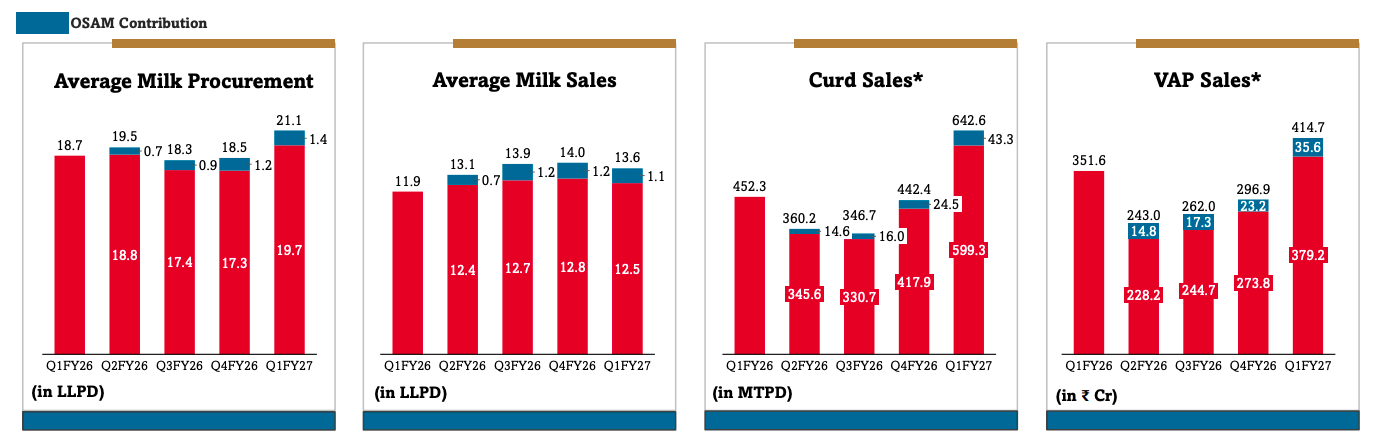
The company is focusing more on value-added products. It showed a robust 42.07% year-on-year growth in curd sales. The total curd sales were 642.6 metric tonnage per day (MTPD) in the recent quarter compared to 452.3 MTPD in the year-ago quarter. This is a massive growth momentum, which has also improved the overall value-added product (VAP) contribution. The VAP sales were Rs 414.7 cr in the recent quarter compared to Rs 351.6 cr in the year-ago quarter. VAP product contribution now stands at 34.6%.
Source: Dodla Dairy Filings
Evaluating Dodla’s Debt Profile and Return on Equity
The key ratios of the company show a mixed picture. The overall debt has been increasing in the last few fiscal years and has reached Rs 57 cr in FY26. However, its debt/equity ratio is still a modest 0.03 and has not moved significantly in the last few years. The cash equivalent is Rs 659.4 cr with a minor dip from previous year. The return on cash employed (ROCE) and return on equity (ROE) metrics also saw a dip in the recent fiscal year compared to FY25.
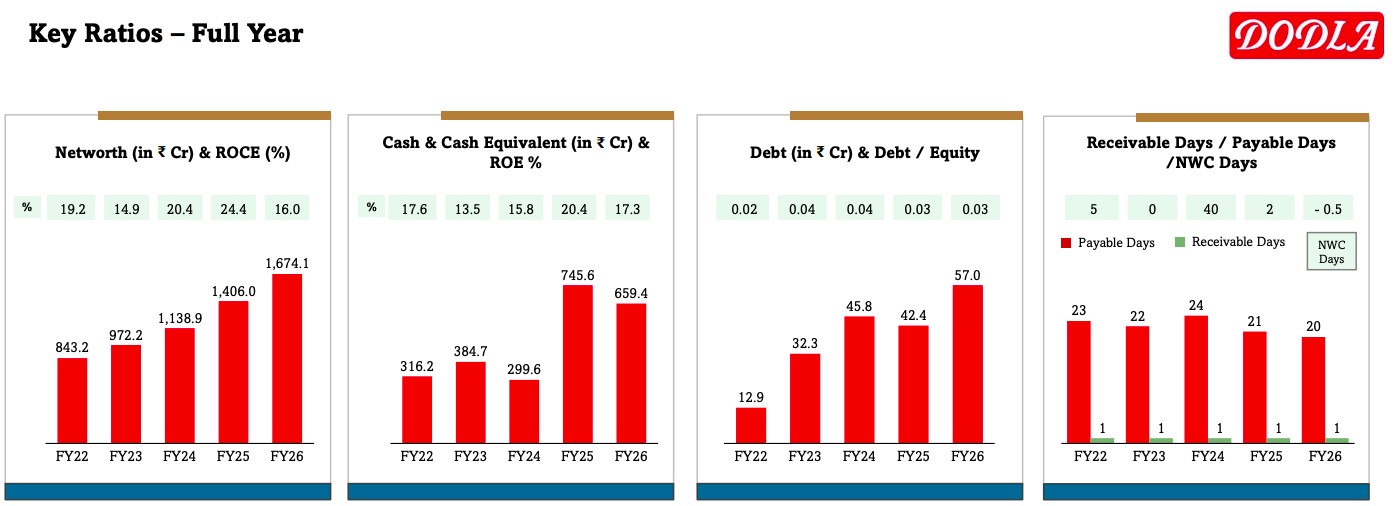
Source: Dodla Dairy Filings
Strategic Shifts to Defend and Rebuild EBITDA Margins
Dodla’s EBITDA and PAT margins have declined significantly. The EBITDA margin has declined from 8.2% in the year-ago quarter to only 5.4% in the recent quarter. Similarly, the PAT margin has declined from 6.2% in the year-ago quarter to 3.4% in the recent quarter. While this margin decline is negative, we need to look at the overall macro picture where there has been a high increase in milk procurement price.
As mentioned above, the company is already showing some signs of improvement in the procurement/realization price metric in the recent quarter. Further improvement in realization price of milk compared to lower increase in milk procurement price could improve the margin profile. The company is also moving into the VAP category aggressively, which will reduce the future impact of milk procurement price. The company continues to expand beyond its core market in South India to other markets. This should improve the revenue growth metric over the next few years.
1-year price chart of Dodla Dairy
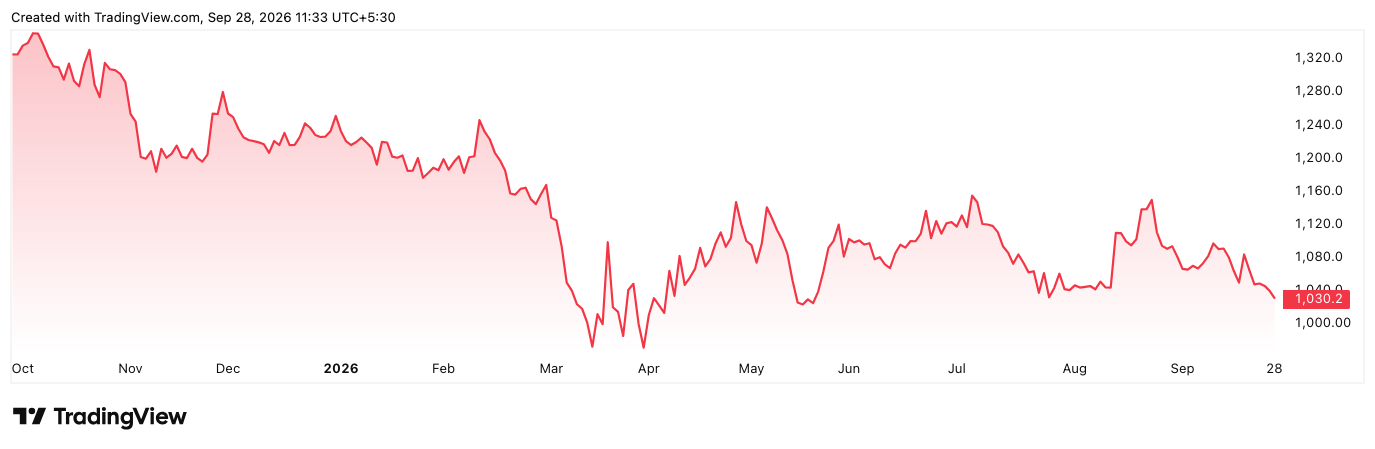
Source: TradingView
Peer Valuation: Milky Mist’s Premium vs. Dodla’s Discount
After the recent run, Milky Mist is trading at a P/E of 133.14. This is high for a company in this segment. However, its ROE is also significantly higher than peers at 38.31% compared to industry median of 16.45%. The year-on-year growth of Milky Mist is also significantly higher than all other peers, which supports this P/E.
Hatsun Agro’s P/E is 68.97 compared to its 10-year P/E median of 89.92. This shows that the stock is cheaper relative to its historical valuation. However, it is still significantly above the industry median P/E of 28.80. Hatsun Agro’s ROE is marginally above the industry median at 19.19%, while its ROCE is 15.19%.
Dodla Dairy has a P/E below the industry median at 25.24. Its ROE and ROCE are also close to the industry median. The most important metric to watch for Dodla would be its ability to deliver a better growth trajectory for realization price in milk compared to its procurement price.
How the Dairy Stocks Stack Up on Valuations
| Company | P/E | 10-year P/E median | ROE (%) | ROCE (%) |
| Milky Mist Dairy | 133.14 | Recent IPO | 38.31 | 15.35 |
| Hatsun Agro | 68.97 | 89.92 | 19.19 | 15.19 |
| Dodla Dairy | 25.24 | 28.55 | 16.45 | 16.72 |
| Industry median | 28.8 | 26.75 | 16.45 | 16.04 |
Source: Screener.in
This shows that Milk Mist Dairy is relatively expensive after the recent price spike post IPO. The higher YoY growth and margins are still a positive for Milky Mist, but the P/E valuation is still relatively more expensive than other peers. Hatsun Agro is in the middle of the pack with its P/E of close to 70. On the other hand, Dodla Dairy is relatively cheap in terms of pricing, but it faces some challenges in terms of the procurement price of milk which has led to a big reduction in its EBITDA and PAT margins. Readers can find a mix of growth and value within these three companies.
Whether the stocks deliver from here on, only time will tell. It may be a good idea to add Milky Mist Dairy, Hatsun Agro and Dodla Dairy to the watchlist.
Disclaimer
Note: Throughout this article, we have relied on data from http://www.Screener.in and the company’s investor presentation. Only in cases where the data was unavailable have we used an alternative, widely used, and accepted source of information
The purpose of this article is only to share interesting charts, data points, and thought-provoking opinions. It is NOT a recommendation. If you wish to consider an investment, you are strongly advised to consult your advisor. This article is strictly for educational purposes only.
About the Author: Rohit is a seasoned financial writer with over a decade of experience covering Indian and international stocks. He specializes in converting complex financial data into actionable insights that can help readers make better calls. He covers macroeconomic trends globally, which gives a better analysis of the growth runway for companies in key sectors.
Disclosure: The writer and his dependents do not hold the stocks discussed in this article. The website managers, its employee(s), and contributors/writers/authors of articles have or may have an outstanding buy or sell position or holding in the securities, options on securities, or other related investments of issuers and/or companies discussed therein. The articles’ content and data interpretation are solely the personal views of the contributors/ writers/authors. Investors must make their own investment decisions based on their specific objectives, resources, and only after consulting such independent advisors as may be necessary.