



You walk into a CaratLane store, and the jewellery surprises you. It’s not the gold you grew up with. It’s lighter. More contemporary. The kind of design that makes you reach for it without thinking. You take it to the counter. You pay. You leave with the box.
Inside that box is jewellery made by a company most people have never heard of: Sky Gold & Diamonds.
From CaratLane to Kalyan Jewellers, Senco, Reliance Jewels, and Indriya, many of India’s biggest jewellery retailers source their finished pieces from manufacturers like Sky Gold.
Sky Gold sits in the invisible layer of India’s ₹7 lakh crore jewellery market. This B2B manufacturer is quietly becoming one of the biggest beneficiaries of the shift from unorganised to organised jewellery retail chains.
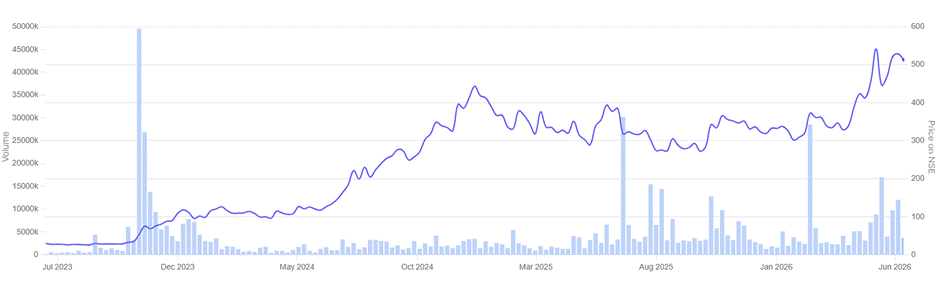
The market has also started to take note. Sky Gold’s stock has surged from around ₹30 to a high of ₹590 in the last three years.
Sky Gold & Diamonds Price Chart
The Invisible Manufacturing Layer
Sky Gold doesn’t sell jewellery directly to consumers. It designs and converts those designs into finished pieces and supplies them to jewellers. In short, the company is a high-volume B2B jewellery manufacturer.
Sky Gold maintains a large design catalogue and a fast replenishment cycle, which allows its partners to keep store inventories fresh without building heavy manufacturing capacity themselves.
The business model is structurally simple. Organised retailers need consistent supply, fast turnarounds, and product variety that they cannot profitably produce in-house. Sky Gold provides all three. So, when a CaratLane store needs to restock its lightweight gold earrings range, or when Kalyan wants to expand into a new design category without committing to in-house production, Sky Gold is where the order goes.
Sky Gold & Diamonds Client List
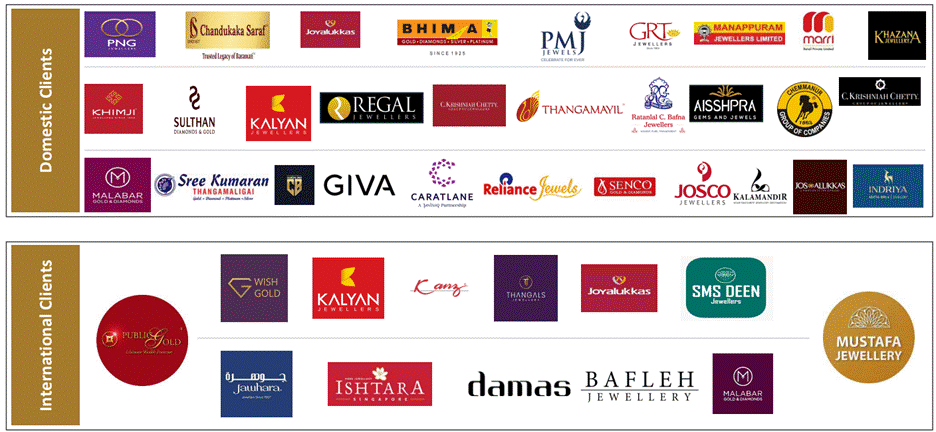
This is the invisible infrastructure layer of India’s biggest jewellery retailers, without which increasing their store counts and scale would be very difficult.
Numbers that are Hard to Ignore
Sky Gold was listed on the BSE SME platform in October 2018 and migrated to the BSE main board in January 2023. It has been among the few small-cap manufacturing companies to consistently outperform its own guidance. The numbers are hard to ignore.
Revenue and Profit Growth Trends
| Metrics | FY23-FY26 |
| 3-yr Compounded Sales Growth | 76% |
| 3-yr Compounded Profit Growth | 145% |
| Operating Margin | 7% (FY26) |
| ROCE | 27% (FY26) |
The scale-up in revenue is sharp. It increased from ₹1,154 crores in FY23 to ₹6,295 crores in FY26. At first glance, this jump can look disproportionate relative to its ₹8,000 crore market capitalisation. But the headline revenue figure reflects the nature of the business. Sky Gold procures gold, manufactures jewellery, and sells finished pieces to retailers. So sales largely mirror the underlying gold value plus making charges.
What matters more is the profit trajectory. It has compounded at 145% in the last three years, from ₹19 crore in FY23 to ₹282 crore in FY26.
The composition of revenue is also improving. Studded jewellery, which carries higher making charges than plain gold, has grown as a share of output. This is important because making charges on studded jewellery are meaningfully higher, which means the revenue growth is not purely volume-driven. Sky Gold is moving up the value chain even as it is scaling.
By every conventional measure, Sky Gold presents a strong growth story. The complication, as is often the case with strong stories, lies underneath.
Cash Flow: The Story Gets Complicated Here
One of the biggest mismatches in Sky Gold’s financial profile is the gap between reported earnings and operating cash flow.
Cash Flow Statement (in ₹ crores)
| FY23 | FY24 | FY25 | FY26 | |
| Cash From Operating Activity | -6 | -158 | -273 | -45 |
| Cash From Investing Activity | -20 | -106 | -157 | -124 |
| Cash From Financing Activity | 43 | 259 | 427 | 171 |
| Free Cash Flow | -9 | -178 | -288 | -140 |
Despite strong earnings growth, operating cash flows have remained negative. The reason lies in the economics of the business. It requires Sky Gold to fund gold purchases upfront and recover the cash only after jewellery is delivered and paid for. As revenue scales, so does the capital tied up in inventory and receivables.
The impact is visible in the cash conversion cycle. The number of days between paying suppliers and collecting cash from customers increased from 49 days in FY23 to 77 days in FY26, peaking at 88 days in FY25.
Evaluating the Peer Efficiency
This working-capital intensity is not unique to Sky Gold. It is a structural feature of the jewellery manufacturing industry.
Cash Conversion Efficiency
| Companies | Cash Conversion Cycle (in Days)- FY26 |
| Goldiam International Ltd | 333 |
| Radhika Jeweltech Ltd | 328 |
| Renaissance Global Ltd | 249 |
| Asian Star Company Ltd | 188 |
| D.P. Abhushan Ltd | 89 |
| Sky Gold & Diamonds | 77 |
Goldiam International reported a cash conversion cycle of 333 days in FY26, Radhika Jeweltech stood at 328 days, Renaissance Global at 249 days, and Asian Star at 188 days. Even smaller players like D.P. Abhushan operate at around 89 days.
Against this backdrop, Sky Gold is relatively more efficient at 77 days. However, the key point is not relative efficiency, but the fact that the entire industry remains structurally cash-flow inefficient.
The Fix Management Is Betting On
To address this issue, management is increasingly focusing on its “Advance Gold” model.
Under this arrangement, retailers would supply the gold while Sky Gold undertakes the design and manufacturing process. Instead of earning a spread on the gold value, the company primarily earns from making charges.
The benefits are significant. Inventory requirements decline, gold price exposure reduces, borrowings come down, and operating cash flow improves.
Advance Gold contributed around 11.5% of volumes in FY26. The management aims to increase this to roughly 30% by FY30.
If this model scales as expected, the business’s financial profile changes meaningfully. Sky Gold’s working capital requirements will come down, borrowings will reduce, and cash flow will improve. But the shift is easier said than done.
When a retailer supplies gold upfront, they are now the ones tying up capital in raw material before a sale is made. Now, their cash conversion cycle and working capital requirements will increase. A situation that every company wants to avoid.
This is why scaling the Advance Gold model is harder than the concept suggests. It has to be negotiated with each customer, based on their own comfort with inventory risk and capital lock-up.
Valuations: Cheap or Expensive?
As of 9th June 2026, Sky Gold is trading at a trailing price-to-earnings multiple of around 29 times, below its five-year median P/E of approximately 34 times. At the same time, earnings have continued to expand steadily, as reflected in the rising EPS trend in recent quarters.
Sky Gold & Diamond P/E Chart
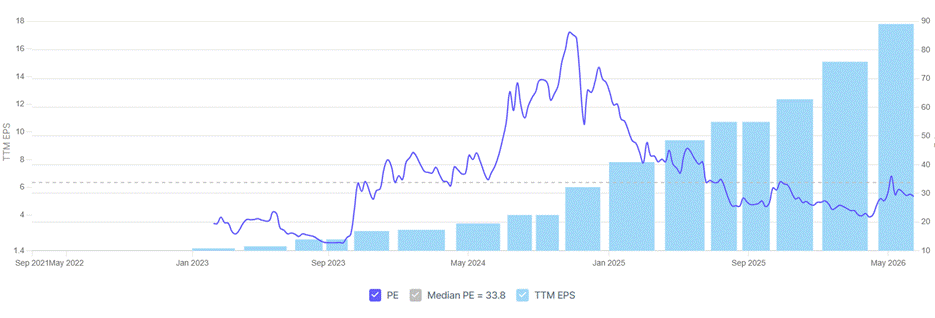
The stock appears relatively cheap based on its own history. For a company compounding profits at 145% over three years, that multiple looks almost modest. The market seems less concerned about growth and more focused on earnings quality, particularly the company’s ability to convert profits into cash flows. This may explain why the P/E multiple has not expanded despite the sharp rise in earnings.
The PEG ratio stands at ~0.20. A PEG below 1 suggests the stock is relatively cheap compared to its earnings growth. On paper, this signals a deeply undervalued growth stock, but there is more to it than what meets the eye.
PEG is calculated by dividing the PE multiple by the earnings growth rate. At a very high growth rate and a lower PE multiple, any stock will look cheap. In Sky Gold’s case, that growth rate was achieved due to a low base. FY22 profits were ₹17 crores, which rose to ₹282 crores in FY26. In such cases, looking at the PEG ratio can be misleading.
Growth Is There, But the Equation Is Still Incomplete
Sky Gold sits in a rare position within India’s jewellery ecosystem. It has already proved it can grow. Revenue has scaled more than fivefold in three years, profits have compounded rapidly, and the company has established itself as a critical supplier to some of India’s largest jewellery retailers.
Now, the management has guided ₹8,100 Cr revenue with a PAT margin of 4.5 – 4.75% in FY27, alongside a target of generating positive operating cash flows.
This is why the next few quarters carry more weight than the last few years. The medium-term roadmap is more ambitious. By FY30, the company is targeting ₹18,000 -19,000 crore in revenue, ~5.3% PAT margin, and a CFO-to-PAT conversion of over 20%.
If management succeeds in expanding the Advance Gold model, improving cash conversion, and delivering positive operating cash flows, the stock’s next re-rating may come from a stronger business model rather than faster revenue growth.
The company has largely solved the growth question. The cash-flow question, for now, remains open.
Note: We have relied on data from www.Screener.in throughout this article. Only in cases where the data was not available, have we used an alternate, but widely used and accepted source of information.
The purpose of this article is only to share interesting charts, data points and thought-provoking opinions. It is NOT a recommendation. If you wish to consider an investment, you are strongly advised to consult your advisor. This article is strictly for educative purposes only.
Deepan Datta has spent over a decade studying stocks and mutual funds. His passion is to uncover interesting stories in the financial markets and share them through his writings with investors at large. He is focused on delivering clear, easy to understand and research-backed insights. Deepan began his career as a Research Associate at S&P Global, where he developed a strong foundation in financial research and data analysis.
Disclosure: The writer and his dependents do not hold the stocks discussed in this article.
The website managers, their employees (s), and contributors/writers/authors of articles have or may have an outstanding buy or sell position or holding in the securities, options on securities or other related investments of issuers and/or companies discussed therein. The content of the articles and the interpretation of data are solely the personal views of the contributors/ writers/authors. Investors must make their own investment decisions based on their specific objectives, resources and only after consulting such independent advisors as may be necessary.