




India’s aviation industry could soon open a new market for the country’s biofuel companies. Aeroplanes usually run on jet fuel made from petroleum oil. This contributes to carbon emissions. Aviation contributes roughly 2% to 3% of global carbon dioxide emissions.
As aviation passenger traffic grows and airlines face pressure to cut carbon emissions, Sustainable Aviation Fuel (SAF) is beginning to find a place in India’s energy transition. SAF is a cleaner fuel made from plants.
The government is now looking to give this market a policy push. The Ministry of Civil Aviation has circulated the Draft SAF Policy 2026, proposing mandatory SAF blending for international flights from January 2027. The draft outlines a phased approach, with blending targeted to increase to 5% by 2030 and 20% by 2040.
The opportunity could extend well beyond the aviation industry. SAF can be produced using ethanol, agricultural residues, used cooking oil and other renewable feedstocks. This creates an additional market for India’s existing biofuel infrastructure.
According to an RSB assessment reported by S&P Global, India’s international aviation sector could require around 5.3 crore litres of SAF in 2027. This could increase to 29 crore litres by 2030. Including domestic aviation, the requirement could reach 72 crore litres by 2030.
Other countries with targets or mandates include the United Kingdom, Singapore, Japan, Brazil, Indonesia, and the European Union. Overall, global SAF consumption is projected to surge 9X to 900 crore litres by 2030, up from 100 crore litres in 2024.
SAF Blending Roadmap
| Particulars | 2027 | 2030 |
| SAF blending target | 1.0% | 5.0% |
| International aviation SAF demand | 5.3 crore litres | 29.0 crore litres |
| Including domestic aviation | 13.0 crore litres | 72.0 crore litres |
| Source: RSB assessment reported by S&P Global | ||
That’s where these two companies come in. One is building a commercial-scale ethanol-to-jet facility. The other has demonstrated its ethanol-to-jet technology and is positioning itself to supply engineering and technology solutions to SAF producers. As India moves towards a SAF blending framework, both companies could find new opportunities in the emerging market.
#1 TruAlt Bioenergy: The Ethanol Maker Capitalising on India’s Jet Fuel Shift
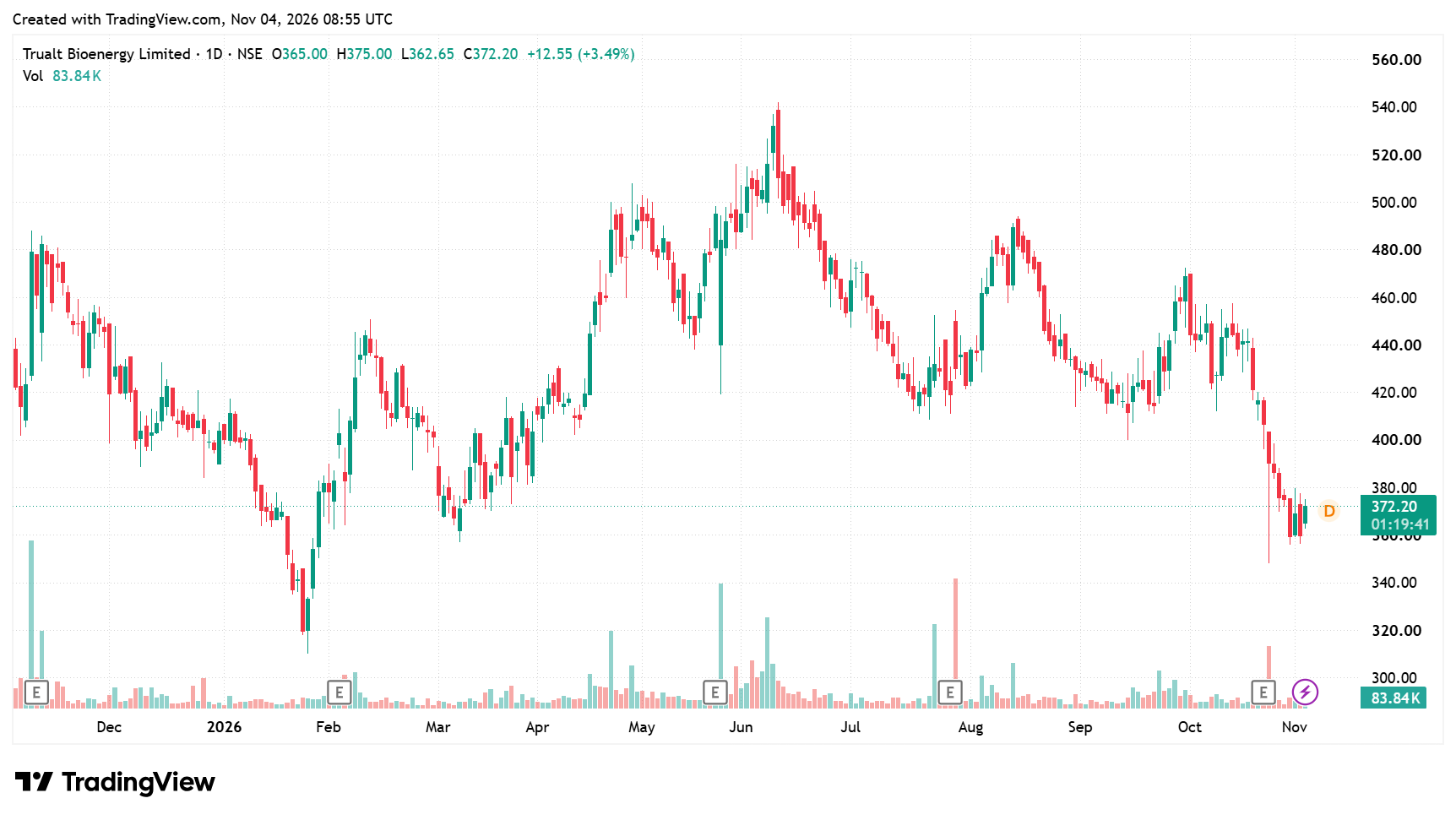
TruAlt Bioenergy is an Indian bioenergy producer. The company converts agricultural materials and organic waste into renewable fuels and bio-based products. Ethanol accounts for the largest share of the company’s revenue (89.4% in H1FY27). TruAlt operates five distillery units with a total capacity of 2,000 kilolitres per day.
Core Ethanol Operations & Dual-Feed Advantage
Of this capacity, approximately 1,300 kiloliters per day is produced using dual-feed technology. This allows the plant to process sugar materials such as molasses and sugarcane syrup, as well as grains such as corn and rice. The plant sells the ethanol to oil marketing companies for blending with gasoline.
The company builds and operates biogas facilities. TruAlt converts agricultural and sugar mill waste, including press mud and animal dung, into CBG. It operates these plants through its subsidiaries and joint ventures with Sumitomo Corporation and GAIL (India). TruAlt also holds Oil Marketing Company status in India.
The ₹2,250 Crore SAF Catalyst: Expanding Beyond Core Ethanol
TruAlt sells usable by-products captured during fuel manufacturing. TruAlt is setting up a SAF production plant in Srikakulam, Andhra Pradesh, with a capacity of 310 kilolitres per day (100 million litres per annum). The company is investing ₹2,250 crore in this project. Management claims it is positioned to be one of India’s largest SAF manufacturing facilities.
The Srikakulam site was chosen for its access to supply chain infrastructure. For instance, it is in close proximity to Hindustan Petroleum Corporation’s Visakh Refinery and Indian Oil’s Paradip Refinery. In terms of logistics connectivity, the plant is located about 8 km from the upcoming Mullapeta Port, near Visakhapatnam Port, along the Howrah-Chennai Railway and near Visakhapatnam Airport.
The project has been approved for a ₹150 crore viability gap fund grant under the Pradhan Mantri JI-VAN Yojana. The company is in discussions with the Andhra Pradesh government for a state incentive package to manage initial project development risks. TruAlt is waiting for the release of the official SAF policy and incentive roadmap.
70% Emission Cuts and the Alcohol-to-Jet Commissioning Timeline
Following final regulatory clearances and financial closure, the plant is expected to take 24 to 30 months to commission. TruAlt is working with Honeywell UOP on the initial engineering and design work. The plant will use a process called Alcohol-to-Jet (ATJ), which converts ethanol into jet fuel.
The fuel meets international quality standards (ASTM D7566) and can be mixed with up to 50% regular jet fuel. Planes and airports can use it directly without changing engines or fueling equipment. This method is expected to cut total carbon emissions by about 70% compared to traditional fossil jet fuel.
Decoding the 606% Q2 Revenue Surge and Margin Turnaround
Financially, TruAlt’s operating revenue grew 606% to ₹811.1 crore in Q2FY27 from a low base. Higher production volumes drove this top-line expansion as capacity utilisation rose to between 65% and 70% across facilities. During FY26, the company temporarily shut down three of its five plants for upgrades.
EBITDA (Earnings Before Interest, Tax, Depreciation, and Amortisation) surged to ₹101.2 crore, up from -₹4.6 crore in the year-ago period. A positive EBITDA margin of 12.5% in Q2 FY27, up from -3.9% in Q2 FY26, helped drive the turnaround. As a result, the company reported a net profit of ₹35 crore, compared to a loss of ₹38 crore in Q2FY26.
Inventory Optimisation and the 0.6x Debt-to-Equity Shield
On the balance sheet, working capital efficiency improved in the first half of FY27. Total inventory decreased from ₹528 crore in March 2026 to ₹206 crore by September 2026. Trade receivables also decreased from ₹406 crore to ₹367 crore during the same period. TruAlt also generated ₹ 192 crore in cash from operating activities during H1FY27.
The company’s debt-to-equity ratio is also low at approximately 0.6x as of September 30, 2026. Key business risks include raw material price fluctuations and regulatory and policy dependencies, including fluctuations in the crude oil market.
#2 Praj Industries: The Technology Player Positioning for India’s Aviation Fuel Shift
Praj Industries operates in the industrial biotechnology and engineering sector. The company designs and builds process equipment for bioenergy, high-purity water systems, modular units, breweries, and industrial wastewater treatment. Its products are patented. The company holds 24 Indian patents and 60 international patents, alongside more than 350 patent filings.
69% Revenue Engine: How Multi-Feedstock Flexibility Powers the Bioenergy Unit
The bioenergy segment is the largest unit, generating 69% of total revenue. It builds plants for first-generation and second-generation ethanol, compressed biogas, and SAF. Its plant designs let processors switch between feedstocks, including sugarcane juice, molasses and grains.
This segment also produces renewable chemicals and bio-based materials under its Bio-Prism platform. The Engineering segment generates approximately 21% of total revenue, followed by HiPurity Systems (10%). Praj’s plant can turn two different types of plant-based alcohol into clean jet fuel within one system.
The Global Alcohol-to-Jet (AtJ) Breakthrough and Upcoming Q1FY28 Investment Decision
This makes it the first company globally to validate a fully integrated Alcohol-to-Jet (AtJ) solution across both Ethanol-to-Jet (EtJ) and Isobutanol-to-Jet pathways. This success gives prospective buyers confidence that Praj’s plant designs are tested and ready for commercial construction. It operates an integrated SAF demonstration plant at its Praj Matrix R&D centre in Pune.
Fuel produced using Praj’s technology also meets global aviation standards (ASTM D7566). For industry certification, Praj signed a Memorandum of Understanding with IATA and the Indian Sugar and Bio-Energy Manufacturers Association. This partnership sets certification guidelines and lifecycle carbon assessment methods for Indian SAF.
Praj is currently finishing a detailed engineering design package for an international ethanol-to-SAF plant. The customer expects to make its final investment decision in Q1FY28. A positive decision will allow Praj to supply process equipment and modular packages for the construction of the facility.
The Q2 Financial Squeeze: Why a 20.2% Profit Jump Hides an 18.5% Engineering Decline
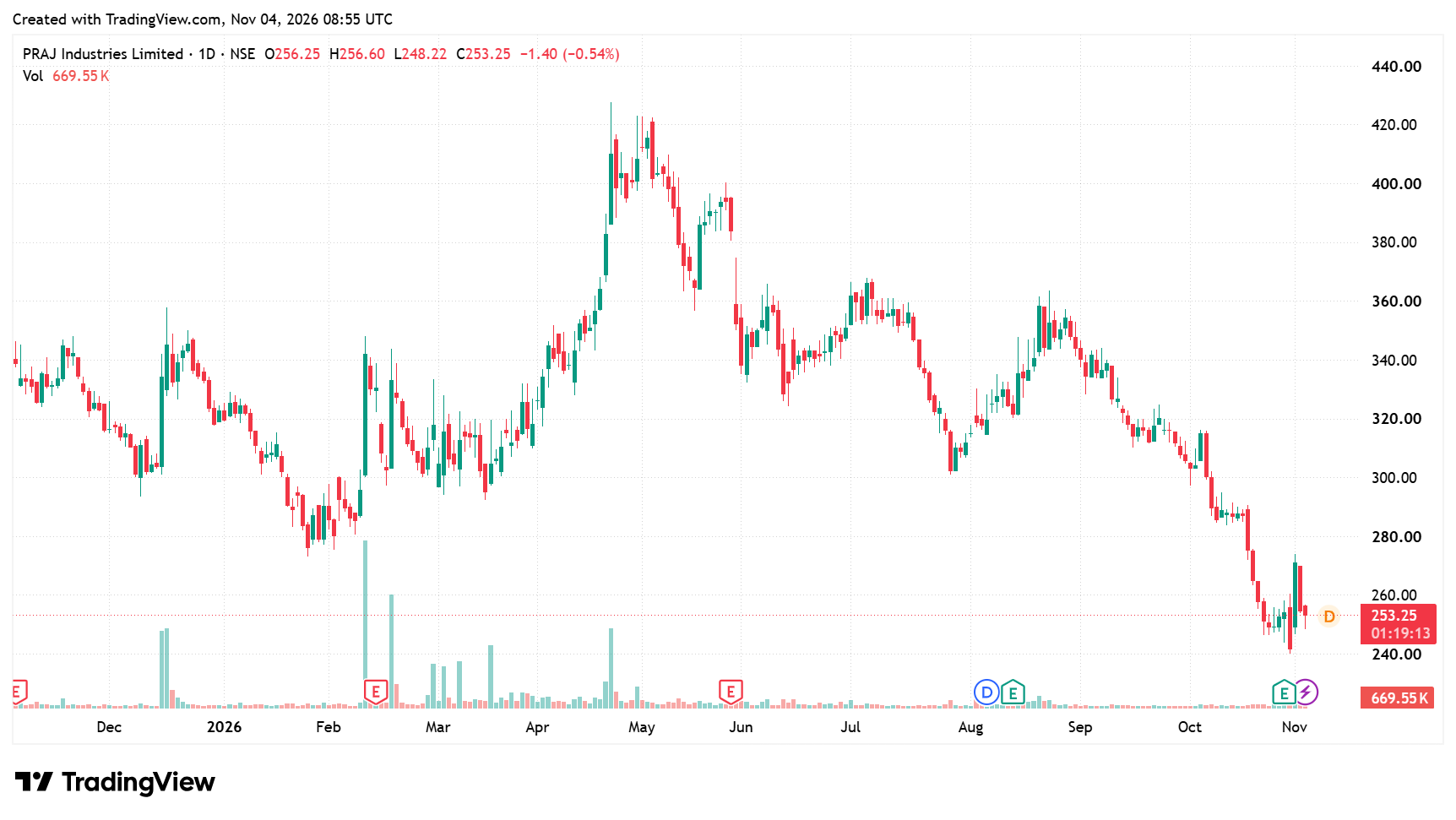
On the financial front, consolidated revenue grew 0.9% year-on-year to ₹849 crore. An 18.5% revenue decline in the engineering division dragged down the revenue. EBITDA decreased 6.3% to ₹52.4 crore while margin declined by 47 bps to 6.2%. Net profit increased 20.2% to ₹23.2 crore, aided by 124% jump in higher other income, lower interest and depreciation cost.
Feedstock uncertainties for ethanol producers created project funding challenges for customers. As a result, converting the greenfield project backlog into revenue took longer than expected. Execution delays and low-margin orders further hampered business growth, particularly in the engineering business.
Zero Net Debt vs. Lengthening Working Capital: Assessing the ₹4,455 Crore Backlog
The muted growth also lengthened the working capital cycle. Working capital days stood at 65 days in FY23, 76 days in FY24, 90 days in FY25, and 91 days in FY26. Management is seeing early signs of recovery in order inflows. It carries zero net debt. The total order backlog stood at ₹4,455 crore as of September 30, 2026, which is 1.4X FY26 revenue of ₹3,168 crore.
Low Valuations, Uneven Returns: Comparing Two Bioenergy Stocks
The two companies have different return profiles, reflecting their business models and current stages of expansion. TruAlt Bioenergy has reported relatively better returns on capital, while Praj Industries continues to face pressure from muted revenue growth and lower profitability.
TruAlt reported an Return on Equity (ROE) of 8.4% and Return on Capital Employed (ROCE) of 10.4%. These ratios indicate that the company is generating positive returns on shareholder funds and capital employed. The additional capital requirement could put pressure on returns until the new plant becomes operational and starts contributing to earnings.
Praj, meanwhile, reported an ROE of 1.5% and ROCE of 6.1%. Its relatively lower return ratios reflect the impact of subdued project execution, subdued engineering revenue, margin pressure and a longer working capital cycle. A recovery in order execution and better utilisation of its existing engineering capabilities will be important for improving returns.
Particulars | EV/EBITDA Multiple (X) | Return Ratios | |||
| Company | 10Y Median | Industry | ROE (%) | ROCE (%) | |
| Praj Industries | 21.2 | 22.8 | 32.4 | 1.5 | 6.1 |
| TruAlt | 8.4 | NA | 25.2 | 8.4 | 10.4 |
| Source: Screener.in (As of November 04, 2026). | |||||
From a valuation perspective, Praj Industries trades at an EV/EBITDA multiple of 21.2x, below its 10-year median (22.8x) and the industry median of 32.4x. This indicates that the stock is trading below its historical and industry benchmarks. This is because of weaker operating performance.
TruAlt Bioenergy trades at an EV/EBITDA multiple of 8.4x, compared with the industry median of 25.2x. However, the company has a shorter operating history as a listed entity.
Overall, the proposed SAF policy could create a new growth opportunity for the biofuel industry. TruAlt Bioenergy is positioning itself to benefit through direct SAF production, while Praj Industries could gain from technology and engineering orders.
However, these policies depend heavily on regulatory and government mandates. So, tracking policy implementation, project completion and commercial viability will be key.
These companies could be worth keeping on your watchlist.
Disclaimer
Note: Throughout this article, we have relied on data from http://www.Screener.in and the company’s investor presentation. We used an alternative, widely accepted source only when the data were unavailable.
The purpose of this article is only to share interesting charts, data points, and thought-provoking opinions. It is NOT a recommendation. If you wish to consider an investment, we strongly advise you to consult your advisor. This article is strictly for educational purposes only.
About the Author: Madhvendra has been deeply immersed in the equity markets for over seven years, combining his passion for investing with his expertise in financial writing. He simplifies complex concepts and shares honest perspectives on startups, listed Indian companies and macroeconomic trends.
Disclosure: The writer and his dependents do not hold the stocks discussed in this article.
The website managers, their employees (s), and contributors/writers/authors of articles have or may have an outstanding buy or sell position or holding in the securities, options on securities, or other related investments of issuers and/or companies discussed therein. The articles’ content and data interpretation are solely the personal views of the contributors/ writers/authors. Investors must make their own investment decisions based on their specific objectives and resources, and only after consulting any independent advisors as necessary.