



The Quick Service Restaurant (QSR) sector appears to have moved past its weakest phase, with earnings showing a sharp improvement over the past few quarters. After a prolonged period of weak profitability, the recovery became more visible in H2FY26 and strengthened further in Q1 FY27. The earnings trend shows a clear shift.
According to TheWrap, Median sales growth improved from 7% in Q1FY26 to 16% in Q1FY27. More importantly, median operating profit growth rose to 24% from a 9% decline a year earlier. The bottom line improved even more sharply, with median net profit growth jumping to 74% from a 44% decline in Q1FY26.
This suggests that the recovery is no longer limited to revenue growth. Operating leverage, improving store-level performance and better profitability are beginning to flow through to earnings. The improvement also comes after several quarters of subdued demand and weak same-store growth.
The recovery is being led by better customer traffic and stronger demand for value offerings. QSR chains have increased their focus on affordable meals and promotions to bring customers back. Against this backdrop, this article examines three QSR stocks that are positioned to benefit from the sector’s improving earnings cycle.
#1 United Foodbrands: Value-led volumes fuel a strong turnaround
United Foodbrands is a prominent player in the casual dining space. As of Q1FY27, the company operates 266 restaurants. The company manages its flagship Barbeque Nation (BBQ), Toscano, and Dum Safar Biryani brands. Management plans to have 300+ restaurants by the end of FY27, with longer-term plans to scale to 400-425 locations by FY30.
How the Shift to Value and App-Driven Bookings Revived Footfalls
Historically, United Foodbrands faced challenges in India’s Tier 2 and Tier 3 markets. It struggled to replicate its metro-market operating model in smaller cities due to standard price points. To reverse this trend, it pivoted to value-driven volume growth starting in Q2 FY26. The turnaround is built on several key operational pillars:-
- The Big Buffet Model & Value Campaigns: The company introduced the ‘Big Buffet’ format. It offered special pricing and customized value deals for time slots and sessions that typically saw lower customer footfall.
- Increased Marketing Spend: To ensure high reach, marketing/advertising spend was raised by about 1 percentage point to 3% of revenue.
- Strengthened the Captive Digital Ecosystem: The company invested heavily in its own digital platform. Monthly active users surged 59.6% year-on-year to 14 lakh on its own app/website. 90% of dine-in transactions are driven through its own captive channels. Over 65% of BBQ dine-in bookings are routed through its proprietary digital channels.
- Back-End Operational Investments: The company strengthened its back-end, including recruiting a new Chief Culinary Officer and four senior culinary leaders with 5-star hotel backgrounds to innovate kitchen operations. It also upgraded reservation tech and implemented AI in its customer care centers to maximize booking conversions.
Record Q1FY27: 28.7% SSSG Signals Volume-Driven Turnaround
The Q1FY27 results highlight that this pivot has translated into a financial turnaround, with the company reporting its strongest operating quarter in recent years. Consolidated Same-Store Sales Growth (SSSG) stood at +28.7% in Q1FY27. This marks a sharp recovery from the negative SSSG of -3.4% in Q1FY26 and -2.2% in Q2FY26. BBQ India led the pack with an SSSG of +33.5%.
Consolidated operating revenue jumped 43.4% year-on-year to ₹425.9 crore. This marked the first time the company has crossed the ₹400-crore threshold in a single quarter. The growth is entirely volume-led (with no price hikes). Dine-in volumes rose 63.5%, while delivery revenue grew 61.9%.
Operating EBITDA (earnings before interest, tax, depreciation, and amortization) rose by 51.8% to ₹69.9 crore, and the EBITDA margin expanded by 90 bps to 16.4%. Profit After Tax (PAT) stood at ₹2.3 crore, compared to a loss of ₹16.7 crore in the same quarter last year. Looking ahead, management expects SSSG rates to moderate in the latter half of FY27 due to a high base.
Cash Flows and Balance Sheet Strength Fund 400-Store Target
Gross margin recovery, new-store maturation, and back-end operating leverage are expected to expand margins. Management will fund store expansion entirely through internal accruals and operating cash flows (₹223 crore in FY26). The company’s debt stood at ₹106 crore, and it has generated free cash flow (FY26: ₹94 crore) since FY23.
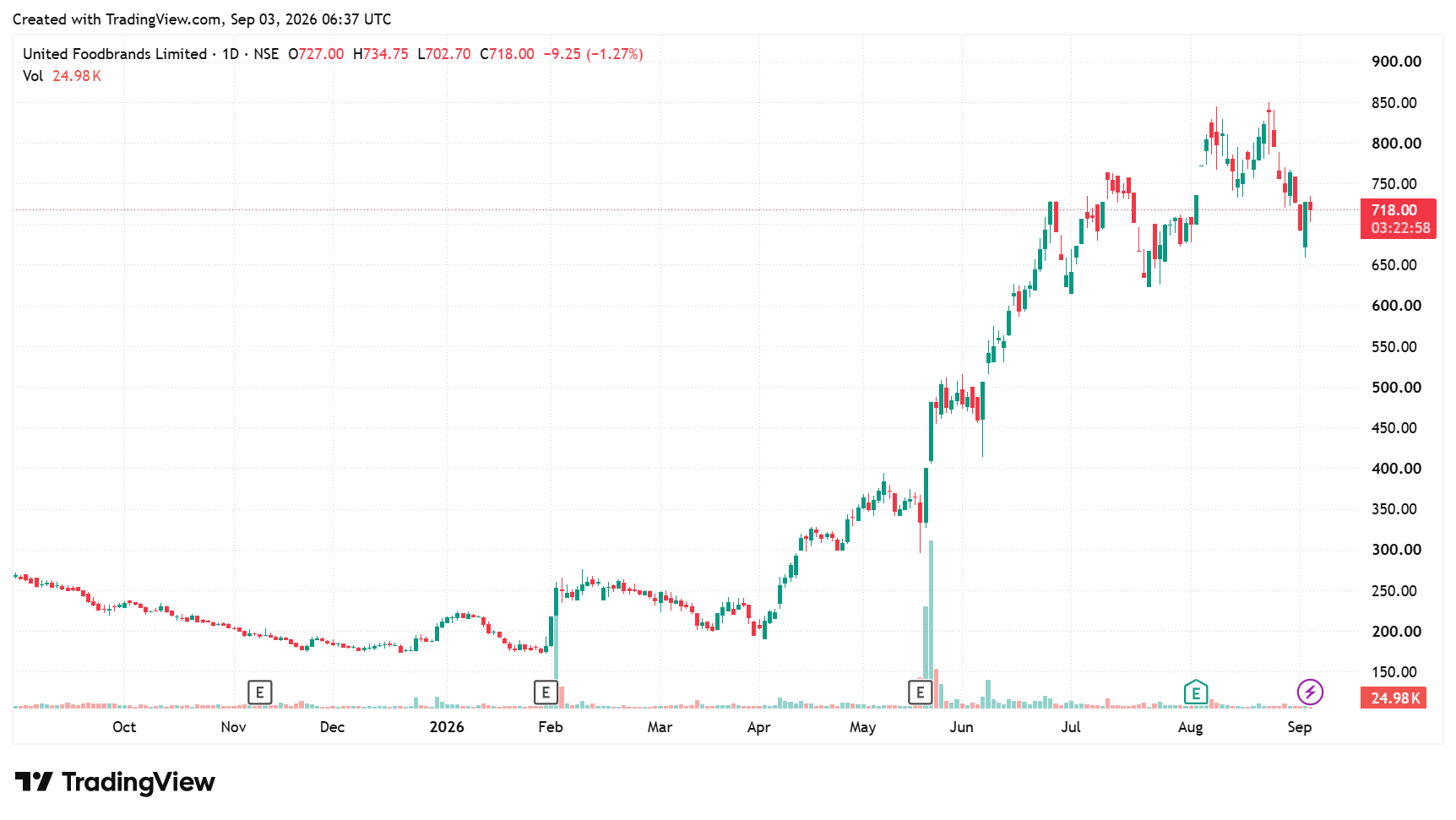
United Foodbrands Share Price is up 232% in 2026
#2 Restaurant Brands Asia: Burger King recovery drives operating leverage
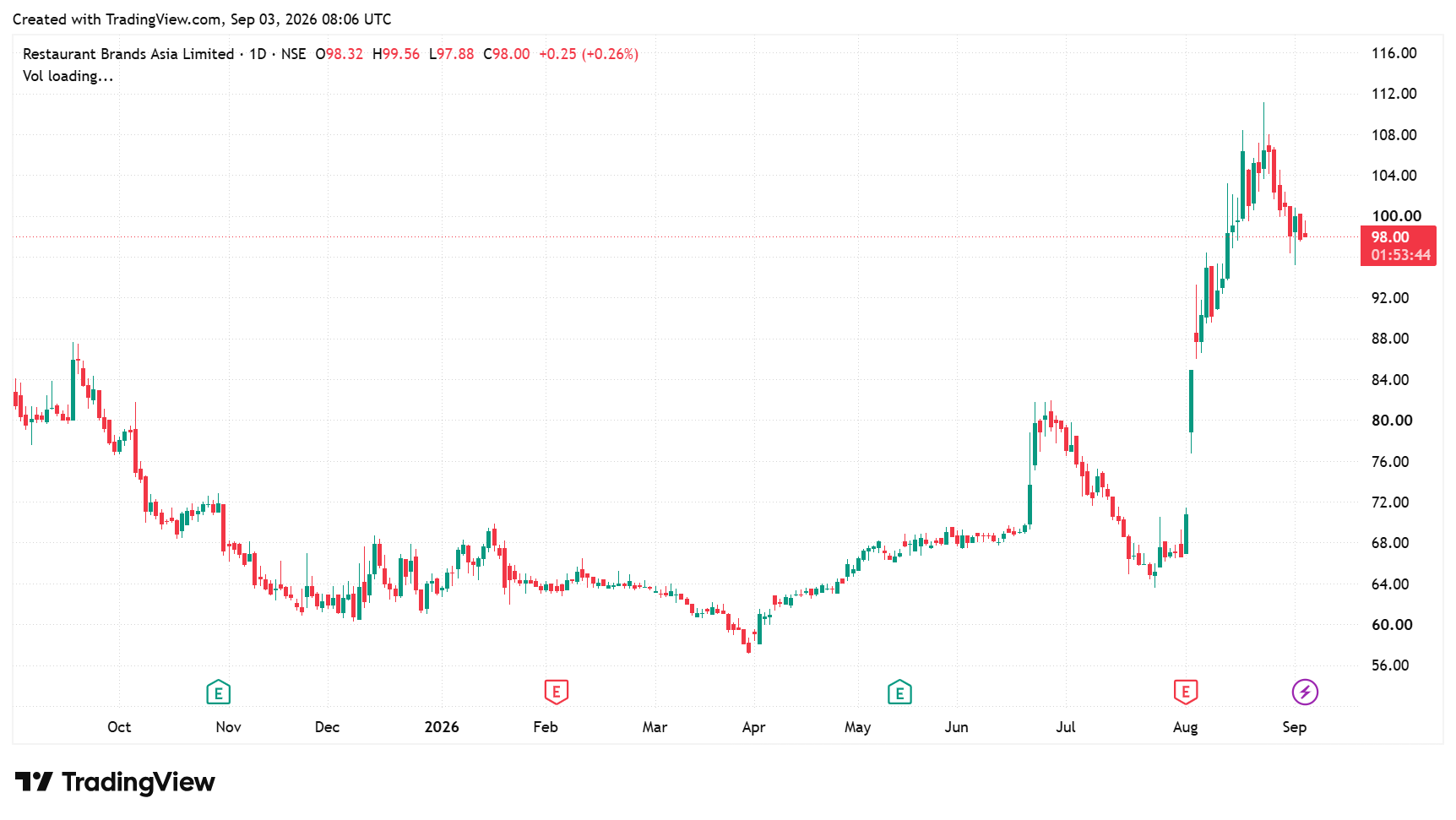
Restaurant Brands Asia (RBA) operates Burger King in India and Indonesia, alongside Popeyes in Indonesia. Across both countries, the company’s total restaurant footprint stood at 752 stores as of Q1FY27. The turnaround is taking shape after Inspira Global, a business group backed by the promoter family of Ajanta Pharma, bought a controlling stake.
Burger King India remains the anchor of the business, accounting for 83% of revenue. Burger King Indonesia and Popeyes Indonesia contributed 15% and 2%, respectively. RBA gained momentum in Q1 FY27, demonstrating that its turnaround strategies are yielding results.
15-Quarter Peak: Standalone SSSG Hits 12.6%
Burger King India recorded an SSSG of 12.6%, the highest rate achieved in the last 15 quarters. Average Daily Sales (ADS) in India rose to ₹1,31,000, driving standalone revenue up by 23.6% year-on-year to ₹682.9 crore. RBA India’s standalone company EBITDA grew 133.6% to ₹52.7 crore.
On a consolidated basis, revenue surged 17.9% year-on-year to ₹822.6 crore. EBITDA rose by 43.5% to ₹108.4 crore while margin expanded 240 bps to 13.2%. Consequently, net loss reduced 27.4% to ₹33 crore in Q1 FY27.
Value Menus and 90% Digital Penetration Drive Footfall Recovery
The turnaround is underpinned by strategies across its operating segments. RBA has continued to capture the market through successful platforms such as the Stunner Menu, Tasty Meal @ 99, and its signature ‘2-for-X’ campaigns (e.g., 2-for-79, 2-for-99). It also expanded its premium offerings with the Whopper Deluxe, the Kimchi Korean range, and the Peri-Peri promotion.
In India, more than 90% of all orders now come through digital channels such as self-ordering kiosks and the app. The company is leveraging this database to launch a Customer Relationship Management platform. The Indonesian business is also undergoing an aggressive turnaround.
Indonesia Margin Recovery vs Popeyes Divestment Risk
Burger King Indonesia reported positive restaurant-level EBITDA of ₹6.4 crore (5.2% margin) in Q1FY27. Popeyes’ restaurants in Indonesia (25) generated an ADS of ₹69,000, revenues of ₹ 15.7 crore, and a restaurant-level EBITDA loss of ₹3 crore in Q1FY27. The company plans to minimize losses and, if possible, restructure or divest it.
Target 72% Gross Margin: RBA’s 80-Store Annual Expansion Blueprint
Moving forward, RBA plans to open approximately 80 new Burger King stores in India annually. Management intends to increase India’s gross margin from 70.8% in Q1 FY27 to 72% over the next two to three years. It is launching a new ‘value strategy’ focused on burgers in Indonesia in late September to boost customer numbers and sales.
#3 Sapphire Foods India: Margins recover as brands regain momentum
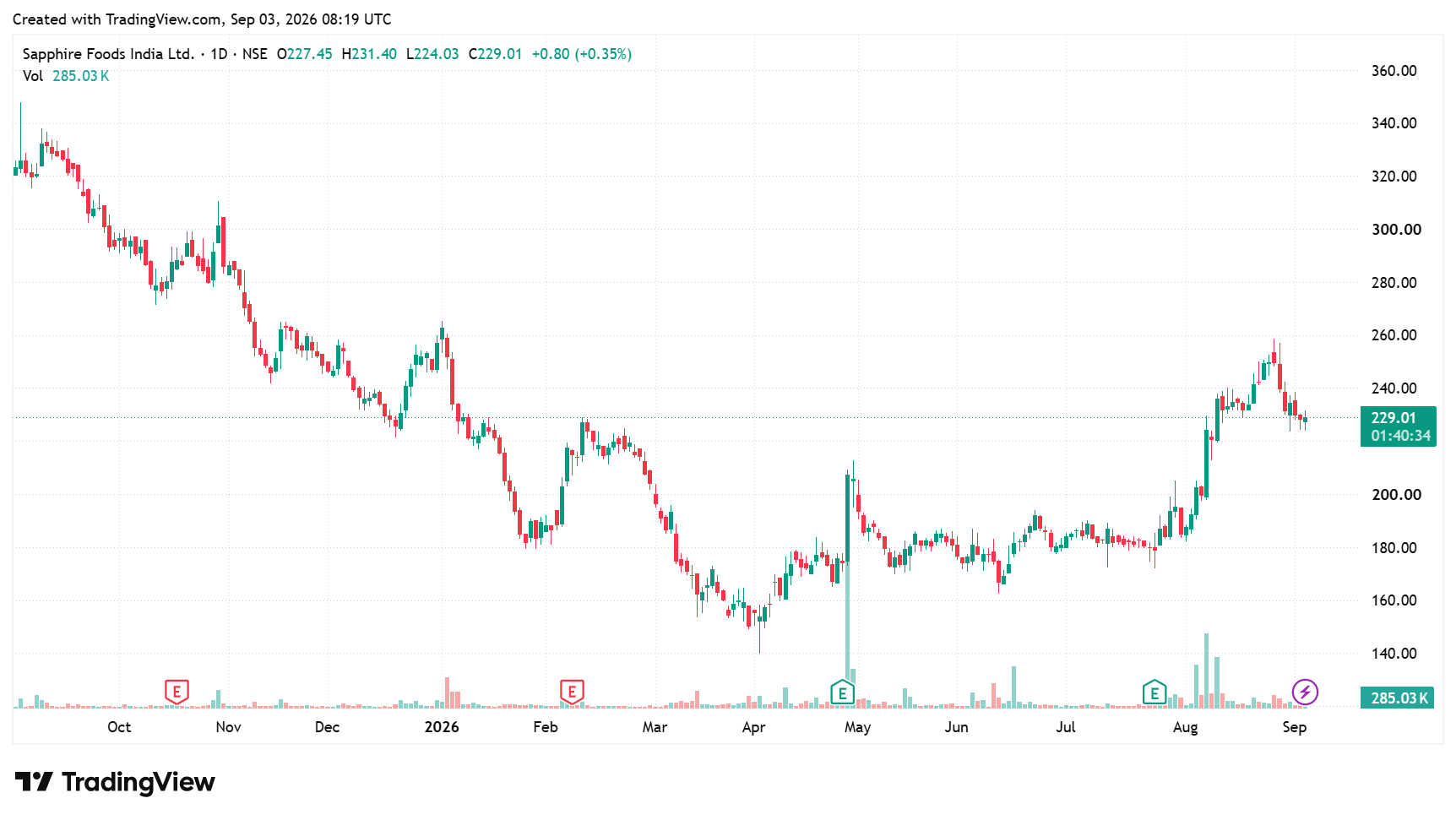
Sapphire Foods Indiais one of the top three QSR franchisee operators in India, Sri Lanka, and the Maldives. The company manages the operations of YUM! Brands, specifically KFC, Pizza Hut, and Taco Bell. As of June 30, 2026, the company operates a network of 1,074 restaurants, consisting of 591 KFCs, 472 Pizza Huts, and 11 Taco Bells.
As an omni-channel player, the company’s sales mix comprises delivery (43%), dine-in (34%), and takeaway (23%). Prior to Q1FY27, Sapphire Foods faced a highly challenging period. For nearly 2 to 2.5 years, the company aggressively expanded its network, adding new restaurants.
However, these new stores typically enter at 80-85% of the average daily sales of established stores, which naturally drags down overall ADS averages. Weak ADS and negative SSSG severely impacted EBITDA margins. To resolve these issues and reverse the negative same-store sales trend, management pivoted to a turnaround.
The ₹99 Pivot: Halting Pizza Hut Expansion to Cure ADS Dilution
Sapphire Foods’ turnaround is driven by a pivot towards value, channel-mix correction, and operational efficiency. The company launched Everyday Value (at ₹99) and abundant meals. The company also focused on dine-in and takeaway channels, as these offer higher transaction values and entail fewer issues associated with third-party delivery aggregators.
Sapphire halted Pizza Hut’s store expansion to focus on fixing the brand proposition and profitability.
Devyani Merger Synergy: Scaling the Tamil Nadu Turnaround Template Nationally
Following approval of the merger with Devyani International, both companies plan to adopt a unified strategy across India. The focus will be on the turnaround strategy used in Tamil Nadu, where marketing and dine-in value offers have driven a significant increase in transactions and improved performance.
11-Quarter Growth High: ₹140.6-Crore EBITDA Anchors 5-Year Doubling Plan
The turnaround strategy has yielded results for consecutive quarters. SSSG turned positive across KFC India (+5%), Pizza Hut India (+1%) and Sri Lanka Business (+9%). Consolidated revenue grew 15% year-on-year to ₹888.2 crore in Q1FY27, the company’s best revenue growth in the last 11 quarters.
EBITDA rose 24% to ₹140.6 crore, while the margin expanded by 120 bps to 15.8%. It turned profitable (₹14 crore), reversing from a loss of ₹2 crore in Q1FY26. Looking ahead, the company plans to launch 60-80 new KFC stores per year. Sapphire intends to double the total number of its restaurants over the next five years.
Q1FY27 Performance Snapshot of the Three QSR Stocks:-
| Particulars | United Foodbrands | Restaurant Brands | Sapphire Foods |
| Revenue Growth | 43.4% | 17.9% | 15.0% |
| SSSG | 28.7% | 12.6% | KFC: 5% / Pizza Hut: 1% |
| EBITDA Growth | 51.8% | 43.5% | 24.0% |
| Net Profit (loss) | ₹2.3 crore | (₹33) crore | ₹14 crore |
| Key Takeaway | Volume-led recovery | Sharp Burger King recovery | Broad-based SSSG recovery |
| Management Commentary and Investor Presentation | |||
The Valuation Spread: Growth Multiple vs Legacy Pricing
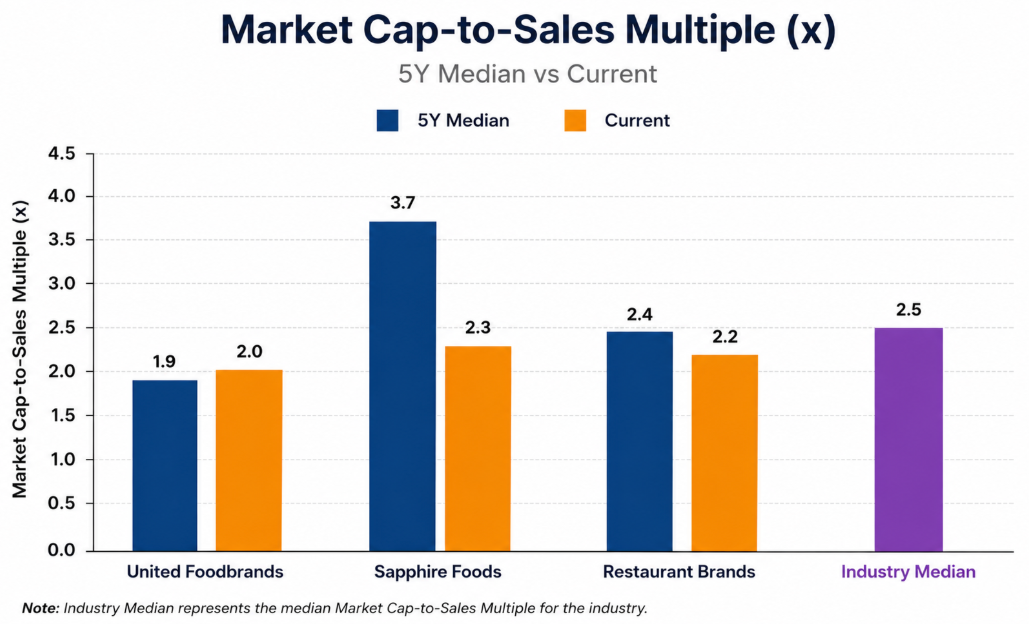
We have not assessed return ratios, as the companies are loss-making on a full-year basis. For a better comparison, we used the Market Cap-to-Sales Multiple. Accordingly, Sapphire Foods and Restaurant Brands currently trade at a discount to both their 5-year historical median and the industry median.
Meanwhile, after a multi-bagger run, United Foodbrands trades at a discount to the industry median but at a slight premium to the historical median.
The QSR recovery is becoming visible in the numbers, but the three stocks offer different turnaround propositions. United Foodbrands has delivered the strongest SSSG and volume-led growth, supported by its value strategy and improving footfalls.
Restaurant Brands Asia is seeing a sharp recovery in Burger King India, with SSSG at a 15-quarter high and strong operating leverage. Sapphire Foods has also turned positive across its key brands, while margin recovery strengthens its case. With all three showing better sales, the next test will be sustaining this momentum as the base gets tougher and expansion continues.
Nonetheless, you could keep these names on your watchlist to track their execution.
Disclaimer:
Note: Throughout this article, we have relied on data from http://www.Screener.in and the company’s investor presentation. We used an alternative, widely used, and accepted source of information only when the data was unavailable.
The purpose of this article is only to share interesting charts, data points, and thought-provoking opinions. It is NOT a recommendation. If you wish to consider an investment, you are strongly advised to consult your advisor. This article is strictly for educational purposes only.
About the Author: Madhvendra has been deeply immersed in the equity markets for over seven years, combining his passion for investing with his expertise in financial writing. With a knack for simplifying complex concepts, he enjoys sharing his honest perspectives on startups, listed Indian companies, and macroeconomic trends.
A dedicated reader and storyteller, Madhvendra thrives on uncovering insights that inspire his audience to deepen their understanding of the financial world.
Disclosure: The writer and his dependents do not hold the stocks discussed in this article.
The website managers, its employee(s), and contributors/writers/authors of articles have or may have an outstanding buy or sell position or holding in the securities, options on securities, or other related investments of issuers and/or companies discussed therein. The articles’ content and data interpretation are solely the personal views of the contributors/ writers/authors. Investors must make their own investment decisions based on their specific objectives and resources, and only after consulting any independent advisors as may be necessary.