



As per S&P Global and CBRE, India’s data-centre capacity crossed 2.1 gigawatts (GW) at the end of the June quarter, with around 0.2 GW added in H126. Another 0.5 GW is expected to come up through the rest of the year. Amazon, Microsoft and Google have also committed nearly $67.5 billion in less than a year towards AI, cloud and data-centre infrastructure in India.
The gap between data consumption and data-centre capacity leaves room for expansion. India generates nearly 20% of the world’s data but accounts for only about 3% of global data-centre capacity. The global build-out is also changing where companies choose to add capacity. S&P Global expects US data-centre capacity to increase from 62 GW in March to 152 GW by 2030.
India is starting from a smaller base, but demand is moving up. Hyperscalers account for roughly half of data-centre occupier activity in the country, according to CBRE. In the March quarter alone, they contracted more than 0.3 GW of capacity. Meanwhile, Jefferies expects India’s data-centre capacity to expand to 10 GW over the next 5 years, which is almost 5X the current capacity.
This expansion is creating a longer-term opportunity across the data-centre ecosystem. Here are three data-centre stocks that could benefit as India adds capacity to meet rising demand from cloud, AI and digital services. Although data centre buildout is currently concentrated in the US, these companies could emerge as key beneficiaries as India’s data centre capacity scales up.
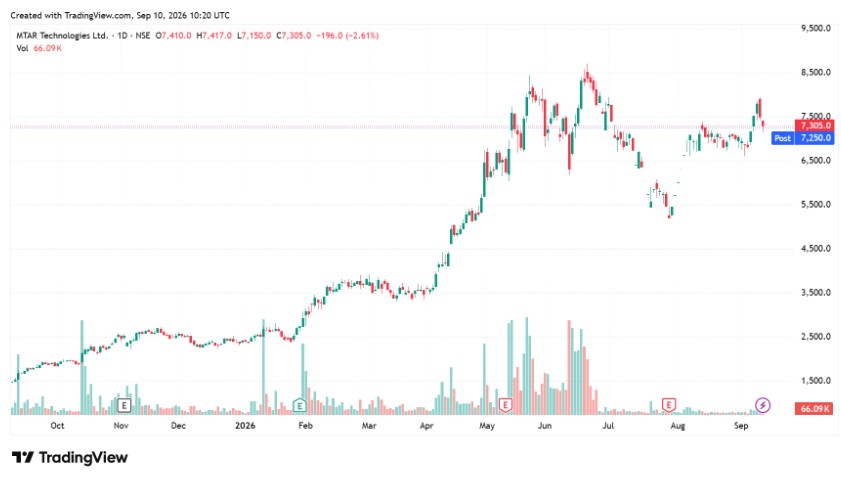
#1 MTAR Technologies: Powering the AI Data-Centre Build-Out
MTAR Technologies is one of the biggest beneficiaries of US data centre demand. It manufactures sheet metal components and assemblies, as well as solid oxide fuel cells. The company is producing sheet metal for global energy tech giant SLB (Schlumberger) under an initial ₹45 crore order.
The US Data Centre Pivot: SLB Pacts and Fuel Cell Assemblies
MTAR targets delivery of the initial ₹45 crore order during Q4FY27. The initial order serves as a qualification batch. After successful qualification, MTAR expects the requirement to grow 8x year-on-year. To support this scale-up, MTAR is constructing a dedicated facility specifically for data centre infrastructure solutions.
MTAR supplies critical hot boxes and assemblies for Solid Oxide Fuel Cells (SOFC). MTAR supplies the hot box, used in behind-the-meter power solutions, to Bloom Energy. Management noted that data centre power demand is a primary structural tailwind for its Clean Energy division. The division order book stood at ₹3,431 crore.
MTAR is expanding its fuel cell capacity. The first phase has already been commissioned. The second phase is set to become operational by October 2026. Meanwhile, the third phase is expected to begin by April 2027.
Order Book Dynamics: ₹5,943-Cr Backlog Gives 2-Year Visibility
The company’s order book as of 30 July 2026 stood at ₹5,943.3 crore. The order book is over 5x its trailing twelve-month revenue of ₹1,080 crore. The company expects to end FY27 with a closing order book of ₹5,000+ crore. Most of the order book will take 1.5 to 2 years to complete.
Earnings Surge: Q1 FY27 PAT Rises 4.6x Amid Margin Expansion
The company’s Q1FY27 financial performance was strong. Revenue surged 130.4% year-on-year to ₹360.7 crore. High-volume production across Clean Energy and Products verticals drove the growth. EBITDA (Earnings Before Interest, Tax, Depreciation, and Amortisation) grew 199.7% to ₹85.1 crore, while margin stood at 23.6%.
PAT increased nearly 4.6x to ₹50.2 crore, supported by higher operating income. Management expects revenue to grow 80% year on year in FY27. Order book execution will accelerate in H2FY27. Full-year EBITDA margins are expected to be around 24%.
#2 Xtranet Technologies: Turning Data Centres into Recurring Revenue
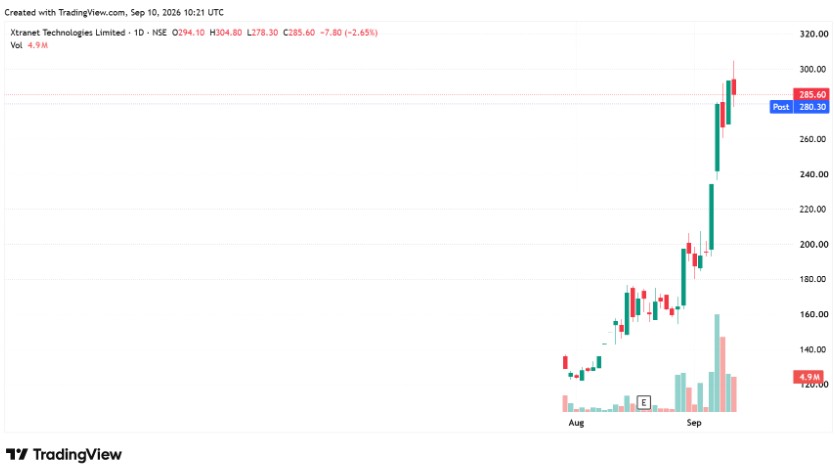
Xtranet Technologies is an integrated technology solutions provider. Its business spans four core business verticals: data centre infrastructure and IT operations, enterprise applications, digital services, and proprietary platforms and products. The data centre vertical is the largest revenue generator, contributing 48% of Q1FY27 revenue.
The data centre business provides end-to-end lifecycle management for mission-critical enterprise infrastructure. This includes infrastructure management, operations centres, disaster recovery and cloud, managed services, and integrated turnkey solutions. XtraNet has executed over 50 data centre projects across India.
Why Long-Term O&M Drives Margin Expansion to 22%
Projects are divided into two phases: deployment and operations and maintenance (O&M). In the former, hardware and initial installation account for 50-60% of the contract value and typically take 9-15 months to deliver. Service-level agreement managed services, which last up to 7 years, account for the remaining 35-40%.
Hardware deployments carry lower EBITDA margins of 6-8%. Once the project transitions into long-term managed services, margins expand to 20-22%. Long-term O&M services are billed quarterly, generating predictable annuity revenue.
The data centre business generated 48% of Q1FY27 revenue and ₹148 crore (40.5%) in FY26. Historically, segment revenue grew from ₹86.8 crore in FY24 to ₹104.6 crore in FY25, and ₹148 crore in FY26.
How a ₹1,200-crore Bid Pipeline Anchors Revenue Visibility
Of Xtranet’s total ₹1,200 crore active bid pipeline, 50% to 60% is concentrated in Data Centre and IT Operations tenders. As of 30 June 2026, its outstanding order book stood at ₹373 crore across 55 projects. About 55% of the order book is expected to be executed within FY27. Government and Public Sector Undertakings accounted for 45% of the order book.
Financially, revenue increased 10.5% year-on-year to ₹50.5 crore in Q1FY27. High contributions from high-margin services (65-68% of revenue) and execution across the Data Centre Infrastructure vertical drove the growth. EBITDA grew 89.1% to ₹10.4 crore, while margin stood at 20.59%. Net profit grew 76.5% to ₹6 crore.
Management aims to sustain 35% to 40% annual revenue growth in this vertical. Revenue contribution is expected to be within 50-55% of the total company revenue.
#3 KRN Heat Exchanger and Refrigeration: Cooling India’s Rising AI Compute Demand
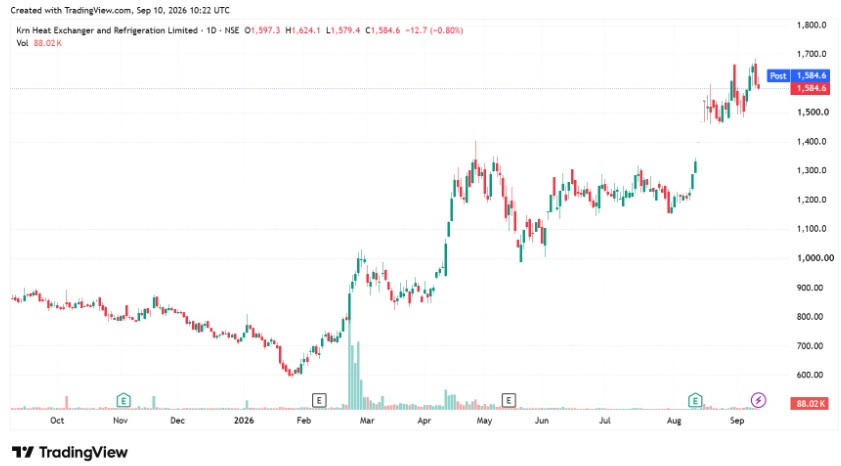
KRN Heat Exchanger and Refrigeration is a thermal and HVAC&R (Heating, Ventilation, Air Conditioning, and Refrigeration) provider. The company manufactures heat exchangers, cooling coils, and comprehensive cooling systems for a wide variety of domestic and international industries.
Cooling the Cloud: How 100 kW AI Rack Densities Are Fueling Demand
KRN is witnessing multi-fold demand growth in the data centre segment. It supplies fin-and-tube and bar-and-plate heat exchangers for both domestic and export markets. Management notes that higher rack power densities (jumping from 5 kW to 100 kW per rack) are driving adoption of liquid cooling.
Fin-and-tube heat exchangers remain indispensable for room-level atmosphere and ambient cooling. As a result, the fin-and-tube products face no threat of direct technology substitution. The product continues to serve both indoor room cooling and outdoor dry cooler applications.
The company supplies India’s leading data centre parts manufacturers. KRN has also expanded its international client base in Q1FY27 by adding 2 to 3 new major customers in North America and Europe, primarily in the data centre space. KRN has recently started exporting fin-and-tube cooling products to North America.
Export Trajectory: Targeting 50% International Share in 2-3 Years
In Q1FY27, KRN’s consolidated export revenue surged 177% year-on-year to over ₹50 crore. The management aims to increase exports to 50% of its Fin-and-Tube (Coil) business over the next 2-3 years. KRN is also India’s largest independent heat exchanger manufacturer and currently caters to around ₹100 crore of business across five to six major customers in South India.
Capex & Earnings: 6X Capacity Expansion Backs ₹2,000-crore Peak Ambition
To meet the surging demand, it recently increased its manufacturing capacity by 6X. This plant (II) is projected to reach 50% capacity utilisation in FY27 and 80% by FY28. At 80% utilisation, the company anticipates a combined peak revenue potential of ₹2,000 crore.
Financially, it reported strong Q1FY27 earnings. Revenue grew 118.9% year-on-year to ₹252.3 crore. EBITDA scaled by 178.9% to ₹49.1 crore, while margin expanded by 418 bps to 19.4%. Net Profit surged 164.8% to ₹32.9 crore. Looking ahead, the management aims to double export revenue to ₹200 crore in FY27.
The Capital Efficiency Gap: Decoupling Stretched Multiples
Xtranet boasts a strong return ratio, including return on capital employed (ROCE) and return on equity (ROE), followed by KRN and MTAR. KRN’s return ratios have declined recently because capacity additions have not yet translated into full earnings.
Valuation-wise, all three companies are trading at a premium to the industry median, while MTAR and KRN also trade at a premium to their historical median. After the recent rally, the market appears to be pricing in strong future growth expectations. Xtranet is a newly listed company and thus has limited trading history.
| Valuation Comparison (X) | |||||
| Price-to-Earnings Multiple | Return Ratios | ||||
| Company | Company | 5Y Median | Industry | ROCE (%) | ROE (%) |
| MTAR Tech | 165.0 | 109.3 | 26.4 | 15.2 | 12.6 |
| Xtranet | 35.8 | NA | 26.0 | 32.8 | 34.8 |
| KRN Heat | 107.0 | 89.4 | 25.3 | 16.1 | 14.3 |
The data-centre opportunity is translating into actual business for these three companies. MTAR has a ₹5,943 crore order book and is scaling its Clean Energy capacity, while XtraNet has a ₹1,200 crore bid pipeline and a business model that can shift towards 20–22% margins as projects move into O&M.
KRN, meanwhile, is expanding capacity sixfold and targets ₹2,000 crore in peak revenue. The catch is valuation. With MTAR at 165x and KRN at 107x earnings, execution will have to match expectations. But it’s worth keeping these stocks on your watchlist.
Disclaimer
Note: Throughout this article, we have relied on data from http://www.Screener.in and the company’s investor presentation. We used an alternative, widely accepted source only when the data were unavailable.
The purpose of this article is only to share interesting charts, data points, and thought-provoking opinions. It is NOT a recommendation. If you wish to consider an investment, we strongly advise you to consult your advisor. This article is strictly for educational purposes only.
About the Author: Madhvendra has been deeply immersed in the equity markets for over seven years, combining his passion for investing with his expertise in financial writing. With a knack for simplifying complex concepts, he enjoys sharing his honest perspectives on startups, listed Indian companies, and macroeconomic trends.
A dedicated reader and storyteller, Madhvendra thrives on uncovering insights that inspire his audience to deepen their understanding of the financial world.
Disclosure: The writer and his dependents do not hold the stocks discussed in this article.
The website managers, its employee(s), and contributors/writers/authors of articles have or may have an outstanding buy or sell position or holding in the securities, options on securities, or other related investments of issuers and/or companies discussed therein. The articles’ content and data interpretation are solely the personal views of the contributors/ writers/authors. Investors must make their own investment decisions based on their specific objectives and resources, and only after consulting any independent advisors as necessary.