



India’s solar energy sector is entering a new phase of growth. Installed solar capacity has increased from less than 3 gigawatts (GW) in 2014 to around 171 GW in 2026, driven by rising electricity demand amid a shift towards renewable energy. The pace of expansion is also picking up. India added around 34 GW of solar capacity in the first half of 2026, up 38% year-on-year, while full-year additions are projected to reach nearly 50 GW.
This growth brings opportunities across the solar value chain. Domestic manufacturing is expanding as companies invest in solar modules, cells, and upstream production facilities. At the same time, the rising number of utility-scale solar projects is creating demand for engineering, procurement, construction, and renewable energy asset management services.
Upstream Integration vs. Turnkey EPC: Structural Comparison
Against this backdrop, this article looks at two distinct business models that offer an interesting perspective on India’s solar growth story. One is strengthening its position through domestic solar manufacturing, capacity expansion, and backward integration, while the other is building its business around renewable energy project execution and a growing international footprint.
#1 Emmvee Photovoltaic Power: Expanding TOPCon Solar Cell Capacity
Emmvee Photovoltaic Power is a leading India-based pure-play integrated solar module and solar cell manufacturer. It is a pure-play solar PV manufacturer specializing in TOPCon (Tunnel Oxide Passivated Contact) cell and solar module production. It has a research partnership with Fraunhofer ISE (Europe’s leading solar research institute) to optimize TOPCon efficiency.
Scaling Up: Solar Module and TOPCon Cell Roadmap to 2028
The installed capacity of solar modules is 10.3 GW and that of solar TOPCon cells is 2.9 GW. Its cell plant achieved an 89% effective utilization rate in Q2FY27. It is adding 6 GW of solar module capacity by December 2026 and 6 GW of TOPCon cell capacity by March 2027. This expansion will increase total annual capacity to 16.3 GW for modules and 8.9 GW for cells by early FY28.
Backward Integration: The ₹5,500-Crore Ingot & Wafer Bet
Further, the company plans to build a 9 GW ingot and wafer manufacturing facility. The capacity will be rolled out in two phases, with 5 GW in FY29 and 4 GW in FY30. This move is designed to secure raw material supplies internally. The estimated capital expenditure of ₹5,000-5,500 crore for this capacity will be funded mainly through internal cash flows.
Regulatory Tailwinds: ALMM List II and Domestic Cell Premiums
The company boasts an order book of 10.4 GW as of September 30, 2026, with 1.5 GW of new order inflows in Q2FY27. In addition, complex tenders for hybrid and round-the-clock power require up to 2x DC module capacity relative to AC grid connections. The Approved List of Models and Manufacturers (ALMM) List II also became active on June 1, 2026.
Regulatory Push: Why ALMM List II Unlocks 40 GW of Protected Demand
Current projects under net-metering and open-access have a transition period until December 31, 2026, after which full List II compliance is required. Solar modules built using domestic cells command a price premium of roughly 60% higher than modules assembled with imported cells. Programs like PM Surya Ghar, PM-KUSUM create a domestic demand pool of at least 40 GW for Indian cell and module makers.
Emmvee has aligned its manufacturing expansion, product listings, and supply chain strategy to capture this regulatory shift. Emmvee’s G12R TOPCon solar cells are officially included under the ALMM List. This qualification allows it to supply domestic cells directly to government schemes and commercial projects requiring DCR compliance.
Financial Trajectory: 35.3% Margins and Cash Flow Acceleration
On the financial front, the company’s revenue rose 39% year-on-year to ₹1,576.4 crore in Q2FY27. EBITDA (Earnings Before Interest, Tax, Depreciation, and Amortisation) also surged 39% to ₹556.9 crore as margins steadied at 35.3% in Q2FY27. Consequently, net profit increased by 61% to ₹382 crore aided by interest savings (₹45.7 crore).
Emmvee management expects to reach the upper end of its FY27 EBITDA target of ₹2,200 crore to ₹2,400 crore. Of this, it has already reached ₹1,105 crore in H1FY27. Management expects to deliver 5.0 to 5.5 GW of the order backlog within the next 12 to 15 months. Operating cash flow after working capital changes grew to ₹409.9 crore in H1FY27, up from ₹131.0 crore in H1FY26.
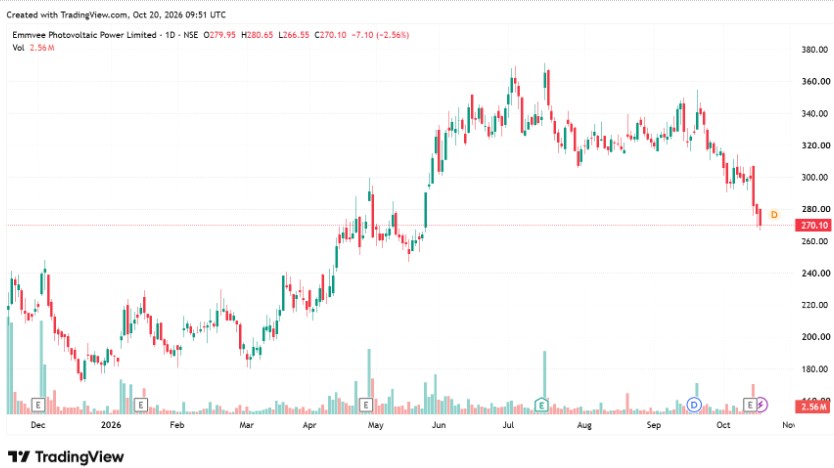
Emmvee Photovoltaic Share Price
#2 Sterling and Wilson Renewable Energy: Executing Global Solar EPC
Sterling and Wilson Renewable Energy is a pure-play renewable energy Engineering, Procurement, and Construction provider. In 2022, Reliance New Energy (part of the Reliance Group) acquired a 40% stake in the company.
Global Asset Footprint: O&M Portfolio Expands to 18.9 GWp
The company provides “concept-to-commissioning” turnkey solutions and Balance of System services across four main areas. This includes Utility-Scale Solar EPC, Hybrid Energy & Battery Energy Storage Systems (BESS), Floating Solar Solutions, and Operation & Maintenance (O&M).
The company has a portfolio of over 29.8 GWp of commissioned solar capacity globally. In addition, it manages 18.9 GWp of operational assets as of September 2026 up from 13.5 GWp in March 2026. The company was ranked as the 2nd largest O&M provider globally by Wood Mackenzie in 2020.
Order Book Dynamics: International Wins Fuel ₹12,481-Crore Backlog
Sterling and Wilson maintains a strong, well-diversified order book. As of September 30, 2026, the order book stood at ₹12,481 crore, up 34% year-on-year. The share of the domestic order book was 56% and the share of the international order book was 44%. The H1FY27 order inflows reached ₹3,626 crore, with nearly 90% of new wins coming from international markets.
The company secured two major projects totalling ₹985 crore during Q2FY27. This includes a 534 MW Balance-of-System solar PV project in Rajasthan from a leading Indian Independent Power Producer. Another one is a standalone BESS project in South Africa on a turnkey basis for a Middle East-based developer.
Bidding Runway: ₹50,000-Crore Pipeline and Adani RFQ Tranche
The bid pipeline is also strong at 34 GW, up from 27.7 GW in Q1FY27. The company sees bidding opportunities worth ₹45,000-50,000 crore across solar and battery storage in H2FY27. BESS opportunities are bid in addition to the 34 GW solar pipeline. Demand is accelerating due to mandates of storage integration for new utility-scale renewable projects starting July 2027.
Sterling & Wilson Solar is also working with Reliance on the technical design and execution preparation for an integrated solar-plus-BESS renewable hub in Kutch, Gujarat. Following the execution of 1.2 GW under its 5-year framework agreement from Adani Group, it has received a Request for Quote for the next 1.2 GW project tranche.
Management maintains its guidance of up to 10% revenue growth for FY27. Following H1FY27 revenue of ₹3,118 crore, execution will scale up sequentially in Q3FY27, with Q4FY27 set to be a heavily loaded quarter. Unexecuted order book is expected to remain above ₹10,000 crore at the close of FY27.
Q2 Financial Review: Revenue Timing Gaps Mask Profit Turnaround
Financially, revenue in Q2FY27 declined 12.7% year-over-year to ₹1,527 crore. This decline in Q2FY27 was primarily due to timing gaps. Four newly won international projects, including the large Egypt West Minya project, were awaiting finalization of notice to proceed or financial closing. Four major domestic PSU projects experienced execution delays.
EBITDA fell 40% to ₹66 crore, while margins contracted 200 bps to 4.3%. Still, the company reported a net profit of ₹17 crore, compared to a loss of ₹478 crore in Q2FY26. Sterling and Wilson Solar reported a high net loss in Q2FY26 due to a one-time impact from US arbitration provisions and write-offs.
Segment Breakdown: O&M Gross Profit Rises 55% as Domestic EPC Steadies
Domestic EPC delivered ₹1,366 crore in revenue and generated ₹106 crore in gross profit. Execution remained steady across existing ongoing sites despite broader industry slowdowns in India. International EPC delivered ₹62 crore in revenue and ₹11 crore in gross profit. O&M business generated revenue of ₹99 crore (up 55% YoY) and ₹23 crore gross profit.
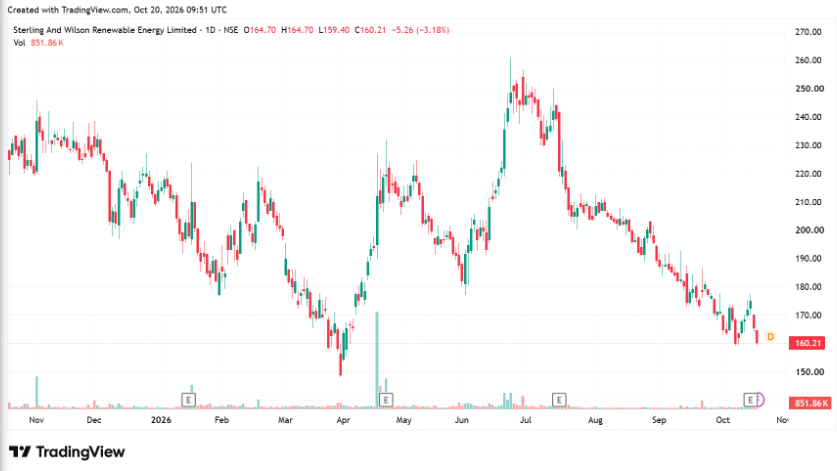
Sterling and Wilson Solar Share Price
Valuation Matrix: Emmvee’s 44% ROCE vs Sterling & Wilson’s Median Multiple
With superior growth and profitability, Emmvee leads the return ratios chart (Return on Capital Employed (ROCE) and Return on Equity (ROE)). Sterling & Wilson’s bottom line, on the other hand, has been volatile with consistent losses on a full year basis.
In terms of valuation, both companies trade at a premium EV/EBITDA multiple compared to the industry median. Sterling & Wilson also trades at a premium to the historical median valuation.
| Valuation Comparison (X) | ||||
| EV/EBITDA Multiple | Return Ratios | |||
| Company | Company | 5Y Median | ROCE (%) | ROE (%) |
| Emmvee | 9.1 | NA | 44.6 | 50.7 |
| Sterling & Wilson | 9.7 | 5.2 | 26.8 | 40.1 |
| Industry | 8.9 | 21.1 | 18.8 | |
| Source: Screener.in (Data as of October 17 2026) | ||||
India’s expanding solar capacity is creating opportunities across manufacturing and renewable energy project execution. Emmvee Photovoltaic Power is focusing on expanding domestic solar manufacturing, increasing TOPCon cell capacity, and strengthening backward integration.
Sterling and Wilson Renewable Energy, on the other hand, is building its growth around solar EPC projects, battery energy storage systems, and a wider international presence. Both companies operate in a sector supported by rising solar installations.
But their growth drivers differ. Emmvee’s progress will depend on capacity expansion, manufacturing efficiency, and demand for domestically produced solar components. Sterling and Wilson’s growth hinges on order execution, new project wins, and its ability to improve margins as revenue scales up.
Execution Risks: Cell Shortfalls and BESS Reverse-Auction Pressures
However, the solar energy industry currently faces significant near-term headwinds. This includes supply chain mismatches where domestic solar cell manufacturing capacity (around 35 GW) falls far short of module capacity under ALMM Phase II mandates, raising project costs by 15% to 17% and delaying EPC awards.
The sector is also impacted by irrational underbidding from new market entrants due to low reverse-auction entry barriers, particularly in BESS, leading to below-cost tariffs, non-viable contract terms, and subsequent project cancellations or delays across the broader market.
Keep these stocks on your watchlist to see how they tap into upcoming demand.
Disclaimer
Note: Throughout this article, we have relied on data from http://www.Screener.in and the company’s investor presentation. Only in cases where the data were unavailable have we used an alternative, widely accepted and widely used source of information.
The purpose of this article is only to share interesting charts, data points, and thought-provoking opinions. It is NOT a recommendation. If you wish to consider an investment, you are strongly advised to consult your advisor. This article is strictly for educational purposes only.
About the Author: Madhvendra has been deeply immersed in the equity markets for over seven years, combining his passion for investing with his expertise in financial writing. With a knack for simplifying complex concepts, he enjoys sharing his honest perspectives on startups, listed Indian companies, and macroeconomic trends.
A dedicated reader and storyteller, Madhvendra thrives on uncovering insights that inspire his audience to deepen their understanding of the financial world.
Disclosure: The writer and his dependents do not hold the stocks discussed in this article.
The website managers, its employee(s), and contributors/writers/authors of articles have or may have an outstanding buy or sell position or holding in the securities, options on securities, or other related investments of issuers and/or companies discussed therein. The articles’ content and data interpretation are solely the personal views of the contributors/ writers/authors. Investors must make their own investment decisions based on their specific objectives, resources, and only after consulting such independent advisors as may be necessary.