


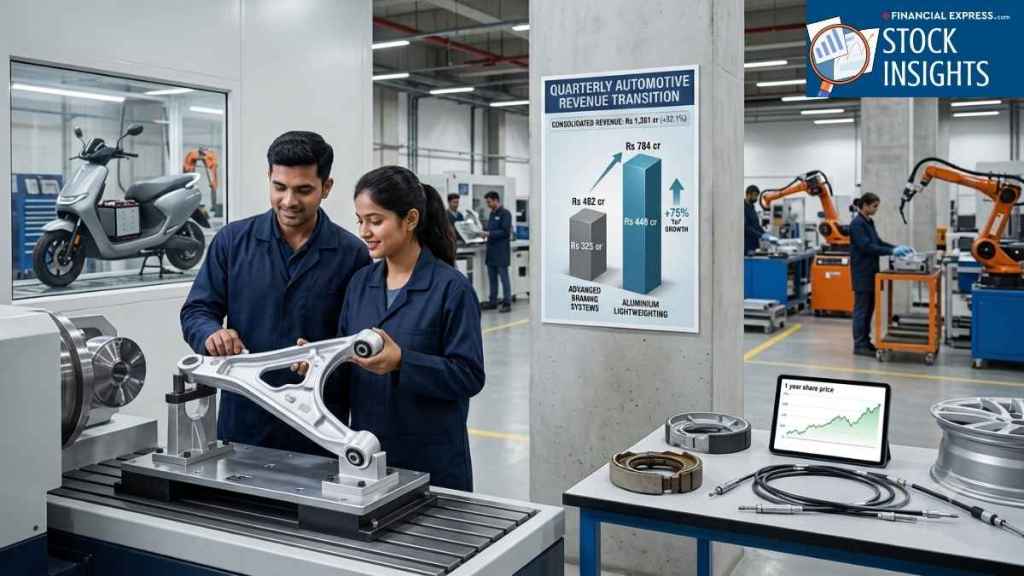

For most auto-component companies, the challenge is not just winning a customer. It is getting more components into the same vehicle, because that can increase revenue without having to depend entirely on higher vehicle production.
ASK Automotive is trying to do just that. What started as a strong position in advanced braking systems for two-wheelers is increasingly becoming a broader business spanning aluminium lightweighting, alloy wheels and control cables, with electric vehicles adding another layer to the opportunity.
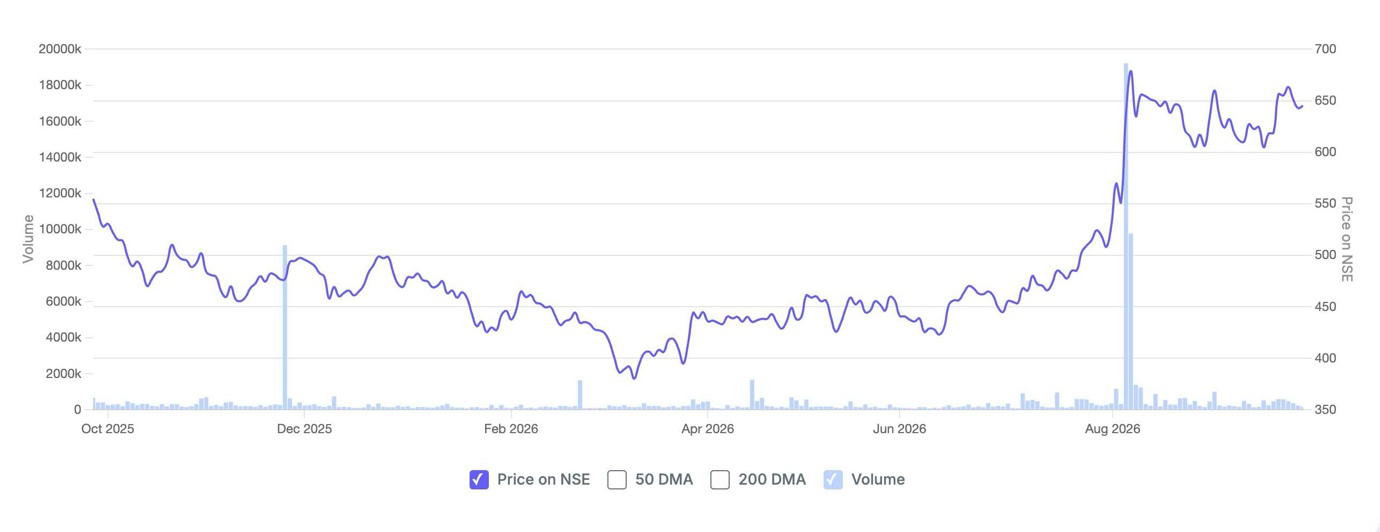
ASK Automotive 1-Year Share Price Chart
The shift is already visible in the numbers. Consolidated revenue grew 52.1% year-on-year in Q1 FY27, although a large part of this increase came from the pass-through of higher alloy prices. After adjusting for the alloy price impact and the company’s decision to reduce its low-margin wheel assembly business, underlying revenue growth was 25.3%.
The company now has a bigger question to answer: can this wider product portfolio generate the same strong returns that its braking business has historically delivered?
Q1 FY27 growth across product segments
| Product segment | Q1 FY26 | Q1 FY27 | YoY growth |
| Advanced Braking Systems | Rs 325 crore | Rs 482 crore | 48% |
| Aluminium Lightweighting Precision Solutions | Rs 448 crore | Rs 784 crore | 75% |
| Safety Control Cables | Rs 33 crore | Rs 39 crore | 18.2% |
| Consolidated revenue | Rs 895 crore | Rs 1,361 crore | 52.1% |
| Net revenue growth, adjusted | 25.3% |
From brakes to a broader component portfolio
ASK Automotive is best known for advanced braking systems, particularly for two-wheelers, where management says it has around 50% market share in India. But the business is no longer dependent on brakes alone.
Its product portfolio now includes advanced braking systems, aluminium lightweighting precision solutions and safety control cables. These products cater to both internal combustion engine and electric vehicles, giving the company exposure to changes in vehicle technology without having to make a single bet on the future of the powertrain.
The biggest change is happening in aluminium lightweighting. In Q1 FY27, the business accounted for 57.7% of product-segment revenue, compared with 35.5% for advanced braking systems. A year earlier, aluminium lightweighting accounted for 50.3% and braking systems 36.4%.
The shift towards lightweighting
| Product segment | Q1 FY26 | Q1 FY27 | Change |
| Advanced Braking Systems | 36.4% | 35.5% | -0.9 pp |
| Aluminium Lightweighting | 50.3% | 57.7% | +7.4 pp |
| Safety Control Cables | 3.7% | 2.9% | -0.8 pp |
| Wheel Assembly | 5.3% | 0.0% | -5.3 pp |
| Others | 4.3% | 3.9% | -0.4 pp |
That change is important because lightweighting is becoming increasingly relevant as vehicle manufacturers look for ways to improve efficiency. For electric vehicles, reducing vehicle weight can also help improve range, making aluminium components a potentially important part of the vehicle architecture.
ASK has also completely exited the low-margin wheel assembly business from April 1, 2026. The move reduces a low-margin activity but also means the company has to replace that revenue with businesses that offer better economics.
The June quarter provides some indication of where that growth could come from. Revenue from advanced braking systems grew 48% year-on-year to Rs 482 crore, while aluminium lightweighting precision solutions grew 75% to Rs 784 crore. Safety control cables grew 18.2% to Rs 39 crore.
Revenue growth is broadening
The headline revenue growth of 52.1% needs some unpacking. Consolidated revenue increased from Rs 895 crore in Q1 FY26 to Rs 1,361 crore in Q1 FY27, but 33.4% of the increase came from the pass-through of higher alloy prices.
After adjusting for the alloy price impact and the 6.6% effect of reducing the wheel assembly business, net revenue growth was 25.3%. That gives a better picture of the underlying growth of the business.
The profitability numbers were also strong. EBITDA increased 32.7% to Rs 164 crore, while profit after tax rose 28.8% to Rs 85 crore.
The reported EBITDA margin, however, fell to 12% from 13.8% a year earlier. The reason is largely mechanical: higher aluminium prices increased the revenue denominator, while the corresponding increase was largely passed through to customers.
Management has said the aluminium business is fully hedged, with 100% pass-through to customers. It expects the overall EBITDA margin to return to around 13.5%-14%, although this remains dependent on commodity prices and the geopolitical environment.
This means the more important number to track is not simply the margin percentage. Absolute EBITDA growth and the ability to improve margins as new capacity gets utilised will matter more.
Capacity is the next constraint
The next phase of the story will require more factories, and ASK has already started increasing its spending. The company had initially indicated FY27 capital expenditure of around Rs 450 crore to Rs 500 crore. It has now raised the potential spending to around Rs 700 crore, following additional orders and the decision to move faster on a new plant in Bangalore.
The capital deployment test
| Metric | Earlier / previous level | Current / FY27 outlook |
| Capex | Rs 450-500 crore initial plan | ~Rs 700 crore |
| Karoli utilisation | 60-65% | ~80% by Q4 FY27 |
| Bangalore utilisation | Near optimum | |
| Karoli monthly revenue | ~Rs 60 crore | ~Rs 110 crore |
| Karoli expected turnover | ~Rs 1,500 crore next year | |
| Debt-equity | ~0.50x | Below 0.5x targeted |
This is not simply a case of building capacity in anticipation of demand. Management has said the additional plant is being considered because of new orders from an existing customer.
Capacity utilization is already moving higher at the existing facilities. Karoli, which was operating at around 60%-65% utilization in the previous quarter, had reached about 75%, with management expecting it to reach around 80% by Q4 FY27. The Bangalore plant is already operating close to optimum utilization.
Karoli is particularly interesting. Monthly revenue from the plant has increased from around Rs 60 crore to Rs 110 crore, while management expects the facility to generate around Rs 1,500 crore of turnover next year.
The company has invested around Rs 750 crore in the 23-acre Karoli facility, but management says there is still around 20% room to add capacity there. That gives ASK some headroom before the economics of the facility are fully tested.
The bigger question is what happens to returns once the Rs 700 crore FY27 capital expenditure programme starts appearing on the balance sheet. New capacity can create significant operating leverage when utilization rises, but the reverse is also true if the ramp-up takes longer than expected.
What management expects in FY27
Management has raised its FY27 growth guidance from mid-teens to high-teens growth. It has also said the momentum seen in Q1 FY27 is expected to continue through the year.
There is some order visibility behind this guidance. The company has confirmed alloy-wheel orders worth around Rs 70 crore to Rs 90 crore for the current financial year and around Rs 250 crore for the following year.
Exports are another part of the growth plan. Management has guided for a 20% increase in exports in FY27 and said it remains confident of achieving this target.
The company is also adding newer products. The sunroof-control-cable business is expected to begin initial supplies in H2 FY27, with substantial growth expected next year. Its joint venture with Japan’s AISIN is also ramping up, although management does not expect significant revenue from it in FY27 and expects better visibility in FY28.
There has also been progress on the passenger-vehicle opportunity. ASK GTD Control Cables, its joint venture with Germany’s T.D. Holding, began commercial production and supply at its Karoli facility in September. The business is focused on sunroof control cables and helix cables for passenger vehicles.
These businesses are still relatively small compared with braking and aluminium lightweighting. But they are important because they show the direction in which ASK is trying to move: from a two-wheeler-heavy component supplier towards a wider vehicle-component platform.
The balance sheet needs watching
The balance sheet is where the excitement around growth needs to be balanced with some caution. Consolidated borrowings stood at Rs 679 crore in March 2026, up from Rs 412 crore a year earlier, while debt-to-equity was around 0.50 and average debt-to-EBITDA was 0.95.
Management expects debt-to-equity to remain below 0.5 even as the company steps up capital expenditure. Internal accruals will fund much of the investment, with term loans used for machines and working capital.
Working capital is also worth watching. Inventory days rose to 41 in FY26 from 34, while the cash conversion cycle increased to 18 days from 11 days.
The return profile, meanwhile, remains healthy. FY26 ROCE was 26.9%, while ROE was around 25%.
The key question is whether ASK can maintain those returns after deploying another Rs 700 crore. The answer will depend on how quickly Karoli, Bangalore and the new capacity move towards useful utilization and how much incremental EBITDA they generate.
Valuation
At around Rs 645 a share, ASK Automotive trades at about 40 times earnings, with a dividend yield of around 0.3%.
That is not a valuation that leaves much room for a prolonged slowdown. The market is already attaching a premium to the company’s growth, strong return ratios and expansion into newer product categories.
The valuation makes the next two years particularly important. Investors will be watching whether high-teens revenue growth, improving margins, rising capacity utilisation and controlled debt translate into stronger earnings and returns.
The risk is not the lack of growth
The interesting thing about ASK Automotive is that the immediate problem is unlikely to be finding growth. The company has new orders, rising utilization, a growing aluminium business and several newer product lines coming through.
The bigger question is whether all this growth can be funded without weakening the financial characteristics that made the existing business attractive in the first place.
The company is already moving from a relatively asset-light growth story towards a more capital-intensive phase. Borrowings are rising, working capital has increased and the planned Rs 700 crore capex is significantly higher than the earlier plan.
That makes cash generation increasingly important. A company can grow revenue quickly when it is adding factories and capacity, but the quality of that growth depends on how much cash and profit those investments generate.
The bigger question is no longer about brakes
ASK Automotive’s story is therefore changing. Its position in advanced braking systems gives it a strong base, but aluminium lightweighting is becoming the larger growth engine, while alloy wheels, control cables and new passenger-vehicle applications could broaden the opportunity further.
The first-quarter numbers show that this transition is already happening. Aluminium lightweighting grew faster than braking systems, underlying revenue grew 25.3%, EBITDA rose 32.7% and the company has raised its FY27 growth outlook to high teens.
But the next phase will be harder. ASK is increasing capital expenditure to around Rs 700 crore, debt has risen, working capital has moved higher and the company will need to bring new capacity up to productive utilization.
The real test, therefore, is not whether ASK can grow faster. Management has already set that target. The more important question is whether it can turn that growth into higher absolute EBITDA, strong cash generation and healthy returns while putting significantly more capital into the business.
That is what could determine whether ASK remains primarily a successful brake-component manufacturer or becomes a much broader auto-component company.
Disclaimer:
Note: We have relied on data from www.Screener.in throughout this article. Only in cases where the data was not available, have we used an alternate, but widely used and accepted source of information.
The purpose of this article is only to share interesting charts, data points and thought-provoking opinions. It is NOT a recommendation. If you wish to consider an investment, you are strongly advised to consult your advisor. This article is strictly for educative purposes only.
Manvi Aggarwal has been tracking the stock markets for nearly two decades. She spent about eight years as a financial analyst at a value-style fund, managing money for international investors. That’s where she honed her expertise in deep-dive research, looking beyond the obvious to spot value where others didn’t. Now, she brings that same sharp eye to uncovering overlooked and misunderstood investment opportunities in Indian equities. As a columnist for LiveMint and Equitymaster, she breaks down complex financial trends into actionable insights for investors.
Disclosure: The writer and her dependents do not hold the stocks discussed in this article. The website managers, its employee(s) and contributors/writers/authors of articles have or may have an outstanding buy or sell position or holding in the securities, options on securities or other related investments of issuers and/or companies discussed therein. The content of the articles and the interpretation of data are solely the personal views of the contributors/ writers/authors. Investors must make their own investment decisions based on their specific objectives, resources and only after consulting such independent advisors as may be necessary.