



Foreign institutional investors (FIIs) have had a miserable relationship with Indian equities this year.
By 6 October, they had pulled nearly US$ 30 billion out of Indian stocks in 2026 so far, on course for the biggest annual outflow and well above the roughly US$ 18 billion sold in 2025.
The reasons are not hard to guess. Higher US Treasury yields, a rupee that has weakened nearly 7% against the dollar, elevated crude oil prices, and a shift of foreign money towards South Korea and Taiwan, where technology and semiconductor stocks are in favour.
The September quarter itself was a swing. FIIs were net buyers of Rs 202 billion (bn) in July and Rs 296.3 bn in August, then turned net sellers of Rs 358.6 bn in September, with more selling on 1 October.
Against that backdrop, a rise in foreign holding in any individual company stands out. It suggests that some overseas funds, even while selling the market, are still picking specific stocks.
The September 2026 shareholding patterns show many such cases.
Let’s look at five of them…
#1 Shilpa Medicare
First on the list is Shilpa Medicare.
Shilpa Medicare is a niche Indian pharma company focused on oncology APIs, complex formulations, and CDMO services.
It is transitioning toward higher-margin segments like biologics and specialty drugs.
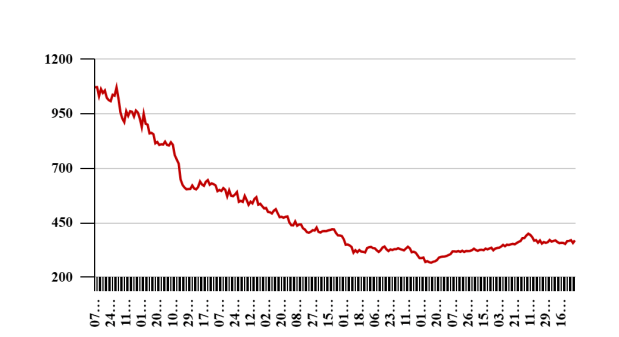
FII holding in the company has risen in each of the last four quarters, from 10.92% in September 2025 to 12.11% now, and the stock has gone from a 52-week low of Rs 259.50 to Rs 1,071, a gain of about 200% in a year.
The business is doing what the shareholders would want to see. Q1 FY27 was the fourth straight quarter of record revenue and EBITDA for the company, with revenue up 43% to Rs 4.7 bn and EBITDA margin of about 30%.
Formulations more than doubled, helped by the US and Europe.
The company has a strong and long pipeline. An aflibercept biosimilar is planned for India in FY27 and a nivolumab biosimilar in FY28.
Its first antibody-drug conjugate biosimilar is expected to enter human trials in FY27, peptide manufacturing capacity is due by the end of FY27, and three new chemical entity programmes in its CDMO business are expected to commercialise in FY28.
The management has said the heaviest capital spending is largely behind it, with existing capacity headroom in both biologics and formulations sufficient to fund near-term growth without major new capex.
Shilpa Medicare – 1 Year Share Price
Data Source: BSE
#2 D-Link
Second on the link is D-Link.
Incorporated in 2008, D-Link is a step-down subsidiary of D-Link Corporation. The company markets networking products of the parent and procures from third-party vendors.
The product profile comprises network switches, wireless local area networks, routers, modems, storage devices, copper and fibre cables and cameras.
The company has seen consecutive FII buying for the past 4 quarters. FII holding has risen from 1.11% to 1.43% over four quarters. That is a tiny stake, with no mutual fund or insurance holding at all. But still, four consecutive quarters of buying should say something.
The company’s operating picture is mixed. In Q1 FY27, its revenue rose 30.5% to Rs 4.6 bn, the highest quarterly sales on record, but profit rose only 13.3% to Rs 276 m as operating margin slipped to 7.6%.
Operating cash flow fell to Rs 140 m in FY26 from Rs 890 m in FY25 because of working capital, and the debtor turnover ratio has dropped to 3.5 times.
In its favour, the company is debt-free, return on equity is about 20%, and at about 14 times earnings it is the cheapest stock in this group.
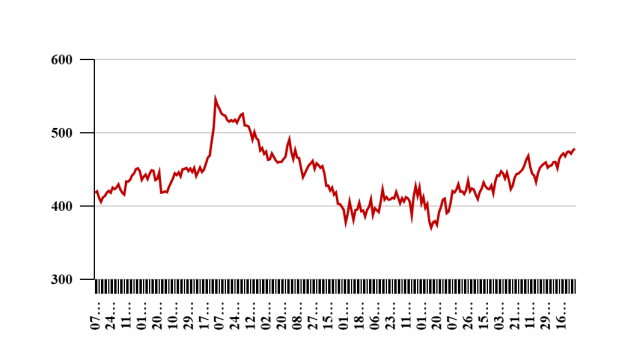
The stock is down about 12% over a year, so the FII increase has not been matched by the price.
D-Link – 1 Year Share Price
Data Source: BSE
#3 Capri Global Capital
Third on the list is Capri Global Capital.
Capri Global Capital is a diversified non-banking financial company (NBFC) with a strong presence in retail lending.
The company offers gold loans, MSME loans, housing finance, construction finance, and Micro LAP. It also earns fee income through insurance and car loan distribution.
Capri Global Capital has seen the biggest FII move in the latest quarter. Foreign holding jumped from 8.21% to 13%, after rising from 4.5% in December 2025 and 5.62% in March 2026.
What makes this interesting is who was on the other side: mutual fund holding slipped from 7.06% to 6.81% in the quarter and holding by financial institutions, banks and insurers has fallen from 12.03% to 9.18% over three quarters.
Foreign money was replacing domestic holders it seems.
The business may have given them some reasons. Its consolidated AUM grew 62% to Rs 401.1 bn, led by gold loans, which now make up about 48% of the book and doubled in a year, and MSME loans.
Its profit after tax doubled to Rs 3.5 bn, net interest margin reached 9.7% and return on average equity was about 19%.
The management has raised its FY27 AUM guidance to about Rs 500 bn and targets Rs 650 bn by FY28, with a plan to add about 400 branches in FY27 on top of 1,433.
That said, its gold loan book has doubled and is now exposed to the price of gold, and Capri’s stage 2 assets rose to 3.8% from 2.8% in the quarter, mainly in gold loans affected by loan-to-value-driven margin calls.
That said, it has received its first international credit ratings from Fitch and Moody’s, which is expected to strengthen its borrowing profile and support future growth.
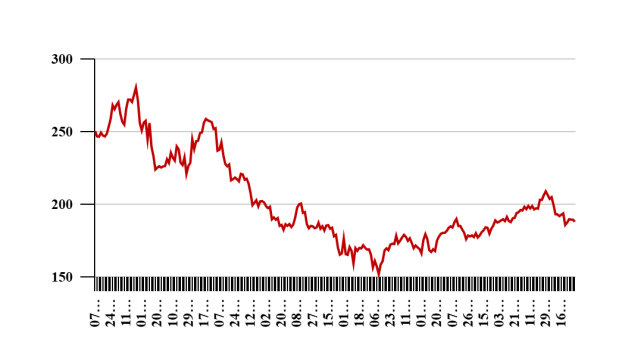
Capri Global – 1 Year Share Price
Data Source: BSE
#4 Billionbrains Garage Ventures (Groww)
Next on the list is Groww.
Groww listed on 12 November 2025 at Rs 100, and its shareholding table needs a note before the numbers mean anything.
The 57.14% FII figure for November 2025 reflects the pre-listing foreign investors, which appear to have been counted differently afterwards, so the meaningful trend starts in December 2025.
From there, FII holding fell to 2.51% by March, and then rose to 6.89% in June and 10.9% in September.
Mutual funds have followed suit, from 3.34% in November 2025 to 10.72% now.
What changed in between is supply. The IPO lock-in expired on 12 May 2026, when Peak XV, Ribbit Capital, Y Combinator’s holding vehicle and Sequoia’s fund sold about 5.01% of the company, reportedly worth Rs 5,637 crore, at a floor price of Rs 182.3.
Part of the rise in FII and mutual fund holdings since then is institutions absorbing shares that early backers were selling.
The company’s operating results are strong. In Q1 FY27, its revenue rose 66% to Rs 15 bn and profit rose 94% to Rs 7.4 bn, with a PAT margin of 47.5%.
Groww added 1.15 lakh net NSE active clients in a quarter when the broking industry lost about 2.57 lakh, and it holds 28.6% of retail commodity derivatives.
Direct mutual fund AUM is Rs 1.9 lakh crore, and the company has received regulatory approvals for State Street’s strategic investment in its asset management arm.
Its management is working to diversify away from equity derivatives, through lending, wealth and bonds.
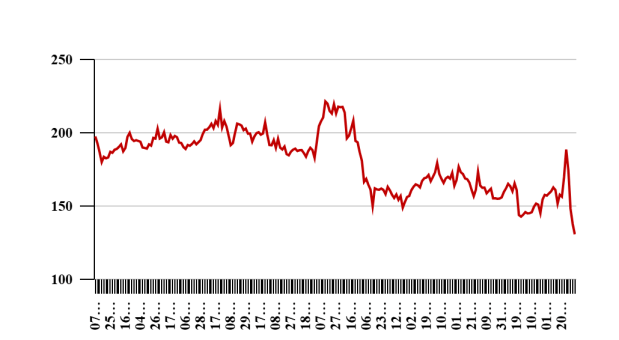
Groww Share Price Since Listing
Data Source: BSE
#5 Shyam Metalics
Last on the list is Shyam Metalics.
Shyam Metalics and Energy (SMEL) is one of India’s fastest-growing integrated multi-metal and steel producers.
SMEL is India’s 6th largest steel producer and the 2nd largest coal-based sponge iron producer. The company commands a combined production capacity of 16.93 Metric Tonne per Annum (MTPA).
It’s the largest aluminium foil manufacturer in India and a premier foil exporter. The business spans carbon steel and building products, stainless steel, the aluminium segment, and railway wagons.
The company’s FII holding rose from 2.97% to 5.29% in September 2026, a gain of 2.32 percentage points after three straight quarters of decline from 3.65% in September 2025.
Promoter holding is steady at 74.59%. Mutual funds hold 1.76%, and financial institutions have trimmed their stake from 7.12% to 5.42% over the last five quarters.
Its Q1 FY27 numbers look solid. Revenue rose 23% to Rs 54.6 bn, EBITDA rose 32% to Rs 7.7 bn, and EBITDA margin improved to 14% from 13.1%.
Under its Vision 2031 plan, commercial production has started at its aluminium foil facility in Odisha and the aluminium flat rolled products facility is due to be commissioned in Q2 FY27.
Captive sources met more than 80% of its power needs in the quarter.
The management plans to expand total production capacity from 16.9 MTPA to around 27 MTPA. It has outlined an expansion plan of Rs 95 bn over the next 3-5 years to fund this expansion.
The company plans to fund this entirely through internal cash accruals without external long-term debt. Management aims to maintain a net-cash balance sheet and a debt-to-equity ratio of 0.5x.
On the expansion front, the company commissioned the colour-coated line at its greenfield cold rolling mill in West Bengal in April 2026, increasing its cold rolling capacity by 60% to 0.4 MTPA.
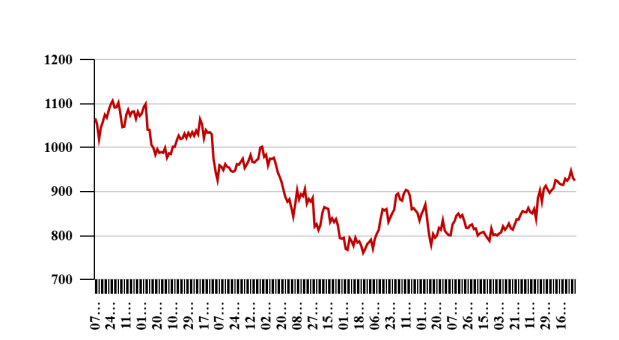
Shyam Metalics – 1 Year Share Price
Data Source: BSE
Conclusion
FII holding is a useful pointer, not a reason to buy. Prices have already moved in Shilpa and Groww, while D-Link and Shyam have not run as hard.
The more useful question for each is whether the business keeps delivering at the pace that foreign investors seem to be paying for, particularly when the overall foreign flow into India has been negative for most of the year.
Before investing, investors should evaluate the company’s fundamentals, corporate governance, and valuations before drawing any investment conclusions.
Happy investing.
Disclaimer: This article is for information purposes only. It is not a stock recommendation and should not be treated as such. Learn more about our recommendation services here…
The website managers, its employee(s), and contributors/writers/authors of articles have or may have an outstanding buy or sell position or holding in the securities, options on securities or other related investments of issuers and/or companies discussed therein. The content of the articles and the interpretation of data are solely the personal views of the contributors/ writers/authors. Investors must make their own investment decisions based on their specific objectives, resources and only after consulting such independent advisors as may be necessary