



Power equipment manufacturers play a vital role in developing a country’s electricity infrastructure.
They produce essential equipment such as transformers, switchgear, circuit breakers, generators and other components required for power generation, transmission and distribution.
As electricity demand increases due to industrial growth, urbanisation, data centres and electric vehicles, the need for reliable power equipment is also rising.
The expansion of renewable energy capacity, including solar and wind power, is creating additional demand for equipment that supports grid connectivity and efficient electricity distribution.
Governments and private companies are investing in modernising existing power networks and building new infrastructure, creating opportunities for manufacturers.
However, business growth depends on order execution, raw material costs, competition and capital expenditure trends. Strong demand alone does not guarantee higher profits or attractive stock valuations.
Here are 5 best power equipment stocks to add to your watchlist. We selected them based on high ROCE and ROE above 18% and compounded profit growth above 20% over the last three years.
#1 GE Vernova T&D India
First on our list is GE Vernova T&D India.
GE Vernova T&D India is a leading player in India’s power transmission and distribution sector. The company manufactures and supplies power transformers, circuit breakers, gas-insulated switchgear and other equipment used in electricity grids and substations.
Its portfolio also includes high-voltage direct current (HVDC) systems, grid automation, digital solutions and maintenance services.
The company has excellent return ratios. The company’s ROE stands at 45.8%, while ROCE stands at 62.6%. It has reported a robust compounded profit growth of 490% over the last three years.
GE Vernova T&D India Financial Highlights (FY23-26)
| FY23 | FY24 | FY25 | FY26 | |
| Net Sales (Rs m) | 27,732 | 31,679 | 42,923 | 62,063 |
| Sales Growth % | -9.6 | 14.2 | 35.5 | 44.6 |
| Operating Profit (Rs m) | 1,550 | 3,541 | 8,936 | 17,951 |
| Operating Margin % | 5.6 | 11.2 | 20.8 | 28.9 |
| Net Profit (Rs m) | -15 | 1,811 | 6,083 | 12,333 |
| Diluted EPS (TTM) | -0.1 | 7.1 | 23.8 | 48.2 |
| Return on Equity % | -0.1 | 14.6 | 34.3 | 45.8 |
Source: Equitymaster
On financial performance in the first quarter, the company’s Q1FY27 revenue stood at Rs 18.4 bn versus Rs 13.3 bn YoY, a growth of 38%. Execution outpaced new orders, so the order backlog moderated to Rs 209.3 bn as of June 26 versus Rs 214.6 bn as of March 26, down 2.5% quarter-on-quarter. The order backlog stands at more than 3 years of the company’s FY26 revenue.
The company secured 400 kV GIS order from GE Vernova entities in Spain and Morocco. 155 MVA 245 kV transformers for a semiconductor customer. Multiple orders for grid automation packages from state utilities, EPCs, and data centers. This export diversification, which now stands at 46% of GE Vernova T&D’s Q1 orders, is a trend the company has been building toward.
Private customers now account for 77% of GE Vernova T&D India’s backlog, with central utilities and PSUs contributing another 21% and state utilities exposure down to just 2%.
Management says that though order intake for the quarter moderated, revenue growth, execution pace, cash generation, and backlog quality remained strong and consistent with its full-year expectations. They remain confident they will convert the Rs 209 bn backlog profitably over the coming years.
#2 Siemens Energy India
Next on the list is Siemens Energy India.
Siemens Energy India was demerged from Siemens Ltd and became a separate, listed company on 19 June 2025. The separation allowed both companies to focus on their core businesses and growth strategies. Siemens Energy India manufactures equipment for power generation and transmission, including transformers, turbines and generators.
The company reported ROE of 25.1% and 34.8%. Siemens Energy India reported solid numbers for Q3 ending 30 June 2026. Revenue was up 39.3% YoY to Rs 24.86 bn; while net profits of the company jumped by up 67.8% YoY to Rs 4.41 bn.
Source: Investor Presentation
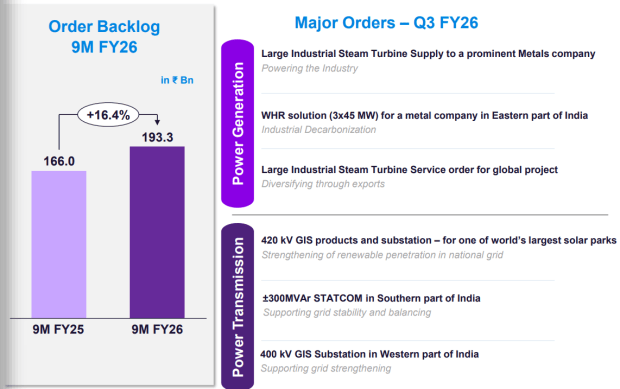
The company secured several large orders during the quarter ending 30 June 2026. In the power generation space, it secured a large Industrial Steam Turbine Supply to a prominent Metals company. It also secured a large Industrial Steam Turbine Service order for a global project.
In the transmission space, Siemens Energy India secured 420 kV GIS products and a substation for one of the world’s largest solar parks.
Siemens Energy India’s future prospects are supported by rising electricity demand, renewable energy integration and investments in power transmission infrastructure. The expansion of India’s power grid and growing requirements for transformers, switchgear and grid stabilisation equipment could create opportunities for the company.
#3 Hitachi Energy India
Next on our list is the stock of Hitachi Energy India. The company is a leading power equipment manufacturer specialising in transformers, high-voltage products, grid integration and automation solutions. Its equipment supports electricity transmission, distribution and renewable energy integration.
Hitachi Energy India has reported robust return ratios. The company’s ROCE stands at 26.1%, while ROE stands at 19.1%. Hitachi Energy has reported a net profit growth of 119% over the last three years.
During Q1FY27, the company secured orders worth Rs 50.96 bn. Several notable wins across key sectors drove these orders. These include India’s first Battery Energy Storage System (BESS) project, a 2 GW wind power evacuation project in Europe, and the supply of GIS/GIB solutions for a 100 GW solar park in western India.
Hitachi Energy India Financial Highlights (FY23-26)
| FY23 | FY24 | FY25 | FY26 | |
| Net Sales (Rs m) | 44,685 | 52,375 | 63,849 | 81,477 |
| Sales Growth % | -8.5 | 17.2 | 21.9 | 27.6 |
| Operating Profit (Rs m) | 2,651 | 3,683 | 6,619 | 15,072 |
| Operating Margin % | 5.9 | 7.0 | 10.4 | 18.5 |
| Net Profit (Rs m) | 939 | 1,638 | 3,840 | 9,878 |
| Diluted EPS (TTM) | 21.1 | 36.7 | 86.1 | 221.6 |
| Return on Equity % | 7.7 | 12.0 | 9.1 | 19.1 |
Source: Equitymaster
In addition, the company secured multiple data center orders from hyperscalers during the quarter. A notable project among these is a 40 × 2500 kVA data center project in Hyderabad, awarded by a leading Indian multinational conglomerate.
As a result, Hitachi Energy India closed the quarter with an order backlog of Rs 322.22 bn, representing strong double-digit growth compared with Q1 FY26 and providing good revenue visibility for the coming quarters.
To further strengthen its execution capabilities, the company began construction of Hitachi Energy India’s 20th manufacturing facility in Karjan, Vadodara, in June 2026.
The new facility is being designed as a fully digital and smart manufacturing unit, leveraging advanced technologies to enhance quality, productivity, and operational performance. With a targeted commissioning date of December 2028, the facility will play a key role in expanding Hitachi Energy India’s manufacturing footprint, strengthening local capabilities, and supporting the growing demand for sustainable energy infrastructure in India and global markets.
Moving ahead, the management says that the focus remains on strengthening the company’s core businesses in Utilities and HVDC, while ensuring the continuity and resilience of its installed base through its services business unit.
At the same time, they remain committed to executing the strong backlog efficiently and enhancing productivity.
The management says the company is well positioned to capitalize on emerging growth opportunities, particularly in Battery Energy Storage Systems (BESS), renewable integration, data centers, and grid modernization, where demand fundamentals remain highly encouraging.
#4 ABB India
Next on our list is the stock of ABB India.
ABB India is an electrical engineering and automation company operating in India. It provides products, systems and services across electrification, motion, and automation. Its offerings include circuit breakers, switchgear, electric motors, drives, robotics, and industrial automation solutions.
The company serves customers across industries such as utilities, manufacturing, infrastructure, transportation, and process industries. ABB India is part of the global ABB Group, headquartered in Switzerland, which specialises in electrification and automation technologies.
The company delivered an ROCE of 28.7%, while ROE was 21.3%. ABB India has delivered a 3-year annualized net profit growth of 30%.
ABB India Financial Highlights (FY23-26)
| Year Ending | Dec 22 | Dec 23 | Dec 24 | Dec 25 |
| Net Sales (Rs m) | 85,675 | 104,465 | 121,883 | 132,027 |
| Sales Growth % | 23.6 | 21.9 | 16.7 | 8.3 |
| Operating Profit (Rs m) | 11,436 | 17,915 | 26,586 | 23,954 |
| Operating Margin % | 13.3 | 17.1 | 21.8 | 18.1 |
| Net Profit (Rs m) | 10,256 | 12,482 | 18,746 | 16,694 |
| Diluted EPS (TTM) | 48.4 | 58.9 | 88.5 | 78.8 |
| Return on Equity % | 20.8 | 21.0 | 26.5 | 21.3 |
Source: Equitymaster
On the financial front, for the first half ending 30 June 2026, the company was up 36% in orders, to roughly Rs 86 bn. Revenues rose to Rs 67.43 bn, up 13% for the half-year. In terms of order backlog it stands at a solid Rs 119 bn.
Management says there are no slow-moving or non-moving orders, and everything will materialise over time as scheduled with customers. Operational EBITA, was up 12.8%.
In terms of emerging and core sectors, Data Centers orders in the quarter ending 30 June 2026 were 15% to 17%. Metals and Mining accounted for 15%, Oil and Gas for 9%, and Buildings and Infra for 8%. Renewables were 6%.
Looking ahead, the company says balancing pricing and market share has become more challenging because of inflationary pressures and expanded industry capacity, which is intensifying market competition.
However, they note that megatrends like electrification, automation, grid modernization, and the energy transition should support the company in the medium to long term.
#5 Transformers and Rectifiers India
Last on our list is Transformers and Rectifiers India.
Transformers and Rectifiers (India) is an Indian manufacturer of power, distribution and special-purpose transformers. Its products include furnace transformers, rectifier transformers, and transformers used in industrial and power transmission applications.
The company supplies equipment to sectors such as power generation, transmission and distribution, steel, oil and gas, and renewable energy. Headquartered in Gujarat, the company operates manufacturing facilities that cater to domestic and international markets.
The company has reported an ROE of 18.1%, ROCE of 26.4%, while the 3-year net profit growth has been 85.9%.
Transformers and Rectifiers Financial Highlights (FY23-26)
| FY23 | FY24 | FY25 | FY26 | |
| Net Sales (Rs m) | 13,952 | 12,874 | 20,145 | 25,049 |
| Sales Growth % | 20.8 | -7.7 | 56.5 | 24.3 |
| Operating Profit (Rs m) | 1,296 | 1,399 | 3,592 | 4,440 |
| Operating Margin % | 9.3 | 10.9 | 17.8 | 17.7 |
| Net Profit (Rs m) | 423 | 470 | 2,164 | 2,722 |
| Diluted EPS (TTM) | 1.4 | 1.6 | 7.2 | 9.1 |
| Return on Equity % | 10.7 | 8.5 | 17.3 | 18.1 |
Source: Equitymaster
Financially, the company recently delivered a strong set of numbers for Q2FY27. Revenues from Transformers and Rectifiers India surged 66%, while net profit rose by a whopping 338%.
The management said that Q2FY27 performance reflected better execution, improved capacity utilisation, and operating leverage across manufacturing facilities.
The company secured fresh orders worth Rs 32.83 bn during Q2FY27. In fact, Transformers and Rectifiers India secured a first-ever order in the nuclear power sector, supplying Generator Transformers for NPCIL’s Kaiga Units 5 & 6 project, marking a strategic entry into a high-value infrastructure segment.
The company also won large order from Damodar Valley Corporation in Oct 2026 for manufacturing and supplying 500 MVA and 200 MVA Auto Transformers, to be executed within 15-28 months.
Transformers and Rectifiers’ unexecuted order book stands at Rs 72.37 bn, while the orders worth Rs 210 bn are inquiries under negotiation.
The management says that its expanded transformer manufacturing capacity supports revenue potential of Rs 50-60 bn.
Conclusion
India’s growing power demand and investments in electricity infrastructure have brought power equipment manufacturers into focus. However, investors should not assume that every company in this sector will deliver strong returns.
Before investing, it is essential to examine fundamentals such as revenue and profit growth, ROE, ROCE, debt levels, cash flow, order book quality and execution capabilities.
Valuation is equally important, as even a fundamentally strong company can be a poor investment if its shares are overpriced. Thorough research and financial discipline are essential before making any investment decision.
Happy investing.
Disclaimer: This article is for information purposes only. It is not a stock recommendation and should not be treated as such. Learn more about our recommendation services here…
The website managers, its employee(s), and contributors/writers/authors of articles have or may have an outstanding buy or sell position or holding in the securities, options on securities or other related investments of issuers and/or companies discussed therein. The content of the articles and the interpretation of data are solely the personal views of the contributors/ writers/authors. Investors must make their own investment decisions based on their specific objectives, resources and only after consulting such independent advisors as may be necessary