




Monopoly stocks are shares of companies that enjoy a dominant position in a particular industry or niche, often because of high entry barriers, strong brands, unique technology, regulatory advantages or extensive infrastructure.
Such companies enjoy pricing power, stable demand, high margins, and predictable cash flows.
Here are 5 top monopoly stocks to watch. In determining the top, we have selected companies that hold near 70% or more market share.
#1 Indian Railway Catering and Tourism Corporation (IRCTC)
First on our list is IRCTC.
IRCTC is a public sector undertaking under the Ministry of Railways, Government of India. It serves as the professional hospitality, ticketing, and travel arm of Indian Railways.
In railway ticketing, Indian Railway Catering and Tourism Corporation (IRCTC) has a monopoly.
IRCTC is the authorised entity responsible for online reserved-ticketing services for Indian Railways. Third-party platforms are IRCTC-authorized service providers and are integrated with IRCTC’s ticketing system.
Financial Highlights of IRCTC
| FY23 | FY24 | FY25 | |
| Total Revenues (Rs m) | 35,415 | 42,602 | 46,748 |
| Operating Profit (Rs m) | 13,967 | 16,304 | 17,789 |
| Net Margin % | 28.4 | 26.1 | 28.1 |
| Profit After Tax (Rs m) | 10,059 | 11,111 | 13,149 |
Source: Equitymaster
On the financial front, the company reported Q1 FY27 revenues of Rs 13,695 m, against Rs 11,597 m YoY. The net profit of IRCTC for Q1FY27 was Rs 3,302 m vs Rs 3,307 m YoY.
The growth was driven by strong contributions from the Catering and Tourism segments.
Looking ahead, the management says they will strengthen the existing business and developing new-age offerings.
Towards this end, the company will leverage technology, enhance operational capabilities, and explore emerging opportunities across tourism, hospitality, and value-added services.
The management says they are confident that the strong financial position, resilient business model, and focus on operational excellence will enable the company to sustain its growth momentum and create long-term and enduring value for all its stakeholders.
#2 MCX
Next on our list is MCX’s stock.
Multi Commodity Exchange of India Limited (MCX) is often considered a near-monopoly business in India’s commodity derivatives market, but it’s not a legal monopoly. Its strength comes from market dominance, liquidity, brand trust, and network effects.
MCX handles roughly 98% of India’s commodity futures trading value and is the clear leader in commodity options as well.
As per FY25 statistics, MCX is the world’s largest Commodity Options Exchange and fourth largest Commodity Derivatives Exchange by number of contracts traded.
Financial Highlights of MCX
| Rs m | FY24 | FY25 | FY26 |
| Revenues | 6,836 | 11,127 | 23,020 |
| Operating Profit | 1,397 | 7,615 | 17,736 |
| Net Profit Margin (%) | 12.2 | 50.3 | 57.8 |
| Profit After Tax | 831 | 5,600 | 13,316 |
Source: Equitymaster
On the financial front, during Q1FY27, the total income increased 85% to Rs 7.52 bn and revenue from operations grew to Rs 7.02 bn, an 88% growth.
EBITDA more than doubled to Rs 5.44 bn, with PAT at Rs 4.13 bn.
Moving ahead, the company is a very early stage of work on its coal exchange. On approval from the regulator, the company has incorporated the MCX Coal Exchange of India and other procedural items are in play towards the next steps on this.
This will create a transparent, efficient technology-driven national coal trading ecosystem aligned with the government’s market reforms as well as the long-term strategy of expanding into new commodity segments.
A big action in Q1FY27 for the company was the expansion of Good Delivery Norms. In line with a lot of policy narratives around the country on bullion, the company has included silver and empanelled the country’s first domestic silver refiner.
According to the management, these norms align with best-in-class global standards, on par with all global norms. Three more domestic gold refiners have also been empanelled, and the Good Delivery framework has also been extended across all contracts.
#3 Coal India
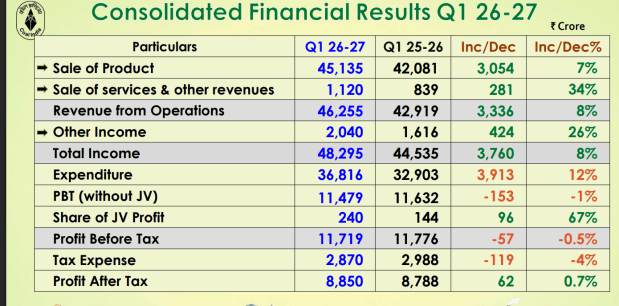
Coal India holds a dominant monopoly position in coal mining and production in India. It has over 80% of the country’s coal production and is the world’s largest coal producer.
The dominance in the market is mainly due to government ownership, regulatory licensing, which gives access over coal blocks. It’s the key coal supplier for key sectors such as power, steel, cement, and fertilisers.
Source: Investor Presentation, Coal India
Moving ahead, the company has received the commissioning certificate in May 2026 from Gujarat Energy Development Agency (GEDA) for 100 MW capacity Solar Power Plant at Bhadramali, Gujarat. The company has begun generating revenue from these operations.
Coal India has commissioned 200 MW of solar power capacity out of the 300 MW Solar Power Project at Khavda, Gujarat.
The above measures, along with other planned ventures, will help the company foray beyond coal.
#4 ONGC
Oil and Natural Gas Corporation (ONGC) is one of India’s most important energy companies and its largest government-owned oil and gas exploration and production enterprise.
It traces its origins to 1956 and operates under India’s Ministry of Petroleum and Natural Gas. It has Maharatna status, the highest category given to major Indian central public-sector enterprises.
ONGC is the largest crude oil and natural gas company in India, contributing around 71 percent of India’s domestic production.
Financial Highlights: ONGC
| FY24 | FY25 | FY26 | |
| Net Sales (Rs m) | 5,499,910 | 5,608,684 | 5,550,782 |
| Operating Profit (Rs m) | 1,160,119 | 1,024,502 | 1,154,763 |
| Operating Margin % | 21.1 | 18.3 | 20.8 |
| Net Profit (Rs m) | 552,731 | 383,286 | 497,931 |
Source: Equitymaster
Gross revenue of ONGC surged in Q1FY27 to Rs 464.6 bn, an increase of over 45% YoY. Standalone profit after tax stood at Rs 170.34 bn, registering a robust growth of over 112% YoY.
Moving ahead, ONGC is taking steps to enhance production. One of the steps is centered on renewed thrust in Western Offshore, under which ONGC is implementing one of the largest capital investment programs in the history of its Western Offshore operations with projects exceeding Rs 400 bn under various stages of execution.
ONGC is doing well on the gas front too. In Q1FY27, revenue from new well gas almost hit Rs 40 bn, generating an incremental realisation of about Rs 19 bn over the administered pricing mechanism.
Prospects of ONGC would depend on crude prices, enhancing production and government policies.
#5 Computer Age Management Systems
Next on the list is the stock of Computer Age Management Systems (CAMS).
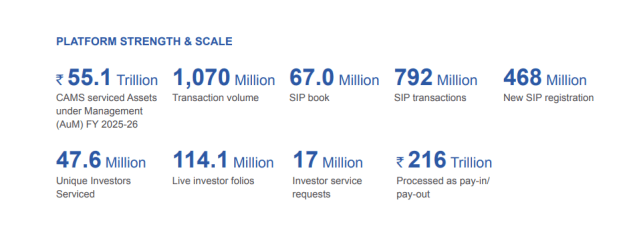
CAMS is India’s premier and fastest growing Qualified Registrar and Transfer Agent (QRTA) for Mutual Fund (MFs). The company’s annual report for FY26 states that its capabilities enable it to serve 10 of the 15 largest mutual funds, supporting 68% of average assets under management.
This gives it a dominant position as a registrar and transfer agent.
Source: Company Annual Report, FY26
On the financial front, EBITDA for Q1FY27 grew 18% YoY to Rs 1,830 m. This is a record number for the company. The net profits grew 17% YoY.
Moving ahead, the company has a principal approval to start a KRA operations from GIFT City. It’s in the process of applying for a payment service provider license.
The management says they’ve seen asset growth come back to a large extent in the previous and in the current quarter, yields have been stable, non-mutual fund growth is on track, and cost control measures are in place.
Conclusion
Monopoly stocks can be appealing, but investors need to exercise caution because having a monopoly doesn’t automatically equate to a sound investment.
Regulatory shifts, technological advancements, or emerging competitors can diminish their appeal.
Additionally, governments may impose price restrictions in some situations. It’s crucial to pinpoint authentic long-term advantages and purchase these businesses only at fair valuations rather than pursuing overpriced monopoly stocks.
Investors should evaluate the company’s fundamentals, corporate governance, and valuations of the stock as key factors when conducting due diligence before making investment decisions.
Happy investing.
Disclaimer: This article is for information purposes only. It is not a stock recommendation and should not be treated as such. Learn more about our recommendation services here…
The website managers, its employee(s), and contributors/writers/authors of articles have or may have an outstanding buy or sell position or holding in the securities, options on securities or other related investments of issuers and/or companies discussed therein. The content of the articles and the interpretation of data are solely the personal views of the contributors/ writers/authors. Investors must make their own investment decisions based on their specific objectives, resources and only after consulting such independent advisors as may be necessary