




Two Super Investors Go Shopping Where the Oil Shock Hit Hardest
When the Strait of Hormuz was shut earlier this year, most investors scrambled to work out what it meant for fuel prices. Few looked at the companies that turn crude oil’s leftovers into products factories cannot run without. Two of India’s best-known investors did.
The September 2026 shareholding filings, now landing on the BSE website, show Dolly Khanna back in Rain Industries with a 1.72% stake, three months after she slipped below the 1% disclosure line. Ramesh Damani, the veteran known for sitting tight on his picks, has raised his holding in Panama Petrochem to 1.22%, his second top-up in as many quarters.
Both companies make a living from what refineries and steel plants leave behind. Both have just reported their strongest quarters in years. And in both cases, a good chunk of the institutional money has been heading the other way. So, who is reading the oil shock correctly? A closer look at the data reveals the strategy.
#1 Rain Industries: Dolly Khanna’s Sell-High, Buy-Back-Bigger Trade
Incorporated in 1974 as Tadpatri Cements Limited, Rain Industries is today a global maker of calcined petroleum coke and coal tar pitch, the two carbon materials that go into the anodes used to smelt aluminium. It also runs a chemicals arm in Europe and a cement business in south India. The company has a current market cap of about Rs 7,332 cr.
Khanna is no stranger to this stock. She first bought it in 2017, built the stake past 2%, then trimmed it until her name faded from the filings. In the March 2026 quarter, she was back with 35,35,895 shares, or 1.05%, which we covered in May. The stock was then trading near Rs 126.
Then the stock took off. The June quarter filing showed her stake below 1%, and by mid-July the price had crossed Rs 200. Most read it as a quick profit booked and a door shut. The shareholding pattern filed with the BSE for the quarter ended September 2026 says otherwise. She now holds 1.72%, close to 58 lakh shares, worth roughly Rs 126 cr at current prices. That is about 64% more shares than her March position, and the extra shares came at a much higher price.
The Quarter That Rewrote the Numbers
So, what changed? Look at the quarter ended June 2026. Revenue rose 17.4% to Rs 5,167 cr. Net profit jumped about fourfold to Rs 341 cr from Rs 83 cr a year ago, and was more than double the Rs 158 cr earned in the March quarter.
The carbon business did the heavy lifting, with revenue up 17.9% to Rs 4,021 cr on better prices and higher volumes. Advanced materials, the European chemicals arm that had been a drag, grew 26.3% to Rs 1,198 cr. Higher selling prices, cheaper feedstock and a better product mix did the rest. Cement stayed weak.
| Calendar Year | CY20 | CY21 | CY22 | CY23 | CY24 | CY25 | 5Y CAGR |
| Sales (Rs cr) | 10,465 | 14,527 | 21,011 | 18,141 | 15,374 | 16,946 | 10% |
| EBITDA (Rs cr) | 1,677 | 2,360 | 3,537 | 933 | 1,274 | 2,137 | 5% |
| Net Profit (Rs cr) | 588 | 694 | 1,577 | -796 | -450 | 136 | -25% |
Rain follows a January to December financial year. EBITDA here is operating profit before other income.
The table explains why so few people wanted this stock a year ago. Sales grew at a modest 10% a year and EBITDA at just 5%. Losses in 2023 and 2024 pushed the five-year profit trend into the red, and 2025 only just scraped back to Rs 136 cr. Against that, the June quarter alone earned well over twice the profit of all of 2025.
Valuation Has Moved, but So Has the Profit
The share price of Rain Industries hit a 52-week low of Rs 100 in December 2025. As of 9th October 2026, it was trading around Rs 218, a jump of over 115% from that low, and some way off its 52-week high of Rs 252.
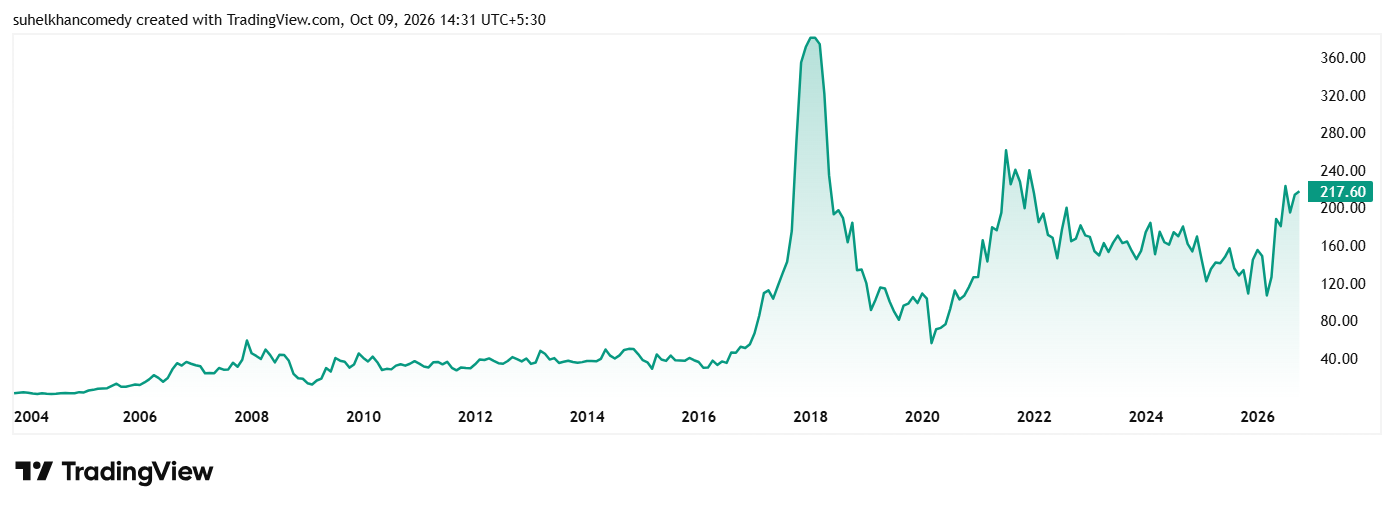
In May, the stock looked pricey at 100 times trailing profit, because that profit base was tiny. With the profit recovery, it now trades at about 14x trailing earnings, which is the same as the current industry median. The 10-year median PE for Rain is 9x, while the industry median for the same period is 13x. So, the stock is no longer the outlier it was, but it is still priced above its own long-run average.
The Other Side of Khanna’s Trade – Balance Sheet Risks
Domestic institutions held 5.2% of Rain in December 2025. By September 2026, that was down to 0.99%. ICICI Prudential’s schemes cut their stake from 4.07% to 1.47%. Foreign investors trimmed from 8.5% to 7.69%. Promoters have held steady at 41.35%.
The risks are real. Net debt stood at about $892 million at the end of June, or 2.77 times operating profit, and interest has eaten into earnings for years. Management sounded cautious about the September quarter, citing geopolitical tension, shipping trouble and costly raw materials. And if the oil-driven price spike fades, so could the margins.
#2 Panama Petrochem: Ramesh Damani’s Growing Bet
Incorporated in 1982, Panama Petrochem makes around 80 kinds of petroleum specialty products. Think white oils and liquid paraffin for cosmetics and medicines, transformer oils for the power grid, and ink and rubber process oils for printers and tyre makers. It also runs a subsidiary in the UAE, Panol Industries RMC FZE. The company has a current market cap of about Rs 3,250 cr.
Damani first showed up on the shareholder list in late 2022 and has held on through rallies and slumps since. His stake hovered between 1.0% and 1.2% through 2024 and 2025. Then he started adding again. Per the filings on BSE, his holding moved from 1.12% in March 2026 to 1.16% in June and 1.22% in September. At current prices, the stake is worth close to Rs 40 cr.
Rs 309 Cr in Three Months, Rs 213 Cr in a Year
For the quarter ended June 2026, revenue rose about 150% to Rs 1,735 cr from Rs 693 cr a year ago. Net profit jumped to Rs 309 cr from Rs 43 cr. For context, the company earned Rs 213 cr in the whole of FY26. Operating margin, which sat near 8% a year ago, came in at about 22%.
The timing matters. The quarter overlapped with the West Asia war and the closure of the Strait of Hormuz, which choked Gulf cargo flows and pushed up prices of petroleum-linked products. A company holding stock bought at old prices gains handsomely when selling prices jump. One market report on the results pointed to inventory timing gains and expected margins to normalise.
| Financial Year | FY21 | FY22 | FY23 | FY24 | FY25 | FY26 | 5Y CAGR |
| Sales (Rs cr) | 1,447 | 2,132 | 2,249 | 2,357 | 2,793 | 3,064 | 16% |
| EBITDA (Rs cr) | 190 | 296 | 309 | 254 | 247 | 276 | 8% |
| Net Profit (Rs cr) | 135 | 230 | 233 | 195 | 187 | 213 | 10% |
EBITDA here is operating profit before other income. The longer view is calmer. Sales have compounded at 16% a year over five years, but EBITDA has grown at only 8% and profit at 10%. Margins peaked near 14% in FY22 and FY23, then slid to about 9% in FY26. This is a steady, low-margin business that had an exceptional quarter, not one that has reinvented itself.
Cheap on Paper, but Which Earnings Do You Trust?
The share price of Panama Petrochem touched a 52-week low of Rs 229 in the past year. It hit a 52-week high of Rs 599.60 on 12th August 2026, the day the results came out. As of 9th October 2026, it was Rs 498.
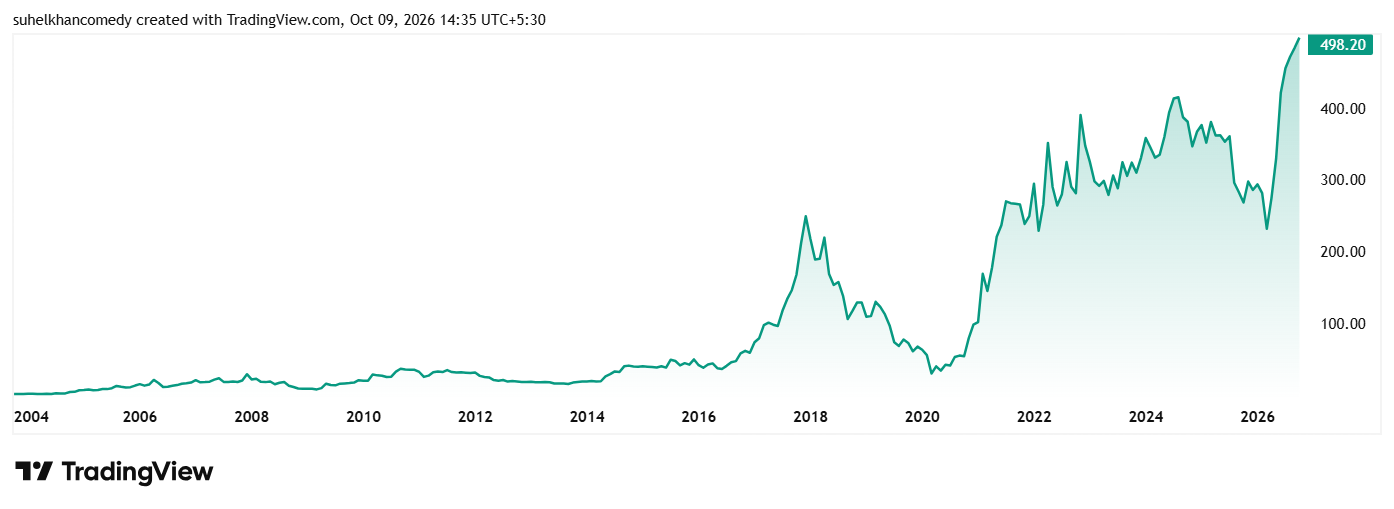
Because the June quarter is now part of trailing earnings, the stock trades at just under 7x trailing profit, compared with a current industry median of 10x. The 10-year median PE for the company is 11x, while the industry median for the same period is 14x. On FY26 earnings alone, the PE is about 15x. Which number you trust depends on how much of the windfall repeats.
Damani is not alone. Allstars Investments has lifted its stake from 1.14% in December 2025 to 3.19% in September 2026, while Abridge Investments cut from 3.20% to 1.53%. Promoters hold a steady 63.16%.
The balance sheet is a comfort. Borrowings were just Rs 33 cr at the end of FY25, and return on capital was about 20%. The company paid a dividend of Rs 3 per share for FY26. The risks are just as plain. Working capital days stood at about 100 in FY25, so cash gets tied up in stock and dues. And if input prices fall as fast as they rose, the same inventory effect that lifted the June quarter can work in reverse.
Same Shock, Two Different Bets
Both ace investors are buying businesses that profit when oil’s by-products get scarce and pricey, and neither is buying at the bottom. Khanna has bought back at around Rs 200 or more, in a stock she owned at about Rs 126 just months ago. Damani added after the stock had already run up.
Their bets differ in the details. Khanna’s Rain is a debt-heavy global player whose profit swings hard with the cycle, so her return looks like a wager that the recovery has legs. Damani’s Panama is a debt-light, family-run company that looks cheap only if this year’s windfall partly sticks. One carries balance-sheet risk. The other carries earnings risk.
The coming quarters will settle it. Rain’s September numbers will show whether the June spike was a turn or a blip, and Panama’s will show how much of its margin survives as Gulf trade routes reopen. Until then, a smart move would be to add these stocks to a watchlist and track them closely.
Disclaimer:
Note: We have relied on data from www.Screener.in and www.trendlyne.com throughout this article. Only in cases where the data was not available, have we used an alternate, but widely used and accepted source of information, including filings made available on the BSE website.
The purpose of this article is only to share interesting charts, data points and thought-provoking opinions. It is NOT a recommendation. If you wish to consider an investment, you are strongly advised to consult your advisor. This article is strictly for educative purposes only.
Suhel Khan has been a passionate follower of the markets for over a decade. During this period, He was an integral part of a leading Equity Research organisation based in Mumbai as the Head of Sales & Marketing. Presently, he is spending most of his time dissecting the investments and strategies of the Super Investors of India.
Disclosure: The writer and his dependents do not hold the stocks discussed in this article.
The website managers, its employee(s), and contributors/writers/authors of articles have or may have an outstanding buy or sell position or holding in the securities, options on securities or other related investments of issuers and/or companies discussed therein. The content of the articles and the interpretation of data are solely the personal views of the contributors/ writers/authors.