



The aircraft cockpit is no longer just a collection of instruments. It is becoming an electronics-intensive system built around displays, flight-management computers, navigation, communication, sensors, automatic flight controls, embedded computing and power-management systems. As per Fortune Business Insights, the global avionics market is estimated at $32.50 billion in 2026, up from $30.21 billion in 2025, and is projected to reach $70.67 billion by 2034 at a 10.2% Compound Annual Growth Rate (CAGR). Flight-deck and cockpit avionics accounted for 14.88% of the market in 2025, putting the segment at roughly $4.49 billion.
India is emerging as one of the faster-growing markets. The country’s avionics market was valued at $777.3 million in 2025 and is projected to reach $1.34 billion by 2030, implying an 11.5% CAGR. MarketsandMarkets‘ latest India study covers electronic flight displays, flight management, navigation, communication, power and data management and other avionics systems.
The headline avionics market size tells only part of the story for readers. What matters more is how effectively Indian electronics companies can convert this opportunity. Data Patterns and Centum Electronics offer two different ways to participate in this transition.
#1 Data Patterns Is Turning Avionics Into A Larger Defence-Electronics Platform
Data Patterns (India) Ltd is a defence and aerospace electronics company involved in the design, development and manufacture of electronic systems for applications including avionics, radar, fire-control systems, automatic test equipment and naval systems. Its aircraft electronics portfolio includes rugged multifunction displays and other avionics products for unmanned, manned and missile-related platforms.
Avionics Already Forms A Material Revenue Pool
Data Patterns’ Q1FY27 revenue from operations stood at ₹116 crore, up 16.8% year-on-year (YoY) but down 66.4% quarter-on-quarter (QoQ). Profit after tax (PAT) fell 13.5% YoY to ₹22.1 crore. The company attributed the quarterly volatility mainly to delays in customer approvals. Profitability was also affected by employee costs and repair and maintenance costs at facilities.
Avionics accounted for 41.3% of Q1FY27 revenue, making it the company’s largest disclosed product category. Radar contributed 27.8%, fire-control systems (FCS) 8.4%, annual maintenance contracts (AMC) 8%, automatic test equipment (ATE) 7%, naval systems 6.2% and services/others 1.3%. This puts Q1 avionics revenue at approximately ₹47.9 crore.
Its cockpit products include rugged multifunction displays ranging from 3-inch to 20-inch units and supporting interfaces and standards such as Aeronautical Radio, Inc. (ARINC) 429, ARINC 708, ARINC 818, MIL-1553B and Avionics Full-Duplex Switched Ethernet (AFDX). The company has disclosed Centre for Military Airworthiness and Certification (CEMILAC) and flight approvals for fighter, trainer and helicopter applications and Directorate General of Civil Aviation (DGCA) qualification for cockpit displays.
Since Data Patterns’ avionics category is much broader, the disclosed revenue number therefore establishes meaningful avionics exposure, but not the exact size of its cockpit business.
The Order Book Shows Where Future Avionics Revenue Could Come From
Data Patterns received ₹117.2 crore of orders during Q1FY27. The largest disclosed order was a ₹44.9 crore avionics development order from the Ministry of Defence, followed by an ₹18.6 crore avionics production order from the Defence Research and Development Organisation (DRDO).
The company’s reported order book stood at ₹927.7 crore as of 30 June 2026, broadly unchanged from ₹926.5 crore at FY26-end. AMC accounted for 31.9%, radar 30%, avionics 20.9%, electronic warfare (EW) 7.4%, services 4.7%, ATE 1.6%, FCS 1%, naval systems 0.03% and others 2.5%. Management also indicated a broader opportunity of ₹2,654 crore including negotiated orders and other opportunities, and expected another ₹2,000 crore of order inflow during FY27 apart from orders already received or negotiated.
The quality of this order book matters here. Development orders can take several years to progress through design, qualification and customer acceptance before serial production begins. The ₹18.6 crore production order therefore has a different revenue-conversion profile from the ₹44.9 crore development order.
Customers Give Visibility, But Also Create Concentration Risk
Q1FY27 revenue was distributed across DRDO at 26.7%, Hindustan Aeronautics Limited (HAL) at 22.1%, exports at 12.8%, BrahMos at 12.7%, Bharat Electronics Limited (BEL) at 7.5%, the Ministry of Defence at 1.9% and others at 16.3%. The international order book stood at ₹39 crore at June-end.
This customer mix gives Data Patterns access to some of India’s most important defence programmes, but programme schedules and approvals can materially influence quarterly revenue, as the Q1 decline despite a large order book shows.
Debt-Free Balance Sheet Supports Programme Investment
Data Patterns remained net debt-free at June-end. FY26 operating cash flow was ₹80.1 crore, compared with negative ₹89.9 crore in FY25.
The company had utilised ₹461.49 crore of its ₹487.74 crore qualified institutional placement (QIP) proceeds by 30 June 2026, including ₹142.59 crore of the ₹167.24 crore earmarked for product development and ₹13.63 crore of the ₹15.23 crore allocated to its electromagnetic interference-electromagnetic compatibility (EMI-EMC) testing facility.
The key point is that Data Patterns is funding capability expansion without carrying net debt.
STAC Acquisition Could Move The Company Up The Aircraft Value Chain
Data Patterns approved the acquisition of 100% of ST Advanced Composites Pvt Ltd for ₹10 crore during Q1FY27. STAC manufactures radio-frequency (RF)-transparent radomes and aerospace-grade composite structures.
The strategic significance goes beyond the acquisition value. The in-house radome and composite capabilities will reduce the need for external vendors and increase Data Patterns’ ability to bid for larger integrated radar and defense programs. That could gradually shift the company from supplying individual electronic boxes towards broader subsystem-level programmes.
The company subsequently received a ₹585.76 crore radar-electronics order from BEL on 21 August 2026, providing another large order addition after the June quarter.
Five-Year Financial Track Record Shows The Scale-Up
| Particulars | FY22 | FY23 | FY24 | FY25 | FY26 |
| Sales (₹ in crores) | 311 | 453 | 520 | 708 | 925 |
| Operating Profit (₹ in crores) | 141 | 172 | 222 | 275 | 374 |
| Net Profit (₹ in crores) | 94 | 124 | 182 | 222 | 271 |
Source: Screener.in
The five-year record shows strong earnings growth, but Q1FY27 highlights the need for caution around execution.
A Strong Stock Run Has Raised The Valuation Bar
Source: Screener.in
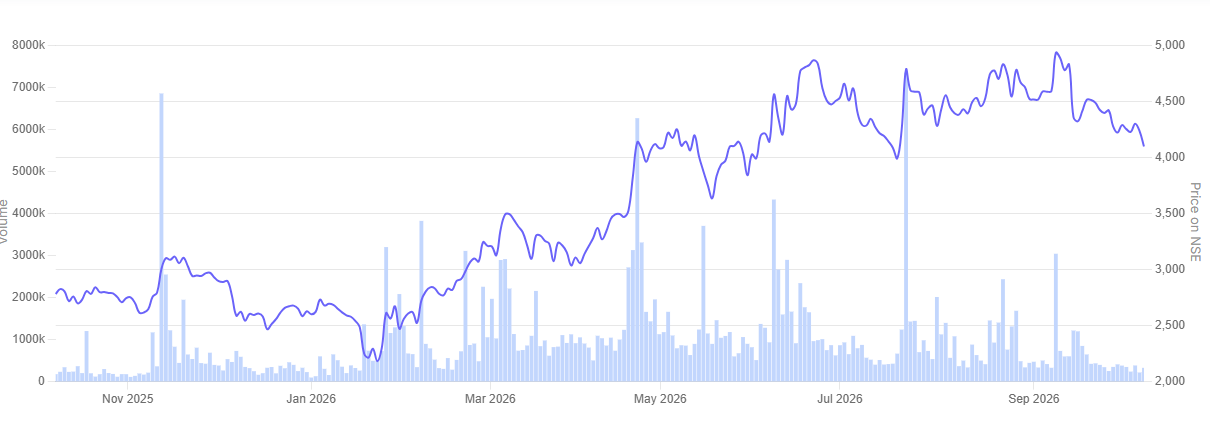
Data Patterns had delivered around 22% six-month returns and 46.5% one-year returns, although the stock had fallen more than 10% over the preceding month. The stock was trading at a price-to-earnings (PE) of about 85.8x.
On 8 October 2026, the stock price was ₹4,174.
Motilal Oswal, in its report dated 31 July 2026, has maintained a Neutral rating with a target price of ₹4,000. At the given closing price, the stock was trading roughly 4.2% above that target, meaning the brokerage’s published valuation did not imply further upside at that price.
This creates the key investment tension: Data Patterns has strong structural growth, a net debt-free balance sheet and substantial defence-electronics opportunities, but the valuation already discounts considerable future growth.
#2 Centum Electronics Is Building A Global Aerospace Electronics And EMS Franchise
Centum Electronics is an electronics system design and manufacturing company serving aerospace, defence, space and other high-reliability applications. Its aerospace portfolio spans embedded computers, actuator controllers, energy-management controllers, AC/DC converters, line-replaceable units (LRUs), data recorders, test equipment and complex electronic assemblies. The company says it participates in both development and production phases of global aerospace programmes.
Its Cockpit Exposure Runs Through More Than PCB Assembly
Centum’s aerospace references include commercial aircraft such as the A380, A350, A340, A330, A320neo and B787, along with military aircraft including Rafale, A400M, Mirage 2000, Jaguar and C-130, and helicopters such as the AW189 and Boeing Chinook.
The company has also been selected by Thales to manufacture selected printed circuit board (PCB) assemblies for flight-avionics systems used in commercial aircraft, extending a relationship that has already lasted more than a decade.
Centum’s aerospace opportunity is not limited to contract PCB assembly. Its capabilities extend into embedded computing, power electronics, controllers, LRUs and test systems. These products can carry more engineering content and potentially higher value per programme than conventional manufacturing work.
BTS Is The Margin Lever Readers Need To Watch
Centum reported standalone Q1FY27 operational revenue of ₹204.8 crore, up 10.7% YoY but down 40.5% QoQ. PAT from the standalone business declined 12.9% YoY to ₹13.5 crore.
Q1FY27 revenue comprised ₹56.6 crore from Build-to-Specification (BTS) and ₹148.2 crore from Electronics Manufacturing Services (EMS). EMS revenue increased 20% YoY, while the BTS order book grew 40% YoY.
Management has indicated benchmark margins of around 18–20%+ for BTS compared with roughly 9–10% for EMS. Therefore, the long-term earnings opportunity is not simply higher revenue; it is a gradual shift towards a greater share of higher-value, design-led BTS work.
The ₹1,797 Crore Order Book Needs To Be Read Through Its Mix
Centum ended Q1FY27 with a ₹1,797.2 crore standalone order book, 31% higher YoY. BTS order book increased 40% YoY. During the quarter, the company secured new business for complex aerospace and defence test systems and continued winning orders for complex payload electronics for an Indian Space Research Organisation (ISRO) programme.
A key programme is the ₹66 crore Phase-I HAL order for development of an active electronically scanned array (AESA) radar system for the Utility Helicopter-Maritime platform, with a potential Phase-II opportunity of around ₹500 crore over five years, subject to the subsequent serial-production order.
The ₹500 crore potential should therefore be treated as an opportunity rather than firm order-book revenue. The investment trigger will be the transition from development to serial production.
Global Revenue Diversifies The Customer Base
Centum’s Q1FY27 standalone revenue was geographically split: 46% India, 31% North America/Rest of World and 23% Europe & UK. Its order book was 54% India, 33% Europe & UK and 13% North America/Rest of World.
The company has relationships with Thales, HAL and global aerospace original equipment manufacturers (OEMs) and Tier-1 suppliers. It has also stated that it supplies electronics through Thales to the Rafale global programme and is evaluating opportunities in radar, electronic warfare and avionics for India’s Advanced Medium Combat Aircraft (AMCA) programme.
The overseas exposure reduces dependence on India’s defence procurement cycle, but adds currency, customer concentration and global aerospace-cycle risks.
The Balance Sheet Is Improving, But Debt Still Matters
Centum had standalone borrowings of ₹122 crore at FY26-end. It also had ₹20.07 crore of unutilised QIP proceeds at 30 June 2026, held through bank deposits, mutual funds and bank balances.
Unlike Data Patterns, Centum is therefore not a net-debt-free balance-sheet story. Readers should focus on whether higher BTS execution and operating cash generation can reduce financial leverage while funding the company’s planned capacity expansion.
Deconsolidation Has Completely Changed The Earnings Base
A major FY27 development was the deconsolidation of Centum T&S Group and certain French subsidiaries following a French court-approved transfer of substantially all operating businesses and employees to successful bidders on 4 June 2026. Centum lost control from that date and recorded a ₹94.3 crore profit on deconsolidation. This lifted consolidated Q1FY27 PAT to ₹105.5 crore despite continuing-operations PAT of only ₹11.2 crore.
This makes the reported consolidated PAT unsuitable as a simple indicator of recurring profitability.
Five-Year Numbers Reveal A Business Still In Transition
| Particulars | FY22 | FY23 | FY24 | FY25 | FY26 |
| Sales (₹ in crores) | 780 | 923 | 1,091 | 740 | 953 |
| Operating Profit (₹ in crores) | 70 | 76 | 86 | 99 | 135 |
| Net Profit (₹ in crores) | (53) | 7 | (3) | (2) | (52) |
Source: Screener.in
The table shows why Centum cannot be valued like a simple high-growth aerospace company. Revenue has recovered from FY25, operating profit has improved, but the historical net-profit record has been uneven, and the business structure has changed materially.
The Stock Price Now Depends On BTS Execution
Source: Screener.in
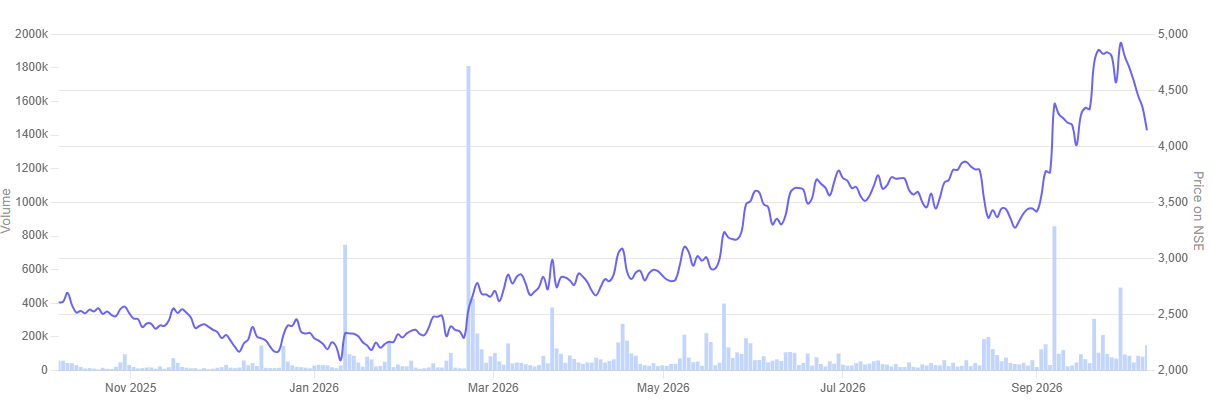
Centum had delivered around 50% six-month returns and 59% one-year returns, although the stock had declined about 5.4% over the preceding month. The stocks are trading at a PE of around 70.2x.
On 8 October 2026, Centum closed around ₹4,157.50.
ICICI Securities initiated coverage on 23 September 2026 with a Buy Rating and a Target Price of ₹5,900. At ₹4,157.50, that represented 42% potential upside to the brokerage’s target.
Why Qualification, Obsolescence and Thermal Limits Can Slow The Opportunity
Aircraft electronics operate under conditions that are very different from ordinary commercial electronics. As onboard processing density rises, heat generation becomes a major engineering constraint inside tightly packed LRUs. Suppliers must balance processor performance, power consumption, conduction cooling, enclosure design and component reliability rather than simply increasing computing capacity.
Component obsolescence is another structural challenge. Aircraft can remain operational for decades, while processors, field-programmable gate arrays (FPGAs), memories, displays and power semiconductors can have much shorter commercial lifecycles. A supplier may therefore have to redesign, retest and requalify electronics long after the original system has entered service. Data Patterns itself highlights maintainability and protection against component obsolescence in its product-development approach.
Qualification can therefore stretch the gap between engineering expenditure and revenue, leaving development orders earnings-light until production volumes accelerate.
Supply-chain localisation presents another challenge. Aerospace electronics require specialised processors, FPGAs, connectors, sensors, displays, power components and high-reliability PCBs. A component substitution is not equivalent to an ordinary commercial-electronics redesign because changing a qualified component can trigger additional validation and certification work. This can increase both engineering costs and programme timelines.
The Cockpit Trade: What Must Happen Before Readers Chase the Next Leg?
For readers, the next step is to build a trigger-based watchlist, rather than chase recent price momentum. For Data Patterns, watch whether newly won programmes move from engineering stages into repeat production, as this would provide stronger evidence of revenue visibility.
For Centum Electronics, monitor whether the growing BTS business actually lifts the company’s profit mix and cash generation, rather than relying on order-book growth alone. Readers should also examine quarterly revenue quality by separating one-off gains from continuing operations, particularly given the structural changes in Centum’s business. At current valuations, missing execution milestones could lead to sharper share-price reactions than they would at lower multiples.
A sensible approach is to compare each company’s quarterly progress against its own operating milestones, not against the other stock’s share-price performance. Fresh production wins, improving cash conversion and stronger recurring earnings should be treated as confirmation signals; delays in qualification, weaker execution or deteriorating cash generation should prompt readers to reassess the thesis.
It may be a good idea to add these stocks to your watchlist and keep track to see how they perform in time to come.
Disclaimer
Note: We have relied on data from www.Screener.in throughout this article. Only in cases where the data was not available, have we used an alternate, but widely used and accepted source of information.
The purpose of this article is only to share interesting charts, data points and thought-provoking opinions. It is NOT a recommendation. If you wish to consider an investment, you are strongly advised to consult your advisor. This article is strictly for educative purposes only.
Rishabh Sinha is a seasoned financial content creator with over 10 years of experience in BFSI domain. His portfolio spans over 20 of India’s most trusted financial brands. Rishabh brings depth, structure, and a reader-first approach to every piece he crafts.
Disclosure: The writer and his dependents do not hold the stocks discussed in this article.
The website managers, its employee(s), and contributors/writers/authors of articles have or may have an outstanding buy or sell position or holding in the securities, options on securities or other related investments of issuers and/or companies discussed therein. The content of the articles and the interpretation of data are solely the personal views of the contributors/ writers/authors. Investors must make their own investment decisions based on their specific objectives, resources and only after consulting such independent advisors as may be necessary.