



What if I told you there is a backdoor way to play India’s electric vehicle (EV) opportunity?
It is not an electric-vehicle manufacturer trading at a huge electric-vehicle multiple. It does not make batteries, motors or charging stations.
It makes bus bodies. And here is the interesting part: it is backed by Tata Motors. Better still, the business has already started showing the kind of operating leverage that can make a small industrial company interesting to the stock market. Revenue rose 41% in FY26, bus sales hit a record 9,328 units and return on capital employed (ROCE) rose to 30.84%.
The company is Automobile Corporation of Goa Ltd (ACGL).
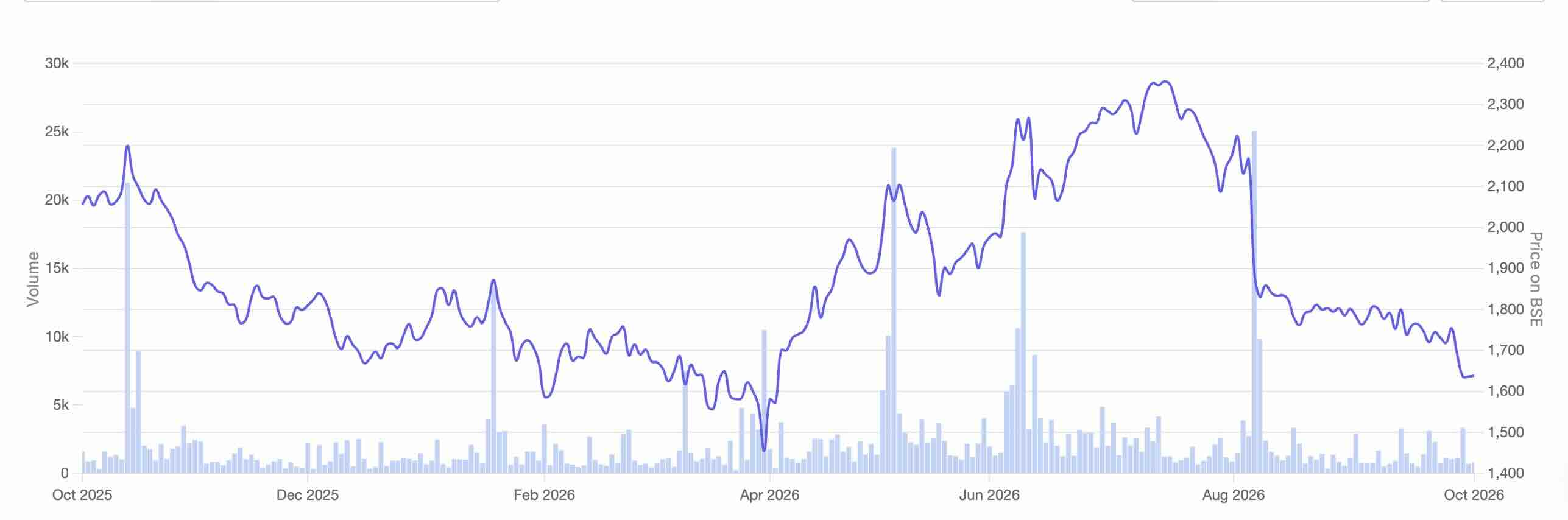
Automobile Corporation of Goa Ltd 1-Year Share Price Chart
Source: Screener.in
For investors, the attraction is not that ACGL is already an electric-vehicle company. It isn’t. The attraction is that an existing bus business, sitting inside the Tata ecosystem, could provide a relatively low-profile way of participating in the gradual shift towards electric buses.
That is the story. But to understand why the market may have another look at ACGL, it is worth going back to 2024.
The July 2024 Catalyst: A 77% Profit Jump and Margin Expansion
In July 2024, ACGL reported its June-quarter numbers and the stock suddenly became a market story. Revenue from operations rose 34.7% year-on-year to Rs 203.3 crore. Earnings before interest, taxes, depreciation and amortisation (EBITDA) rose 72%, while net profit jumped 77% to Rs 17.9 crore.
EBITDA margin expanded to 12.44% from 9.57% in the corresponding quarter. The stock responded by hitting a 20% upper circuit at Rs 2,861, surpassing its earlier high of Rs 2,540.
Why did investors get excited? Because there was more to the story than one good quarter.
Investors were not simply buying a small bus-body company. They were buying a simple operating equation: if Tata Motors sold more buses, ACGL could build more bus bodies; if ACGL’s factories ran at better utilisation, incremental revenue could translate into a faster rise in profits.
The market had spotted operating leverage.
Volume Meets Leverage: Breaking Down the FY26 Record Deliveries
This is where the ACGL story becomes more interesting. Bus sales were 6,511 units in FY24. They rose to 7,265 in FY25 and then jumped to 9,328 in FY26, the highest ever. Revenue moved from roughly Rs 584 crore to Rs 661 crore and then to Rs 934 crore.
The 2024 thesis eventually showed up in the numbers
| FY24 | FY25 | FY26 | |
| Revenue from operations | Rs 584 crore | Rs 661 crore | Rs 934 crore |
| Revenue growth | — | 13% | 41% |
| Bus sales | 6,511 | 7,265 | 9,328 |
| Operating profit | Rs 43 crore | Rs 52 crore | Rs 86 crore |
| Operating margin | 7% | 8% | 9% |
| Profit after tax | Rs 38 crore | Rs 47 crore | Rs 70 crore |
| ROCE | 19% | 20% | 30.84% |
| Borrowings | Rs 63 crore | Rs 86 crore | Rs 8.9 crore |
Source: Screener and Annual Report
Margins moved in the same direction. Operating margin was around 7% in FY24, about 8% in FY25 and around 9% in FY26. Profit after tax rose 49% in FY26 to Rs 70.07 crore. So the 2024 market excitement was not entirely a story built on hope.
The business actually delivered the volume growth and operating leverage that investors were beginning to price in. There is another detail worth noticing. Management says FY26 growth was helped by higher production volumes, improved efficiency and a favourable product mix, including higher-tonnage and institutional buses.
That matters because the next leg of growth need not come only from producing more buses. It can also come from producing more valuable buses.
Improving Economics via Higher-Tonnage Manufacturing
ACGL has increased its installed manufacturing capacity to around 1,200 buses a month. Management also says capacity utilization improved substantially in FY26 and that the company has strengthened its engineering and manufacturing capabilities for higher-tonnage vehicles and emerging electric mobility.
There is a useful way of looking at this. FY26 bus sales of 9,328 units are well below the annualised theoretical output implied by 1,200 buses a month. With installed capacity of around 1,200 buses a month, ACGL has room to increase volumes before another major capacity expansion becomes necessary, although actual output will depend on product mix, customer schedules and production constraints.
And management is trying to improve the economics of that capacity by moving towards higher-tonnage vehicles. The stated objective is to improve price realisation and operating leverage.
This is important for an investor. A company that merely grows volumes by 10% is one thing. A company that grows volumes while shifting towards higher-value products and using existing capacity more efficiently is another.
The EV Transition: Engineering the 13.5-Metre Electric Sleeper
This is where the story moves from an interesting bus manufacturer to something potentially more unusual. ACGL is developing electric bus bodies and has initiated development of a 13.5-metre electric sleeper bus. It is also working on electric vehicles and expanding its portfolio across school, staff and EV segments.
Management has identified government spending on infrastructure and electric mobility as an opportunity for commercial vehicles and mass-transportation solutions.
So there is a straightforward argument. India does not have to replace every conventional bus with an electric one for ACGL to benefit. Even a gradual increase in the share of electric buses can create an additional market for bus-body manufacturers that already have the engineering and manufacturing capabilities needed to participate.
And unlike a pure-play electric-vehicle stock, ACGL comes with an existing business. The bus business is the business. EV is the option.
What could drive ACGL’s next leg of growth?
| Business trigger | Current position |
| Tata Motors | Rs 818 crore of FY26 revenue, around 88% of total |
| Bus volumes | Record 9,328 buses in FY26 |
| Manufacturing capacity | Around 1,200 buses/month |
| Higher-tonnage buses | Focus area to improve price realisation and operating leverage |
| Electric buses | EV bus-body development underway; 13.5-metre electric sleeper being developed |
| Exports | 3,382 buses sold overseas in FY26 |
Source: ACGL FY26 Annual Report
That distinction is important because it changes how one can think about valuation. The investment case does not depend on ACGL suddenly becoming an electric-vehicle company. It depends on the existing business continuing to grow while the EV opportunity gets layered on top.
Balance Sheet Quality: Zero-Debt Ambitions and 30% ROCE
Growth is one thing. The quality of growth is another.
In FY26, ACGL’s borrowings fell from around Rs 85 crore to less than Rs 9 crore, and the debt-equity ratio declined from 0.34 to 0.03.
Working capital also improved. Inventory turnover increased from 12.56 times to 15.04 times, while trade-receivables turnover rose from 6.26 times to 9.44 times. Net capital turnover improved from 3.31 times to 4.16 times.
ROCE, meanwhile, rose from 18.52% to 30.84%. That combination is worth paying attention to.
ACGL did not produce FY26 growth by building a giant debt-funded balance sheet. In fact, the balance sheet became lighter even as profitability increased.
The next question is whether that return profile can hold. And that is where the neat ACGL story starts becoming less neat.
Risk Factor 1: The Q1 FY27 Margin Contraction
The first risk is also the simplest. FY26 was an exceptionally strong year.
The latest quarter gives investors a reason not to assume that every quarter from here will look like FY26. In Q1 FY27, sales were Rs 249 crore against Rs 256 crore a year earlier, while operating profit fell to about Rs 13 crore from Rs 28 crore. Operating margin consequently declined to around 5% from 11%. Net profit was about Rs 11 crore against Rs 23 crore in Q1 FY26.
One quarter does not establish a trend. But it does ask an important question: how much of the FY26 margin improvement was structural, and how much came from a particularly favourable combination of volumes, utilisation and product mix?
For the investment thesis to strengthen, investors will want to see margins recover alongside revenue growth rather than simply seeing bus volumes increase.
Risk Factor 2: Translating EV Prototypes into Order Books
There is another distinction that must be considered. ACGL is clearly investing in electric-bus capabilities. So there is a danger in getting carried away with the “backdoor EV play” label.
Today, an investor is buying a bus-body manufacturer with an EV opportunity, not an EV company with a bus-body opportunity. That is still interesting. But the eventual proof will have to come through actual electric-bus orders, volumes and revenue.
Risk Factor 3: The 88% Tata Motors Concentration Moat
Then there is the customer concentration. Tata Motors contributed Rs 817.8 crore of ACGL’s FY26 revenue of Rs 933.7 crore, which works out to roughly 88%. No other customer accounted for more than 10% of revenue.
This is both reassuring and uncomfortable. It is reassuring because ACGL has a major customer with which it has a long operating relationship. It is uncomfortable because a business deriving close to nine-tenths of its revenue from one customer does not have complete control over its growth trajectory.
The Tata relationship is therefore not simply a moat. It is also a concentration risk.
Risk Factor 4: Multinational Entry and Export Vulnerabilities
As electric buses become more important, multinational companies are entering the space and local bus-body manufacturers are partnering with foreign companies. That could increase competitive pressure, particularly in electric buses.
Exports add another variable. ACGL sold 3,382 buses internationally in FY26, and management has flagged geopolitical developments in the Middle East as a risk to exports, freight costs and commodity prices.
So the business has several growth levers. It also has several things that could pull in the opposite direction.
Valuation Check: Pricing in the New Normal at 16.5x Earnings
At around Rs 1,638, the stock trades at about 16.5 times earnings. It is trading well below its 52-week high of Rs 2,403. But a fall in the share price does not automatically make a stock cheap. The market has already seen the FY26 numbers. It knows that revenue can grow, that margins can improve and that ROCE can cross 30.84%.
What it does not yet know is whether those numbers represent the new normal. That is the real investment question.
The Final Verdict: Scaling Beyond a Tata Small-Cap Story
There are two very different ways the next few years could play out.
In one, ACGL continues to benefit from a healthy bus cycle, sells more higher-tonnage buses, gets more from its existing manufacturing capacity and maintains stronger margins than it did a few years ago. The electric-bus opportunity then starts becoming a meaningful additional growth engine.
In the other, bus volumes normalise, product mix becomes less favourable and margins move back towards earlier levels. In that case, the EV opportunity remains more of a promise than a profit driver, while Tata Motors continues to account for most of the business.
That is why ACGL is interesting now. The stock is no longer simply a story about a Tata-backed small-cap whose numbers suddenly surprised the market in 2024. The first part of that story has already played out.
The more interesting question is whether ACGL can do it again, but this time with electric buses as part of the next chapter. For investors looking at the stock, the numbers to watch are therefore quite simple: bus volumes, revenue per bus, operating margin, higher-tonnage mix, EV orders and the share of revenue coming from customers other than Tata Motors.
Because the real opportunity is not that a bus-body maker has discovered electric vehicles. It is that a company that already has the business, the Tata relationship and the manufacturing base may have found another market to grow into.
And that is a much more interesting proposition than simply buying an EV stock.
Disclaimer
Note: We have relied on data from www.Screener.in throughout this article. Only in cases where the data was not available, have we used an alternate, but widely used and accepted source of information.
The purpose of this article is only to share interesting charts, data points and thought-provoking opinions. It is NOT a recommendation. If you wish to consider an investment, you are strongly advised to consult your advisor. This article is strictly for educative purposes only.
Manvi Aggarwal has been tracking the stock markets for nearly two decades. She spent about eight years as a financial analyst at a value-style fund, managing money for international investors. That’s where she honed her expertise in deep-dive research, looking beyond the obvious to spot value where others didn’t. Now, she brings that same sharp eye to uncovering overlooked and misunderstood investment opportunities in Indian equities. As a columnist for LiveMint and Equitymaster, she breaks down complex financial trends into actionable insights for investors.
Disclosure: The writer and her dependents do not hold the stocks discussed in this article. The website managers, its employee(s) and contributors/writers/authors of articles have or may have an outstanding buy or sell position or holding in the securities, options on securities or other related investments of issuers and/or companies discussed therein. The content of the articles and the interpretation of data are solely the personal views of the contributors/ writers/authors. Investors must make their own investment decisions based on their specific objectives, resources and only after consulting such independent advisors as may be necessary.