



A large infrastructure project creates business well beyond the company building it. It needs equipment, components and a network of suppliers. For smaller businesses serving these needs, each project can open a new avenue for growth.
This article looks at four SME-listed companies linked to India’s capital expenditure and infrastructure cycle. The focus is on businesses combining strong three-year sales and profit growth with healthy returns on capital and low debt.
To find them, we screened SME companies with a market capitalisation above Rs 100 crore. Both the latest return on capital employed (ROCE) and its three-year average had to exceed 15%. Debt-to-equity had to be below 0.5, with positive cash flow from operations in the latest financial year.
We also required three-year sales and profit growth above 10%, operating profit margins above 10% and debtor days below 150. Promoter ownership had to exceed 30%, with no decline over the period measured by the screen and no pledged shares. Each company also needed more than 100 shareholders.
This left 46 companies. Of these, nine stood out for their links to infrastructure spending. We then selected four based on a combination of the highest three-year sales and profit compound annual growth rates (CAGRs).
Here is a closer look at these four businesses, what is driving their growth and the risks investors should watch.
#1 Neetu Yoshi: Riding Railway CapEx with Railway Casting
Incorporated in January 2020, Neetu Yoshi is engaged in manufacturing customized ferrous metallurgical products.
Neetu Yoshi’s three-year sales CAGR of 82% and profit CAGR of 291% place it among the infrastructure-linked SMEs selected through our screen. Its railway-component business provides exposure to spending on rolling stock. The company reported RoCE of 31.8%.
4-Year Profit and Sales Data of Neetu Yoshi
| Year | FY23 | FY24 | FY25 | FY26 | CAGR |
| Sales | 16 | 47 | 71 | 98 | 82% |
| Profit | 0 | 13 | 16 | 25 | 291% |
The small-cap company makes safety-critical castings and machined components for wagons, coaches and locomotives. Its investor presentation traces its shift from trading into manufacturing in 2023. Integrated casting and machining capabilities support its railway business. However, this transition also helps explain the sharp profit growth from a small base.
How Small-Cap Engineering Firms are Scaling Up
Expansion is the next driver. According to its disclosure to BSE, an IPO-funded plant in Bhagwanpur, Haridwar, is scheduled to begin commercial production on September 13, 2026. The facility is intended to strengthen execution capacity and meet railway and engineering demand.
The company’s FY26 annual report records an order book exceeding Rs 160 crore. Approvals from the Integral Coach Factory and Rail Coach Factory broaden its reach beyond wagon components. Converting these opportunities into deliveries will determine how quickly additional capacity contributes.
The annual report shows FY26 consolidated operating revenue rising 39.3% to Rs 98.3 crore. Net profit increased 52% to Rs 25 crore. Operating margins stood at 31%. The balance-sheet figures imply debt-to-equity of approximately 0.03 times. Its shareholding data show promoter ownership unchanged at 70.03% in June 2026.
The 291% annualised profit growth looks particularly high because the company earned very little profit in FY23, the starting year used for the calculation. Profits continued rising after its shift to manufacturing. However, FY26 operating cash flow was only Rs 4 crore against net profit of Rs 25 crore, according to its annual report. Debtor days of 118 also make collections a key monitor. SME lot sizes, potentially limited liquidity and half-yearly reporting warrant caution.
Neetu Yoshi Financial Performance
| Metric | FY26 |
| Revenue | Rs 98.35 crore |
| Revenue growth | 39.3% YoY |
| Net profit | Rs 25.01 crore |
| Profit growth | 52.0% YoY |
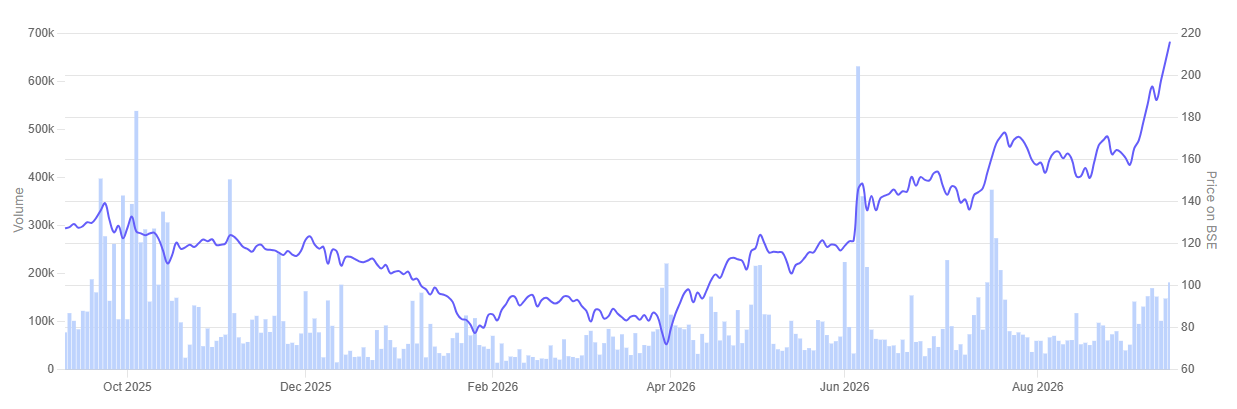
In the past year, the share price of Neetu Yoshi has rallied 69.7%
Neetu Yoshi 1-Year Share Price Chart
#2 Ganesh Green Bharat: Powering Solar & Water Infrastructure
Incorporated in 2016, Ganesh Green Bharat specializes in solar PV module manufacturing, solar systems and allied services, electrical contracting, and water supply scheme projects.
Ganesh Green Bharat’s three-year sales CAGR of 132% and profit CAGR of 110% secured its place among the selected infrastructure-linked SMEs. The small-cap company supplies solar modules and executes solar, electrical and water projects. These businesses connect its growth to renewable-energy and infrastructure spending.
4-Year Profit and Sales Data of Ganesh Green Bharat
| Year | FY23 | FY24 | FY25 | FY26 | CAGR |
| Sales | 85 | 166 | 311 | 1,065 | 132% |
| Profit | 8 | 14 | 30 | 75 | 110% |
Battery Storage and Solar Expansion Drive Order Pipeline
Its May 2026 investor presentation outlines plans to expand solar-module capacity from 1.1 GW to 2 GW by the end of 2027. Manufacturing generated more than 70% of FY26 business, management said in its earnings call. This supported higher sales, although manufacturing carried lower margins.
Battery storage adds another source of demand. The presentation lists Rs 2,212.91 crore of unexecuted orders, including a Rs 1,510 crore battery energy storage project. Management identified the storage work as an NTPC REL project covering approximately 1 GWh. It indicated a 12-month execution period in the May earnings call. Timely procurement and delivery will be central to converting this pipeline into revenue.
The company’s audited FY26 results show standalone net sales rising 240.9% to Rs 1,061.4 crore. Net profit increased 153.7% to Rs 75.1 crore. No exceptional or extraordinary items were reported. Operating margins were about 10%, down from 14% in FY25.
ROCE stood at 36.8% and debtor days at 25. Borrowings of roughly Rs 50 crore against equity and reserves of Rs 274 crore imply debt-to-equity of approximately 0.18 times. Promoter ownership remained unchanged at 73.42% in March 2026.
Sales and profits rose across successive years, but cash generation was weaker. The audited results show FY26 operating cash flow of Rs 13.29 crore, following an outflow of Rs 40.07 crore in FY25. Inventory and advances absorbed substantial cash. Falling margins and project execution therefore need monitoring. SME lot sizes, potentially limited liquidity and half-yearly reporting also warrant caution.
Ganesh Green Bharat Financial Performance
| Metric | FY26 |
| Net sales | Rs 1,061.37 crore |
| Sales growth | 240.9% YoY |
| Net profit | Rs 75.15 crore |
| Profit growth | 153.7% YoY |
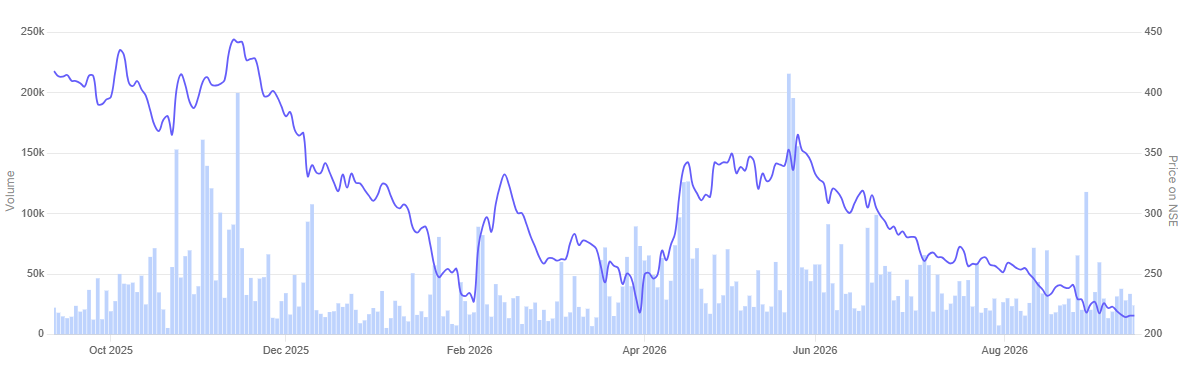
In the past year, the share price of Ganesh Green Bharat is down 48%.
Ganesh Green Bharat 1-Year Share Price Chart
#3 Apex Ecotech: Scaling Industrial Wastewater Treatment
Incorporated in 2009, Apex Ecotech specializes in turnkey water and wastewater treatment projects.
Apex Ecotech recorded three-year sales CAGR of 63% and profit CAGR of 69%. Growth continued across successive years, although a sharp increase in FY26 lifted the three-year figures. Project execution can make revenue uneven, while cash generation has lagged reported profits.
4-Year Profit and Sales Data of Apex Ecotech
| Year | FY23 | FY24 | FY25 | FY26 | CAGR |
| Sales | 35 | 53 | 71 | 149 | 63% |
| Profit | 4 | 7 | 9 | 17 | 69% |
We recently covered this stock in the four niche SME stocks with ROCE above 35% article. You will find a detailed analysis on the company’s performance there.
#4 Danish Power: Supplying Transformers for Renewable Energy
Founded in July 1985, Danish Power manufactures various types of transformers, including inverter duty transformers for use in renewable power projects such as solar power plants and wind farms.
Danish Power’s three-year sales CAGR of 40% and profit CAGR of 101% secured its place among the selected infrastructure-linked SMEs. The small-cap manufacturer supplies transformers for renewable-energy projects and power networks. Its growth is tied to investment in generation and transmission infrastructure.
4-Year Profit and Sales Data of Danish Power
| Year | FY23 | FY24 | FY25 | FY26 | CAGR |
| Sales | 188 | 332 | 425 | 521 | 40% |
| Profit | 9 | 38 | 58 | 70 | 101% |
Greenfield Capacity Additions and Export Horizons
Expansion is gathering pace. An NSE disclosure outlines a greenfield investment of Rs 150–200 crore. This would add 12,000–15,000 megavolt ampere (MVA) to existing annual capacity of approximately 11,000 MVA. Investment is planned over 18–24 months, funded through internal accruals and debt.
The company is also entering higher-voltage power transformers. In its May earnings call, management said prototype development and testing had begun for transformers up to 100 MVA and 245 kV. Customer approvals and performance validation remain essential. Meaningful revenue contributions were expected from FY28.
Exports provide another growth avenue. Management reported an FY26 export contribution of approximately 8–9%, with business across the Middle East, Europe, Africa and Australasia. Its confirmed order book exceeded Rs 500 crore at the time of the call.
The FY26 annual report shows standalone revenue rising 22.6% to Rs 520.9 crore. Net profit increased 20.4% to Rs 70 crore, using the restated FY25 comparison. Operating margins stood at 17%, ROCE at 23.8% and debtor days at 78. Borrowings of roughly Rs 2 crore imply debt-to-equity below 0.01 times. Promoter ownership edged up to 73.62% in March 2026.
The 101% profit CAGR includes a sharp earlier increase in margins. Recent growth has been slower, with lower finance costs and higher other income supporting FY26 earnings. Operating cash flow recovered to Rs 46.89 crore, following an FY25 outflow. Expansion execution and collections remain key monitors. SME lot sizes, potentially limited liquidity and half-yearly reporting also warrant caution.
Danish Power Financial Performance
| Metric | FY26 |
| Revenue | Rs 520.9 crore |
| Revenue growth | 22.6% YoY |
| Net profit | Rs 70. crore |
| Profit growth | 20.4% YoY |
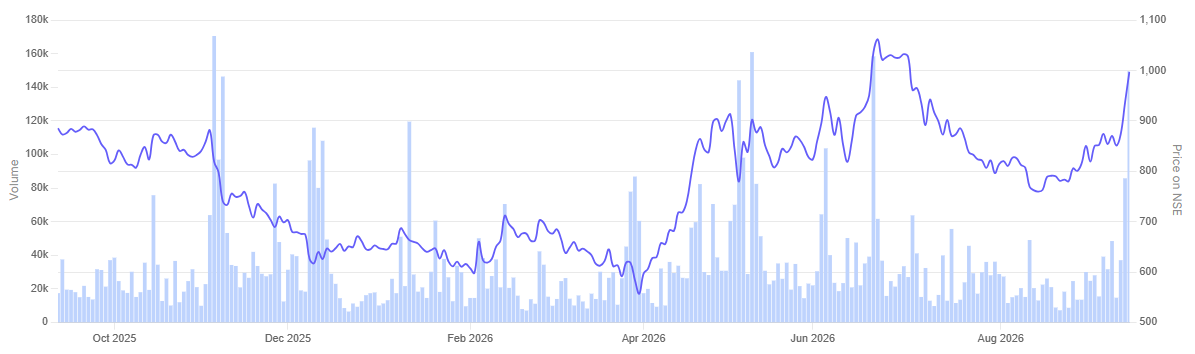
In the past year, the share price of Danish Power is up 12.2%.
Danish Power 1-Year Share Price Chart
Conclusion
These four SMEs show how infrastructure spending can translate into business growth across railway components, solar equipment, transformers and industrial water treatment. Their three-year sales and profit records explain their selection. Capacity additions and project orders provide further opportunities.
The next test is execution. New facilities must secure business, orders must turn into revenue, and reported profits must translate into cash. Small starting bases and earlier margin improvements have also lifted some growth rates. Investors should weigh these factors alongside valuations, customer concentration and the limited liquidity of SME stocks. Strong past growth is a starting point for closer study, rather than a guarantee of future returns.
Four Infrastructure-Linked SMEs: Growth and Operating Performance
| Metric | Neetu Yoshi | Ganesh Green Bharat | Apex Ecotech | Danish Power |
| Three-year sales CAGR | 82% | 132% | 63% | 40% |
| Three-year profit CAGR | 291% | 110% | 69% | 101% |
| FY26 operating margin | 31% | 10% | 15% | 17% |
| FY26 debtor days | 118 | 25 | 41 | 78 |
| FY26 operating cash flow (₹ cr) | 4.03 | 13.29 | 6.77 | 46.89 |
Neetu Yoshi figures are consolidated; the other companies’ figures are standalone. Neetu Yoshi’s profit CAGR reflects a very small FY23 starting profit.
You can track how these are progressing by adding stocks to your watchlist.
Disclaimer:
Note: We have relied on data from www.Screener.in throughout this article. Only in cases where the data was not available, have we used an alternate, but widely used and accepted source of information.
The purpose of this article is only to share interesting charts, data points and thought-provoking opinions. It is NOT a recommendation. If you wish to consider an investment, you are strongly advised to consult your advisor. This article is strictly for educative purposes only.
Ekta Sonecha Desai has a passion for writing and a deep interest in the equity markets. Combined with an analytical approach, she likes to deep dive into the world of companies, studying their performance, and uncovering insights that bring value to her readers.
Disclosure: The writer and her dependents do not hold the stocks discussed in this article.
The website managers, its employee(s), and contributors/writers/authors of articles have or may have an outstanding buy or sell position or holding in the securities, options on securities or other related investments of issuers and/or companies discussed therein. The content of the articles and the interpretation of data are solely the personal views of the contributors/ writers/authors. Investors must make their own investment decisions based on their specific objectives, resources and only after consulting such independent advisors as may be necessary.