



For most businesses, selling a product means the transaction ends when the product leaves the factory. Msafe Equipments is trying to build a different kind of business around a rather unglamorous product: the temporary structures used at construction sites to help workers reach and work safely at different heights.
The company manufactures and sells aluminium and mild steel (MS) scaffolding, besides renting out these structures to construction, infrastructure and industrial customers. The rental model changes the economics because the same equipment can generate revenue through multiple rental cycles instead of being sold only once.
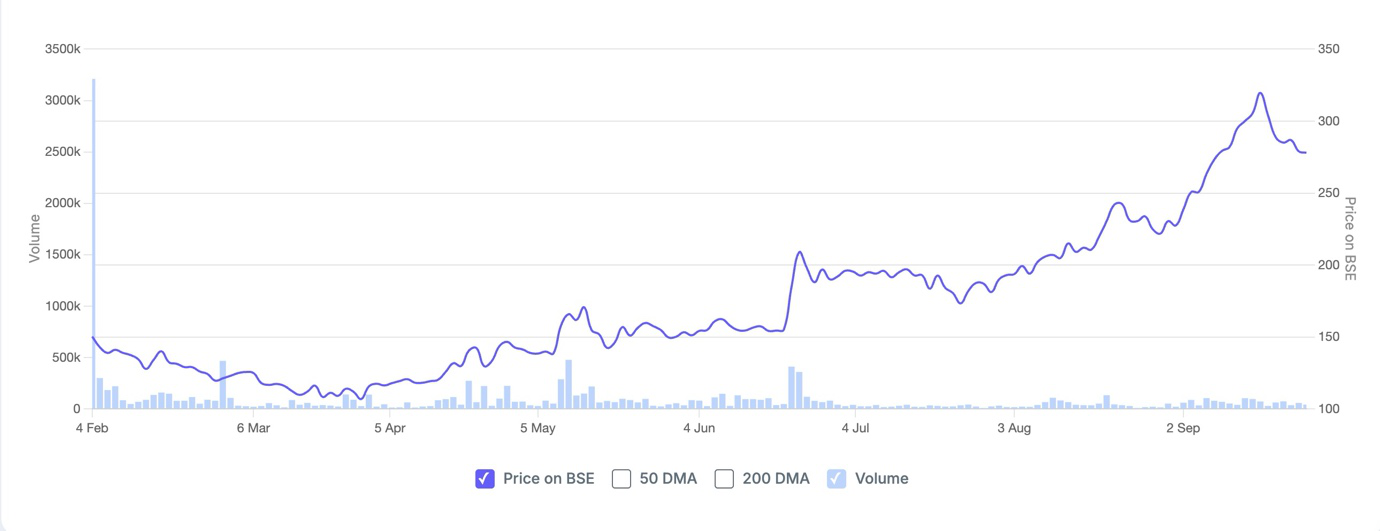
Msafe Equipments 1-Year Share Price Chart
That model is now becoming a much bigger part of the business. Rental contributed 46% of revenue in Q1 FY27, while revenue grew 40% year-on-year and the operating margin remained close to 40%.
The company is now trying to take this model to the next level by adding manufacturing capacity, expanding its rental asset base and entering aluminium formwork. The opportunity is sizeable, but so is the capital required, making cash generation an important part of the story as the company expands.
From selling scaffolding to renting it
The attraction of the rental model is fairly simple. When equipment is sold, the company gets revenue from one transaction. When it is rented, the same asset can potentially generate revenue through several rental cycles, provided it remains in demand and is properly utilised.
This is particularly relevant in scaffolding, where construction and industrial projects require equipment for specific periods rather than necessarily requiring customers to own it. Msafe operates an asset-backed rental model alongside its manufacturing and sales operations, giving it two ways of monetising the same product portfolio.
Rental business delivers stronger margins
| Business segment | EBITDA margin |
| Aluminium scaffolding rental | 47% |
| MS scaffolding rental | 47% |
| Aluminium scaffolding sales | 38% |
| MS scaffolding sales | 10% |
The rental opportunity is also significant within the broader market. Industry data cited by the company estimates India’s aluminium scaffolding market at Rs 1,298 crore in 2024, rising to Rs 2,334 crore by 2030, implying a projected CAGR of about 10.27%. Rental accounted for 59.2% of the market in 2024 and is expected to reach 60.1% by 2030.
The steel scaffolding market is considerably larger. It was estimated at Rs 4,621 crore in 2024 and is projected to reach Rs 8,270 crore by 2030, with rental again accounting for the larger portion of the market.
Msafe is already seeing the benefit of pushing harder into rentals. Management said MS rental revenue grew seven times year-on-year in Q1 FY27, while aluminium rental revenue grew 24%. Rental contributed 46% of the company’s revenue in the quarter, leaving sales with the remaining 54%.
The economics of the two models also explain why management wants rental to become a larger part of the business. Management puts EBITDA margins at around 47% for both aluminium and MS rental, compared with 38% for aluminium sales and about 10% for MS scaffolding sales.
The company also says rental yields are attractive, ranging from 30-60% depending on the equipment. Aluminium rental yields are estimated at 60-66% a year, while MS rental yields are around 32-38% a year.
The numbers, however, should not be read as a guarantee that a higher rental mix will automatically lift overall margins. Management expects rental to grow faster, but has indicated that its contribution to the overall mix could initially increase by only 1-2%, limiting the immediate impact on margins.
Revenue growth and margins
The first-quarter numbers support the strategy. Revenue from operations rose 39.92% year-on-year to Rs 31.79 crore in Q1 FY27 from Rs 22.72 crore a year earlier, while profit before tax increased 46.32% to Rs 9.73 crore from Rs 6.65 crore.
Net profit rose 44.25% to Rs 7.27 crore from Rs 5.04 crore. Operating profit stood at Rs 12.62 crore, giving the company an operating margin of 39.70%, compared with 38.64% in Q1 FY26.
The margin profile is important because the company’s rental operations carry higher margins than some of its sales businesses. At the same time, management does not expect overall margins to rise sharply simply because rental becomes a larger part of the business, given the cost pressures and the need to balance rental and sales.
The company’s stated approach is therefore to maintain broadly similar margins while growing the business. The bigger question is whether it can maintain those margins as new capacity comes on stream and formwork becomes a larger part of the business.
Capacity is the immediate constraint
The problem Msafe is trying to solve now is capacity. Management said its existing capacity is almost fully utilised, which is why the company added MS scaffolding capacity through temporary rented premises instead of waiting for its new owned facility.
The company is developing an integrated manufacturing facility at Kosi Kotwan near Mathura, with operations targeted for May 2027. The facility is expected to provide 90 lakh kg of annual scaffolding capacity, while the company has already added 30 lakh kg through rented premises.
Management expects the expansion to nearly double overall manufacturing capacity. Existing capacity utilisation is already above 80%, according to the company, leaving relatively little room to grow without adding assets.
There is an important point here, however. Commissioning the factory does not mean that the additional capacity will immediately be fully utilised, and management has said that reaching the targeted business level could take another six months after the facility becomes operational.
The company may also continue operating from the rented premises alongside the new factory, depending on demand and operating efficiency at that point. In other words, May 2027 is the start of the new capacity rather than the point at which its entire earnings potential suddenly appears.
Formwork could broaden the opportunity
The more ambitious part of Msafe’s expansion is aluminium formwork, a system of reusable aluminium panels used to cast the walls, slabs, columns and beams of a building. Unlike scaffolding, which provides workers with a temporary platform, formwork helps create the building’s concrete structure itself.
The system is suited to high-rise and mass-housing projects where similar sections are built repeatedly. The panels can then be removed and reused, helping speed up construction.
The company is targeting 500 tonnes per annum of capacity, with production expected to begin around December 2026. The timeline has been delayed because of machine deliveries, with four machines received and five still to arrive, but management continues to target Rs 30-40 crore of formwork business in FY27.
Management has also indicated that it may undertake some trading at lower margins initially. The business requires more capital than scaffolding, while initial trials could put some pressure on margins, although management expects margins to become broadly similar to aluminium scaffolding over time.
Balance sheet needs watching
The expansion is also putting pressure on the balance sheet. Borrowings rose to Rs 39 crore in FY26 from Rs 33 crore a year earlier, while the debt-to-equity ratio was around 0.39 and interest coverage about 10.7 times.
More importantly, inventory days rose from 179 days in FY25 to 379 days in FY26, while the cash conversion cycle increased from 134 days to 395 days. Cash from operating activities was Rs 12 crore, against Rs 63 crore of cash used in investing activities, leaving free cash flow at negative Rs 9 crore.
With the company simultaneously adding rental assets, building capacity and entering formwork, working capital and cash generation will be important metrics to watch as the business expands.
Returns remain strong
The company currently has strong return ratios, with ROCE at 37.2% and ROE at 39.5%, while three-year ROE stands at 49.3%.
The key will be whether these returns can be sustained as more capital is deployed. Faster capacity utilisation would support returns, while slower ramp-up could put pressure on them.
What management expects in FY27
Management remains committed to the 50% compound annual growth rate (CAGR) objective associated with its IPO. It said it expects to achieve at least Rs 150 crore of revenue in FY27 and will try to reach Rs 175 crore.
Capacity expansion sets up the next phase of growth
| Expansion initiative | Capacity / investment | Timeline / target |
| MS scaffolding | 30 lakh kg added through rented facilities | Operational |
| Integrated manufacturing facility | 90 lakh kg annually | May 2027 |
| Aluminium formwork | 500 tonnes annually | December 2026 |
| Specialised rental equipment | 748 tonnes | Rs 6 crore capex |
| FY27 revenue target | Rs 150 crore minimum | Rs 175 crore being pursued |
Management also continues to target Rs 30-40 crore of formwork business in FY27, with the 500-tonne capacity expected to start around December 2026. The larger integrated facility is targeted to become operational by May 2027.
The expansion will require substantial capital. The company has earmarked Rs 6 crore to add 748 tonnes of specialised rental equipment, while management said it spent around Rs 7.88 crore on scaffolding capex in Q1 and expects quarterly spending to remain at or above this level.
It also indicated another Rs 3-4 crore of investment in scaffolding assets in the following quarter and around Rs 1 crore of additional machinery investment for aluminium scaffolding. The key is whether these investments translate into revenue and cash generation quickly enough.
Competitive advantage is not just manufacturing
Msafe’s model combines manufacturing with rental, which management sees as an advantage over companies focused on only one of the two. The company also has 21 warehouses across India and says it can deliver products within 24 hours.
Management said it can now take orders of around Rs 5 crore and is receiving large orders from public sector undertakings, including orders of more than Rs 1 crore. Aluminium and MS scaffolding, formwork and ladders are also offered under one umbrella.
There are limits to this advantage. Msafe currently procures the extrusion used in its aluminium products rather than manufacturing it, although management has said an extrusion plant could be considered once the formwork business is established.
That would require further capital, adding to the investment already needed for the company’s expansion.
Valuation
At Rs 279, Msafe trades at about 21.3 times earnings, with a market capitalisation of about Rs 569 crore. The stock’s 52-week high is Rs 329, while its 52-week low is Rs 102.
The valuation needs to be viewed alongside the growth expectations already built into the business. The company is targeting rapid revenue growth, but investors will also need to track utilisation, margins, working capital and cash generation as the expansion progresses.
Why the SME tag adds another risk
There is also a structural risk that comes with the company’s listing on the BSE SME platform. Smaller companies can have lower trading liquidity and greater price volatility, which can make entering or exiting a position more difficult than in a larger listed company.
That matters in Msafe’s case because promoter ownership stood at 73.23% at the end of June 2026, while public ownership was 17.02%. The number of shareholders was 1,014, compared with 556 at the end of March 2026.
For an SME company pursuing rapid expansion, there is another consideration. The business can change significantly over a few years, but so can the amount of capital required to support that change. That makes working capital, debt, cash generation and return on incremental capital particularly important metrics to follow.
The real test is cash, not just growth
Msafe is no longer simply a small scaffolding manufacturer trying to sell more products. It is attempting to build a rental-led access-solutions business in which the same assets can generate revenue repeatedly, while manufacturing capacity and new products such as aluminium formwork widen the opportunity.
The first-quarter numbers show that the rental strategy is gaining traction. Revenue grew 39.92%, rental contributed 46% of revenue and the operating margin remained close to 40%.
But the next phase will be harder. The company is investing heavily, inventory days have risen sharply, the cash conversion cycle has lengthened and formwork will require more capital than the existing scaffolding business.
The central question is therefore not simply whether Msafe can grow quickly. Management has already set an ambitious growth objective. The more important question is whether the company can convert that growth into cash while maintaining its margins and returns as the business moves from a small scaffolding operation towards a larger, rental-led platform.
Disclaimer:
Note: We have relied on data from www.Screener.in throughout this article. Only in cases where the data was not available, have we used an alternate, but widely used and accepted source of information.
The purpose of this article is only to share interesting charts, data points and thought-provoking opinions. It is NOT a recommendation. If you wish to consider an investment, you are strongly advised to consult your advisor. This article is strictly for educative purposes only.
Manvi Aggarwal has been tracking the stock markets for nearly two decades. She spent about eight years as a financial analyst at a value-style fund, managing money for international investors. That’s where she honed her expertise in deep-dive research, looking beyond the obvious to spot value where others didn’t. Now, she brings that same sharp eye to uncovering overlooked and misunderstood investment opportunities in Indian equities. As a columnist for LiveMint and Equitymaster, she breaks down complex financial trends into actionable insights for investors.
Disclosure: The writer and her dependents do not hold the stocks discussed in this article. The website managers, its employee(s) and contributors/writers/authors of articles have or may have an outstanding buy or sell position or holding in the securities, options on securities or other related investments of issuers and/or companies discussed therein. The content of the articles and the interpretation of data are solely the personal views of the contributors/ writers/authors. Investors must make their own investment decisions based on their specific objectives, resources and only after consulting such independent advisors as may be necessary.