




Artificial intelligence and cloud adoption are becoming increasingly important parts of enterprise technology spending. Businesses are investing in generative AI, analytics, automation and cloud infrastructure to improve efficiency and build new digital capabilities.
The opportunity is not limited to large technology companies. Smaller listed firms are also participating in this shift through AI-led solutions, analytics projects, cloud services and the digital infrastructure needed to support enterprise AI adoption.
However, exposure to a fast-growing theme alone does not make a strong investment case. Financial quality remains equally important, particularly in the SME segment.
We therefore screened SME companies for return on capital employed (ROCE) above 15%, three-year average ROCE above 15%, debt-to-equity below 0.5 and positive operating cash flow. The screen also required three-year sales and profit growth above 10%, operating margins above 10%, promoter holding above 30% with no decline, zero promoter pledging and debtor days below 150 days.
From this universe, three companies stand out with profit CAGR above 30% and ROCE above 30%, while also having exposure to the AI and cloud ecosystem.
Importantly, these are not pure-play AI companies. They also do not separately disclose how much revenue comes specifically from AI. Their exposure comes through AI-enabled solutions, analytics, generative AI capabilities and cloud infrastructure.
Let’s take a closer look at these three companies and how they are positioned within the AI and cloud ecosystem.
#1 Systango Technologies: AI and Cloud Push Expands Digital Engineering Opportunity
Incorporated in 2007, Systango Technologies deals in supplying software and development services.
The company’s June 2026 investor presentation highlights its strategic alliance with Alibaba Cloud to accelerate AI-driven cloud adoption. Systango also works with Google Cloud and has specialisations in Generative AI services and cloud infrastructure. Its GenAI Studio is designed to take enterprise AI use cases from initial assessment to production planning within a 12–16 week cycle.
The FY26 annual report shows that its AI capabilities extend beyond consulting. The company has developed an AI Workbench, an AI governance layer and production-grade solutions around AI agents, intelligent document processing and decentralised AI. Its cloud practice covers cloud-native architecture, infrastructure-as-code and site reliability engineering across AWS, Azure and Google Cloud.
The opportunity is therefore tied to enterprises moving from cloud adoption towards AI-enabled workloads and applications. However, Systango does not separately disclose revenue generated from AI or cloud, so it should not be viewed as a pure-play AI company.
To know more about Systango’s financial performance, promoter holding and investment case, read our earlier article on promoters raising stakes in low-debt SME stocks.
#2 Sahana System: AI-Led Projects Backed by 39.8% ROCE
Incorporated in 2012, Sahana System is in the business of IT services, digital marketing, software development, and trading of computer hardware.
AI Deployments Support the Growth Story
Three-year sales and profit CAGRs of 139% and 122%, respectively, support its inclusion among our selected SMEs. ROCE stands at 39.8%.
The company’s FY26 annual report shows that its AI exposure is backed by actual deployments. It has developed an AI-based battlefield simulation and decision-support system using computer vision and geospatial analytics. It has also delivered an AI-driven research analysis platform for surveys, analytics and dynamic reporting. Its wider portfolio includes AI/ML solutions, computer vision, AI dashboards and cloud computing.
Global Expansion Accompanies Strong Financial Growth
Sahana plans to deepen its domestic and international presence through regional delivery hubs, strategic alliances and new verticals. It is also investing in AI-led platforms for healthcare analytics, surveillance, education and financial risk assessment. Its wholly owned foreign subsidiary, Sahana System Inc, was incorporated in February 2026, although it had yet to commence operations at FY26-end.
FY26 consolidated operating revenue rose 97.8% YoY to Rs 331.2 crore. Net profit increased 90.7% YoY to Rs 74.8 crore. Operating margins stood at around 30%, while debt-to-equity was about 0.07. Debtor days were 106, and operating cash flow stood at about Rs 41.2 crore.
Promoter holding stood at 57.31% in August 2026, with no pledged shares. However, the top ten customers accounted for about 88% of FY26 revenue, creating concentration risk. The company also does not separately disclose revenue from AI, so it should not be viewed as a pure-play AI stock.
Investors should also account for SME trading lots and potentially limited liquidity. NSE filings show that the company reports on a half-yearly basis, leaving longer gaps between financial updates.
Sahana System Financial Performance
| Metric | FY26 |
| Revenue | Rs 331.2 crore |
| Revenue growth | 97.8% YoY |
| Net profit | Rs 74.8 crore |
| Profit growth | 90.7% YoY |
Source: Sahana System’s FY26 annual report
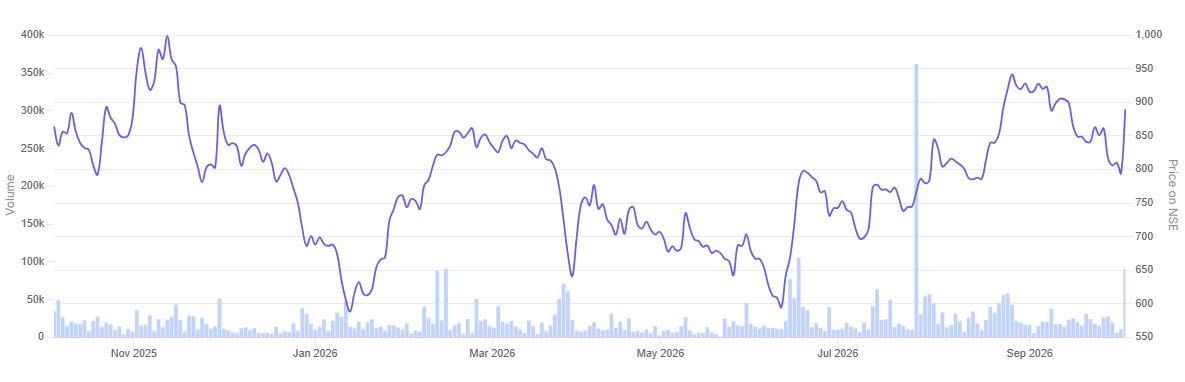
In the past year, the share price of Sahana System is down 2.3%.
Sahana System 1-Year Share Price Chart
Source: Screener.in
#3 Workmates Core2Cloud Solution
Founded in 2018, Workmates Core2Cloud Solution, is an AWS premier consulting partner known for scalable and innovative cloud solutions across India.
Recurring Cloud Base Creates Room for AI Upselling
Three-year sales and profit CAGRs of 71% and 103%, respectively, support its inclusion among our selected SMEs. ROCE stands at 37.2%.
The company’s September 2026 investor presentation places AI Acceleration & Managed AI alongside cloud migration, FinOps, cybersecurity and managed data services. Its model is built around converting cloud projects into recurring relationships. Cloud, cybersecurity and GenAI upselling are expected to deepen customer wallet share.
The AI push has also moved into deployment. Workmates says six AI assets across IT operations and business applications are already in live production. These cover incident automation, AI-led cloud cost optimisation, compliance, customer interactions and process automation.
Recurring Revenue and Overseas Expansion Add Visibility
According to its FY26 annual report, recurring business accounted for 82.5% of revenue, while customer retention stood at 95%. Monthly recurring revenue increased to Rs 13.25 crore entering FY27, providing visibility before fresh bookings and AI-led upselling.
The September investor presentation also says the company has restarted expansion plans for the US and UK. A US office is being established to support global customer billing, while its Singapore go-to-market strategy is being recalibrated.
FY26 consolidated revenue rose 33.6% YoY to Rs 143.8 crore, while net profit increased 13.8% to Rs 15.9 crore, according to the FY26 annual report. Operating margins stood at around 16%, while debt-to-equity was zero. Promoter holding stood at 72.03%, while debtor days were 74.
However, profit growth lagged revenue growth in FY26 and margins moderated as the company invested in talent and new capabilities. It also does not separately disclose revenue from AI. SME trading lots, potentially lower liquidity and half-yearly financial reporting add another layer of risk.
Workmates Core2Cloud Solution Financial Performance
| Metric | FY26 |
| Revenue | Rs 143.8 crore |
| Revenue growth | 33.6% YoY |
| Net profit | Rs 15.9 crore |
| Profit growth | 13.8% YoY |
Source: Workmates Core2Cloud Solution FY26 annual report
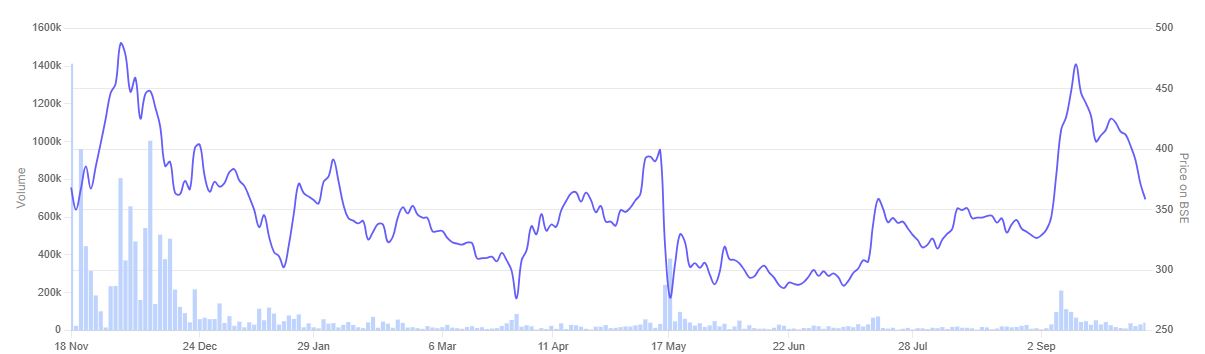
In the past year, the share price of Workmates Core2Cloud is down 3.6%.
Workmates Core2Clouds 1-Year Share Price Chart
Source: Screener.in
Conclusion
The three companies show how the AI opportunity is extending beyond pure-play technology names. Their exposure comes through different parts of the ecosystem — from AI-led software and analytics to cloud infrastructure, managed services and enterprise deployment.
Financially, all three combine this thematic exposure with strong historical growth and healthy capital efficiency. However, investors should avoid treating AI exposure alone as an investment thesis. None of the companies separately discloses how much revenue comes specifically from AI, and their businesses remain diversified across broader technology services.
Execution will therefore matter. The key question is whether rising AI and cloud adoption translates into sustained client wins, recurring revenue and healthy margins over time.
Investors should also keep the usual SME risks in mind, including lower liquidity, larger price swings and longer gaps between financial updates. Strong past growth does not guarantee similar returns ahead.
Three Quality SMEs Riding the AI & Cloud Boom: Growth and Operating Performance
| Metric | Systango Technologies | Sahana System | Workmates Core2Cloud Solution |
| Three-year sales CAGR | 20% | 139% | 71% |
| Three-year profit CAGR | 32% | 122% | 103% |
| ROCE | 33% | 39.8% | 37.2% |
| FY26 operating margin | 38% | 30% | 16% |
| FY26 debtor days | 48 | 106 | 74 |
| FY26 operating cash flow (Rs crore) | 33.77 | 41.21 | 0.39* |
Sources: Screener data for growth, ROCE, operating margins and debtor days; FY26 annual reports of Systango Technologies, Sahana System and Workmates Core2Cloud Solution for operating cash flow.
You can track how these are progressing by adding stocks to your watchlist.
Disclaimer
Note: We have relied on data from www.Screener.in throughout this article. Only in cases where the data was not available, have we used an alternate, but widely used and accepted source of information.
The purpose of this article is only to share interesting charts, data points and thought-provoking opinions. It is NOT a recommendation. If you wish to consider an investment, you are strongly advised to consult your advisor. This article is strictly for educative purposes only.
Ekta Sonecha Desai has a passion for writing and a deep interest in the equity markets. Combined with an analytical approach, she likes to deep dive into the world of companies, studying their performance, and uncovering insights that bring value to her readers.
Disclosure: The writer and her dependents do not hold the stocks discussed in this article.
The website managers, its employee(s), and contributors/writers/authors of articles have or may have an outstanding buy or sell position or holding in the securities, options on securities or other related investments of issuers and/or companies discussed therein. The content of the articles and the interpretation of data are solely the personal views of the contributors/ writers/authors. Investors must make their own investment decisions based on their specific objectives, resources and only after consulting such independent advisors as may be necessary.