




A stock that is trading near its 52-week low generally means that the stock has been under consistent selling pressure. But a weak stock price doesn’t always mean a weak business.
Sometimes the market price will fall even if the business is still growing steadily and has healthy fundamentals.
If a company continues to grow sales and profits, earns healthy returns on the capital it employs, and has manageable debt, a weak stock price can create an interesting contrast between business performance and market sentiment.
And this is what makes fundamentally strong stocks trading near their 52-week lows worth a closer look.
We have three such stocks that are trading near their 52-week lows, have market capitalisation of more than Rs 1,000 crore, consistently deliver strong sales and profit growth over multiple years, and consistently generate healthy returns on equity (ROE) and capital employed (ROCE). We have also screened the stocks for low debt levels and no pledged promoter shares.
Let’s dig in to understand what actually made these stocks fall and whether the business is genuinely strong or not.
#1 Indian Energy Exchange: Business Remains Strong, But Market Coupling Overhang Persists
Indian Energy Exchange (IEX) offers an automated platform for trading electricity, renewable energy, and energy certificates, holding a market share of around 85%. The exchange, which began operations in 2008 and is regulated by the Central Electricity Regulatory Commission (CERC), has built an ecosystem of more than 9,100 registered participants, including over 120 distribution utilities, over 1,100 conventional generators, and more than 5,000 commercial and industrial consumers.
Why Has The IEX Stock Fallen?
The biggest concern around IEX is the proposed market coupling and its possible impact on the company’s market share, and margins. CERC has proposed a system where power exchanges would use a common price-discovery mechanism, with Grid India proposed as the market-coupling operator. IEX has challenged the process and continues to pursue the matter through regulatory and legal channels.
For IEX, the concern is straightforward, and that is, if market coupling shifts some trading volumes from IEX to rival exchanges, the company could lose part of its market share in the Day-Ahead Market. Since transaction volumes are an important driver of IEX’s revenue, a sustained loss of share could also affect margins, and therefore earnings growth.
This uncertainty around a possible change to the market structure, rather than a sharp deterioration in the company’s financial performance, has been the key overhang on the stock.
Earnings Continue To Hold Up
Even though the stock price has declined, the financials have not, reflecting the strong fundamentals. During FY26, revenue of the exchange surged 13.6% YoY to Rs 747 crore, while profit after tax (PAT) rose 14.9% YoY to Rs 492.9 crore. Electricity traded volumes increased 17% YoY to 141 billion units.
The momentum continued into the April-June quarter of FY27, with profit increasing by 12% YoY to Rs 135 crore, while revenue rose to Rs 156 crore from Rs 140 crore, growing at 11% YoY.
New Markets Could Broaden The Growth Story
IEX is also working on ways to reduce its dependence on the traditional Day-Ahead Market (the segment covered by the market coupling proposal). It has sought approval for new products such as Green RTM (Real Time Market), peak-DAM and peak-RTM. The company also wants to extend the Term-Ahead Market contract period from three months to 11 months.
The company believes this diversification will help it retain a significant market share even if coupling is implemented and limit the impact on its overall business.
The proposed Indian Coal Exchange could open another growth avenue. IEX estimates that the market could have an opportunity of around 100 million tonnes in the first year. Furthermore, all existing e-auction platforms and marketplaces will cease to operate within 6 months after the first coal exchange becomes operational.
Its other exchange, the International Gas Exchange (IGX), is already headed for an IPO. As part of this, IEX will be selling a part of its stake in line with regulatory guidelines. A successful IPO could turn in a significant payday for IEX.
Valuation: Cheap Enough To Ignore The Risks?
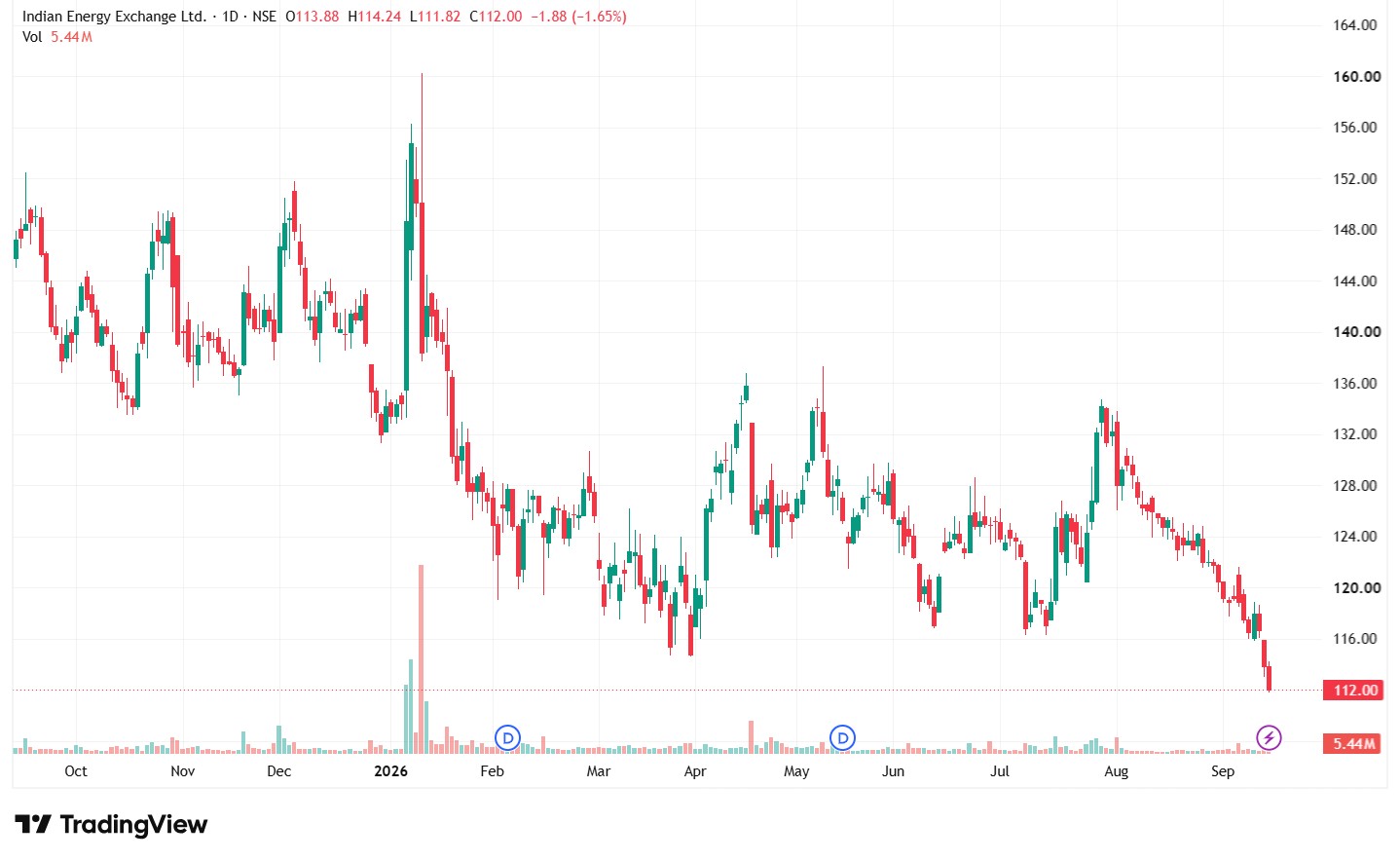
The stock closed at Rs 112 on NSE as of 15 September 2026, while its 52-week low is Rs 111.82. At this price, the stock was trading at price/earnings (PE) ratio of 20.84x, below the industry median of 48.8x, suggesting the stock could be relatively cheaper than its peers.
However, its price/earnings to growth (PEG) ratio was 1.06x, higher than the industry median of 0.5x, indicating that the stock might not be undervalued if adjusted for growth.
1-Year Share Price Chart of IEX Ltd.
#2 Jeena Sikho Lifecare: Stock Near 52-Week Low Despite Strong Growth
Jeena Sikho Lifecare Ltd. is an integrated Ayurveda healthcare company with hospitals, clinics, day-care centres, and Ayurvedic products. It had around 2,400 operational beds and 58 hospitals across 23 states as of Q1FY27.
Why Has The Jeena Sikho Stock Fallen?
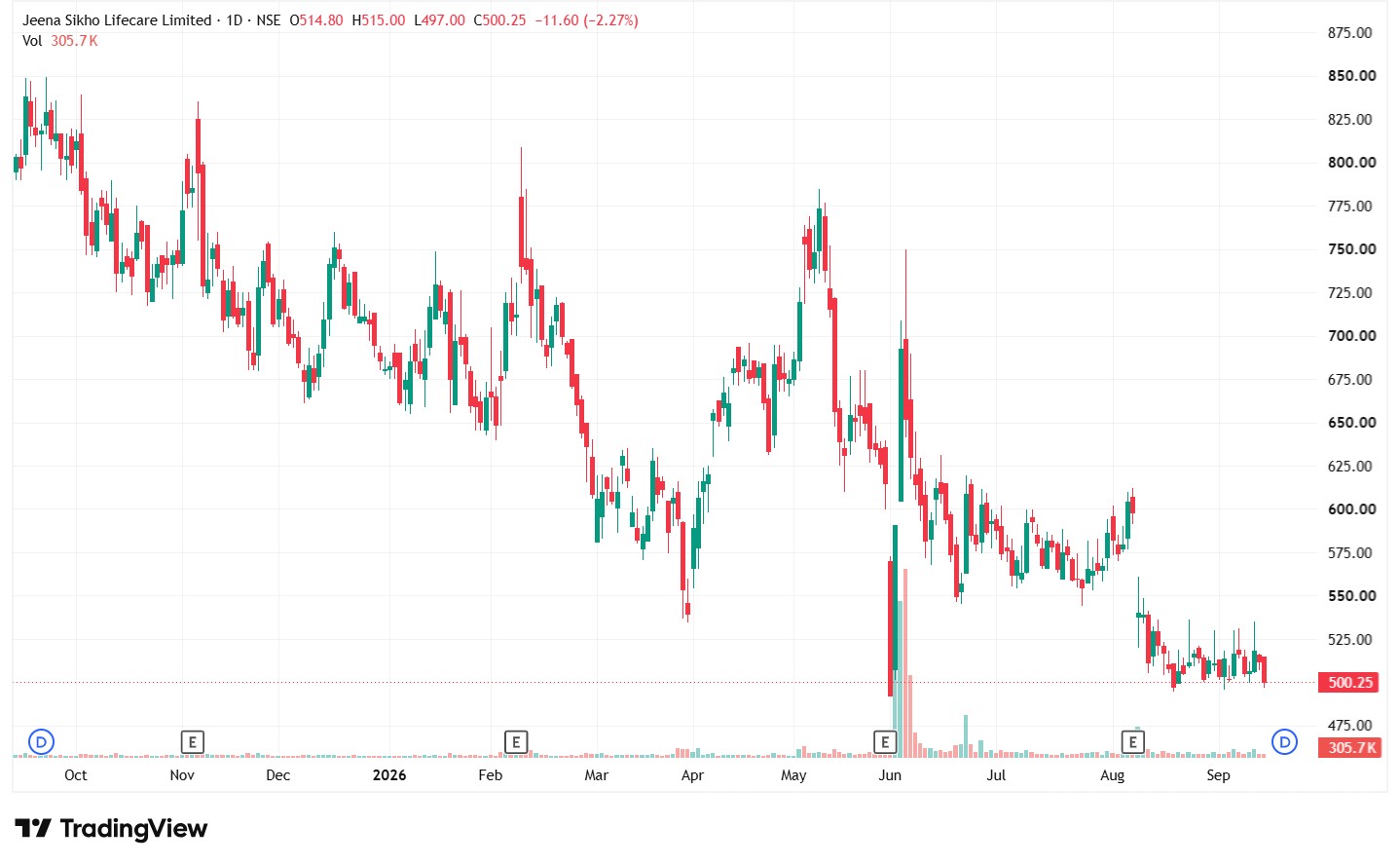
The stock has fallen over 37% in the past year, and it is perhaps due to investors’ sentiments around how quickly the company can translate its expansion into sustained earnings growth.
The company added 573 beds in 2025, another 700 beds in 2026, and has 450 in the pipeline as of August 2026.
The number of beds grew by 43.8% between FY25 and FY26; however, the average revenue per bed grew only 1.2% from Rs 8,200 in FY25 to Rs 8,300 in FY26.
In Q1FY27, government business fell to Rs 5 crore from Rs 15 crore. However, the management said the move was intentional to make the business model more cash-rich.
Another near-term factor was higher advertising expenditure. Jeena Sikho spent an additional Rs 4 crore on advertising during the quarter, with management saying the benefits of its six-month Colors TV campaign would be visible in subsequent quarters.
The overall operating expenses also increased 38% YoY from Rs 77.2 crore in Q1FY26 to Rs 106.6 crore in Q1FY27. This could be another reason weighing on the stock price.
There is also a valuation question after the stock’s sharp run-up from its listing levels. The stock gained close to 350% since listing, and thus investors booking profits could be another reason behind the stock falling to its 52-week low.
Numbers Tell A Different Story
Even though the stock price fell and operating expenses surged; the underlying financial performance remained strong. During FY26, revenue increased to Rs 801.35 crore from Rs 469.07 crore in FY25, while profit nearly tripled to Rs 222.18 crore from Rs 79.94 crore. Even earnings before interest, tax, depreciation and amortisation (EBITDA) margin improved sharply to 44% from 30% during the period.
The quarter ended on June 30, 2026, added to that picture with revenue surging 29% YoY to Rs 224 crore, while profit rose 28% to Rs 65.7 crore.
Panchakarma revenue grew 13%, supported by a 33% increase in inpatient volumes, while day-care volumes rose 31% to 19,419 patients a day.
The company also has a three-year average ROCE of 46%, supported by its capital-light business model.
Expansion Is The Bigger Bet
Management is targeting 7,000-10,000 beds over the next three to five years and has set a Rs 3,000 crore revenue ambition.
The company is also expanding its product portfolio, including two new Ayurvedic products launched in September.
Valuation: Has The Fall Made It Attractive?
The stock closed at Rs 500.25 as on September 15, against a 52-week low of Rs 492, and at this price level, the stock was trading at a PE of 26.4x, at par with the industry median. Even its PEG ratio was at 0.3x, at par with the peers.
1-Year Share Price Chart of Jeena Sikho Lifecare Ltd.
#3 RailTel Corporation Of India: Order Book Holds Up, But Earnings Need To Catch Up
RailTel Corporation of India Ltd. is a Navratna PSU under the Ministry of Railways and one of the largest neutral telecom infrastructure providers across the country. Its business spans telecom services, IT and ICT projects, railway signalling, data centres, cloud services and digital solutions. The company operates a pan-India optical fibre network of more than 63,000 route km.
Why Has The RailTel Stock Fallen?
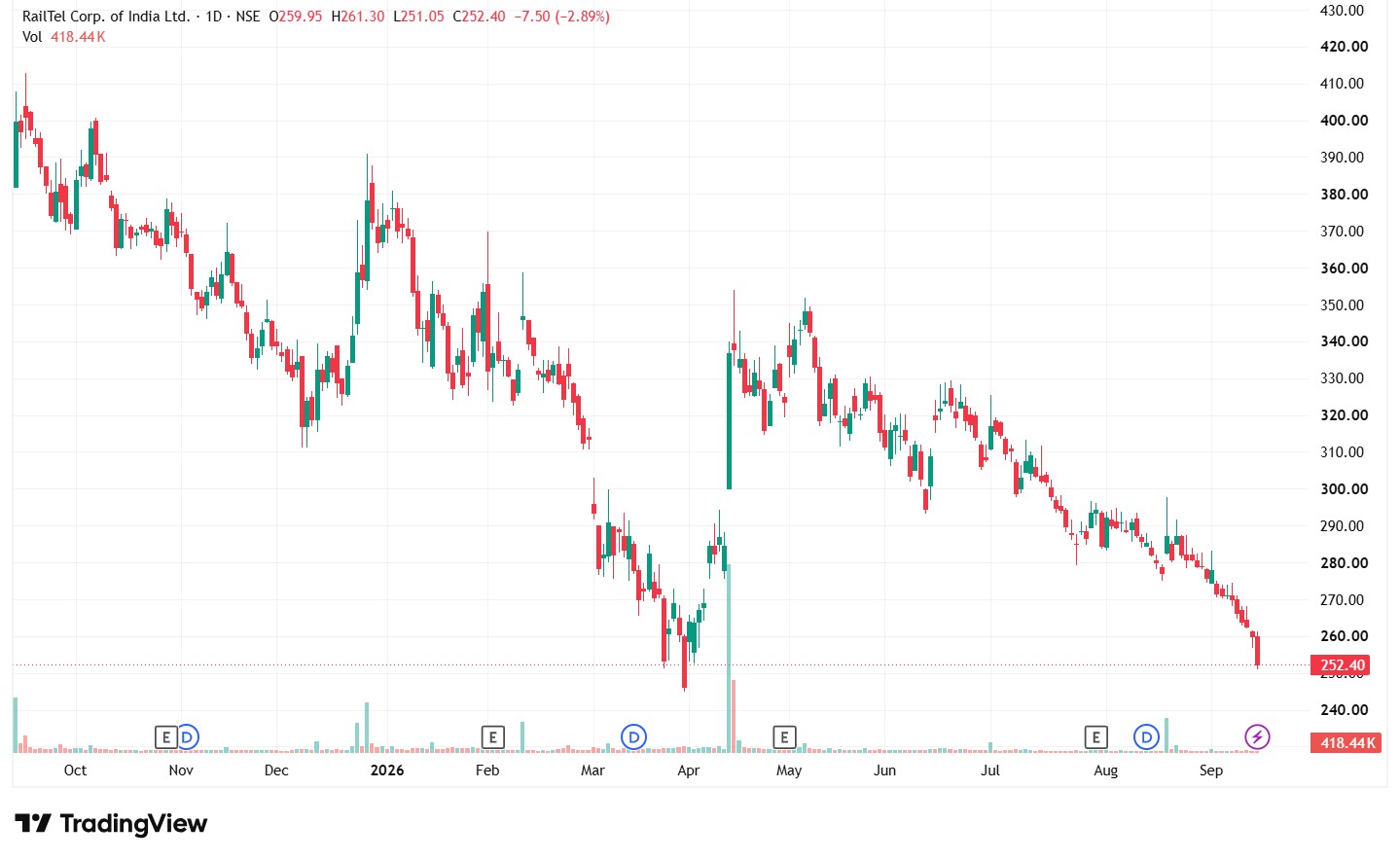
The stock has fallen nearly 37% in the past year to its current price of Rs 252.4 per share, even as the business continues to win large contracts.
The management identified project execution, cost and time overruns, and working-capital management as areas that are perhaps affecting the financial performance, as the revenue growth of the company is yet to be translated into similar profit growth.
During the April-June quarter, revenue of the firm rose 20% YoY to Rs 893 crore, but the bottom line was almost flat at Rs 65.8 crore against Rs 66.1 crore a year earlier. Furthermore, the profit declined significantly sequentially from Rs 142 crore in Q4FY26, which perhaps weighed more on investors’ sentiment.
Fresh Orders Keep The Pipeline Healthy
The company entered FY27 with a sizeable project pipeline. The order book stood at Rs 11,747 crore as of June 30, 2026, while orders received during Q1FY27 were Rs 1,688 crore.
RailTel received 11 fresh orders worth about Rs 735 crore during July and August 2026, spread across railways, telecom, cloud, cybersecurity and government projects, offering revenue visibility over multiple upcoming quarters.
| Date | Client | Order value | Execution Deadline |
| July 2 | Haryana State Electronics Development Corporation | Rs 16.20 Cr | Dec. 31, 2027 |
| July 9 | IT & Electronics Department, Uttar Pradesh | Rs 18.54 Cr | Nov. 17, 2027 |
| July 23 | North Central Railway | Rs 32.75 Cr | Jan. 23, 2028 |
| July 28 | Odisha Police | Rs 43.90 Cr | Aug. 30, 2029 |
| July 30 | IRCTC | Rs 33.79 Cr | Sept. 30, 2029 |
| Aug 6 | North Western Railway | Rs 37.67 Cr | Aug. 6, 2027 |
| Aug 10 | Department of Posts | Rs 119.19 Cr | Sept. 21, 2026 |
| Aug 12 | Deendayal Port Authority | Rs 63.00 Cr | Aug. 16, 2031 |
| Aug 17 | EPFO | Rs 166.80 Cr | Feb. 9, 2027 |
| Aug 19 | Western Coalfields | Rs 164.79 Cr | Sept. 20, 2031 |
| Aug 26 | Cotton Corporation of India | Rs 38.59 Cr | Oct. 14, 2032 |
| Total | 11 orders (July and August 2026) | Rs 735.21 Cr |
Source: Company Filings
Data Centres And Kavach Add To The Opportunity
RailTel is investing around Rs 241 crore in FY27 in network expansion, data centres and technology upgrades. Its upcoming 10-megawatt Noida data centre is progressing, and the management expects this to be operational by May 2027.
The company is also executing Kavach-related projects covering more than 2,000 route km and expects further opportunities as Indian Railways expands the safety system.
Valuation: Still at a Premium?
RailTel closed at Rs 252.40 on September 15, close to its 52-week low of Rs 245. The stock was trading at a PE of 21.9x, while the industry median stood at 15.2x, and the PEG ratio was at 0.9x, at par with the industry median, indicating that the stock might be relatively expensive even if adjusted for growth.
1-Year Share Price Chart of Railtel Corporation of India Ltd.
The Real Question: Are These Falls Opportunities?
These three stocks reflect why a falling share price should not be viewed in isolation, as these businesses continued to report healthy business growth even as their shares trade close to 52-week lows. However, each has a different concern, whether it is regulatory uncertainty or the challenge of turning rapid expansion into sustained growth or profit conversion and project execution.
That makes the investment case more nuanced. A 52-week low may offer a better entry price, but it does not automatically make a stock a bargain. Thus, investors need to weigh the strength of the underlying business against the risks that pushed sentiment lower and, importantly, whether the current valuation offers enough comfort for those risks; to do the same, one needs to add these stocks to your watchlist.
Disclaimer
We have relied on data from www.Screener.in throughout this article. Only in cases where the data was not available have we used an alternate, but widely used and accepted source of information.
The purpose of this article is only to share interesting charts, data points, and thought-provoking opinions. It is NOT a recommendation. If you wish to consider an investment, you are strongly advised to consult your advisor. This article is strictly for educational purposes only.
Maumita Mitra is a seasoned writer specializing in demystifying the world of investment for a broad audience. She has a keen eye for detail and a knack for explaining complex financial concepts in the simplest manner possible.
Disclosure: The writer and her dependents do not hold the stocks discussed in this article.
The website managers, its employee(s), and contributors/writers/authors of articles have or may have an outstanding buy or sell position or holding in the securities, options on securities, or other related investments of issuers and/or companies discussed therein. The content of the articles and the interpretation of data are solely the personal views of the contributors/ writers/authors. Investors must make their own investment decisions based on their specific objectives and resources, and only after consulting such independent advisors as may be necessary.