


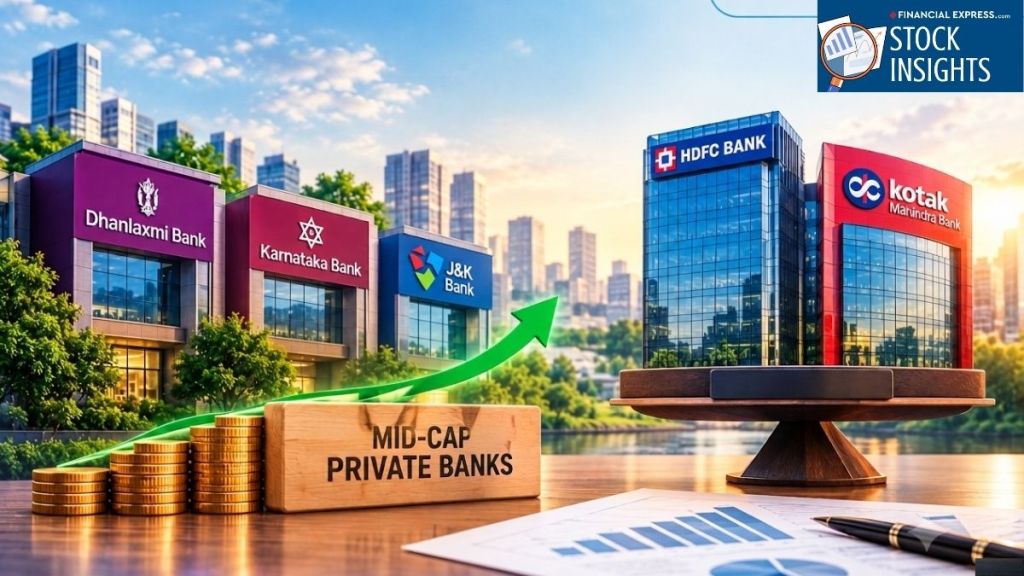

It’s not just large private sector banks, which have reported strong growth in the key operational parameter – loan growth y-o-y in the September 2026 quarter.
Mid-cap private banks, which often do not get much attention from the media, have also reported strong provisional numbers for the quarter (view table below). Mid-cap banks often operate in certain states / regions and with a strong emphasis on lending high margin gold loans, SME and retail loans.
Defying the Monsoon Slump: The Mid-Cap Credit Strategy
The above strategy has helped mid-cap private banks to grow their loan books by more 20% y-o-y in the second quarter of FY27, which is often described as the “slack” season for credit, given that it is the monsoon season across most parts of the country and business activity is often sluggish.
And this year the monsoon was broadly deficient in the country with states like Maharashtra and Karnataka declaring drought in several districts / talukas. The above lending strategy has broadly helped mid-cap private banks in earlier quarters to offset the ‘soft’ interest environment followed by RBI for several quarters.
However, it needs to be recognized that the loan books of mid-cap private banks is a small fraction of larger peers, Kotak Mahindra Bank and HDFC Bank.
In addition, mid-cap private banks also trade at valuations much lower than Kotak Mahindra Bank and HDFC Bank, on the preferred valuation matrix – price-to – (standalone) book value (view table below).
Here are our findings on the provisional performance of mid-cap banks.
Dhanlaxmi’s Margin Engine: Surging Gold and MSME Credit
Kerala-based Dhanlaxmi Bank highlighted that its gross advances (broadly loan book) grew by 22.29% y-o-y to Rs 15,948 crore in the quarter. And high margin gold loans grew 53.4% y-o-y to Rs 6,823 crore while MSME loans expanded 35.9% y-o-y to Rs 2,544 crore.
Of equal importance, Dhanlaxmi Bank’s total deposits grew 20.15% y-o-y to Rs 20,552 crore in the quarter, with low-cost CASA (current and savings accounts) expanding 16.8% to Rs 5,769 crore.
Deposits form the basis of a bank providing loan/credit facilities.
Loan book growth of mid-cap private banks v/s HDFC Bank and Kotak Mahindra Bank – September 2026 quarter
| Bank | Loan book growth – % change (y-o-y) | Total deposits growth – % change (y-o-y) |
| Dhanlaxmi Bank | 22.29% | 20.15% |
| Karnataka Bank | 24.9% | 12.0% |
| Jammu and Kashmir Bank | 23.72% | 16.3% |
| Kotak Mahindra Bank | 24.7% | 23.2% |
| HDFC Bank | 15.3% | 18.8% |
Source – Provisional numbers declared by banks
It does appear that the broadly deficient monsoon season this year coupled with the continuing Middle East crisis has not shown any impact on mid-cap banks, with credit growth of more than 20% y-o-y in the second quarter of FY27.
Karnataka and J&K: Retail and Corporate Books Outpace the Giants
Mangaluru-based Karnataka Bank grew its gross advances by 24.9% to Rs 92,014.58 crore. Of equal importance, its total deposits grew by 12% y-o-y to Rs 1.15 lakh crore with low-cost CASA deposits that grew 14.9% to Rs 36,626.38 crore.
In earlier quarters, Karnataka Bank’s loan growth was driven by improved demand for retail loans including gold loans, and other loans and they include those to NBFCs, large and mid-corporates.
Srinagar–based Jammu and Kashmir Bank highlighted its gross advances grew 23.72% y-o-y to Rs 1.33 lakh crore. Of equal importance, Jammu and Kashmir Bank’s total deposits grew 16.3% y-o-y to Rs 1.76 lakh crore with low-cost CASA deposits rising 6.45% y-o-y to Rs 74,277 crore.
In earlier quarters, loan growth for the bank has been powered by corporate loans, agriculture and car loans.
Return on Equity: The Scale vs. Efficiency Debate
Karnataka Bank has a standalone return on equity of 10.4%, according to Screener.in.
Dhanlaxmi Bank has a return on equity of 7.15% and 15.2% for Jammu and Kashmir Bank.
HDFC Bank has a standalone RoE of 14% and 11.1% for Kotak Mahindra Bank.
Return on Equity – mid-cap private banks v/s HDFC Bank and Kotak Mahindra Bank
| Bank | Return on Equity (%) |
| Dhanlaxmi Bank | 7.15% |
| Karnataka Bank | 10.4% |
| Jammu and Kashmir Bank | 15.2% |
| Kotak Mahindra Bank | 11.1% |
| HDFC Bank | 14% |
Source – Screener.in
The core banking operations for the respective banks are reflected in their standalone results.
The 58% Valuation Gap: Market Anomaly or Justified Discount?
Dhanlaxmi Bank trades on the preferred valuation matrix – price-to-(standalone) book value at 0.8 times, according to Screener.in.
Karnataka Bank trades at 0.9 times and 0.9 times for Jammu and Kashmir Bank.
More than 20% loan growth for mid-cap banks n Q2 – Is the valuation gap justified?
| Bank | Price-to-(standalone) book value |
| Dhanlaxmi Bank | 0.8 times |
| Karnataka Bank | 0.9 times |
| Jammu and Kashmir Bank | 0.9 times |
| Kotak Mahindra Bank | 3.2 times |
| HDFC Bank | 1.9 times |
Source – Screener.in
For perspective, HDFC Bank trades at 1.9 times, and 3.2 times for Kotak Mahindra Bank.
Mid-cap private banks are expected to show strong double-digit loan growth in the “busy” credit season that has just commenced, and grow faster than larger peers, on a much smaller loan book.
The festive season is a just a few days away and consumers are expected to borrow via different instruments for purchase of autos and electronic gadgets, amongst others.
Mid-cap private banks trade at a discount of 52% to 58% to HDFC Bank. Readers can add mid-cap private banks to their watch list of stocks for 2026, and see if their performance matches expectations, going forward.
Disclaimer
Amriteshwar Mathur is a financial journalist with over 20 years of experience.
The writer and his family have no shareholding in any of the stocks mentioned in the article.
The website managers, its employee(s), and contributors/writers/authors of articles have or may have an outstanding buy or sell position or holding in the securities, options on securities or other related investments of issuers and/or companies discussed therein. The content of the articles and the interpretation of data are solely the personal views of the contributors/ writers/authors. Investors must make their own investment decisions based on their specific objectives, resources and only after consulting such independent advisors as may be necessary.