


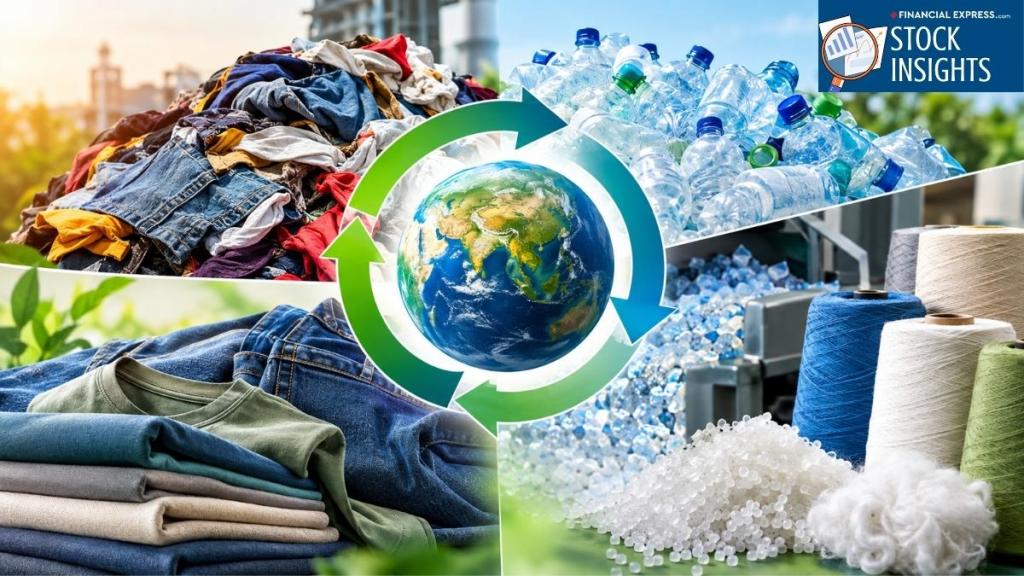

India’s textile industry may not have the biggest opportunity in making more garments, but in extracting more value from the clothes and textile materials already being discarded. The Ministry of Textiles estimates that India generates 70.73 lakh tonnes of textile waste every year, of which 42% is pre-consumer waste and 58% is post-consumer waste. More than 70% of this waste is already recovered through recycling, reuse, upcycling and downcycling. The Ministry estimates that India’s textile recycling market could reach US$3.5 billion (₹33,000 crores) by 2030.
However, the question is not market size; it is how much of that opportunity can actually translate into revenue, EBITDA, and free cash flow for listed companies.
At present, India’s recycling ecosystem is already relatively efficient in some areas. Around 95% of pre-consumer textile waste is recovered, while only about 55% of post-consumer textile waste is diverted from landfills. The spinning industry has achieved near-100% in-situ reintegration of much of its homogeneous process waste. The bigger opportunity therefore lies in moving from collection and low-value recovery towards higher-value recycling, particularly where discarded textiles can be converted back into useful fibres and materials.
For readers, this creates two very different opportunities. One is textile-to-textile recycling, where discarded garments and textile waste are converted into fibres and yarns again. The other is bottle-to-textile recycling, where PET bottles are converted into recycled polyester fibre and yarn.
#1 RSWM Limited: Where Recycling Sits Inside a Much Larger Textile Business
RSWM Limited was established in 1960 by L. N. Jhunjhunwala, who set up a textile mill in Bhilwara, Rajasthan. That business became the foundation of the LNJ Bhilwara Group. RSWM has subsequently developed into an integrated textile manufacturer covering synthetic, cotton and melange yarns, denim, knitted fabrics and recycled polyester fibre. The company currently has 13 manufacturing plants and exports products to more than 70 countries.
The key point is that recycling is not a standalone waste-management operation; it is embedded in the company’s broader manufacturing chain. That means RSWM can potentially capture value at multiple stages of the chain rather than depending exclusively on selling recovered waste.
The Recycling Loop Is Already Inside the Factory
The company uses open-ended spinning mills to recycle waste generated during spinning, putting fibre waste back into productive use. Its fabric manufacturing facilities also have systems to convert and reuse waste generated by fibre plants.
Cotton waste recycling is another component of this activity. It reduces the need for virgin cotton and extends the usable life of the material. RSWM also processes post-consumer waste fabric into usable fibres. In its FY2022-23 annual report, the company stated that it was recycling approximately 30 tonnes of waste fabric every month into new usable fibres.
The investment relevance here is that not all recycling economics are the same.
Factory-generated waste is generally easier to recover because its composition is known and the material is available close to the manufacturing process. Post-consumer fabric is more difficult because it must be collected, sorted and processed before it can become a reliable raw material.
Despite recovery rates exceeding 70%, substantial headroom remains to tap the higher-value potential of textile recycling.
FibreGreen Shows Where RSWM Already Has Scale
RSWM’s recycling exposure also extends beyond textile waste.
Its Ringas facility near Jaipur converts waste PET bottles into FibreGreen, a certified recycled polyester fibre. The process involves converting discarded PET bottles into flakes and then processing those flakes into polyester fibre in different deniers and cuts for yarn spinning.
In FY25, RSWM reported recycling 43,250 MT of PET bottles and using 38,270 MT of recycled polyester. The company also reported consumption of around 6.5 million PET bottles a day at its recycling facility.
For readers, this distinction helps put the opportunity into the right perspective.
PET bottles are a relatively consistent feedstock compared with discarded garments containing cotton, polyester, elastane, dyes, buttons, zips and other components. Consequently, a company with an established PET recycling chain may have a more predictable feedstock model than a company attempting to build large-scale post-consumer textile-to-textile recycling.
RSWM therefore has exposure to both ends of the broader circular textile theme: recycling textile manufacturing waste and converting PET waste into recycled polyester, while continuing to operate a large conventional textile manufacturing business.
The Q1 FY27 Numbers Tell a More Complicated Story
RSWM reported a mixed but improved Q1 FY27 performance.
Revenue from operations stood at ₹1,161.24 crore, down 0.7% year-on-year from ₹1,169.19 crore in Q1 FY26, but up 1.7% from ₹1,141.96 crore in Q4 FY26. Net profit increased sharply to ₹16.74 crore, around 2.4 times the ₹6.96 crore reported in Q1 FY26. However, it declined from ₹34.55 crore in Q4 FY26.
The sequential decline needs careful reading. The Q4 FY26 comparison was affected by a major one-time tax benefit recognised after RSWM decided to adopt the concessional corporate tax regime.
Yarn remained the largest segment, with revenue of ₹992.94 crore in Q1 FY27, compared with ₹978.60 crore in Q1 FY26 and ₹979.71 crore in Q4 FY26. Fabric revenue was ₹283.42 crore, compared with ₹287.81 crore in Q1 FY26 and ₹263.86 crore in Q4 FY26. The fabric segment reported a ₹0.50 crore loss before tax and interest, compared with a profit of ₹15.90 crore in Q1 FY26 and a ₹2.07 crore loss in Q4 FY26. The company reported no revenue from the food-grade rPET chips segment at the consolidated segment-reporting level in Q1 FY27, although it is developing this business.
Operationally, domestic sales increased to ₹825 crore from ₹774 crore in Q4 FY26, while exports stood at ₹336 crore.
For now, RSWM’s earnings recovery is being led more by its broader textile operations than by emerging recycling opportunities. Recycling is becoming strategically more important, but it has not yet grown large enough to be the sole explanation for the company’s earnings trajectory.
The ₹500 Crore Project Could Change the Earnings Mix
RSWM is developing a 50,000-tonne-per-year food-grade rPET granules project, with civil construction underway and critical machinery orders placed. Management expects the first phase to generate around ₹500 crore in revenue at full capacity, with an industry EBITDA margin of around 15%. However, no customer tie-ups have been finalised yet.
At these assumptions, the project could generate around ₹75 crore of EBITDA at full utilisation. The projected ₹500 crore revenue would equal about 11% of RSWM’s FY26 revenue of ₹4,554 crore, while the implied EBITDA would be meaningful relative to the company’s FY26 operating profit of ₹283 crore.
For readers, the key issue is not the planned capacity but how quickly RSWM can convert it into commercial volumes and earnings. The lack of finalised customer tie-ups remains a key risk. Actual returns will depend on customer approvals, product acceptance, selling prices, feedstock availability, utilisation and the spread between recycled and virgin PET.
RSWM Is Increasing Its Capital Commitments
During Q1 FY27, the Board approved a ₹186.30 crore denim garment facility through a proposed joint venture with NDS9 Private Limited.
The project is planned to be funded through 30% equity and 70% term loans, subject to lender requirements. The first phase is expected to have a capacity of up to 5 lakh pieces per month, with further phases possible.
Separately, RSWM is investing ₹92 crore to expand its knitting operations. The technology upgrade is expected to be completed in H1 FY27, with benefits expected to accrue from Q3 FY27.
The company also acquired 100% of LNJ GreenPET Private Limited for ₹20.01 crore. The subsidiary has around 44 acres of land in Ratlam, Madhya Pradesh, where RSWM plans to establish a greenfield bottle-to-bottle recycling facility producing food-grade recycled PET chips and granules for FMCG, beverage, pharmaceutical and packaging applications.
These commitments create a second question beyond revenue growth:
Can the company earn an adequate return on the capital being deployed?
RSWM reported a nominal ROCE of 5.62%. If recycling and downstream projects require substantial capital but generate returns close to existing levels, revenue growth alone may not create meaningful shareholder value.
RSWM’s Five-Year Numbers Show Why the Turnaround Needs Testing
| Particulars | FY22 | FY23 | FY24 | FY25 | FY26 |
| Sales (₹ in crores) | 3,817 | 3,789 | 4,058 | 4,826 | 4,554 |
| Operating Profit (₹ in crores) | 432 | 248 | 95 | 209 | 283 |
| Net Profit (₹ in crores) | (246) | (123) | (21) | (40) | 52 |
| EPS (₹) | 52.28 | 26.08 | (4.47) | (8.50) | 11.04 |
Source: Screener.in
Over five years, sales increased, but net profit remained negative for three consecutive years before returning to a profit in FY26.
That raises an important question:
How much of the earnings recovery is structural and how much is linked to the textile cycle, input prices, product mix and other operating factors?
The Stock Has Rerated Before the Recycling Story Has Fully Matured
RSWM’s share price has risen 9% in one month, 56.40% over six months, and 43.06% year-to-date. The stock trades at a P/E ratio of 14.29.
If future earnings from rPET, garmenting and knitting are already partly reflected in the share price, the company must execute those projects and convert capacity into cash earnings for the investment thesis to strengthen.
Shareholding also changed in Q1 FY27. FIIs reduced their stake by 0.23 percentage points to 0.97%, while DIIs increased their holding by 0.9 percentage points to 0.52%.
#2 Ganesha Ecosphere Limited: A Different Route Into the Circular Economy
Ganesha Ecosphere Limited entered the recycling business in 1987 and has built its core operations around converting post-consumer PET bottle waste into recycled polyester products. While the company is primarily a PET-waste recycler rather than a textile-waste recycler, its recycling output is directly linked to the textile industry because its recycled polyester staple fibre (RPSF), recycled spun yarn and recycled polyester filament products are used as raw materials for textiles and other fabric-based applications.
The company has pioneered the manufacture of rPET fibre and rPET yarn from pre- and post-consumer PET bottle scrap. Its recycling process involves collecting PET waste through its network, sorting and cleaning the bottles, converting them into flakes and processing the flakes into recycled polyester fibre through a non-chemical process.
Ganesha’s Moat Starts Before the Recycling Plant
The company’s ability to source waste is central to its business model.
Its FY26 disclosures state a group recycling capacity of 1,85,940 tonnes per annum, supported by 300+ suppliers and collection partners across India, which mobilise nearly 450 tonnes of PET bottle waste every day.
Ganesha operates six manufacturing facilities across India and Nepal, with operations in Uttar Pradesh, Uttarakhand, Telangana and Nepal. It exports to more than 16 countries and has a vertically integrated model covering collection, washing, recycling and downstream manufacturing.
The company also identifies itself as a pioneer in rPET fibre and yarn and reports recycling more than six billion PET bottles annually.
For readers, the important point is that recycling capacity alone does not create a competitive advantage.
A plant needs a reliable feedstock network. Collection partnerships, sorting capability, quality control and the ability to process waste consistently can also determine whether installed capacity actually translates into production and margins.
Warangal Gives Ganesha Operating Leverage, but Also a Question
During Q1 FY27, Ganesha expanded its Warangal rPET granules facility by 22,500 TPA. A further 22,500 TPA expansion and debottlenecking are underway.
The company also invested ₹98 lakh in Ganesha Recycling Chain Private Limited, its associate formed with Race Eco Chain to strengthen PET-waste sourcing.
These investments address two sides of the same business: more processing capacity and more secure feedstock access. That combination matters because additional capacity can remain underutilised without sufficient raw material, while expanded collection can tie up working capital without adequate downstream demand.
Q1 FY27 showed both the opportunity and the constraint.
Consolidated production rose 18.8% year on year to 42,826 tonnes, up from 36,049 tonnes in Q1 FY26, and 3.8% sequentially from 41,268 tonnes. However, sales volume fell 11.2% sequentially to 40,113 tonnes from 45,162 tonnes, even though it remained 19.2% higher than the 33,650 tonnes recorded in Q1 FY26.
The company attributed the sequential decline mainly to weaker demand in its standalone business, higher polymer prices and geopolitical uncertainties.
Higher production and productivity improvements supported margins, but the sequential decline in sales shows that production growth cannot by itself be treated as demand growth.
The legacy business operated at 102% capacity utilisation, while the Warangal business operated at 72%. The newer plant therefore has room to increase output if demand improves, without immediately requiring equivalent new capacity.
By contrast, the legacy operation is already running at a very high utilisation level. Future growth from this business is therefore increasingly dependent on debottlenecking, additional capacity or a better product mix rather than squeezing more volume from the same assets.
Q1 FY27 Shows What a Better Mix Can Do
Ganesha Ecosphere reported a significantly stronger Q1 FY27.
Consolidated revenue from operations rose 25.7% year on year to ₹423.7 crore, compared with ₹337.1 crore in Q1 FY26, while remaining broadly flat against ₹423.9 crore in Q4 FY26. Consolidated EBITDA rose 64.7% year on year to ₹59.8 crore from ₹36.3 crore and 14.2% sequentially from ₹52.4 crore. Consequently, EBITDA margin improved to 14.1%, compared with 10.8% in Q1 FY26 and 12.4% in Q4 FY26.
Consolidated PAT more than doubled to ₹29 crore, compared with ₹10.8 crore in Q1 FY26 and ₹23.2 crore in Q4 FY26. Basic EPS increased to ₹10.86, compared with ₹4.23 in Q1 FY26 and ₹8.68 in Q4 FY26.
The key takeaway is that profitability improved much faster than revenue, pointing to operating leverage, productivity gains and a favourable product mix rather than volume growth alone.
However, one quarter does not establish a new long-term margin structure.
Ganesha’s Five-Year Record Raises a Different Question
| Particulars | FY22 | FY23 | FY24 | FY25 | FY26 |
| Sales (₹ in crores) | 1,021 | 1,180 | 1,123 | 1,466 | 1,482 |
| Operating Profit (₹ in crores) | 114 | 128 | 138 | 211 | 144 |
| Net Profit (₹ in crores) | 62 | 69 | 41 | 103 | 38 |
| EPS (₹) | 28.39 | 31.82 | 16.01 | 40.51 | 14.26 |
Source: Screener.in
The five-year record shows a business that has grown revenue but has not delivered a smooth earnings trajectory. The numbers demonstrate the difference between recycling capacity growth and shareholder earnings growth.
It is important to determine whether the stronger margin marks the start of a more durable earnings cycle or a recovery from a weaker FY26 base.
Ganesha Ecosphere has a ROCE of 5.58%. That means if new capacity generates higher utilisation but does not produce materially better returns on capital, the economic benefit of the recycling expansion may remain limited.
The Stock’s Performance Is Sending a Different Signal
Ganesha Ecosphere’s recent price performance shows a short-term correction despite stronger medium-term gains. The 10.10% decline over 30 days indicates near-term selling pressure, while the 19.21% six-month and 15.19% year-to-date gains point to a relatively stronger medium-term trend. However, the stock’s PE of 46.98 suggests investors are already assigning a high valuation, leaving less room for earnings disappointments. The 0.35% dividend yield also indicates limited income contribution.
Ganesha’s shareholding pattern also changed in Q1 FY27. FII ownership increased to 10.38% from 8.89% in the March quarter of FY26, while DII ownership declined by 4.35 percentage points to 15.07%.
Six Bottlenecks That Can Stop a Large Market From Becoming a Large Profit Pool
The opportunity may be large, but converting discarded material into dependable shareholder returns will depend on overcoming the following operational and economic hurdles:
- Blended Fibre Separation: Garments made from cotton-polyester, elastane, or other fibre blends are difficult to separate efficiently. This limits the ability of recyclers to recover individual fibres at the quality required for new textile production.
- Post-Consumer Collection: Collecting used garments from households remains more difficult than sourcing factory waste. Post-consumer waste passes through fragmented collection, sorting and aggregation networks, making consistent feedstock supply challenging.
- Feedstock Quality: Textile waste can contain dyes, finishes, buttons, zips, labels and other non-fibre materials. Contamination increases sorting and pre-processing requirements and can affect recycled fibre quality.
- High Sorting Costs: T2T recycling requires classifying waste by fibre type, colour, and composition. Manual sorting can be labour-intensive, while automated sorting technologies require significant investment.
- Price Competition: Virgin polyester and other conventional fibres compete directly with recycled materials. When virgin material prices fall, recyclers may face pressure to keep recycled-fibre pricing commercially viable.
- Environmental Compliance: Recycling facilities must manage wastewater, emissions, chemicals and other environmental requirements. Compliance can increase capital and operating costs, particularly as companies move towards more sophisticated chemical recycling.
Government Support Is Building the Ecosystem, Not Guaranteeing Company Earnings
The Government of India announced the Tex-Eco Initiative in the Union Budget 2026–27 as part of its integrated textile programme. Rather than limiting support to conventional waste disposal, the initiative focuses on developing technologies that can convert discarded textiles into commercially useful materials.
For textile companies, the initiative specifically covers textile waste management, recycling and value addition, including the development of recycled fibres, new materials, sustainable packaging and other high-value products from discarded textiles. The Government plans to pursue these areas through collaboration among textile companies, research institutions, Textile Research Associations, Centres of Excellence and start-ups.
The Ministry of Textiles has also undertaken “Mapping of Textile Waste Value Chain in India” to identify textile waste generated at both pre-consumer and post-consumer stages and identify opportunities for stronger recovery and recycling networks.
The support extends beyond recycling technology. The Government is also using the UNEP-backed In-Tex India project to promote circular business models using Life Cycle Assessment and Product Environmental Footprint methods. In addition, an MoU involving the Textiles Committee, SCOPE and GeM seeks to promote upcycled products through government procurement, potentially creating a market for recycled and upcycled textile products.
Readers should separate policy support from financial benefit.
A government initiative can accelerate technology adoption, improve infrastructure and create demand conditions. It does not automatically increase the earnings of every recycling company.
The financial transmission mechanism still has to work, from policy support and technology adoption to customer demand, capacity utilisation, revenue, EBITDA, cash flow and, ultimately, return on capital.
What Needs to Happen for Value to Compound
The next phase for readers is to track earnings quality rather than capacity announcements. The critical signals will be customer conversions, utilisation ramp-up, product realisation and operating cash generation from new projects. For RSWM, readers should watch whether incremental investments broaden earnings without weakening balance-sheet efficiency, particularly as multiple projects compete for capital.
For Ganesha Ecosphere, the key evidence will be whether higher throughput translates into sustained margins and stronger cash generation rather than merely higher production. Across both companies, working-capital intensity deserves close attention because inventory build-up or delayed receivables can absorb reported profits. Readers should also track recycled-material price spreads against virgin alternatives, since this will determine margin resilience.
The central test is whether expansion eventually produces higher free cash flow and improving returns on incremental capital, rather than simply larger reported revenue.
It may be a good idea to add these stocks to your watchlist and keep track to see how they perform in time to come.
Disclaimer
Note: We have relied on data from www.Screener.in throughout this article. Only in cases where the data was not available, have we used an alternate, but widely used and accepted source of information.
The purpose of this article is only to share interesting charts, data points and thought-provoking opinions. It is NOT a recommendation. If you wish to consider an investment, you are strongly advised to consult your advisor. This article is strictly for educative purposes only.
Rishabh Sinha is a seasoned financial content creator with over 10 years of experience in BFSI domain. His portfolio spans over 20 of India’s most trusted financial brands. Rishabh brings depth, structure, and a reader-first approach to every piece he crafts.
Disclosure: The writer and his dependents do not hold the stocks discussed in this article.
The website managers, its employee(s), and contributors/writers/authors of articles have or may have an outstanding buy or sell position or holding in the securities, options on securities or other related investments of issuers and/or companies discussed therein. The content of the articles and the interpretation of data are solely the personal views of the contributors/ writers/authors. Investors must make their own investment decisions based on their specific objectives, resources and only after consulting such independent advisors as may be necessary.