




Same Filing Season, Opposite Instincts
The September 2026 shareholding filings from India’s SME platforms have thrown up an unusual pair of trades. Mukul Agrawal, known for backing small companies early, now appears on the shareholder list of a Bengaluru firm that makes precision parts for aircraft and defence programmes. The company’s shares are up 5 times since its listing in March 2026.
Ashish Kacholia did the opposite on price. Per the company’s shareholding filing with BSE, he raised his stake in a supplier of safety and control electronics to Indian Railways, from 1.18% in March 2026 to 1.64% in September 2026. That stock trades about 20% below its June peak. Agrawal also has been holding this stock, but his stake slipped in the same filing.
One paid up for momentum. The other bought a dip in a stock his frequent co-investor is lightening. Neither trade is a signal on its own, but together they raise a sharper question. What exactly is each man paying for? Let us dive in.
The Red Flag of Thin Liquidity and Relaxed Norms
Before you read further, you must know that both stocks trade on SME platforms, and that changes the rules. Shares trade in fixed lots, not single units, results come out every six months and not every quarter. Several governance rules under the listing regulations are relaxed. Volumes are thin, which can trap sellers on a bad day.
#1 Apsis Aerocom: Mukul Agrawal’s Fresh Defence Pick
Incorporated in 2022, Apsis Aerocom machines metal components to very fine tolerances for aerospace, defence and healthcare customers. Much of its work comes from foreign aircraft and defence makers that source parts in India to meet offset obligations, along with Indian Air Force and Navy programmes.
The company has a market cap of Rs 755 cr and listed on the NSE SME platform on 18th March 2026. Agrawal bought a 1.21% stake in the company, about 146,400 shares, worth close to Rs 9.2 cr. Names appear in these filings only above 1%, so this is the first time his holding is visible.
In the same six months, the foreign institutional share fell from 3.02% to 0.39%. The domestic institutional share dropped from 5.25% to 2.73%. Lock-ins on the IPO’s anchor allotments ended in April and June. The number of shareholders rose from 307 to 521.
Defence Driving Two-Thirds of the Revenue
Defence work brought in about Rs 20 cr of FY26 revenue, or roughly 65%. Aerospace added about Rs 7.9 cr and healthcare about Rs 2.4 cr. The open order book stood at Rs 40.5 cr, around 1.3 times FY26 sales, with Rs 25.3 cr of it from defence.
Management has guided for revenue of about Rs 48 cr in FY27 and set an aim of Rs 500 cr in annual sales by around 2031. That is 16 times what it sold in FY26, and would need growth of roughly 75% a year for five years. Treat it as an ambition, not a forecast.
3-Year Financial Trajectory
| Financial Year | FY23 | FY24 | FY25 | FY26 | 3Y CAGR |
| Sales (Rs cr) | 10.4 | 16.9 | 20.5 | 30.7 | 44% |
| EBITDA (Rs cr) | 1.9 | 4.2 | 10.2 | 11.5 | 82% |
| Net Profit (Rs cr) | 1.0 | 2.6 | 6.6 | 7.5 | 95% |
Source: Screener.in
EBITDA is operating profit before other income. A five-year growth rate is not possible here, because the company has only four years of accounts. The three-year pattern is strong, but look at FY26 closely.
Sales jumped 50%, yet operating profit rose only about 13%, as the operating margin slid from 49.8% to 37.5%. The company blamed rent and staff costs at its second plant before it began earning, listing expenses and dearer raw material. It has guided for margins of 37% to 40% from here.
Paying 95 Times Earnings for a Rs 31 Crore Business
The share price of Apsis Aerocom opened at Rs 153 on listing day against the Rs 110 issue price. As on 12th October 2026 it was Rs 627, which is a gain of over 470%. This is closer to the stock’s all-time high of Rs 634.
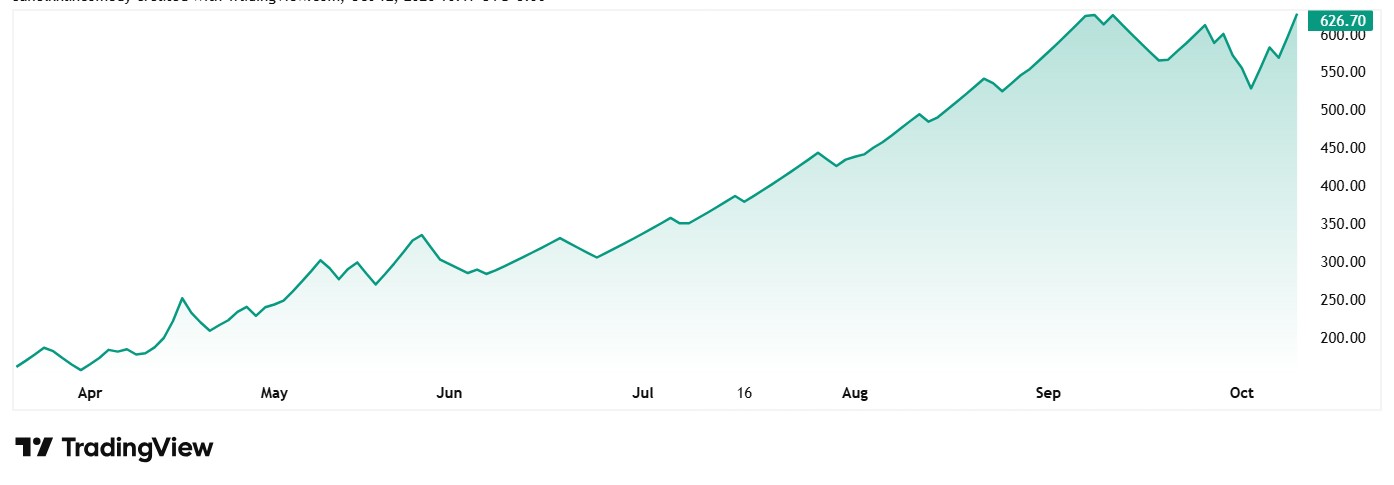
The stock trades at a PE of about 100x against the current industry median of 78x. A 10-year median PE does not exist for a company that has been listed for seven months, so that comparison is left out. The market cap is about 23 times FY26 sales and nearly 15 times book value.
Return on capital employed of 32%, return on equity of 25.5% and debt of just Rs 4.5 cr back some of that premium. The risks are concrete too. The largest customer brings in 35% of revenue and the top five 87%. Inventory days stood at 151 in FY26, and the new plant relies on machines from Europe and Japan with lead times of six to ten months.
#2 Concord Control Systems: The Kavach Stock Kacholia Is Buying and Agrawal Is Trimming
Incorporated in 2011, Concord Control Systems started out making coach parts for Indian Railways, such as couplers, emergency lights, carriage fans and battery chargers. It has since moved into higher-value systems, including locomotive wireless controls, propulsion equipment and Kavach, the home-grown train protection system that applies the brakes automatically to prevent collisions.
The company has a market cap of about Rs 2,574 cr. Kacholia first came in through a preferential allotment in September 2024, buying 76,433 shares at Rs 1,570 each. A 3:5 bonus issue in October 2025 lifted that to 1,22,293 shares. His September 2026 stake of 1.64% works out to about 1.70 lakh shares, worth close to Rs 40 cr.
Agrawal is the bigger holder. He owned 4,01,000 shares, or 3.86%, in March 2026, and his wife Asha Mukul Agrawal held another 1.47%. His own stake eased to 4.09% in the September 2026 filing, down from 4.2% in the previous quarter’s filing.
A Rs 697 Crore Order Book on Rs 210 Crore of Sales
Concord booked Rs 695 cr of new orders in FY26 and closed the year with an order book of Rs 697 cr, about 3.3 times its annual revenue. After the year ended, on 30th May 2026, its associate Progota India won a Rs 279.90 cr order for on-board Kavach 4.0 equipment. One detail matters here. Concord owns 46.5% of Progota, so that order will reach its accounts as a share of profit, not as revenue.
5-Year Financials for Concord Control Systems
| Financial Year | FY21 | FY22 | FY23 | FY24 | FY25 | FY26 | 5Y CAGR |
| Sales (Rs cr) | 18 | 32 | 49 | 65 | 124 | 210 | 64% |
| EBITDA (Rs cr) | 2 | 4 | 8 | 17 | 29 | 62 | 99% |
| Net Profit (Rs cr) | 1 | 3 | 5 | 13 | 23 | 43 | 112% |
Source: Screener.in
EBITDA is operating profit before other income. Those growth rates start from a tiny base of about Rs 1 cr of profit in FY21. FY26 also includes Advanced Rail Controls, a subsidiary that was merged into Concord with effect from April 2025. Still, the operating margin has widened from about 13% in FY21 to roughly 29.5% in FY26, which suggests the newer products earn more.
The Cash Is Still Stuck with the Customer
This is the part of the story the order book headlines skip. At the end of March 2026, money owed by customers stood at about Rs 121 cr in the standalone accounts, more than half of the year’s revenue. Inventory was another Rs 84 cr, while cash and bank balances were only about Rs 16 cr. Fast growth on slow payments eats cash. Operating cash flow was negative at Rs 7 cr in FY25.
Valuations and Near-Term Triggers
The share price of Concord Control Systems was Rs 1,645 at its 52-week low on 24th October 2025. It hit Rs 3,069.85 on 5th June 2026 and was about Rs 2,479 on 12th October 2026. Kacholia’s extra shares were bought in a six-month window that took in both the peak and part of the slide.
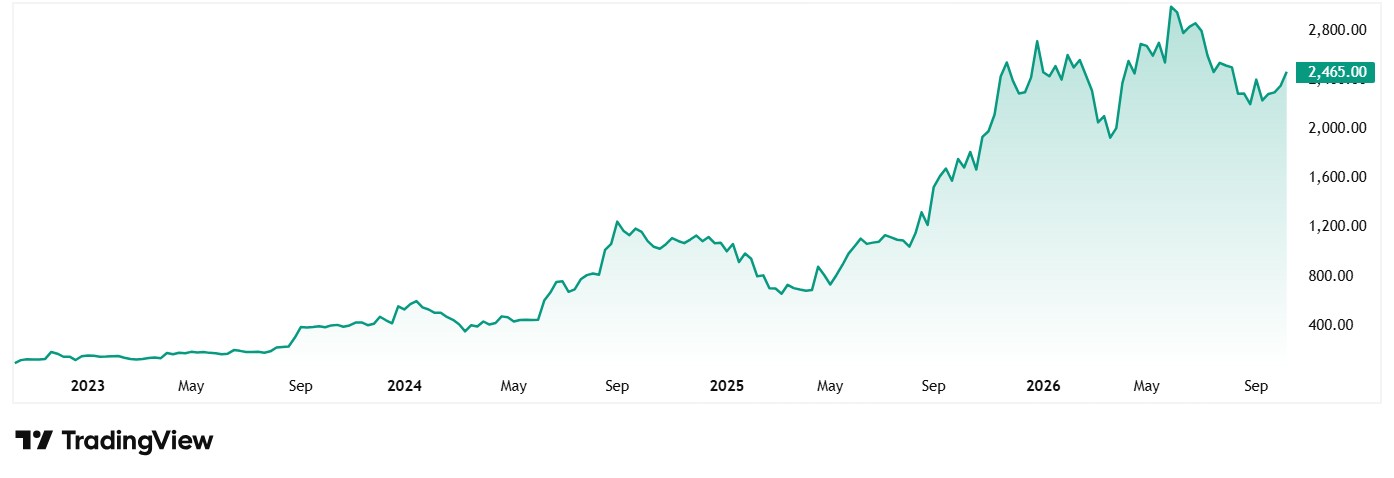
At that price the stock trades at about 61 times FY26 earnings, against the current industry median of 35x. A 10-year median PE is not meaningful for a company that listed in October 2022 and has since issued bonus shares, so I have left it out.
There is also a near-term trigger. On 21st September 2026, shareholders voted 100% in favour of moving from the BSE SME platform to the BSE main board. They also cleared a direct listing on NSE. Exchange approval is still pending. A move would bring trading in single shares, quarterly results and a wider pool of buyers.
3-Year Financial Trajectory
Apsis asks you to pay 100 times earnings for a Rs 31 cr business on the promise that a new plant and a Rs 500 cr ambition come good. Concord asks you to trust that a Rs 697 cr order book turns into cash, not just into bigger bills owed by the railways.
Agrawal bought in after over a 450% run. Kacholia added after a 20% fall. Kacholia also has a cushion a fresh buyer does not, since his original shares cost about Rs 981 each after adjusting for the bonus. Copying them at today’s prices is a different trade altogether.
Both companies closed their trading windows on 1st October ahead of first-half FY27 results. For Apsis, the test is whether the second plant has started earning and margins have held. For Concord, it is receivables, order conversion and the exchange’s word on the main board move. A sensible first step would be to add both stocks to a watchlist and track the numbers as they land.
Disclaimer
Note: We have relied on data from www.Screener.in and www.trendlyne.com throughout this article. Only in cases where the data was not available, have we used an alternate, but widely used and accepted source of information, including filings made available on the BSE website.
The purpose of this article is only to share interesting charts, data points and thought-provoking opinions. It is NOT a recommendation. If you wish to consider an investment, you are strongly advised to consult your advisor. This article is strictly for educative purposes only.
Suhel Khan has been a passionate follower of the markets for over a decade. During this period, He was an integral part of a leading Equity Research organisation based in Mumbai as the Head of Sales & Marketing. Presently, he is spending most of his time dissecting the investments and strategies of the Super Investors of India.
Disclosure: The writer and his dependents do not hold the stocks discussed in this article.
The website managers, its employee(s), and contributors/writers/authors of articles have or may have an outstanding buy or sell position or holding in the securities, options on securities or other related investments of issuers and/or companies discussed therein. The content of the articles and the interpretation of data are solely the personal views of the contributors/ writers/authors.