



The Three-Filter Test
I ran a screen on screener.in to find Indian pharmaceuticals that are relatively small, with market cap between Rs 1,000 cr and Rs 5,000 cr, with return on capital above 20%, a dividend yield above industry median and finally negligible debt. I got a list of around 10 stocks that cleared this 3-filter test.
However, 2 stocks stood out as they had the highest dividend yield in that subset of 10, which beat their respective industry medians as well. You see, the dividend filter is harsher. Mankind Pharma yields 0.04%, Zydus Lifesciences 0.09% and Divi’s Laboratories 0.32%. That is strategy, not stinginess: cash goes into research, American filings and capacity. A yield above 1% here says more about how a management treats its own money.
So, I chose to dive into two small but strong companies that clear all three filters. Both had a busy September. One crossed its dividend record date on the 4th, the other on the 11th. Yet the market has priced them as opposites. Let us dive in.
#1 Amrutanjan Health Care: The Century-Old Balm Maker Expanding Its Moat
Amrutanjan Health Care has been making its ayurvedic pain balm since 1893 and is run by the third generation of the founding family. Its 89th annual general meeting falls on 23rd September. The portfolio is wider than the balm suggests: Amrutanjan in pain relief, Relief in congestion, Comfy in women’s hygiene and Fruitnik in fruit drinks. Market capitalisation is Rs 1,419 cr.
On the filters it scores well. Return on capital employed for FY26 was 25%, roughly twice the industry median, and the ten-year median is 25%, so this is how the business has always behaved. Borrowings are Rs 2 cr against reserves of Rs 367 cr. FY26 dividends came to Rs 4.90 a share, including a Rs 2.90 final with a record date of 11th September 2026. At Rs 491, that is a yield of exactly 1.00%. At the line, not over it.
A ₹150 Crore Pivot Toward In-House Manufacturing
The most consequential thing this company has done in years has nothing to do with balm. Amrutanjan told the exchanges on 5th August 2026 that it had commissioned a greenfield sanitary napkin plant in Rangareddy district, Telangana. It cost Rs 150 cr, runs two high-speed Japanese lines and can make 700 million napkins a year.
The point is control. Comfy was made by third parties and is now made in house. In the June 2026 quarter, women’s hygiene and personal care sales rose 27% to Rs 36.36 cr. The trouble sits in the biggest bucket: OTC products, the balm franchise, came in at Rs 57.26 cr, up all of 0.5%.
The spending is already visible. Capital work in progress jumped from Rs 16 cr in March 2025 to Rs 106 cr, and free cash flow turned negative by Rs 19 cr in FY26.
Margin Compression and the Base-Year Illusion
| Financial Year | FY21 | FY22 | FY23 | FY24 | FY25 | FY26 | 5Y CAGR |
| Sales (Rs cr) | 333 | 406 | 380 | 421 | 452 | 503 | 9% |
| EBITDA (Rs cr) | 75 | 80 | 45 | 52 | 58 | 76 | Flat |
| Net Profit (Rs cr) | 61 | 67 | 40 | 45 | 51 | 58 | Flat |
EBITDA here refers to operating profit before other income. Read those last two rows carefully. FY21 was an anomaly of sorts, with operating margin at 22% against 12% in FY20. Start the clock there and sales compound at 9% a year while operating profit compounds at close to zero and net profit goes backwards at 1%. Shift the base one year earlier and from FY20 to FY26 sales compounded at 11.6%, operating profit at 16.1% and net profit at 15.1%. The base year is doing the work.
The June quarter was ugly. Sales rose 9.5% to Rs 102.97 cr, but profit after tax fell 47.7% to Rs 4.37 cr. A one-off lease rent settlement took part of the blame, and profit before that exceptional item and tax was Rs 8.10 cr against Rs 11.29 cr.
Operating margin still collapsed to 6.1% from 9.0%, and pain management volumes fell 3.4% against 6.6% growth a year earlier as retailers adjusted inventory after the goods and services tax changes.
Inside a 35% Correction: Evaluating Amrutanjan’s Valuations
The share price of Amrutanjan Health Care closed at Rs 491 on 11th September 2026, against a 52-week range of Rs 483 to Rs 785. It is down about 35% over a year and minus 8% a year over five.
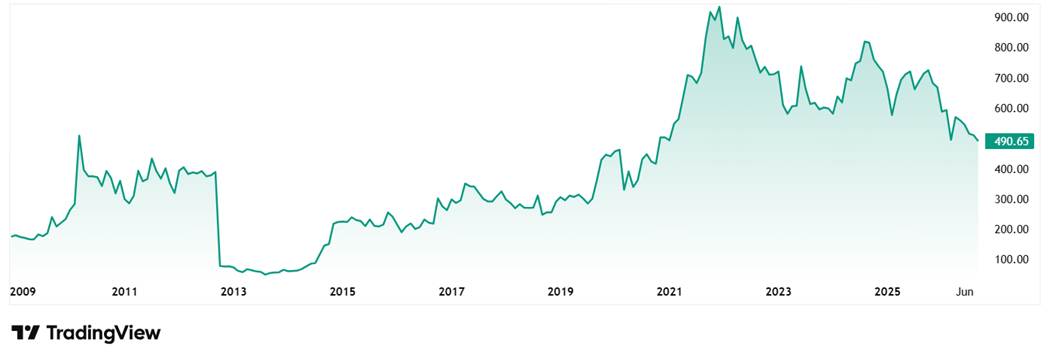
Regarding the valuations, the stock is trading at a PE of 23x and the current industry median is about 35x. The 10-year median PE for the company is 41x while the industry median for the same period is 28x.
The watch items are real. Promoter holding stepped down from 50.59% to 46.52% in the September 2024 quarter and has not moved since. The shareholder count has thinned from 72,002 in September 2023 to 45,135. And the new plant must be filled before that Rs 150 cr earns its keep, just as the balm business that funds everything has stopped growing.
#2 Jagsonpal Pharmaceuticals: The Quiet Gynaecology Leader Generating 23% ROCE
Incorporated in 1978 and run out of Gurugram, Jagsonpal Pharmaceuticals is built around women’s health, with gynaecology and orthopaedics as its focus segments. Seventeen of its brands rank in the top five of their respective molecule categories, carried by a field force of more than 900 people, and its top five brands make up about 47% of revenue.
It clears the filters from a different direction. Return on capital employed was 23% in FY26, again close to double the industry median, but the ten-year median here is 17.5%, so today’s figure sits above its own history.
Borrowings are Rs 8 cr and free cash was Rs 191 cr as on 31st March 2026, against a market capitalisation of Rs 1,536 cr. The FY26 dividend is Rs 4 a share, a 200% payout on a Rs 2 face value that includes a one-time special component and costs roughly Rs 26 cr. Record date was 4th September. At Rs 233, the yield is 1.7%.
How Promoters Increased Equity Without Spending a Paisa
Here is the number most screens will read wrong. Promoter holding moved from 67.89% in March 2026 to 69.06% in June 2026, and the obvious conclusion is that insiders were adding. However, they were not.
The board approved a buyback on 12th March 2026 and shareholders cleared it on 27th April. The tender offer ran from 8th to 14th May at Rs 250 a share for 16 lakh shares, or Rs 40 cr. The promoter group stayed out, and the offer was oversubscribed about 3.67 times. The shares were extinguished on 2nd June, cutting the capital to 6,55,39,150 shares.
Cancel 2.38% of the equity, sit out the tender, and your percentage climbs without spending a paisa. Management expects the exercise to lift return on capital by about 400 basis points.
Breaking Down the 25% EBITDA Growth Engine
| Financial Year | FY21 | FY22 | FY23 | FY24 | FY25 | FY26 | 5Y CAGR |
| Sales (Rs cr) | 188 | 218 | 237 | 209 | 269 | 287 | 9% |
| EBITDA (Rs cr) | 19 | 26 | 34 | 23 | 51 | 58 | 25% |
| Net Profit (Rs cr) | 17 | 19 | 27 | 22 | 55 | 43 | 20% |
EBITDA is operating profit before other income. Sales have compounded at 9% a year, the same pedestrian rate as Amrutanjan. Everything interesting happened below that line: operating margin went from 10% in FY21 to 20% in FY26.
One caveat about that FY25 profit of Rs 55 cr. The company sold its Faridabad facility for Rs 41 cr and booked an exceptional item of Rs 23.18 cr in the December 2024 quarter, lifting FY25 other income to Rs 28 cr against Rs 10 cr in FY26. So FY26’s Rs 43 cr is the cleaner figure, and the apparent fall came even as operating profit rose from Rs 51 cr to Rs 58 cr.
The balance sheet discipline is real: working capital days are down to 11 from 24, inventory days to 51 from 134 in FY21. The June quarter kept it going, with revenue up 9% to Rs 82.2 cr, net profit up 22% to Rs 13.2 cr and operating margin at 23.2% against 20.8%.
The Aequitas Acquisition: Buying a Hospital Distribution Channel
In July 2026 Jagsonpal completed the purchase of an 85% stake in Aequitas Healthcare for about Rs 20.8 cr, with the sellers retaining 15%. Aequitas is not profitable today: FY26 revenue was Rs 53.3 cr, but EBITDA was only Rs 0.5 cr and post-tax profit Rs 0.1 cr, which is why the price works out to roughly 0.4 times sales.
What it buys is a hospital channel Jagsonpal did not have. Management targets Rs 10 cr of EBITDA by year two and Rs 100 cr of revenue within two and a half years.
Charting a 32% Decade-Long Return
The share price of Jagsonpal Pharmaceuticals closed at Rs 233 on 11th September 2026, inside a 52-week range of Rs 155 to Rs 265. It is down about 3% over a year, but the five-year price CAGR is 29% and the ten-year rate 32%.
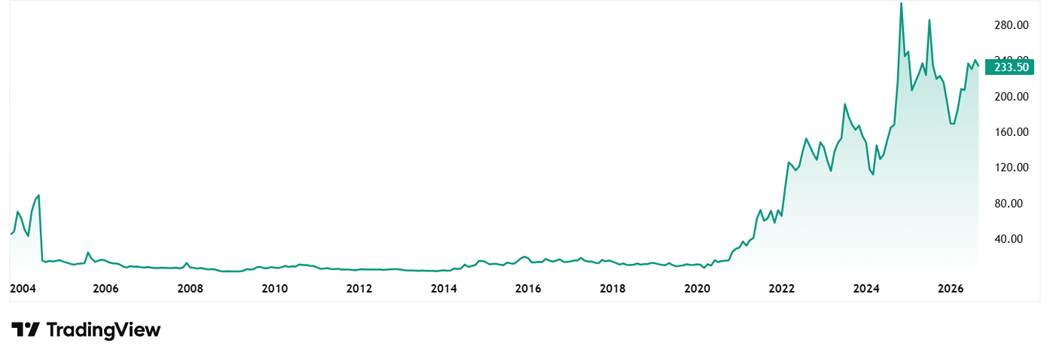
As for the valuations, the company’s share is trading at a PE of 23x and the industry median is 35x. The 10-year median PE of the company is 32x while the industry median for the same period is 28x.
The risks mirror Amrutanjan’s. Nine per cent sales growth is modest, and a margin that has already doubled cannot double again. The free float is 28.04% after the buyback, which thins liquidity. Aequitas has to be fixed. And that 1.77% yield includes a special dividend, so it is not a run rate.
Patience vs. Momentum
Both pass a screen many of Indian pharma companies fail, both earn about twice the sector’s median return on capital, and neither carries meaningful debt. Then they part ways.
Amrutanjan is the cheap one with the problem. Its return on capital has been excellent for a decade, but operating profit has gone nowhere in five years and Rs 150 cr has just gone into a plant that must still be filled.
Jagsonpal is the dear one with the momentum, where margins have doubled and cash has come back through a dividend and a buyback, but the growth is mostly margin arithmetic and the next leg rests on an acquisition earning nothing today.
What the screen proves is that neither needs the market’s money. What it cannot tell you is what either earns in FY28. Amrutanjan needs pain management volumes to return and Jagsonpal needs Aequitas to work. A sensible way to follow both is to add these stocks to a watchlist and track them closely.
Disclaimer:
Note: We have relied on data from http://www.Screener.in and http://www.trendlyne.com throughout this article. Only in cases where the data was not available, have we used an alternate, but widely used and accepted source of information.
The purpose of this article is only to share interesting charts, data points and thought-provoking opinions. It is NOT a recommendation. If you wish to consider an investment, you are strongly advised to consult your advisor. This article is strictly for educative purposes only.
Suhel Khan has been a passionate follower of the markets for over a decade. During this period, he was an integral part of a leading Equity Research organisation based in Mumbai as the Head of Sales & Marketing. Presently, he is spending most of his time dissecting the investments and strategies of the Super Investors of India.
Disclosure: The writer and his dependents do not hold the stocks discussed in this article. The website managers, its employee(s), and contributors/writers/authors of articles have or may have an outstanding buy or sell position or holding in the securities, options on securities or other related investments of issuers and/or companies discussed therein.