



Beyond the Order Book: Surgical Defence PSU Rally
Picture a business with virtually no debt, a return on capital employed (ROCE) above 30%, and net profit that has compounded in double digits over five years. Your first guess is software, or maybe a premium consumer franchise. The real answer is a company that welds together 6,000-tonne stealth frigates for the Indian Navy. It one of India’s leading warship builders, and it is not even the bigger of the two companies I want to tell you about today.
The defence trade has changed character. The first leg, powered by headline order-book numbers and a wave of indigenisation optimism, lifted almost anything with the word defence attached to it. That phase has matured. Screener.in now shows the peer industry median over 60 times earnings, which leaves very little room for a business that cannot back the price tag with hard returns. Stock-picking in this corner has turned surgical.
Which is exactly what makes the two companies below worth a dive into. One runs India’s fighter-jet and helicopter line. The other is among its busiest warship yards. Both operate on almost no borrowed money, both throw off returns on capital that is unheard of in heavy manufacturing, and both trade at a clear discount to the sector’s lofty median. Time to dive in and find out more.
#1 Hindustan Aeronautics: Operational Moat and Aerospace Leadership
Incorporated in 1963, Hindustan Aeronautics (HAL) is the country’s flagship aerospace public sector undertaking. It designs, builds, repairs and overhauls aircraft, helicopters and aero-engines, mostly for the Indian armed forces, with the LCA Tejas, the Su-30MKI line, the Dhruv and the Light Combat Helicopter among its better-known platforms.
The company partnered with GE for manufacturing GE-414 engines for LCA Mk2 and with SAFHAL (a JV with Safran) for IMRH and DBMRH engine development. It has secured a contract to export ring forgings for LEAP engines with Safran Aircraft Engines and is collaborating with Airbus to set up an A-320 MRO facility in Nasik, aiming to build a comprehensive MRO hub in India.
With a market cap of about Rs 2,94,462 cr, it is the second-largest listed defence company in India after Bharat Electronics. The Government of India holds a 72% promoter share in the company.
Let us take a look at the financials.
Squeezing Margins Over Volume
| Financial Year | FY21 | FY22 | FY23 | FY24 | FY25 | FY26 | 5-Yr CAGR |
| Sales (Rs cr) | 22,882 | 24,620 | 26,927 | 30,381 | 30,981 | 33,089 | 8% |
| EBITDA (Rs cr) | 5,344 | 5,415 | 6,686 | 9,752 | 9,621 | 9,770 | 13% |
| Net Profit (Rs cr) | 3,246 | 5,080 | 5,828 | 7,621 | 8,364 | 9,116 | 23% |
Sales have grown at a compound rate of just under 8% over five years, from Rs 22,882 cr in FY21 to Rs 33,089 cr in FY26. EBITDA (earnings before interest, taxes, depreciation and amortisation) has compounded at about 13%, from Rs 5,344 cr to Rs 9,770 cr. Net profit has compounded at roughly 23%, from Rs 3,246 cr to Rs 9,116 cr.
That gap between an 8% sales line and a 23% profit line is the whole HAL story. The growth has come from margins, not volume. Operating profit margin has climbed from the low twenties to about 30%, helped by a richer mix and better execution.
One honest caveat is however that a chunk of reported profit is other income, Rs 3,743 cr in FY26, mostly treasury earnings on a large cash pile. So, the operating engine is strong, but it is not the only thing driving reported profit.
How HAL Generates Elite Operating Profits Risk-Free
On capital efficiency, HAL posts a return on capital employed (ROCE) of about 32% which is double the current industry median of about 16%. In plain words, for every Rs 100 of capital the company puts to work, it earns roughly Rs 32 in operating profit before tax. The company also has a return on equity (ROE) of 24% while the industry median is 13%.
The balance sheet is the other surprise. Against reserves of more than Rs 40,000 cr, HAL carried borrowings of just Rs 11 cr at the end of FY26. The debt-to-equity ratio is, for all practical purposes, zero, making it virtually debt free.
This also means that the company is free from high interest repayments, giving it the freedom to use the profits to grow the business or give back to investors by means of dividends. HAL has a current dividend yield of 0.9%, which is amongst the highest in class as the industry average lies around 0.04%.,
Stock Price History: Premium Multiples Cool Down
The share price of HAL was about Rs 520 in June 2021 and as on 18th June 2026 it was Rs 4,403 which is a 746% jump in 5 years. Rs 1 lakh invested in the stock 5 years ago would have been about Rs 8.5 Lakhs today.
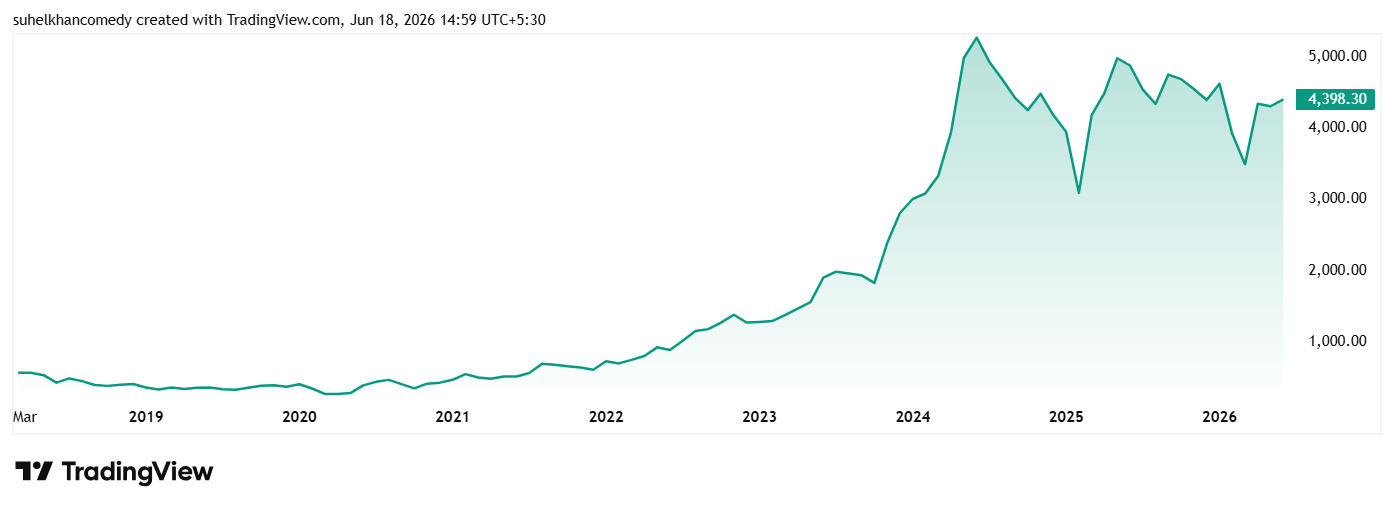
The current price is roughly 17% below its 52-week high of Rs 5,066 and well clear of the 52-week low of Rs 3,479. The stock is actually down around 15% over the past year, a reminder that even a quality compounder can cool off after a long run. In fact, the current price is over a 22% discount on the all-time high of Rs 5,675.
On valuation, HAL has a current PE of 32x which is about half of the current industry median of 62x, making the country’s largest pure defence manufacturer one of the cheapest names in its own sector.
A word of caution on long-run comparisons: HAL listed only in 2018, so a true ten-year median PE figure does not yet exist, and any quoted figure would be guesswork. What can be said is that the current multiple sits at the lower end of its short trading life.
As per the recent investor presentation from May 2026, the order book of the company further improved to Rs 2,54,538 cr against the previous year order book position of Rs 1,89,302 cr, and after the liquidation of the current year turnover of Rs 31,792 cr.
So, the attraction is a debt-free, high-return, cash-rich monopoly trading below its peers. The catch is the top line. At 8% sales growth, HAL has to keep squeezing margins to justify the profit trajectory, and there is a ceiling to how far margins can stretch.
#2 Garden Reach Shipbuilders: Rapid Growth in Warship Engineering
Incorporated in 1934, Garden Reach Shipbuilders and Engineers (GRSE) sits under the Ministry of Defence and builds warships for the Indian Navy and Coast Guard, from frigates and anti-submarine corvettes to survey vessels and patrol craft. Shipbuilding is close to 90% of revenue, with a smaller engineering arm that makes portable steel bridges and deck machinery.
With a market capitalisation of about Rs 32,150 cr, majority of the products manufactured by GRSE are supplied to central and state governments and entities owned and controlled by the government i.e. the Indian Navy and the Indian Coast Guard.
Now, while the company is a fraction of HAL’s size, its recent growth has been far quicker.
Faster Deliveries Driving Exponential Revenue
| Financial Year | FY21 | FY22 | FY23 | FY24 | FY25 | FY26 | 5-Yr CAGR |
| Sales (Rs cr) | 1,141 | 1,754 | 2,561 | 3,593 | 5,076 | 7,002 | 44% |
| EBITDA (Rs cr) | 81 | 141 | 149 | 235 | 422 | 795 | 58% |
| Net Profit (Rs cr) | 153 | 190 | 228 | 357 | 527 | 748 | 37% |
Sales have compounded at about 44% over five years, from Rs 1,141 cr in FY21 to Rs 7,002 cr in FY26. EBITDA has grown even faster, at roughly 58%, from Rs 81 cr to Rs 795 cr, though that comes off a modest FY21 base and should be read with that in mind. Net profit has compounded at about 37%, from Rs 153 cr to Rs 748 cr. As order execution has picked up, the deliveries have followed.
Customer Advances vs. Pricing Power: Inside GRSE’s Capital Discipline
Here is where a popular shorthand needs correcting, because the headline can mislead. GRSE does not earn fat margins. Its operating profit margin in FY26 was only about 11%, much lower than HAL’s 30%. And yet its ROCE is roughly 43%, higher than HAL’s. The question is, HOW?
The answer is the capital structure, not the margin. GRSE builds ships largely on the Navy’s money. Customers pay big advances as work progresses, which means the company funds much of its production without locking up its own cash. Its working capital is negative, its fixed-asset base is tiny relative to sales, and so the capital it actually employs is small. A modest profit on a small capital base produces a very large return on that capital.
In plain words, for every Rs 100 of capital GRSE puts to work, it generates close to Rs 43, but it gets there through capital discipline and customer advances, not through pricing power. ROE tells the same story, at about 32% for the latest year. Borrowings were Rs 37 cr against reserves of Rs 2,512 cr, so this too is an almost debt-free balance sheet.
High Returns vs. Lumpy Cash Flows
The share price of GRSE was about Rs 208 in June 2021 and as on 18th June 2026 it was Rs 2,825 which is a jump of almost 1,260% in 5 years. Rs 1 lakh invested in the stock 5 years ago would have been close to Rs 13.6 lakhs today.

At the current price the stock is trading at a discount of 20% from its 52-week high of Rs 3,538 which also happens to be the all-time high for the stock.
Regarding valuation, GRSE currently is trading at a PE of 43x which is lower than the industry median of 62x, but higher than that of HAL above. Like HAL, GRSE also was listed in 2018, so a genuine ten-year median price-to-earnings figure is not available.
The retail attraction is obvious. Big growth, elite capital returns, near-zero debt, and a captive customer in the Indian Navy. But the risks are just as real. This is a lumpy project business. Free cash flow swings hard from year to year, operating cash flow was actually negative in FY26 as working capital moved, and debtor days have crept up from 34 to about 64. The growth is real, but it does not arrive in a smooth line.
Are India’s Apex Defense Monopolies Genuinely Cheap?
HAL and GRSE make the same point by two different routes. Both are nearly debt free and backed by the Government of India. Both earn returns on capital that asset-heavy defence work is not supposed to allow. HAL gets there through genuine margins; GRSE gets there through a capital structure built on customer advances. And both trade below the sector’s stretched median, which on the face of it looks like the market mispricing its own apex monopolies.
But cheaper than the sector is not the same as cheap. That roughly 62x peer median is itself inflated by a long tail of small, high-priced defence names, several of them loss-making or barely profitable. Measured against that, almost anything with real earnings looks reasonable. HAL’s discount may simply be the market’s honest read of an 8% sales line. GRSE’s premium to HAL may be the market paying up for faster growth while quietly discounting how lumpy that growth is.
What the two do confirm is that the indigenous defence theme has matured past the stage where a rising tide carried every boat. The order pipelines are real, the balance sheets are genuinely strong, and the returns on capital are the kind most manufacturers can only envy. Whether today’s prices reward the people who own these businesses from here is a question for the coming time to reveal. Adding both to a watchlist, and tracking the next few quarters of execution, looks like a sensible place to start.
Disclaimer:
Note: We have relied on data from http://www.Screener.in and http://www.trendlyne.com throughout this article. Only in cases where the data was not available, have we used an alternate, but widely used and accepted source of information.
The purpose of this article is only to share interesting charts, data points and thought-provoking opinions. It is NOT a recommendation. If you wish to consider an investment, you are strongly advised to consult your advisor. This article is strictly for educative purposes only.
Suhel Khan has been a passionate follower of the markets for over a decade. During this period, he was an integral part of a leading Equity Research organisation based in Mumbai as the Head of Sales & Marketing. Presently, he is spending most of his time dissecting the investments and strategies of the Super Investors of India.
Disclosure: The writer and his dependents do not hold the stocks discussed in this article. The website managers, its employee(s), and contributors/writers/authors of articles have or may have an outstanding buy or sell position or holding in the securities, options on securities or other related investments of issuers and/or companies discussed therein.