


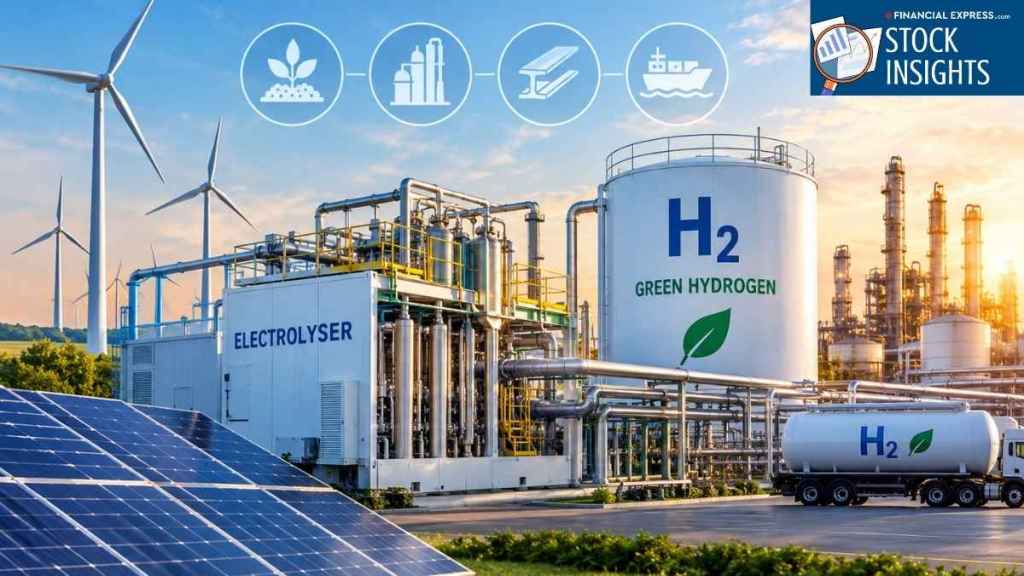

Green hydrogen, produced by splitting water through electrolysis using renewable electricity, is emerging as a potential industrial fuel for fertiliser, oil refining, steelmaking and shipping. According to Grand View Research, the global green hydrogen market is estimated at US$1.7 billion in 2026, up from US$1.1 billion in 2025, and is projected to reach US$11.7 billion by 2033, implying a compound annual growth rate (CAGR) of 32.2%.
India’s opportunity is driven by its National Green Hydrogen Mission, approved with an outlay of ₹19,744 crore, including ₹17,490 crore for incentives covering electrolyser manufacturing and hydrogen production. The mission targets 5 million tonnes per annum (MTPA) of green hydrogen production by 2030, supported by approximately 125 gigawatts (GW) of additional renewable energy capacity and more than ₹8 lakh crore in expected investment.
By March 2026, the government had awarded 3 GW per annum of electrolyser manufacturing capacity to 15 companies and 8.62 MTPA of green hydrogen production capacity to 18 companies. However, only around 8,000 TPA of production capacity had been commissioned by February 2026.
This gap between planned capacity and operating projects raises a crucial question for manufacturers such as L&T and Thermax: which electrolyser factories can secure real demand before capital costs mount?
#1 Larsen & Toubro: Can India’s Engineering Giant Turn Electrolysers Into a Profitable Business?
Larsen & Toubro (L&T) is an engineering, procurement and construction (EPC) company with businesses spanning infrastructure, energy, manufacturing, defence and technology. Its green energy operations combine electrolyser manufacturing with the development and execution of hydrogen and derivative projects.
Through L&T Electrolysers Limited, it manufactures high-pressure alkaline electrolysers at Hazira, Gujarat, while L&T Energy GreenTech develops green hydrogen projects. This combination gives L&T two potential revenue streams: supplying equipment and engineering systems, and developing projects that produce and sell hydrogen.
Hazira’s Manufacturing Edge Needs Commercial Proof
L&T’s Hazira facility is India’s first giga-scale expandable high-pressure alkaline electrolyser manufacturing facility. The company has indigenised more than 85% of its electrolyser supply chain and developed a 4 MW electrolyser stack using zero-gap technology. Its in-house research and development and testing facilities support further product development.
These given capabilities can improve supply security and lower reliance on imported components. However, localisation alone does not establish cost competitiveness. Readers still need evidence of manufacturing utilisation, equipment deliveries, realised selling prices, warranty costs and margins. L&T has not separately disclosed electrolyser revenue or manufacturing profitability in its financial reporting.
Panipat Provides a Demand Anchor, but Project Returns Remain Unclear
L&T Energy GreenTech has secured a project with Indian Oil Corporation Limited (IOCL) to supply 10,000 tonnes of green hydrogen annually to the Panipat refinery for 25 years. The project uses alkaline electrolysers manufactured at Hazira. L&T has also commissioned a 1 MW green hydrogen plant for Deendayal Port Authority at Kandla, Gujarat.
The commercial distinction between equipment supply and hydrogen production is crucial. Equipment sales can generate revenue as products are delivered, whereas a build-own-operate project requires capital investment before recurring hydrogen sales begin. Its financial performance depends on construction costs, financing, renewable electricity prices, operating efficiency, maintenance and the agreed selling price of hydrogen.
The government’s own hydrogen procurement data illustrates the cost challenge. Competitive bidding under the National Green Hydrogen Mission discovered prices of ₹397 per kilogram, including goods and services tax (GST), for supply to IOCL’s refinery and ₹387 per kilogram for refineries operated by Bharat Petroleum Corporation Limited and Hindustan Petroleum Corporation Limited. These are procurement prices, not evidence of L&T’s realised selling price or project margin.
The Manufacturing Segment Cannot Stand in for Hydrogen Earnings
L&T’s Manufacturing & Products segment reported revenue of ₹4,648 crore in Q1FY27, up 8.7% year-on-year from ₹4,276 crore in Q1FY26. Segment profit declined to ₹593 crore from ₹646 crore. The segment includes precision engineering, heavy engineering, defence electronics and other businesses, so neither its revenue nor its profit can be attributed solely to electrolysers.
Consolidated revenue from operations rose 6.7% year-on-year to ₹67,942 crore in Q1FY27, while consolidated profit after tax (PAT), including joint ventures and associates, increased 15.5% to ₹4,988 crore. Both figures declined sequentially from Q4FY26.
Operating cash flow, excluding Financial Services, stood at ₹4,300 crore during the quarter, against group collections of ₹65,800 crore on the same exclusion basis. The consolidated debt-equity ratio was 1.01 at June 2026, or 1.12 including borrowings classified as held for sale.
These figures demonstrate the scale of L&T’s wider operations and provide context for its funding capacity. But because L&T does not publish separate financials for its electrolyser business, it does not show how much capital the hydrogen business requires or whether it generates positive cash flow.
Does the Valuation Allow Room for Execution Risk?
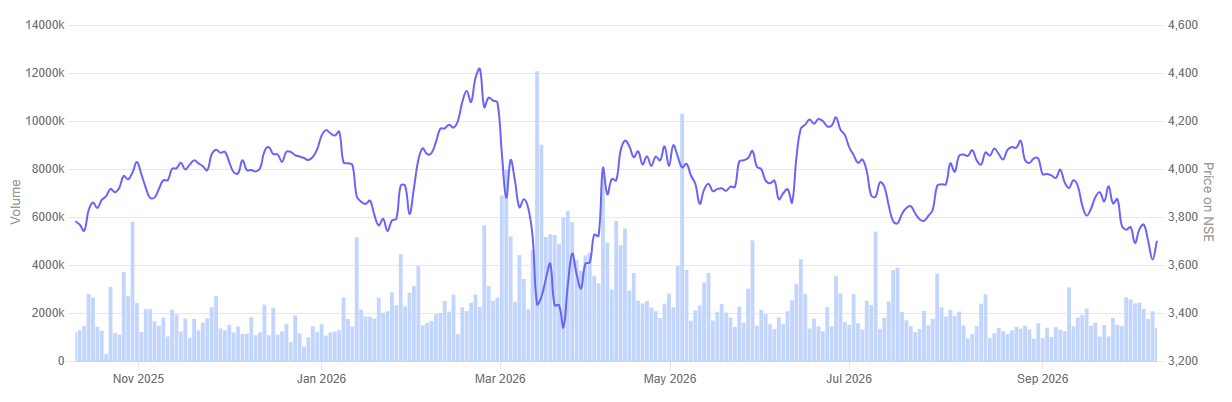
L&T’s share price declined approximately 6% over six months and 1% over one year. Its price-to-earnings (PE) ratio stood at 28.9. On 7 October 2026, Motilal Oswal Financial Services maintained a Buy rating with a target price of ₹4,400. Against the National Stock Exchange (NSE) closing price of ₹3,703.30 on 9 October, this implied potential upside of approximately 18.8%.
The brokerage recommendation and target price are not guarantees of future returns. Because the brokerage firm does not specify how much of the target valuation depends on green hydrogen, the investment case rests on the parent company’s broader earnings outlook and the potential for hydrogen projects to scale.
#2 Thermax: Can Two Electrolyser Technologies Create One Scalable Business?
Thermax is an energy and environmental solutions company serving industrial customers through businesses covering industrial products, energy projects, chemicals, water and waste solutions, and green energy. Its green hydrogen strategy combines alkaline water electrolysis with solid oxide electrolyser cell (SOEC) technology.
Through its partnership with Norway-based HydrogenPro, Thermax supplies integrated alkaline electrolyser systems, including locally engineered balance-of-plant components. Its collaboration with the United Kingdom’s Ceres Power covers SOEC technology, which uses electricity and steam at high temperatures. This gives Thermax exposure to two technology routes, but their commercial maturity differs.
HydrogenPro Brings a Nearer-Term Route to Market
Thermax’s August 2025 partnership with HydrogenPro gives it exclusive rights in India to supply, install, commission and service alkaline water electrolysis systems. HydrogenPro supplies the electrolyser stacks, while Thermax engineers and manufactures key balance-of-plant components, including systems for gas purification, high-purity water and heat integration.
Thermax states that its alkaline systems can operate between 40% and 100% of their operating range and produce hydrogen purity of up to 99.9% at the hydrogen purification system outlet. These capabilities could help industrial customers integrate electrolysers with variable renewable electricity supplies. However, they are product specifications rather than proof of profitability across commercial installations.
The commercial performance will depend on securing firm orders, pricing systems competitively and delivering projects within budget.
Ceres Power Opens a Higher-Efficiency Route, but Commercialisation Comes First
Thermax’s partnership with Ceres Power covers SOEC technology, which uses electricity and steam at approximately 500–600°C. The technology could benefit industrial sites where usable waste heat is available, potentially lowering electricity consumption compared with conventional electrolysis systems.
Thermax states that its SOEC technology can consume 25–30% less electricity than conventional alternatives. The company is developing a pilot plant to demonstrate the technology, with its public technical information describing a 720-kilowatt (kW) pilot facility.
The potential efficiency advantage matters because electricity is a major component of green hydrogen production costs. However, readers should not treat the stated reduction as a guaranteed reduction in total hydrogen production costs. Actual results will depend on the electricity and heat available at the site, equipment performance, operating life, maintenance and the cost of integrating the system into an industrial plant.
The key milestones are successful demonstration, reliable operation, customer acceptance and conversion into commercial orders. Until those milestones are established, SOEC represents a technology opportunity rather than a proven source of material earnings.
The First Commercial Test Is Turning Pipeline Into Booked Orders
During the 31 July 2026 earnings call, Thermax’s Managing Director and Chief Executive Officer said the company had agreed in principle on a hydrogen project but could not yet announce or book it. Management expected an order announcement in the following quarter and anticipated hydrogen-related revenue beginning in FY28.
These statements indicate the expected timing of commercial progress, not confirmed order intake or guaranteed revenue. Readers should look for a signed contract, disclosed project value, delivery schedule and subsequent revenue recognition before treating the opportunity as a financial contribution.
Thermax’s Green Solutions segment recorded revenue of ₹244.72 crore in Q1FY27, up 3.0% year-on-year and down 16.5% sequentially. Its loss before tax widened 215.5% year-on-year to ₹16.85 crore, although it narrowed 47.2% from Q4FY26.
Order booking rose 149% year-on-year to ₹382 crore, while the reported order balance increased 17% to ₹1,568 crore. However, ₹139 crore of the order-balance increase reflected a change by Thermax Onsite Energy Solutions Limited (TOESL) to a rolling 12-month forecast for long-term contracts. This change did not represent equivalent new demand for electrolysers.
Green Solutions also includes activities beyond hydrogen. Its revenue, losses and order balance therefore cannot be used as direct measures of the electrolyser business. The segment’s results show why readers need a hydrogen-specific breakdown rather than relying on broader operating figures.
A Profitable Parent Business Does Not Guarantee Profitable Hydrogen Projects
Thermax’s consolidated operating revenue rose 6.7% year-on-year to ₹2,303 crore in Q1FY27. However, PAT fell 85.4% to ₹22 crore. Profitability was affected by a ₹91 crore increase in the estimated cost to complete an Industrial Infrastructure project, while the previous-year quarter included ₹56 crore of incentive income under a state incentive scheme.
These factors matter when interpreting the earnings decline: the reported pressure should not be attributed directly to hydrogen. The quarter nevertheless illustrates how project cost overruns and one-off items can affect the wider company’s earnings.
Other segments provide context on Thermax’s operating base. Industrial Products reported revenue of ₹1,058 crore and segment profit before interest and tax of ₹64 crore. Industrial Infrastructure generated revenue of ₹814 crore and recorded a segment loss of ₹71 crore. Chemicals reported revenue of ₹230 crore and segment profit of ₹26 crore.
Thermax’s FY26 annual report records consolidated revenue of ₹10,694 crore and PAT of ₹720 crore. Its international business revenue reached ₹3,084 crore, up 33.4% year-on-year, while group order booking rose to ₹13,871 crore. These figures show the size of the parent business and its reach to industrial customers, but inform nothing about the financial contribution of electrolysers.
Is Future Growth Already Reflected in the Price?
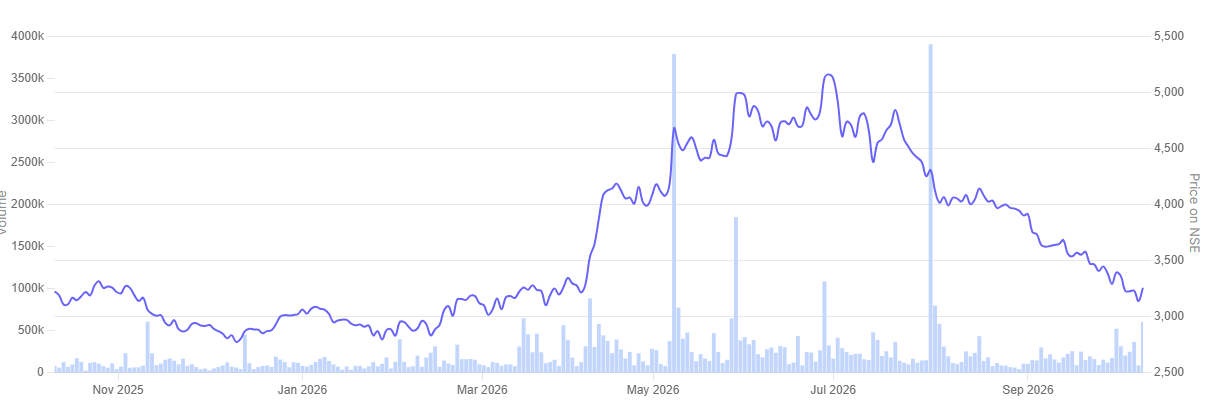
Thermax’s share price declined approximately 8% over six months, while its 52-week return was 2.9%. The company has a PE ratio of 70.5.
On 9 October 2026, Kotak Institutional Equities upgraded Thermax from Sell to Buy with a target price of ₹4,000. Against the 9 October closing price of ₹3,256.30 on the NSE, the target implied potential upside of approximately 22.9%.
Kotak’s positive view was linked to Thermax’s growth prospects, including businesses such as data centres and compressed biogas, as well as expected revenue growth and margins. The upgrade should not be interpreted as a hydrogen-specific recommendation.
The valuation question is whether the company can deliver the earnings growth the brokerage expects while funding its newer businesses.
The Electrolyser Survival Test: Three Industry Risks That Could Separate Winners From Struggling Factories
India’s electrolyser manufacturing opportunity faces a commercial challenge: announced capacity must eventually translate into firm orders, repeat customers and profitable production. The government’s award of 3 GW per annum of manufacturing capacity does not mean that all factories will operate at full utilisation.
If hydrogen projects are delayed or customer demand grows more slowly than expected, manufacturers may struggle to recover investment in specialised production lines, testing equipment, skilled employees and quality control. Low utilisation would raise manufacturing costs per unit, while aggressive pricing to secure orders could compress margins. Companies must therefore demonstrate not merely installed capacity, but a credible pipeline of executable orders and evidence that production volumes can support their cost base.
Supply-chain localisation is another test. Domestic assembly does not guarantee control over every high-value component, including specialised membranes, catalysts, porous transport layers, coatings, power electronics and precision separators. Dependence on imported components can expose manufacturers to supply delays, currency movements and changes in procurement costs. However, localisation must also be commercially sensible: producing components domestically only creates an advantage if their cost, quality and reliability compare favourably with imported alternatives.
Technology performance and lifecycle costs could also determine which manufacturers win repeat business. Electrolysers must deliver reliable hydrogen output under actual operating conditions, while maintenance, stack replacement, servicing and warranty claims can affect the economics of both equipment suppliers and plant operators.
From Hydrogen Hype to Hard Numbers: The Next Move
Readers should establish a staged entry strategy rather than make a large commitment based on the long-term hydrogen theme. Start by separating the core investment case of each company from the additional value that green hydrogen could eventually create.
For L&T, assess whether its wider engineering and manufacturing businesses justify the share price even if hydrogen adoption takes longer than expected. For Thermax, apply greater scrutiny to how much future earnings growth the current valuation requires, given its exposure to several developing businesses.
Next, review quarterly announcements for changes in capital spending, commitments to new facilities and funding requirements that could compete with shareholder returns. Also compare management’s earlier commercial timelines with actual delivery, commissioning and billing milestones to identify repeated delays.
Set a clear reassessment point for each holding: if commercial progress slips while spending rises, revisit the investment case rather than automatically extending the waiting period. If execution improves, reassess valuation against demonstrated earnings, not distant market forecasts. This approach keeps capital allocation tied to evidence rather than excitement.
It may be a good idea to add these stocks to your watchlist and keep track to see how they perform in time to come.
Disclaimer:
Note: We have relied on data from www.Screener.in throughout this article. Only in cases where the data was not available, have we used an alternate, but widely used and accepted source of information.
The purpose of this article is only to share interesting charts, data points and thought-provoking opinions. It is NOT a recommendation. If you wish to consider an investment, you are strongly advised to consult your advisor. This article is strictly for educative purposes only.
Rishabh Sinha is a seasoned financial content creator with over 10 years of experience in BFSI domain. His portfolio spans over 20 of India’s most trusted financial brands. Rishabh brings depth, structure, and a reader-first approach to every piece he crafts.
Disclosure: The writer and his dependents do not hold the stocks discussed in this article.
The website managers, its employee(s), and contributors/writers/authors of articles have or may have an outstanding buy or sell position or holding in the securities, options on securities or other related investments of issuers and/or companies discussed therein. The content of the articles and the interpretation of data are solely the personal views of the contributors/ writers/authors. Investors must make their own investment decisions based on their specific objectives, resources and only after consulting such independent advisors as may be necessary.