




The Indian IT services industry is built on a simple advantage: cost arbitrage. Companies could get work done in India at a lower cost without compromising on quality. Today, the Indian IT services industry has become a $250 billion-plus export industry.
Experts believe the next leg of that story could come from Engineering and R&D (ER&D) outsourcing. Compared to 46% offshore outsourcing of global IT services, only 5-6% of global ER&D activity is currently outsourced, according to a Nasscom report. The gap points to a large opportunity, but engineering work is not easy to outsource, especially when you need to work in close coordination with customers.
The market is expanding too. Global ER&D spending is expected to rise from $1.5 trillion in 2024 to $2.5 trillion by 2030, growing at about 8.9% annually. Software-defined products, connected devices, electrification, and AI are increasing the engineering content of products across industries.
For Indian ER&D companies, the opportunity is two-fold. Capture a larger share of existing engineering budgets and win a greater portion of the additional spending. Tata Elxsi, L&T Technology Services (LTTS) and KPIT Technologies offer three different ways to participate in this shift. But their results show why this opportunity will not translate to even financial gains.
#1. Tata Elxsi: Moving Beyond Headcount to Domain-led Engineering
Tata Elxsi is positioning itself to capture the global ER&D outsourcing opportunity by moving beyond conventional engineering staffing towards IP-led, specialised solutions. The strategy is to integrate its own platforms into customers’ day-to-day operations, strengthen ties with automakers, and expand into other engineering segments.
The shift is already visible in the customer mix. Today, 78% of automotive revenues come from original equipment manufacturers (OEMs), reducing dependence on Tier-1 automotive suppliers. It partnered with JSW Motors to establish JNEXT Technology Center to develop software-defined vehicle architecture, advanced driver assistance systems, and EV technologies. Another growth route is deals with Japanese OEMs.
Tata Elxsi is also using proprietary platforms to differentiate itself from vendors competing primarily on engineering hours. Its DevStudio.ai platform targets automotive software development. NEURON is helping telecom customers automate network operations.
The model is aimed at defending margins as AI reduces the engineering hours required for software development. However, execution remains an immediate challenge for sustained growth and should translate into stronger margin recovery.
Growth Meets Margin Pressure
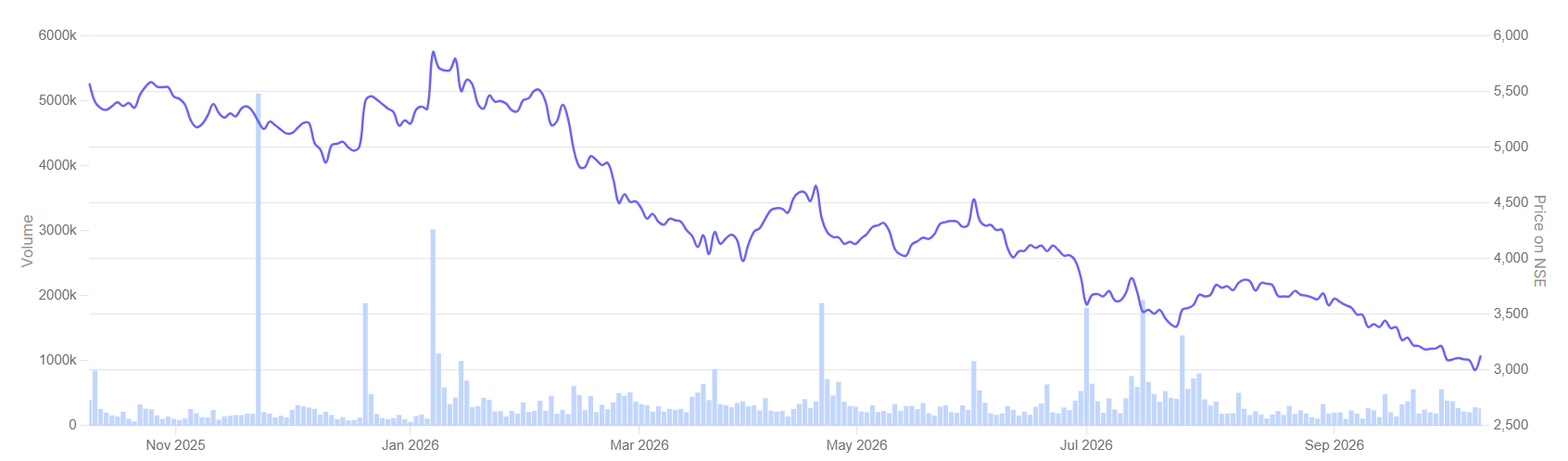
Tata Elxsi reported ₹1,021 crore revenue from operations in Q1FY27, up by 14.5% YoY. It crossed the ₹1,000 crore quarterly revenue milestone for the first time. But the revenue milestone came with a setback. Although the Earnings Before Interest, Tax, Depreciation, and Amortisation (EBITDA) margin shows a 30 basis points YoY improvement, it contracted 340 basis points QoQ.
The management has stated the margin contraction was due to expensive sub-contracts, higher AI spending, and upfront costs on new contracts.
Tata Elxsi: Financial Performance
| Period | Q1FY26 | Q1FY27 | YoY Growth (%) |
| Revenue From Operations (₹ crore) | 892.1 | 1,021.1 | 14.5% |
| EBITDA (₹ crore) | 186.7 | 216 | 15.7% |
| EBITDA Margin (%) | 20.90% | 21.20% | 30 bps |
| Net Profit (₹ crore) | 144.4 | 170.6 | 18.1% |
Tata Elxsi: 1 Year Stock Chart
LTTS: AI-led Engineering Supports the Next Growth Phase
LTTS is investing in AI-led engineering to improve productivity, shorten design cycles, and move towards higher-value work. Its partnerships with Anthropic and Databricks support its Engineering Intelligence strategy, which aims to automate routine tasks and improve delivery efficiency.
The opportunity is particularly relevant to fixed-price contracts, which account for 35.1% of revenue. Under these contracts, LTTS delivers work for a predetermined fee. If AI reduces the time and cost required to complete projects, the company can retain some of those efficiency gains as higher margins.
There is also a near-term growth challenge. Large-deal wins moderated to around $100 million in Q1FY27, compared with a quarterly average of roughly $200 million in FY26. Q2 deal wins will be important in determining whether this was a temporary slowdown or a sign of weaker demand.
Revenue Growth and Margin Gains
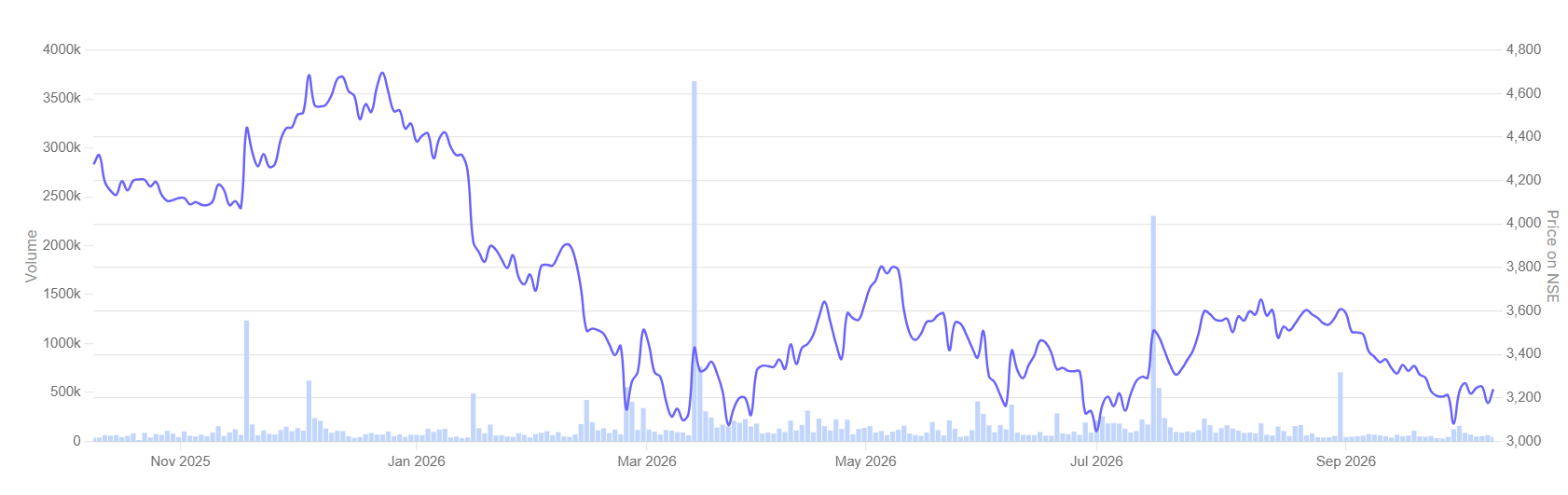
Q1FY27 Revenue from operations grew 11.5% YoY to ₹2,940 crore and EBITDA margin improved by 200 bps to 18.7% v/s 16.7% in Q1FY26. Growth in EBITDA was faster, meaning profitability grew alongside revenue, but the sustainability of that growth is still important.
LTTS: Financial Performance
| Period | Q1FY26 | Q1FY27 | YoY Growth (%) |
| Revenue From Operations (₹ crore) | 2,637.5 | 2,940.1 | 11.5% |
| EBITDA (₹ crore) | 441 | 548 | 24.3% |
| EBITDA Margin (%) | 16.7% | 18.7% | 200 bps |
| Net Profit (₹ crore) | 316 | 357 | 13.0% |
LTTS also benefits from a diversified engineering portfolio spanning industrial engineering, mobility and technology. Its Sustainability segment, which includes plant design, industrial automation and energy transition, contributed 37.1% of revenue in Q1FY27 and grew 11.3% YoY in value. The Tech vertical contracted 10.6%, while Mobility improved sequentially.
The company’s Lakshya’31 plan targets annual revenue growth of 13-15% over the next five years and EBIT margins of 16-17%. Delivering on these targets will require both sustained deal momentum and continued operating efficiency.
LTTS: 1 Year Stock Chart
KPIT Technologies: When Customer Weakness Tests the SDV Story
KPIT Technologies is expanding beyond passenger cars to reduce its dependence on a single automotive segment. It has begun engagements with seven off-highway equipment and commercial vehicle manufacturers, opening up adjacent markets where software and engineering capabilities can support product development.
The company is also expanding its software platforms, including Beacon, automotive cybersecurity through Cymotive, and in-car gaming through N-Dream/AirConsole. These initiatives could broaden its revenue base and create additional growth avenues. However, their contribution will take time to scale, and diversification alone cannot offset weakness in the core business immediately.
However, the near-term challenge is customer spending. European automakers are grappling with Chinese EV competition, rising costs, and tariff uncertainty. As manufacturers restructure and postpone vehicle launches, engineering programmes are being pushed back, directly affecting companies like KPIT. That said, the long-term need for SDVs remains strong, but near-term spending is proving cyclical.
Revenue Growth Fails to Protect Margins
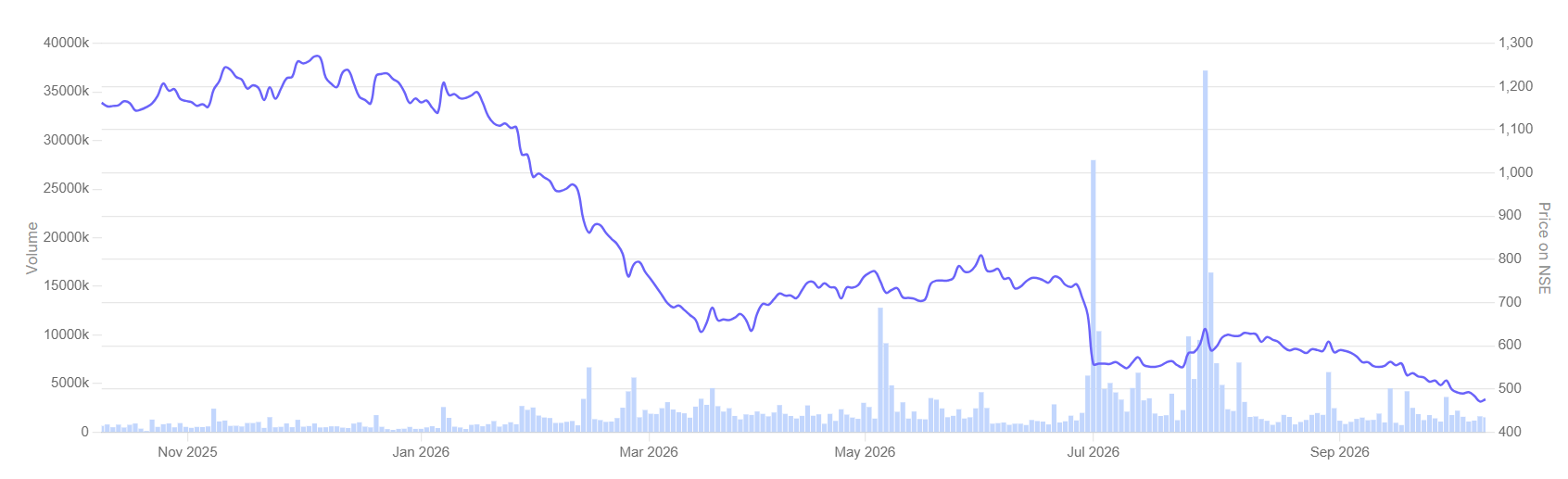
KPIT’s Q1FY27 results highlight this disconnect. Revenue from operations grew 8.9% YoY to ₹1,675 crore, but the EBITDA margin contracted sharply by 380 basis points to 17.2%. Net profit fell 32.3% to ₹116.4 crore.
KPIT Technologies: Financial Performance
| Period | Q1FY26 | Q1FY27 | YoY Growth (%) |
| Revenue From Operations (₹ crore) | 1,539 | 1,675 | 8.9% |
| EBITDA (₹ crore) | 324 | 288 | -11.2% |
| EBITDA Margin (%) | 21.0% | 17.2% | -380 bps |
| Net Profit (₹ crore) | 172 | 116.4 | -32.3% |
The divergence between revenue and EBITDA growth is the key concern. KPIT continues to grow, but delayed programmes and weaker customer spending are weighing on profitability.
KPIT’s revenue grew from ₹641 crore in FY19 to ₹6,455 crore in FY26, with an EBITDA margin of 20.8% in FY26. The latest quarter shows how that growth trajectory can be disrupted when automakers defer engineering investments.
However, the management is still hopeful of reaching an EBITDA margin of 22 to 24% by FY29, supported by software platforms and outcome-based pricing. Achieving those targets depends on the restart of delayed programmes and strong execution in other verticals.
The long-term SDV opportunity remains intact. Near-term investment case, however, rests on an earnings recovery that is yet to show up in the numbers. Until then, the SDV opportunity remains a long-term growth driver rather than a near-term guarantee of earnings recovery.
KPIT Technologies: 1 Year Stock Chart
Valuation: The Outsourcing Opportunity is Not Enough
All three stocks trade below their five-year median P/E multiples, but the ER&D outsourcing opportunity alone may not justify a re-rating. With only 5-6% of global ER&D work outsourced, the runway is long. The investment question is how quickly Indian vendors can convert that opportunity into revenue and earnings.
P/E Trend
| Metrics | P/E | 5-yr Median | Industry PE |
| Tata Elxsi | 27.8 | 57.3 | 18.87 |
| LTTS | 25.7 | 37.2 | |
| KPIT Technologies | 20.9 | 57.9 |
LTTS trades at 25.7 times earnings against its five-year median of 37.2. Its ability to convert large deals and sustain margin gains will determine whether the valuation gap narrows. Tata Elxsi, at 27.8 times versus a median of 57.3, needs to revive growth and recover margins before its historical premium can be justified.
KPIT is the cheapest at 20.9 times earnings against a median of 57.9, but its exposure to automotive software makes it vulnerable to OEM spending cuts. Its discount will mean little if earnings continue to weaken.
India’s ER&D opportunity is still in its early stages, but the stocks will not benefit equally. The next leg of growth depends less on how much engineering work moves offshore and more on which companies can win that work, protect margins, and turn it into earnings. The outsourcing gap is the opportunity; execution will decide the returns. Add these stocks to your watchlist and monitor how they execute their growth plans.
Disclaimer:
Note: We have relied on data from www.Screener.in throughout this article. Only in cases where the data was not available, have we used an alternate, but widely used and accepted source of information.
The purpose of this article is only to share interesting charts, data points, and thought-provoking opinions. It is NOT a recommendation. If you wish to consider an investment, you are strongly advised to consult your advisor. This article is strictly for educational purposes only.
Deepan Datta has spent over a decade studying stocks and mutual funds. His passion is to uncover interesting stories in the financial markets and share them through his writings with investors at large. He is focused on delivering clear, easy-to-understand, and research-backed insights. Deepan began his career as a Research Associate at S&P Global, where he developed a strong foundation in financial research and data analysis.
Disclosure: The writer and his dependents do not hold the stocks discussed in this article.
The website managers, their employees (s), and contributors/writers/authors of articles have or may have an outstanding buy or sell position or holding in the securities, options on securities or other related investments of issuers and/or companies discussed therein. The content of the articles and the interpretation of data are solely the personal views of the contributors/ writers/authors. Investors must make their own investment decisions based on their specific objectives, resources and only after consulting such independent advisors as may be necessary.