




India’s medical-device opportunity is becoming broader than high-value machines such as imaging systems, robotic surgery platforms and advanced diagnostic equipment. The more repeat-driven opportunity may lie in disposable devices, consumables and other single-use components that hospitals need continuously.
Fortune Business Insights estimates India’s medical devices market at USD 16.16 billion in 2025, rising to USD 17.86 billion in 2026 and USD 44.76 billion by 2034, implying a 12.2% CAGR. The opportunity becomes particularly relevant in disposables: Grand View Research estimates India’s medical disposables market at USD 15.88 billion in 2023, with revenue projected to reach USD 51.42 billion (₹4.9 lakh crores) by 2030, representing an 18.3% CAGR.
Sterilisation supplies were the largest segment in 2023, while diagnostic and laboratory disposables are projected to be the fastest-growing segment. Grand View Research’s latest India data also covers wound management, drug delivery, diagnostic and laboratory disposables, dialysis disposables, respiratory supplies and other categories, showing that the market is much broader than syringes and gloves.
For readers, the key questions are which medical-disposable categories Indian listed companies can competitively manufacture, their potential market share, and the resulting revenue and profits. The investment lens therefore shifts to volume, pricing, margins, capital intensity, cash generation and valuation, with Poly Medicure and Molbio Diagnostics offering distinct exposure.
#1 Poly Medicure Limited: The Disposable Manufacturer Becomes a Broader Medtech Platform
Poly Medicure Limited (Polymed) has built a broad medical-device portfolio covering infusion therapy, vascular access, blood collection and management, anaesthesia and respiratory care, dialysis, surgery and wound drainage, gastroenterology and urology.
Its manufacturing network comprises 12 facilities with annual production capacity of more than 1.5 billion medical devices. The company has also expanded beyond its traditional disposable-device base into cardiology and critical care.
The company operates manufacturing facilities in India, China, Italy and Egypt and exports its products to more than 125 countries.
The ₹1,875-Crore Business Behind the Disposable Thesis
Poly Medicure reported consolidated revenue from operations of ₹525.38 crore in Q1 FY27, up 30.3% YoY but down 1.7% QoQ. However, PAT stood at ₹85.27 crore, down 8.4% YoY and up 31.1% QoQ.
That divergence between revenue and profit deserves attention. The 30.3% revenue growth did not translate into comparable earnings growth.
Polymed does not report a separate disposable-device P&L, but its Q1 FY27 product-wise data shows where growth came from. Infusion Therapy revenue rose 11.1% to ₹259.2 crore, while Renal declined 3.8% to ₹43.2 crore due to pricing pressure from Chinese players. Cardiology surged to ₹28.6 crore from ₹2.9 crore, supported by PendraCare, while Orthopaedics contributed ₹49.2 crore after the Citieffe acquisition. Others grew 18.5% to ₹141.9 crore.
The key reason for the 30.3% consolidated revenue growth was inorganic expansion. Of the ₹525 crore consolidated revenue, approximately ₹72.3 crore came from acquisitions.
The underlying growth picture is therefore more nuanced. Europe grew 43.8% to ₹187.3 crore, including 17.6% organic growth. The Rest of World business grew 30.3% on a reported basis but only 4% organically. The major drag was the Middle East, where revenue declined 32% because logistics and infrastructure disruptions linked to the West Asia crisis prevented the company from shipping against existing demand and order book.
Five Years Reveal a Strong Top Line, but a More Complicated Profit Story
| Particulars | FY22 | FY23 | FY24 | FY25 | FY26 |
| Sales (₹ in crores) | 922 | 1,115 | 1,375 | 1,669 | 1,875 |
| Operating Profit (₹ in crores) | 215 | 267 | 361 | 456 | 446 |
| Net Profit (₹ in crores) | 147 | 179 | 258 | 339 | 321 |
Source: Screener.in
Sales rose from ₹922 crore in FY22 to ₹1,875 crore in FY26, roughly 19% annualised growth over the period. Net profit and operating profit also increased. But the FY26 numbers also expose the pressure underneath the growth story. Sales increased, while operating profit and net profit declined.
The test for Polymed is consequently moving from “Can it grow?” to “Can it convert growth into higher operating profit and cash generation?”
The company’s current return on capital employed (ROCE) is 12.5%. That is another number to monitor alongside revenue growth. A business expanding capacity and making acquisitions needs to generate sufficient returns from the capital deployed.
The Unused QIP Creates a Capital-Allocation Question
As of 30 June 2026, ₹465.05 crore of the ₹1,000 crore QIP proceeds raised in August 2024 remained unutilised, with the balance temporarily invested in liquid mutual funds, fixed deposits and bonds.
Its FY27 investment plan includes ₹200–225 crore of capital expenditure, primarily for the new Palwal/Faridabad facility for orthopaedics, transfusion and additional infusion capacity, along with expansion of cardiology manufacturing from the Noida facility.
Readers should therefore track whether the new capacity translates into higher utilisation, incremental revenue, operating profit and returns on capital.
Polymed’s Disposable Moat Is Manufacturing Scale, Not Just Market Growth
Polymed’s manufacturing scale supports high-volume, repeat production, but the Renal business shows that scale does not automatically protect margins. Revenue in the segment fell 3.8% to ₹43.2 crore because of pricing pressure from Chinese players.
For readers, this highlights an important distinction: higher volumes can improve operating leverage when pricing remains stable, but rising volumes with falling prices may not translate into stronger profits.
Poly Medicure Ltd: The Market Is Already Pricing a Growth Story
Source: Screener.in
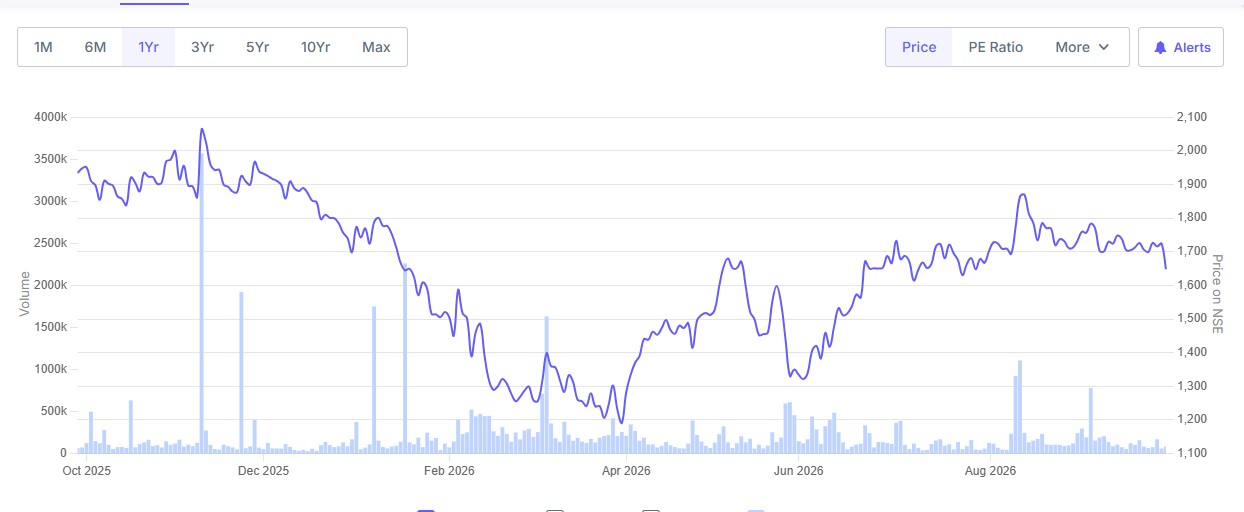
Polymed closed at ₹1,724.40 on the National Stock Exchange (NSE) on 25 September 2026. The stock had gained more than 33% over six months, although it was down more than 2% on a year-to-date basis.
At the stated P/E of 54.62, the market is already placing a relatively high valuation multiple on the company’s earnings.
JM Financial has a Buy rating with a ₹1,800 target price. At ₹1,724.40, that target represents approximately 4.4% potential upside.
#2 Molbio Diagnostics Limited: Where the Disposable Is the Recurring Revenue Engine
Molbio Diagnostics‘ disposable medical-device opportunity is closely linked to its Truenat molecular diagnostics platform rather than being a standalone conventional medical-equipment business.
Truenat uses single-use consumables, creating recurring demand alongside the installed base of testing devices. As of 31 March 2026, more than 12,500 Truenat devices were installed across 90+ countries.
Molbio completed its IPO in August 2026, raising a fresh issue of ₹200 crore. The company said the proceeds would be used towards automation capex and construction of an R&D facility in Bengaluru.
The Real Molbio Story Is Not the Machine. It Is What the Machine Consumes
Molbio reported consolidated revenue of ₹411.48 crore in Q1 FY27, up 309.5% YoY but down 27.2% QoQ. PAT turned positive at ₹52.74 crore, compared with a loss of ₹23.94 crore in Q1 FY26, but declined from ₹95.83 crore in Q4 FY26. PAT margin was 12.82%.
The company said the improvement was primarily driven by higher Truenat test-kit consumption, while operating leverage supported margins. It also cautioned that its revenue is non-linear because large public-health and export orders can shift between quarters.
Molbio’s consolidated financial statements classify the group as a single healthcare operating segment, so a separate revenue figure for Truenat disposables is not available. However, the Truenat business has two distinct revenue streams: Truenat devices/workstations and recurring test kits. The company states that roughly 75% of revenue now comes from test kits.
That mix gives Molbio a different economic profile from a conventional medical-device manufacturer. A machine sale creates revenue once. A machine installed in a healthcare facility can then generate repeated test-kit demand.
6.24 Million Kits Change the Investment Equation
In Q1 FY27, Molbio sold 6.24 million Truenat test kits, compared with 0.79 million in Q1 FY26 and 5.38 million in Q4 FY26. That represents an increase of approximately 690% YoY and 16% QoQ.
In contrast, Truenat device sales fell to 164 units, from 216 in Q1 FY26 and 1,158 in Q4 FY26.
This difference is important because it shows that recurring test-kit consumption is increasingly driving the business rather than one-time device placements.
For readers, the key operating equation is installed Truenat devices, tests performed, kits consumed, recurring revenue and operating leverage. If the installed base grows while kit consumption also increases, the consumables business can expand without requiring a matching increase in device sales.
The Q1 Surge Has a Timing Adjustment
The Q4 FY26 comparison needs particular care.
Molbio disclosed that around ₹57 crore of export orders relating to Q4 FY26 were deferred because of the situation in the Gulf and subsequently recognised in Q1 FY27. Therefore, part of the sequential Q1 FY27 performance reflects business originally expected in the preceding quarter.
Export contribution rose to 16.48% of revenue from 6.03% in Q4 FY26, while domestic revenue accounted for 83.52%.
The result is a business with strong recurring test-kit consumption but potentially uneven quarterly revenue, as public-health programmes and export orders can shift between periods.
Capacity Headroom Could Allow Growth Before Another Capex Cycle
As of 31 March 2025, Molbio had five manufacturing facilities in India, with an installed capacity of 3,600 devices and 3.9 crore Truenat test kits per year. FY25 utilisation was 58.89% for devices and 43.44% for test kits. By FY26, reported utilisation was 42% for devices and 58% for test kits.
This leaves capacity headroom, particularly for test kits. Molbio said in its Q1 FY27 update that existing capacity should support volume-led growth without near-term incremental capex.
This could support operating leverage if higher kit volumes are achieved without a proportionate increase in manufacturing investment. The company’s 17.96% ROCE is another metric to monitor as utilisation rises.
Five-Year Numbers Show the Turnaround, Not a Straight-Line Growth Story
| Particulars | FY22 | FY23 | FY24 | FY25 | FY26 |
| Sales (₹ in crores) | 776 | 327 | 756 | 971 | 1,313 |
| Operating Profit (₹ in crores) | 319 | 40 | 204 | 226 | 252 |
| Net Profit (₹ in crores) | 187 | 16 | 111 | 140 | 145 |
Source: Screener.in
Molbio’s revenue increased from ₹776 crore in FY22 to ₹1,313 crore in FY26, although the path was highly uneven. Revenue fell sharply in FY23 before recovering in FY24, FY25 and FY26.
The key question now is whether recurring test-kit consumption can make earnings less dependent on the timing of large public-health and export orders.
IPO Debut: A High Starting Valuation for a Newly Listed Consumables Story
Source: Screener.in
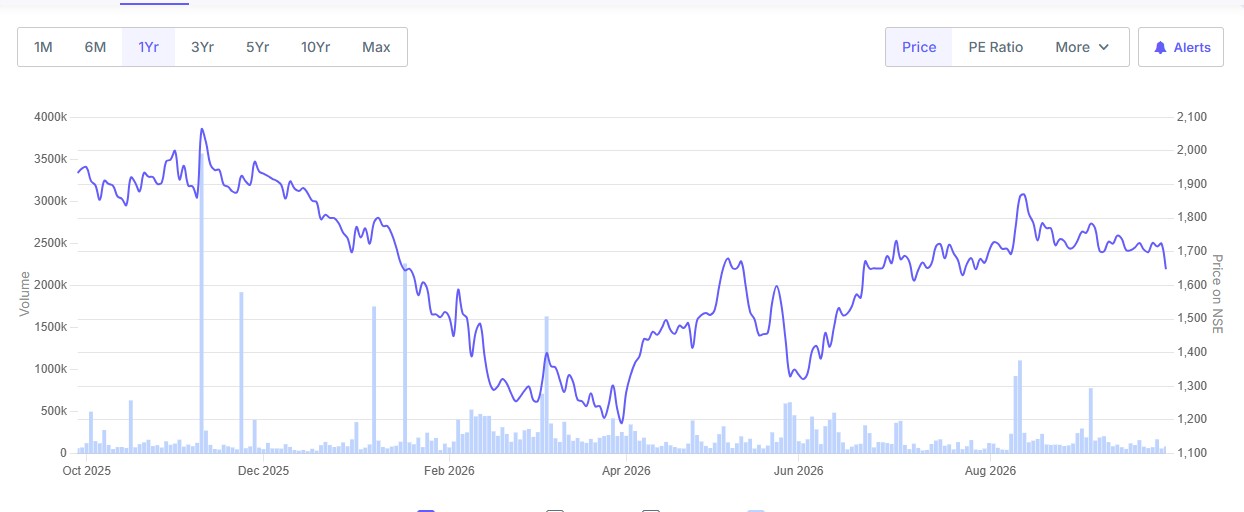
Molbio Diagnostics Limited listed on the NSE and the Bombay Stock Exchange (BSE) on 17 August 2026. The IPO was priced at ₹807 per share. The shares opened at ₹980 on both exchanges, giving investors a 21.44% premium to the IPO price. Since its listing, the stock surged by over 54% on the price chart. The stock is trading at a P/E of 66.13.
The company has no brokerage rating post-listing.
At this valuation, future earnings growth becomes central to the investment case. A high P/E can remain supported only if earnings, margins and cash generation expand sufficiently over time.
The Chinese Competition Test
India’s medical-device sector still has substantial import exposure. A government response in 2025 said import dependence remained about 70%, while the Department of Pharmaceuticals launched a medical-device programme partly to address this dependence.
A 2023 government response showed FY2022-23 medical-device imports at USD 7.49 billion, including USD 1.09 billion of consumables and disposables, of which USD 254.4 million came from China.
For listed manufacturers, the opportunity lies in replacing imported supply while maintaining competitive pricing, quality and margins. The key risks are therefore not simply import competition but whether domestic companies can protect pricing while scaling production.
Polymed’s Renal performance provides a direct example of this risk, with revenue declining 3.8% because of pricing pressure from Chinese players.
Government Support: Helpful, but Not a Blanket Subsidy
The government’s ₹500-crore Scheme for Strengthening Medical Device Industry (SMDI) supports areas including import substitution, manufacturing capacity, skills, clinical studies and industry development.
The Marginal Investment Scheme for Reducing Import Dependence can provide eligible manufacturers with a one-time capital subsidy of up to ₹10 crore for selected components, raw materials, finished devices and accessories.
The medical-device PLI scheme has a ₹3,420 crore outlay and provides incentives on incremental sales for selected product categories. However, its current target segments include cancer care/radiotherapy, imaging, anaesthesia/cardio-respiratory/renal care and implants. Ordinary disposable products do not automatically qualify merely because they are medical devices.
It is worth noting that government support can improve the economics of domestic manufacturing, but it should not be treated as a direct earnings driver for every disposable-medtech company.
What Comes Next?
India’s disposable-medtech opportunity is ultimately an earnings-conversion story rather than simply a market-growth story.
For Polymed, readers should track whether acquisitions and new capacity translate into sustained organic growth, operating-profit expansion, stronger cash generation and higher returns on capital. Pricing pressure, particularly from Chinese competitors, remains a key risk.
For Molbio, the central metric is the relationship between the installed Truenat base and recurring test-kit consumption. Its existing capacity provides room for volume growth, but public-health programmes and export orders can continue to make quarterly revenue uneven.
At the industry level, the more attractive economics are likely to emerge where recurring consumption, specialised manufacturing, regulatory barriers and localisation combine to create differentiation beyond commodity pricing.
It may be a good idea to add these stocks to your watchlist and keep track to see how they perform in time to come.
Disclaimer
Note: We have relied on data from www.Screener.in throughout this article. Only in cases where the data was not available, have we used an alternate, but widely used and accepted source of information.
The purpose of this article is only to share interesting charts, data points and thought-provoking opinions. It is NOT a recommendation. If you wish to consider an investment, you are strongly advised to consult your advisor. This article is strictly for educative purposes only.
Rishabh Sinha is a seasoned financial content creator with over 10 years of experience in BFSI domain. His portfolio spans over 20 of India’s most trusted financial brands. Rishabh brings depth, structure, and a reader-first approach to every piece he crafts.
Disclosure: The writer and his dependents do not hold the stocks discussed in this article.
The website managers, its employee(s), and contributors/writers/authors of articles have or may have an outstanding buy or sell position or holding in the securities, options on securities or other related investments of issuers and/or companies discussed therein. The content of the articles and the interpretation of data are solely the personal views of the contributors/ writers/authors. Investors must make their own investment decisions based on their specific objectives, resources and only after consulting such independent advisors as may be necessary.