



India’s steel story is usually about only two numbers: how much steel the country will produce and where the steel prices are headed. For investors, that makes it a difficult cycle to play. When prices rise, profits can surge. But when the cycle turns, margins can compress just as quickly.
However, there is another way to play the steel market. One that is less dependent on where steel prices are headed. As steel production rises and mills run harder, demand for the materials that keep their furnaces running rises with it.
That creates an interesting contrast further down the value chain. Companies supplying consumables to steel furnaces do not need steel prices to rise to benefit from higher production. They need furnaces that process the steel to run.
A Steel Play that Follows Volumes, Not Prices
According to a PIB release, India’s crude steel production rose to 168 million tonnes in FY26, up by 10.5% YoY. India plans to take this to 500 million tonnes (MT) by 2047.
The real investment thesis, however, lies in what happens inside the furnaces that produce this steel. A significant part of India’s steel capacity is based on induction furnaces, particularly among secondary steel producers. As steel production expands and furnace utilisation rises, these units consume more of the materials required to keep production running.
This is where ramming mass comes into the picture. An induction furnace uses a refractory lining on its inner wall to contain molten metal. With every cycle, that lining wears out and has to be rebuilt periodically. This makes ramming mass a key material in the steel production process.
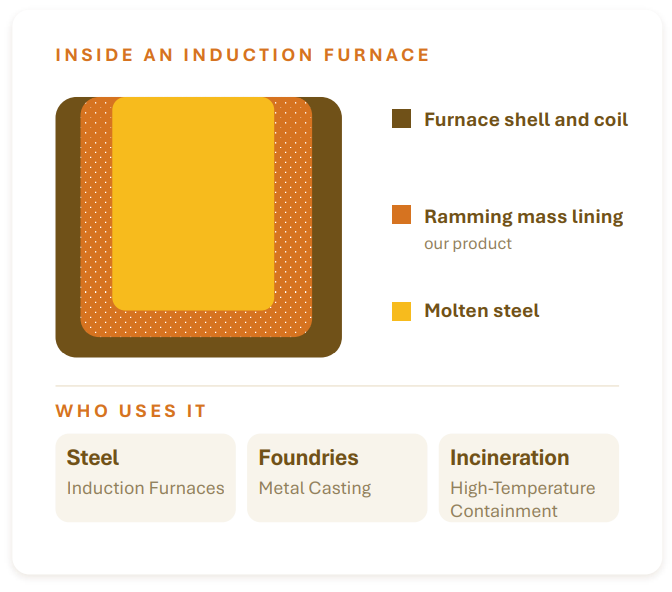
Source: Raghav Productivity Enhancers
The economics of ramming mass are relatively simple. More tonnes melted means more wear. More wear means more frequent replacement. That makes the demand driver different from the one investors typically track in steel.
A steelmaker can see its margins squeeze even when volumes rise because finished-steel prices fall or input costs rise. But ramming mass suppliers are relatively insulated from steel price volatility because their demand is driven more by tonnes melted than by the price of finished steel.
In this space, there are two listed companies to watch: Raghav Productivity Enhancers and Monolithisch India.
#1. Raghav Productivity Enhancers: Turning Furnace Consumables Into a Specialty Business
Raghav Productivity Enhancers offers one of the clearest examples of how a seemingly commoditised furnace consumable can become a specialty business.
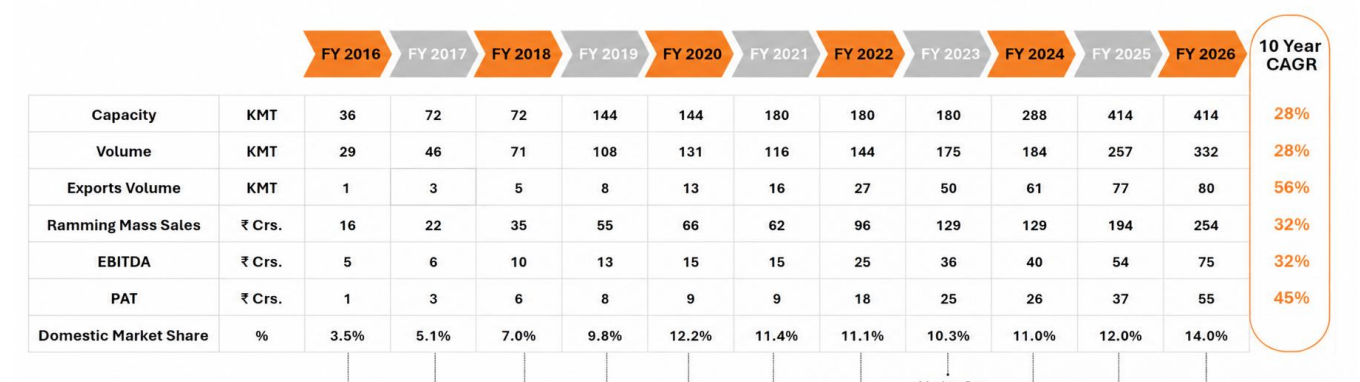
The numbers show the transformation. Between FY16 and FY26, Raghav’s ramming-mass revenue grew from ₹16 crore to ₹254 crore, a 10-year CAGR of roughly 32%. Earnings Before Interest, Tax, Depreciation, and Amortisation (EBITDA) grew at a similar pace, while profit compounded at 45%.
In Q1FY27, revenue from operations rose 48.7% YoY to ₹86.9 crore, while net profit grew faster, by 67.6% to ₹19.6 crore, pointing to operating leverage and improving profitability.
Raghav Productivity Enhancers: 10-Year Financial Performance
Source: Company Presentation
During the period, installed capacity increased from 36,000 tonnes in FY16 to 414,000 tonnes in FY26, while sales volumes rose from 29,000 tonnes to 332,000 tonnes. Domestic market share increased from 3.5% to 14%. The difference is not just scale. Raghav has gradually moved away from competing purely on price.
Absorbing More Heat Per Cycle
Ramming mass accounts for less than 0.5% of an induction furnace’s operating cost, according to the company. But a higher-quality lining can extend lining life by 25-35% more heats. That can reduce downtime and improve furnace productivity. This gives customers a reason to pay a premium for performance.
The domestic realisations for the company are around ₹8,500-10,500 per tonne, which is significantly higher than the ₹4,500-6,500 range for standard ramming mass. EBITDA per tonne has consequently increased from around ₹1,245 in FY17 to roughly ₹2,650 in Q1FY27. That pricing power is important. It means the company’s growth does not have to come entirely from India’s steel production growth.
Capacity Provides the Next Leg of Growth
Raghav ended FY26 with 414 KMT of capacity and operated at around 80% utilisation at the group level. It is expanding capacity to around 534 KMT, with the additional capacity expected to be commissioned by October 2026.
The company has also formed an 80:20 joint venture with TRL Krosaki, a subsidiary of Nippon Steel Corporation, to build a 350,000 MTPA ramming-mass plant in Odisha, with an estimated investment of around ₹100 crore. For Raghav, this could lower the cost of serving India’s eastern steel cluster while giving the company a stronger platform to expand its market share.
For investors, this makes Raghav an important test of the broader thesis: if induction-furnace volumes continue to rise, the company has both capacity and market-share levers to grow faster than the steel industry.
The key risk is that its recent growth has been unusually strong, while the stock’s valuation can reflect much of that expectation. The next few quarters will show whether higher volumes, premium realisations and market-share gains can continue together.
Raghav Productivity Enhancers: 1 Year Stock Chart
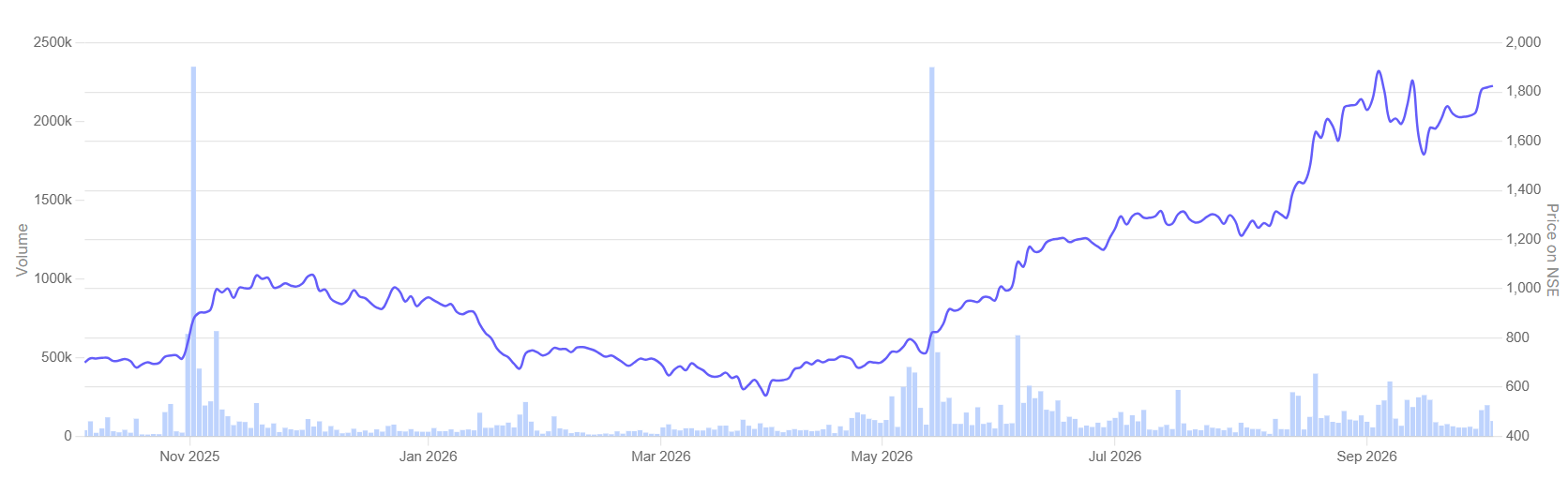
Source: Screener.in
#2. Monolithisch India: Winning on Proximity and Premiumisation
If Raghav’s strength is scale and an increasingly national footprint, Monolithisch India’s edge is more local: it is positioned close to India’s largest induction-furnace clusters.
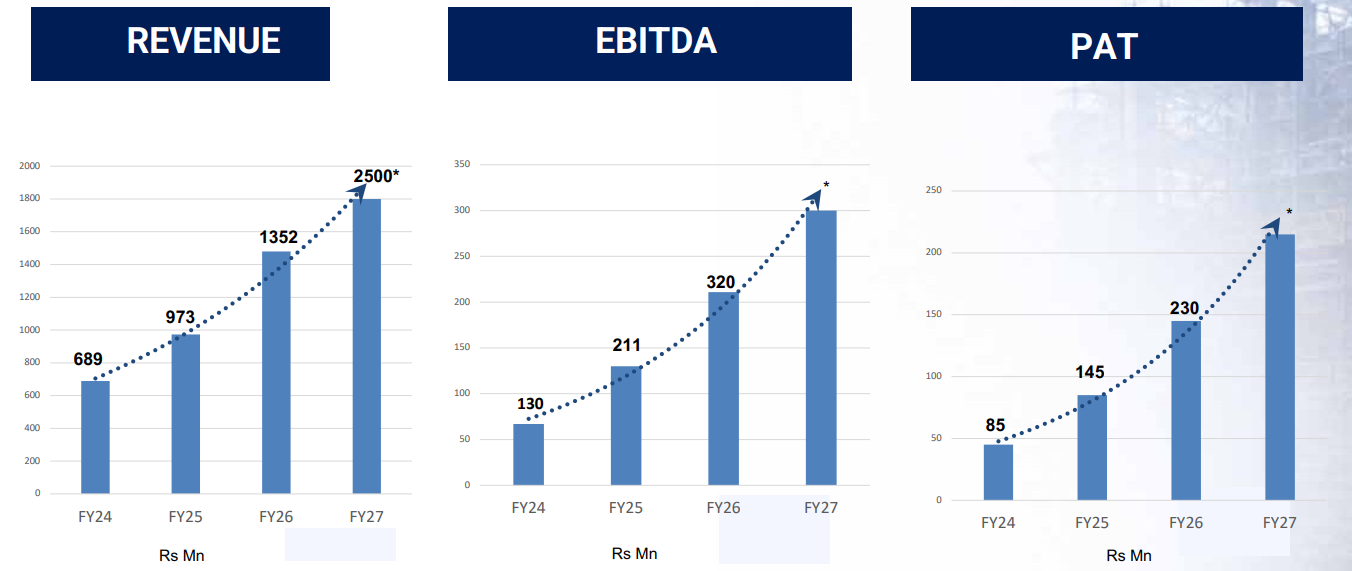
Founded in Purulia, West Bengal, the company has grown rapidly. Revenue increased from ₹68.9 crore in FY24 to ₹135.2 crore in FY26, while EBITDA rose from ₹13.1 crore to ₹32 crore. Net profit increased from ₹8.7 crore to ₹23 crore over the same period.
Monolithisch India: Three-Year Financial Performance
Source: Company Presentation
In Q1FY27, Monolithisch’s revenue from operations rose 63.3% YoY to ₹47.2 crore, while EBITDA nearly doubled to ₹13.1 crore. Net profit grew even faster, surging 134.9% to ₹10.1 crore, pointing to sharp operating leverage and margin expansion.
Monolithisch India: Quarterly Financial Performance
| Period | Q1FY26 | Q1FY27 | YoY Growth (%) |
| Revenue from Operations (₹ crore) | 28.9 | 47.2 | 63.3% |
| EBITDA (₹ crore) | 6.6 | 13.1 | 98.5% |
| Net Profit (₹ crore) | 4.3 | 10.1 | 134.9% |
Source: Company Presentation
Premiumisation is Lifting Margins
Monolithisch’s immediate earnings driver is the change in product mix. The company is focusing on selling more of its premium range of ramming mass – SGB Limited Series. Its formulation is designed to extend furnace campaign life by 15-20%. Customers pay a premium of roughly ₹700-1,000 per tonne for the product, while the incremental formulation cost is estimated at only ₹250-300 per tonne.
The shift has been rapid. SGB Limited accounted for around 15% of revenue in Q4FY26, rising to roughly 50% in Q1FY27. The company is now targeting 65% of its revenue from the SGB series product range in Q2FY27.
Monolithisch has also moved towards backward integration, securing a quartzite mineral block in Nawada, Bihar. The company expects captive sourcing to reduce raw material costs by around 40%, or roughly ₹1,200-1,500 per tonne of finished product.
If those savings and the premium product mix hold, the company has a second lever beyond volume growth. The investment case, therefore, is not simply that India’s induction-furnace base is expanding. Monolithisch is trying to capture that growth through lower logistics costs, higher-value products, and a rapidly expanding manufacturing footprint.
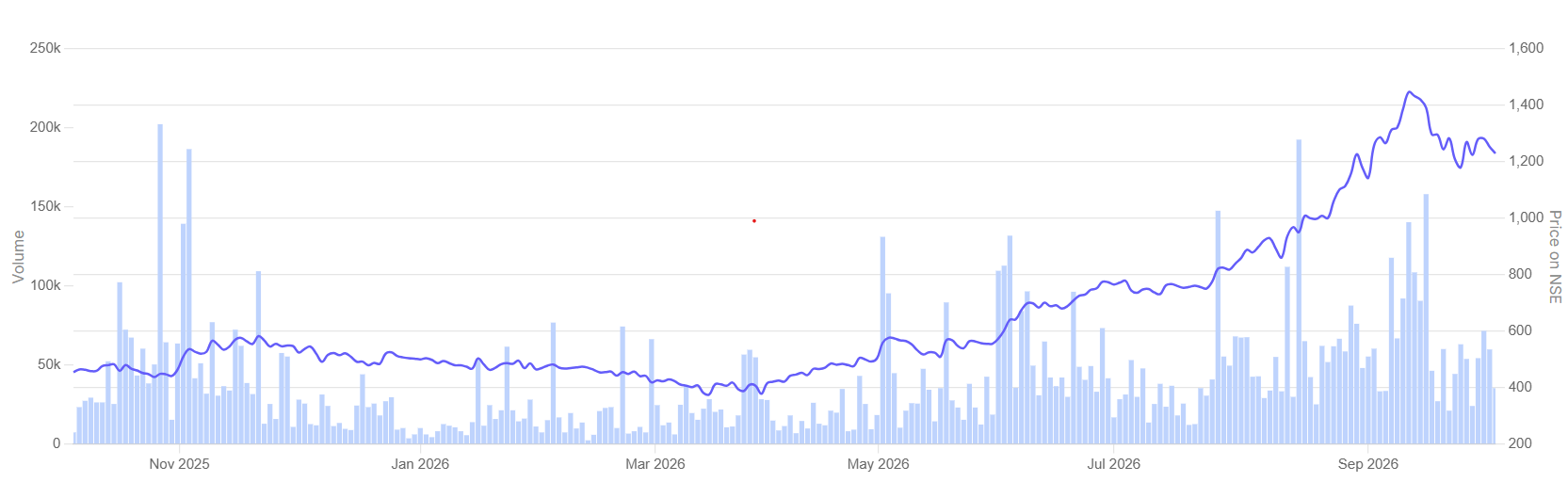
Monolithisch India: 1 Year Stock Chart
Source: Screener.in
Valuation: Growth Comes at a Premium
The market is already pricing in strong growth for both companies. Raghav Productivity Enhancers trades at a Price-to-earnings (P/E) multiple of 133x, nearly twice its five-year median of 68.9x and more than four times the industry P/E of 31.1x.
P/E Trend
| Metrics | P/E | 5-yr Median | Industry PE | Listing Platform |
| Raghav Product Enhancer | 133.0 | 68.9 | 31.06 | Mainboard (NSE/BSE) |
| Monolithisch India | 92.8 | – | NSE Emerge (SME) |
Source: Screener.in
Monolithisch India trades at a lower 92.8x P/E, but that is still a premium valuation, particularly when compared with the broader industry. The gap suggests investors are not valuing these companies as conventional refractory suppliers; they are pricing in sustained earnings growth, market-share gains, and margin expansion.
That leaves less room for execution misses. For the re-rating to sustain, earnings will need to grow fast enough to catch up with the valuations already built into the stocks.
Both companies have delivered impressive financial performance, but their listing status creates an important distinction. Raghav’s migration from the SME platform to the mainboard has improved accessibility and potentially reduced the liquidity discount attached to the stock. This gives the stock a wider potential investor base as its earnings scale.
Monolithisch India, on the other hand, continues to trade on the NSE’s SME platform, where the minimum trading lot is 250 shares. The relatively high ticket size makes entry more difficult for retail investors and can limit liquidity. Therefore, the valuation gap between the two stocks reflects not just their earnings growth, but also the difference in liquidity and investor accessibility.
The Real Bet is on Execution
India’s steel expansion creates a clear volume opportunity for furnace-consumable suppliers, and two companies are sitting at different stages of that journey. Raghav has built scale, moved to the mainboard, and is adding capacity with a strategic JV partner. Monolithisch is growing rapidly from an SME base, using its location advantage and premium products to expand margins. The opportunity is therefore bigger than simply riding higher steel output. It is about whether these companies can keep taking market share, sustain premium realisations and convert capacity expansion into earnings. The next test is whether their valuations can keep pace with that execution. Add these stocks to your watchlist and monitor how they execute their growth plans.
Disclaimer
Note: We have relied on data from www.Screener.in throughout this article. Only in cases where the data was not available, have we used an alternate, but widely used and accepted source of information.
The purpose of this article is only to share interesting charts, data points, and thought-provoking opinions. It is NOT a recommendation. If you wish to consider an investment, you are strongly advised to consult your advisor. This article is strictly for educational purposes only.
Deepan Datta has spent over a decade studying stocks and mutual funds. His passion is to uncover interesting stories in the financial markets and share them through his writings with investors at large. He is focused on delivering clear, easy-to-understand, and research-backed insights. Deepan began his career as a Research Associate at S&P Global, where he developed a strong foundation in financial research and data analysis.
Disclosure: The writer and his dependents do not hold the stocks discussed in this article.
The website managers, their employees (s), and contributors/writers/authors of articles have or may have an outstanding buy or sell position or holding in the securities, options on securities or other related investments of issuers and/or companies discussed therein. The content of the articles and the interpretation of data are solely the personal views of the contributors/ writers/authors. Investors must make their own investment decisions based on their specific objectives, resources and only after consulting such independent advisors as may be necessary.