




India’s airport privatisation drive is gathering momentum. According to an October 20 Financial Express report, the government has received in-principle approval to offer 11 airports across five bundles under the public-private partnership (PPP) model.
The proposed concessions would run for 50 years. Chennai and Kolkata airports may also be considered for privatisation in a subsequent round.
The government is also looking to limit the number of bundles awarded to a single bidder to prevent excessive concentration in the sector.
For established private airport operators, this could create fresh expansion opportunities. However, securing new concessions would depend on competitive bidding and their ability to undertake additional investments.
We identified two listed companies with established airport portfolios and direct exposure to this opportunity. But which is better positioned to benefit from the next phase of airport privatisation?
Let’s take a closer look at their existing businesses and the opportunities ahead.
#1 Adani Enterprises: Eight-Airport Portfolio Accounts for 23% of India’s Passenger Traffic
Adani Enterprises operates eight airports through its subsidiary, Adani Airport Holdings (AAHL). Its portfolio includes Mumbai, Ahmedabad, Lucknow, Jaipur and Navi Mumbai.
The company handles approximately 23% of India’s passenger traffic and 29% of air cargo volumes. This operating scale, along with its experience in developing airport infrastructure, supports its inclusion among potential beneficiaries of the government’s proposed privatisation programme.
According to its FY26 annual report, AAHL handled 95.3 million passengers, an increase of around 1% year-on-year (YoY). Cargo volumes rose 7% to 1.2 million tonnes. The company also added 24 routes, four airlines and 37 flights during the year.
Why Airport Income Rose 28% Despite Just 1% Passenger Growth
The airport business reported FY26 income of Rs 13,081 crore, up 28% YoY. Earnings before interest, tax, depreciation, and amortisation (EBITDA) increased 55% to Rs 5,394 crore. Tariff revisions and growth in commercial activities supported performance despite limited passenger growth.
The opening of Navi Mumbai International Airport on 25 December 2025 added another growth avenue. Its first phase can accommodate 20 million passengers annually. International operations commenced on 15 July 2026.
According to the July earnings-call transcript, management plans to begin construction of Navi Mumbai’s second phase during FY27. Excavation was expected to start after the monsoon.
Rs 20,000 Crore Airport-City Plan: Four Sites Under Construction, FY30 Target
AAHL is also developing commercial infrastructure around its airports. The first phase involves approximately 22 million square feet of mixed-use development, including hotels, retail outlets, offices and entertainment facilities.
Management has outlined capital expenditure of around Rs 20,000 crore, with completion targeted for FY30. Construction was underway at Ahmedabad, Mumbai, Navi Mumbai and Lucknow as of July 2026.
In September, AAHL signed agreements to raise Rs 9,825 crore from investors including Temasek, Premji Invest and BlackRock-managed funds. The proceeds will support airport expansion, commercial development and plans to increase annual passenger-handling capacity to approximately 200 million.
At the consolidated level, Adani Enterprises’ FY26 total income increased 3% YoY to Rs 1,02,943 crore. Profit attributable to shareholders rose 32% to Rs 9,339 crore, although exceptional gains contributed to reported earnings.
Adani Enterprises is yet to declare its Q2FY27 financial results. The board meeting is scheduled for 28 October 2026.
The stock trades at an EV/EBITDA of 24 times, against its five-year median of 31.7 times and a peer multiple of 25.4 times. ROCE of 5.8% and ROE of 4.5% indicate modest capital efficiency. While its airport network provides an established operating base, high capital requirements, debt servicing and passenger growth remain important considerations for future expansion.
Adani Enterprises Financial Performance
| Metric | FY26 |
| Total income | Rs 1,02,943 crore |
| Income growth | 3% YoY |
| Net profit attributable to shareholders | Rs 9,339 crore |
| Profit growth | 32% YoY |
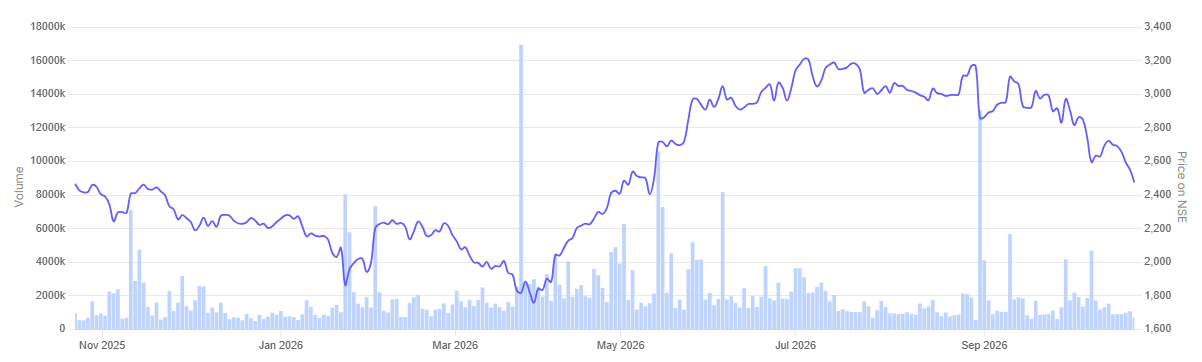
In the past year, the share price of Adani Enterprises is up marginally 0.6%.
Adani Enterprises 1-Year Share Price Chart
#2 GMR Airports: 121.6 Million Passengers, 27% Share of India’s Air Traffic
GMR Airports operates major airports including Delhi, Hyderabad and Goa’s Mopa airport. Its portfolio also includes overseas operations in Indonesia and airport development projects in Greece.
According to the FY26 annual report, the company handled 121.6 million passengers across its portfolio in FY26. Its Indian airports accounted for approximately 27% of the country’s passenger traffic and 34% of air cargo volumes.
This operating scale, experience in airport development and partnership with France’s Groupe ADP support its inclusion among companies that could participate in India’s next airport privatisation round.
Why Airport Income Rose 40% Despite Less Than 1% Passenger Growth
Passenger traffic increased just 0.9% YoY in FY26, but financial performance improved considerably. Revised aeronautical tariffs at Delhi and expansion of commercial businesses supported earnings. Combined aeronautical revenue per passenger across Delhi, Hyderabad and Mopa rose 62% to Rs 433.
The FY26 annual report also shows that consolidated revenue from operations increased 42.2% YoY to Rs 14,807 crore. EBITDA rose 47% to Rs 6,150 crore. The company reported a net profit of Rs 472 crore, against a loss of Rs 817 crore in FY25.
Growth beyond passenger charges remains important. GMR took over duty-free operations at Delhi and Hyderabad during FY26. It also secured the concession for Delhi’s Cargo Terminal 1 and is developing cargo infrastructure across 50.5 acres.
Delhi Traffic Rises 5% as Hyderabad and Goa Record Double-Digit Declines
The company’s September 2026 traffic update shows contrasting trends.
Delhi handled 38.5 million passengers in H1FY27, up 5% YoY. However, Hyderabad traffic declined 11.7% to 13.6 million, while Mopa fell 14.4% to 2 million. Overall portfolio traffic, excluding Cebu, increased just 0.5% to 58.2 million.
Airline route rationalisation and disruptions linked to West Asian geopolitical tensions weighed on passenger growth.
Meanwhile, GMR added two airports to its operating network. It took over Nagpur Airport on 25 June 2026. The greenfield Bhogapuram Airport commenced commercial operations on 17 August. Bhogapuram has an initial annual capacity of six million passengers, expandable to 40 million.
GMR Airports is yet to declare its Q2FY27 financial results.
The stock trades at an EV/EBITDA of 20 times, below its five-year median of 24.8 times. ROCE stands at 11.6%. However, FY26 finance costs of approximately Rs 3,859 crore highlight the capital-intensive nature of the business. Recovering passenger growth, managing debt and generating returns from new airport concessions will remain important.
GMR Airports Financial Performance
| Metric | FY26 |
| Revenue from operations | Rs 14,807 crore |
| Revenue growth | 42.2% YoY |
| Net profit | Rs 472 crore |
| Profit growth | Turned profitable from Rs 817 crore loss in FY25 |
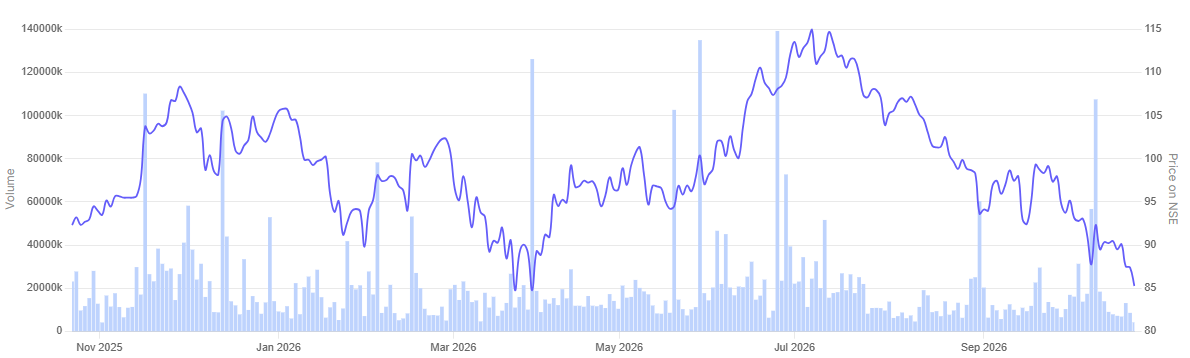
In the past year, GMR Airports’ share price has declined 7.8%. GMR Airports 1-Year Share Price Chart
11 Airports, Rs 8,622 Crore Investment: Where Does the Real Opportunity Lie?
The proposed privatisation is not simply about adding more airports to existing portfolios. The five bundles combine larger airports, such as Varanasi and Bhubaneswar, with smaller facilities like Gaya, Kushinagar and Hubballi. The idea is to use revenue from busier airports to support the development of smaller ones.
The government expects around Rs 8,622 crore in private investment across these airports. For Adani and GMR, this could create opportunities to expand passenger operations and develop additional commercial revenue streams.
However, the bidding will be based on per-passenger fees payable to the Airports Authority of India. This makes traffic potential, commercial development opportunities and bidding costs particularly important. The ability to turn smaller airports into financially viable operations could ultimately determine the returns from these concessions.
Adani Enterprises vs GMR Airports: How Do the Two Operators Compare?
Both companies have established airport portfolios, but differ in operating scale and financial metrics. Here is how they compare.
| Metric | Adani Enterprises | GMR Airports |
| FY26 passenger traffic at Indian airports | 95.3 million | 114.6 million |
| Share of India’s passenger traffic | 23% | 27% |
| Share of India’s air cargo volumes | 29% | 34% |
| EV/EBITDA | 24x | 20x |
| Five-year median EV/EBITDA | 31.7x | 24.8x |
| ROCE | 5.8% | 11.6% |
Note: Passenger and cargo figures relate to airport operations. Valuation and ROCE metrics are for the listed companies.
GMR handles more passengers and cargo, while also reporting a higher ROCE and lower EV/EBITDA multiple. Adani Enterprises has an established airport network but offers exposure to several other infrastructure businesses. For both operators, the ability to fund new concessions while improving returns on existing assets will be important.
Conclusion
India’s proposed privatisation of 11 airports could create fresh growth opportunities for established operators. However, winning new concessions is only part of the equation. The cost of acquiring operating rights, future capital expenditure and passenger growth will determine whether these investments generate attractive returns.
GMR Airports currently leads on passenger traffic and ROCE, while Adani Enterprises has a diversified infrastructure portfolio and an expanding airport business. Both are investing in commercial activities to increase earnings beyond passenger-related charges.
For investors, the key will be whether these companies can expand without placing excessive pressure on their balance sheets. Regulatory approvals, tariff revisions, debt servicing and returns on new investments remain important risks. The proposed bidding process offers an opportunity, but does not guarantee higher profitability or shareholder returns.
You can track how these are progressing by adding stocks to your watchlist.
Disclaimer:
Note: We have relied on data from www.Screener.in throughout this article. Only in cases where the data was not available, have we used an alternate, but widely used and accepted source of information.
The purpose of this article is only to share interesting charts, data points and thought-provoking opinions. It is NOT a recommendation. If you wish to consider an investment, you are strongly advised to consult your advisor. This article is strictly for educative purposes only.
Ekta Sonecha Desai has a passion for writing and a deep interest in the equity markets. Combined with an analytical approach, she likes to deep dive into the world of companies, studying their performance, and uncovering insights that bring value to her readers.
Disclosure: The writer and her dependents do not hold the stocks discussed in this article.
The website managers, its employee(s), and contributors/writers/authors of articles have or may have an outstanding buy or sell position or holding in the securities, options on securities or other related investments of issuers and/or companies discussed therein. The content of the articles and the interpretation of data are solely the personal views of the contributors/ writers/authors. Investors must make their own investment decisions based on their specific objectives, resources and only after consulting such independent advisors as may be necessary.