




The next aerospace and defence opportunity may not sit inside the aircraft or the missile. It may sit in the supply chain that builds them. Commercial aircraft backlogs have crossed $1 trillion, covering around 15,000 aircraft. Rising air travel and years of delayed fleet replacement are driving this demand.
At the same time, global military spending reached a record $2.9 trillion in 2025. Defence backlogs have also risen sharply over the past three years. But demand is only one part of the story. The aerospace industry is also changing where it manufactures.
Geopolitical tensions, trade restrictions and supply disruptions have made companies rethink their supply chains. Global Original Equipment Manufacturers (OEMs) are looking at multiple manufacturing locations. This is creating a gradual China+1 shift, with India emerging as one of the countries being considered for alternative supply capacity.
India enters this cycle with two sources of demand. The first is domestic. India’s aerospace and defence market was worth around $30.72 billion in 2025 and is expected to grow at a 7.1% CAGR through 2035. Defence production has already reached ₹1.78 lakh crore in FY26, while Defence exports have also reached a record ₹38,424 crore.
The second is global sourcing. India is becoming part of the supply chain for some of the world’s largest aerospace companies. Airbus now sources more than $1.5 billion annually from India and has 100+ Indian companies supplying components for its global programmes. The company expects its sourcing from India to cross $2 billion well before the end of the decade.
The opportunity, therefore, extends beyond aircraft assembly or large defence platforms. Indian companies are supplying aerostructures, forgings, electronics and other components.
Against this backdrop, the focus is shifting towards Indian companies that could benefit from both rising domestic defence spending and the global shift towards diversified aerospace supply chains. Against this backdrop, we look at two companies that could benefit.
#1 Sigma Advanced Systems: The Turnaround to Tier-1 Global Status
Sigma Advanced Systems Limited is an integrated aerospace and defence company. It has evolved from a domestic defence manufacturer into a Tier-1 global firm. Sigma operates across several key segments of the aerospace and defence value chain. The product portfolio supports demanding applications where switching costs are high and qualifications are stringent.
This includes aero-engines and aerostructures, defence electronics and avionics. In defence, the product portfolio includes counter-UAS and autonomous systems, as well as munitions and naval systems. It provides precision components, sub-systems, complex assemblies and proprietary technologies in India, the UK and Europe.
The ₹3,800 Cr Rolls-Royce Anchor & UK Expansion
The company serves major global OEMs including Rolls-Royce, Airbus, Boeing, General Electric (GE Aerospace), Safran, and Lockheed Martin. Sigma holds a major long-term agreement (LTA) with Rolls-Royce valued at about ₹3,800 crore. In August 2026, its UK subsidiary secured an additional LTA worth ₹1,600 Crore to supply complex engine structures.
Decoding the ₹9,600+ Crore Order Book
Sigma has a consolidated order book of over ₹8,000 crore (as of April 2026). This has increased to ₹9,600+ crore after receiving a new long-term contract in August 2026. Approximately 75% of the company’s total order book is directly tied to the aerospace sector.
In the Aerospace segment, approximately 66% of the order book comes from high-barrier, complex aero-engine programs. Over 90% of the order book comes from international markets, with multi-year contracts ranging from 7 to 8 years. This provides strong revenue visibility going forward.
The Shift to Indian Manufacturing & Margin Expansion
Sigma aims to integrate UK aerospace qualifications with Indian manufacturing economics. Initial qualifications are conducted in UK facilities. These qualified programs can be transferred to low-cost Indian manufacturing facilities within 4 to 6 months. To this end, the company plans to commercialise operations in Q3FY27 at Sri City, Andhra Pradesh.
Management expects this to expand EBITDA (Earnings Before Interest, Tax, Depreciation, and Amortisation) margins by 200-400 bps by the end of FY27. Margins are expected to further expand by 400-600 bps by FY28. Vacant capacity in the UK will be filled with high-margin defence work.
Q1FY27 Financials: Revenue Surge Amidst Margin Squeeze
In Q1FY27, total operating revenues reached ₹374 crore, up 16% sequentially (over Q4FY26). Of this, the aerospace business accounted for 61.2% (₹229 crore), defence exports for 27.8% (₹104 crore), and defence-domestic for 11.0% (₹41 crore).
Operating EBITDA increased 11% quarter-on-quarter to ₹61 crore. EBITDA margin declined slightly to 16% from 17%. This reflects the scaling of the UK businesses acquired by the group before transferring lower-cost Indian work. However, net profit declined to ₹38 crore from ₹125 crore in Q4FY26 due to large one-offs, including other income of ₹91 crore.
Key Operational & Integration Risks
Key operational risks include programme execution delays and challenges in integrating recent acquisitions. Additionally, supply-chain disruptions and working-capital pressures could pose financial risks.
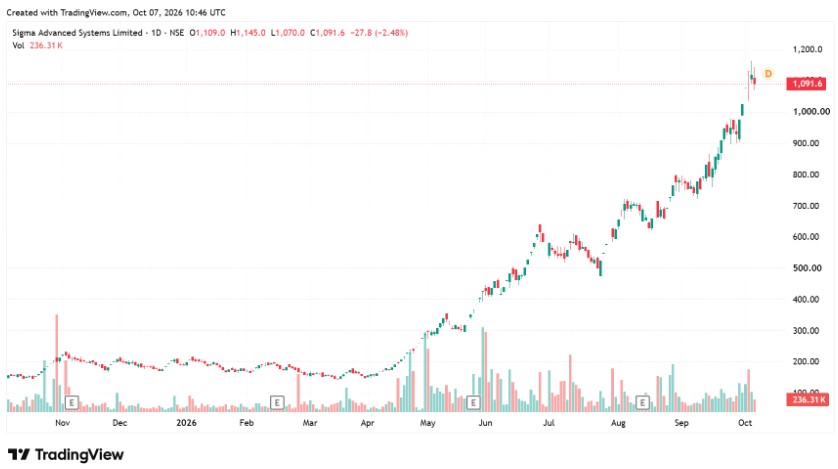
Sigma Advanced Share Price is up 484% in one year
#2 Rossell Techsys: Moving Up the Value Chain
Rossell Techsys is a Tier-2 partner to leading global OEMs. Its presence spans the Aerospace & Defence, Semiconductor, and Space sectors. The company operates from a plant in Bengaluru and the USA.
Its core product portfolio for aerospace includes electrical wiring, electrical panel assembly, avionics and mission systems integration, automated test solutions, and aftermarket, maintenance, repair, and overhaul.
Embedded in US Military Platforms & Global Scale
Today, Rossell Techsys’s components and assemblies are embedded in nearly every US military platform. It provides full lifecycle Build-to-Print (manufacturing as per customer blueprints) and Build-to-Specification engineering solutions. It maintains long-standing, multi-year relationships with 30+ marquee global customers across 8 countries.
These relationships average 8 to 12 years and serve as a strong competitive moat against new entrants. Clients include Boeing, Lockheed Martin, Honeywell, and other major OEMs. The company is actively moving up the aerospace value chain. To this end, it is transitioning from a wire harness manufacturer into electromechanical integrated systems and assemblies.
Moving Up the Value Chain & Margin Expansion
Management estimates this transition will increase content share and boost operating margins from the historical 17-22% range to 21-30%. This aligns with Rossell Techsys plan to grow its revenue per platform 3x to 5x on existing military and commercial programs. The long-term goal is to expand build contribution on aircraft from 2% up to 15-25%.
Q1FY27 Financials & The ₹4,500 Crore Pipeline
Management also plans to deepen its presence in major commercial aircraft platforms. As of June 30, 2026, it has ₹800 crore in confirmed purchase orders. In addition, it holds multi-year strategic agreements worth over ₹3,000 crore. These agreements provide long-term revenue visibility over 3 to 5 years. The active pipeline is ₹4,500 crore across its business segments.
Financially, the company’s revenue grew 78% year-over-year to ₹154.7 crore. EBITDA increased 95% to ₹23.3 crore, with margins at 15.1%. Net profit more than doubled to ₹7.1 crore from ₹3.3 crore in Q1FY26. Management is targeting revenue growth of 80-90% for FY27. FY27 revenue is projected to split evenly at 50% Aerospace & Defence and 50% non-Aerospace & Defence.
Key Operational Risks & Vulnerabilities
EBITDA margins for core competencies are guided in the 17% to 22% range. On the risk side, customer concentration and geographical risk (98-99% from exports), supply chain vulnerabilities, and multi-year pricing risk.
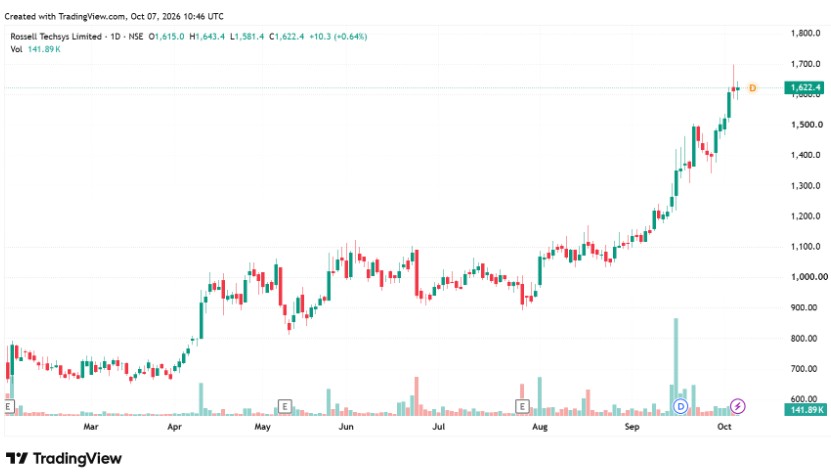
Rossell Techsys Share Price is up 134% in 1 year
Valuation Check: High Multiples vs. Execution Visibility
Sigma Advanced boasts a higher Return on Capital Employed (ROCE) than Rossell Techsys. Meanwhile, Rossell has a higher Return on Equity (ROE) while Sigma’s ROE is negative as it has recently turned profitable.
Valuation-wise, after delivering multibagger returns in the last one year, both companies are now trading at a significant premium to the industry median. Sigma is also trading at a premium to its three-year historical median valuation.
| Peer Comparison (X) | ||||
| Company | Price-to-Earnings Multiple | Return Ratios | ||
| Company | 5Y Median | ROCE (%) | ROE (%) | |
| Sigma Advanced | 127.0 | 61.2 | 11.7 | -4.0 |
| Rossell Techsys | 225.0 | NA | 11.5 | 15.7 |
| Industry | 78.6 | 14.5 | 11.4 | |
| Source: Screener.in (Data as of October 06 2026) | ||||
The China+1 shift has opened up a big opportunity for India across industries. Global OEMs in aerospace and defense need qualified suppliers who can support programs for years. Sigma Advanced Systems and Rossell Techsys are already moving in that direction.
Sigma combines a large aerospace order book with global engine programmes and is shifting more manufacturing to India. Rossell has long-duration relationships with global OEMs and is moving from wiring and components towards higher-value integrated systems. The opportunity is visible while valuations remain elevated.
You can keep these names on your watchlist to track their execution.
Disclaimer
Note: Throughout this article, we have relied on data from http://www.Screener.in and the company’s investor presentation. Only in cases where the data was unavailable have we used an alternative, widely used and accepted source of information.
The purpose of this article is only to share interesting charts, data points, and thought-provoking opinions. It is NOT a recommendation. If you wish to consider an investment, you are strongly advised to consult your advisor. This article is strictly for educational purposes only.
About the Author: Madhvendra has been deeply immersed in the equity markets for over seven years, combining his passion for investing with his expertise in financial writing. With a knack for simplifying complex concepts, he enjoys sharing his honest perspectives on startups, listed Indian companies, and macroeconomic trends.
A dedicated reader and storyteller, Madhvendra thrives on uncovering insights that inspire his audience to deepen their understanding of the financial world.
Disclosure: The writer and his dependents do not hold the stocks discussed in this article.
The website managers, its employee(s), and contributors/writers/authors of articles have or may have an outstanding buy or sell position or holding in the securities, options on securities, or other related investments of issuers and/or companies discussed therein. The articles’ content and data interpretation are solely the personal views of the contributors/ writers/authors. Investors must make their own investment decisions based on their specific objectives, resources, and only after consulting such independent advisors as may be necessary.