




India’s solar pump market is moving from a policy-led opportunity to a large replacement cycle. The market grew from just ₹170 crore in FY19 to ₹16,450 crore in FY25. By FY30, it is estimated to reach ₹27,110 crore. Agriculture is driving most of this demand, accounting for 99% of solar pump demand in FY25.
Macro Landscape: Sizing India’s ₹3.6 Lakh Crore Solar Irrigation Shift
But the larger opportunity sits beyond the current market size. India has around 80 lakh diesel pumps on farms, creating an estimated ₹1,20,000 crore replacement opportunity. Another 11.4 crore farmers lack access to pumps, offering an untapped market worth ₹2,41,200 crore. In total the opportunity for solar agricultural pumps in India is estimated at ₹3,61,200 crore.
Government policy is adding another layer to this demand. Under PM-KUSUM, India aims to solarise 1.4 crore agricultural pumps. Yet, as of July 2026, only around 11.7 lakh solar pumps had been installed under the scheme. This leaves a significant gap between the target and current deployment.
To bridge the gap, the Indian government launched the PM-KUSUM 2.0 scheme with an outlay of ₹34,422 crore. The economics also make the shift relevant. Replacing diesel-powered irrigation with solar can save a farming family ₹50,000-80,000 a year in fuel costs.
Against this backdrop, this article examines two leading players in the solar pump industry, with a significant share of their revenue derived from the solar pump business.
#1 Shakti Pumps:
Solar Pumps serve as the primary growth engine and core business for Shakti Pumps (India) Limited. The company maintains an integrated manufacturing setup for solar pumping solutions in India. Shakti Pumps holds an estimated 25% market share under the PM-KUSUM Scheme.
It has deployed 2.6+ lakh solar pumps to date (including 1.9+ lakh under PM-KUSUM). In FY26, the company installed 20% more solar pumps than last year, at 86,086. Solar pump installations grew 57.6% year-on-year to 27,678 pumps in Q1FY27, up from 17,557 pumps in Q1FY26.
Order Book Strength and State Tender Execution
As of July 22, 2026, Shakti Pumps holds a B2G-dominated order book of approximately ₹1,000 crore. Management expects this order book to be executed over the next two quarters. Major order pipelines come from Maharashtra’s Magel Tyala Saur Krushi Pump Yojana (10 lakh pump target over 5 years) and Karnataka (where Shakti holds an order book of ₹476 crore.
The primary drivers are Component B (standalone pumps) and Component C (solarisation of grid pumps). The upcoming rollout of PM-KUSUM 2.0 is expected to further expand demand for off-grid pumps, feeder-level solarisation, and agrivoltaics.
Backward Integration: Securing Margins with 2.2 GW Solar Plant
Shakti Pumps manufactures pumps, motors, controllers, inverters, and mounting structures in-house. Domestic Content Requirement cells make up 40-50% of a solar pump set’s total cost. To reduce reliance on third-party cell suppliers and protect margins, Shakti Pumps is building a 2.2 GW solar DCR cell & PV module plant.
The initial 0.5 GW module capacity is set for commissioning in September 2026. To reduce reliance on volatile government tenders, Shakti Pumps has scaled its retail channel to 100+ exclusive outlets, generating ₹24 crore in Q1FY27 and ₹77.4 crore in FY26. Overseas solar pump projects generated ₹411 crore in FY26 revenue.
Long-Term Outlook: Targeting ₹5,000 Crore Revenue by FY29
Looking ahead, Shakti Pumps’ management has targeted reaching ₹5,000 crore in consolidated revenue by FY29 across its integrated portfolio. Beyond government tenders, the addressable opportunity includes 80-90 lakh diesel pumps awaiting replacement with solar alternatives, along with an estimated overall demand of 120 to 135 lakh solar pumps across India.
The company is investing ₹1,700 crore to double its pump and motor capacity to 10 lakh units; the new lines are expected to become operational from the third quarter of FY27 (Q3FY27). Inverter and Variable Frequency Drive capacity has doubled to 4,00,000 units per annum.
This expansion aims to position Shakti as an integrated solutions provider for the PM Surya Ghar program. Shakti Pumps has onboarded 90+ dealers and registered as a brand owner under the government’s 1-crore household program.
Financial Performance: Revenue Expands 38% Amid Raw Material Cost Pressure
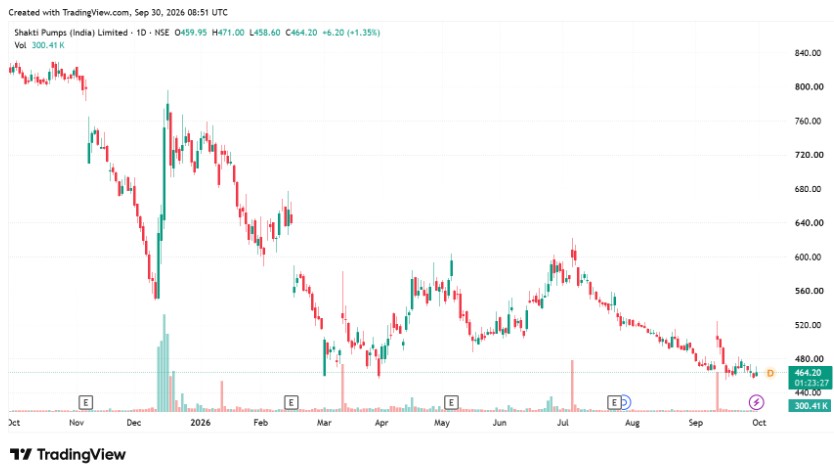
Financially, revenue from operations grew by 37.9% year-on-year to ₹858.7 crore. EBITDA (Earnings Before Interest, Tax, Depreciation, and Amortisation) fell 42.3% to ₹82.9 crore. EBITDA Margins shrank 1,350 bps to 9.6% due to raw material inflation. Net profit declined 46.7% to ₹51.6 crore.
#2 Oswal Pumps
Oswal Pumps is an integrated manufacturer and turnkey provider of solar pumping solutions. It manufactures and supplies solar-powered and grid-connected submersible pumps, monoblock pumps and electric motors. Other products include solar PV modules and complete turnkey solar pumping systems under the “Oswal” brand.
Agriculture is its primary end-use sector (accounting for 83.6% of FY26 revenue), followed by residential (15.5%) and industrial applications (0.9%). The company’s operation is supported by a commercial network of 1,406 distributors and 220 authorised service centres across 16 states.
Order Pipeline and PM-KUSUM Market Foothold
Oswal Pumps is a leading provider under the central government’s PM-KUSUM scheme. It has cumulatively executed 1,19,402 solar pumping systems across 13 states. The company holds an estimated 27% market share as of April 30, 2026. During Q1 FY27, Oswal Pumps supplied a total of 43,077 pumps ( 19,724 solar + 23,353 non-solar).
Income from government schemes accounts for 67.6% (₹300 crore) of the total product income of ₹443.5 crore. Non-government business constitute 32.4% of the total income. As of July 31, 2026, Oswal holds a pump order of 22,025 units. The near-term pipeline exceeds 12,500 pumps across PM-KUSUM, state schemes, and exports.
Medium-Term Growth Targets and KUSUM 2.0 Inflexion
Management has guided for revenue growth of 20% to 25% for FY27. Growth is expected to be back-ended through the year, picking up in H2 FY27. EBITDA range is maintained at 15-17%. Over the medium term (FY28 and FY29), management targets a revenue CAGR of 30-40% as new business verticals reach scale.
Management expects the rollout of PM-KUSUM 2.0 to serve as a major order flow inflexion point during FY2027. Oswal has already developed a 4G IoT remote monitoring unit to comply with the smart monitoring mandate under Kusum 2.0. It is also completing capacity expansion by Q3FY27.
Vertical Expansion: Entering Rooftop Solar and C&I Projects
To reduce dependence on core government agricultural schemes like PM-KUSUM, Oswal Pumps is rapidly expanding into four new verticals. This includes Rooftop Solar, Commercial, Industrial & Utility Solar (C&I), Industrial Pumps and Jal Jeevan Mission. It is targeting 2,00,000 household solar installations in FY27. Management projects this to generate ₹800-1,000 crore in revenue.
Commercial launch of the industrial pump lines is scheduled for FY27. The company has also identified an addressable pipeline of 42,000 pumps. Oswal Pumps is also launching wire and cable and solar channel sales through existing distribution networks. In C&I, the current order book is 72 megawatts (MW), supported by an active pipeline of 359 MW.
Financial Headwinds: Margin Pressures Drive 47% EBITDA Contraction
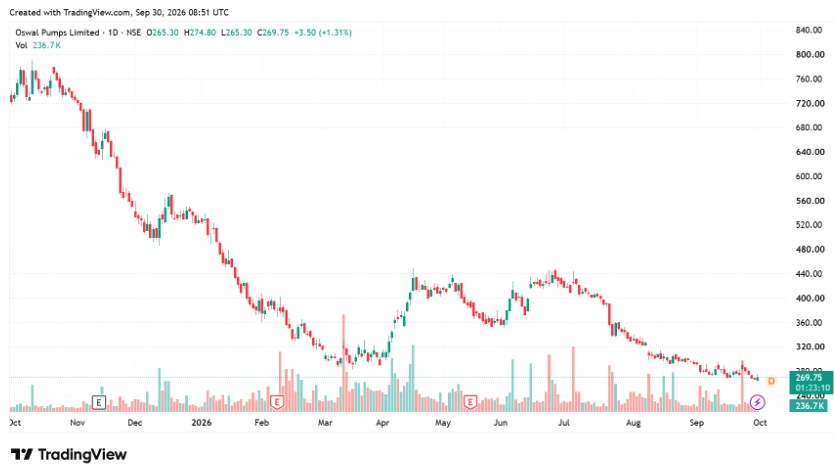
From a financial perspective, revenue declined by 7.9% year-on-year to ₹473.6 crore in Q1FY27. Operating EBITDA declined 47.2% to ₹74.3 crore. Overall margin contracted 1169 bps to 15.7%. Net profit fell 43.1% to ₹53.8 crore. Financials weakened due to execution schedules, project award timing, competitive tender pricing and delayed nationwide rollout of PM-KUSUM 2.0.
Here’s a summary of where each of these companies is at this juncture:
| Particulars (Q1FY27) | Shakti Pumps | Oswal Pumps |
| Revenue (₹ crore) | 858.7 | 473.6 |
| YoY Growth (%) | +37.9 | -7.9 |
| Net Profit (₹ crore) | 51.6 | 53.8 |
| YoY Growth (%) | -46.7 | -43.1 |
| Order Book | ₹1,000 crore | 22,025 Units |
| Source: Management Commentaries and Investor Presentations | ||
Shakti Pumps delivered stronger revenue growth, while Oswal Pumps saw a decline. However, both companies reported sharp drops in net profit, highlighting near-term margin and execution pressures.
Execution Reality: Profit Compression Behind the Volume Surge
Oswal Pumps has a higher Return on Capital Employed (ROCE) and Return on Equity (ROE) than Shakti Pumps. In terms of valuation, Shakti Pumps is trading at a discount to the industry average, but at a slight premium to the 5-year historical average. Oswal Pumps trades at a deep discount to industry valuation.
| Peer Comparison (X) | |||||
Company | Price-to-Earnings Multiple | Return Ratios | |||
| Company | 5Y Median | Industry | ROCE (%) | ROE (%) | |
| Shakti Pumps | 26.9 | 25.5 | 42.3 | 23.6 | 18.0 |
| Oswal Pumps | 9.1 | NA | 48.1 | 38.2 | 35.2 |
| Source: Screener.in (Data as of September 30 2026) | |||||
The solar pump market has already grown sharply, but the bigger number is the gap between what exists today and what could be deployed over the next several years. With around 80 lakh diesel pumps still operating and only about 11.7 lakh solar pumps installed under PM-KUSUM so far, the transition has a long way to go.
That gap explains why the next phase could be more about execution. Shakti Pumps is adding manufacturing capacity and building backward integration. Oswal Pumps is expanding beyond agricultural pumps into rooftop, C&I and industrial solar applications. Both are also preparing for the technology requirements expected under PM-KUSUM 2.0.
However, the near-term numbers show that this transition will not be linear. Both companies reported a sharp decline in net profit in Q1FY27, while margin pressure remains a key factor to watch. Thus, the key question is how efficiently these companies can convert the upcoming demand into revenue, margins and cash flows.
That said, keep these names on your watchlist to track their execution.
Disclaimer
Note: Throughout this article, we have relied on data from http://www.Screener.in and the company’s investor presentation. Only in cases where the data was unavailable have we used an alternative, widely used and accepted source of information.
The purpose of this article is only to share interesting charts, data points, and thought-provoking opinions. It is NOT a recommendation. If you wish to consider an investment, you are strongly advised to consult your advisor. This article is strictly for educational purposes only.
About the Author: Madhvendra has been deeply immersed in the equity markets for over seven years, combining his passion for investing with his expertise in financial writing. With a knack for simplifying complex concepts, he enjoys sharing his honest perspectives on startups, listed Indian companies, and macroeconomic trends.
A dedicated reader and storyteller, Madhvendra thrives on uncovering insights that inspire his audience to deepen their understanding of the financial world.
Disclosure: The writer and his dependents do not hold the stocks discussed in this article.
The website managers, its employee(s), and contributors/writers/authors of articles have or may have an outstanding buy or sell position or holding in the securities, options on securities, or other related investments of issuers and/or companies discussed therein. The articles’ content and data interpretation are solely the personal views of the contributors/ writers/authors. Investors must make their own investment decisions based on their specific objectives, resources, and only after consulting such independent advisors as may be necessary.