


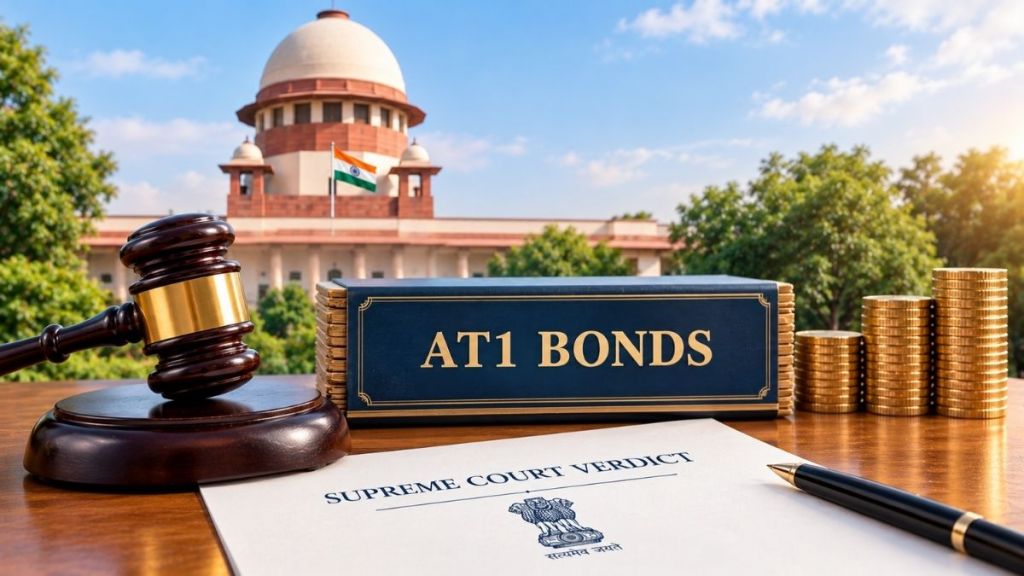

The Supreme Court’s decision to strike down YES Bank’s Rs 8,415-crore additional tier-1 (AT1) bond write-off could prove to be a turning point for India’s debt market. By reinforcing investor rights and the sanctity of contractual obligations, the landmark ruling is expected to restore confidence in these high-risk instruments, lower risk premiums and make it easier for banks to raise capital.
Market experts believe the judgment could have implications well beyond YES Bank, particularly for the pricing and issuance of AT1 bonds.
“The judgment is positive for the bond market, as it reinforces the sanctity of contractual terms. By providing greater certainty, it should support investor confidence and aid the development of India’s bond market,” said Shruti Kanodia, managing partner at Sagus Legal.
Vishal Goenka, co-founder of IndiaBonds, agreed. “This is a welcome step. AT1 bonds inherently carry far greater risk than other fixed-income instruments because of their loss-absorption feature. It is therefore a pro-investor move and should provide greater clarity on where AT1 bonds rank within a bank’s capital structure.”
AT1 bonds are perpetual debt instruments issued by banks to strengthen their capital buffers under Basel III regulations. Unlike conventional bonds, they have no fixed maturity and carry higher loss-absorption risks. They rank below other debt instruments but above common equity in the capital structure.
Investors accept these risks in exchange for higher coupon payments. Currently, AT1 bonds issued by highly rated Indian banks offer yields of around 7.5-9%.
The controversy surrounding AT1 bondholder rights is not unique to India. In March 2023, Swiss regulator FINMA ordered the write-off of more than $20 billion worth of Credit Suisse AT1 bonds as part of the bank’s emergency takeover by UBS. The move triggered investor outrage and legal challenges. In 2025, a Swiss court ruled that the write-off was unlawful, intensifying the global debate over the treatment of these instruments during banking crises.
In India, the immediate impact of the Supreme Court ruling could be reflected in AT1 bond valuations. Experts expect the risk premium demanded by investors to narrow as uncertainty over the enforceability of contractual terms eases.
“The ruling should lead to repricing, as the uncertainty premium that previously weighed on the asset class may no longer apply. AT1 bonds may now be viewed more clearly as an integral part of a bank’s capital structure and as obligations that, barring specific trigger events under Basel III norms, are expected to be honoured,” said Amar Koradia, director and head of fixed income at Client Associates.
Koradia, however, cautioned that the judgment does not eliminate the inherent risks associated with these instruments. “Over the next decade, the ruling could prove to be a defining moment for India’s debt markets. From an investor confidence perspective, it reinforces the belief that financial institutions cannot arbitrarily make investors bear the full brunt of institutional failures,” he said.
Kanodia said the 2020 write-off had affected AT1 bond pricing and created challenges for several banks. Following the Supreme Court ruling, yields could soften as investor confidence improves. However, she pointed out that AT1 bonds remain a discretionary source of capital, with not all banks opting to issue them.
According to Prime Database, there have been just 62 AT1 bond issuances since 2020, aggregating Rs 1.18 lakh crore. In FY26, State Bank of India and Canara Bank raised Rs 4,691 crore and Rs 2,042 crore, respectively, through these instruments.
The YES Bank crisis also prompted tighter regulatory safeguards. In October 2020, the Securities and Exchange Board of India (Sebi) restricted participation in primary issuances of AT1 bonds to qualified institutional buyers, with a minimum investment of Rs 1 crore. In the secondary market, all categories of investors are permitted to participate, subject to the same minimum lot size.
While YES Bank bondholders may consider exiting once their investments are restored and compensation issues are resolved, the broader market could benefit from renewed investor confidence.