




India’s proposed insurance reforms could leave SBI Life Insurance, Niva Bupa Health Insurance and Star Health and Allied Insurance Company Ltd. with very different cost-adjustment tasks, despite all three being covered by the same proposed expense-of-management framework. Nomura’s analysis shows the gap clearly: SBI Life Insurance Company Ltd. starts with a much lower expense base, while Niva Bupa and Star Health would need more substantial changes to reach the proposed limits.
The brokerage’s assessment also shows that commission caps could have very different effects across insurers. For SBI Life, Nomura estimates the benefit from lower commissions could cover the entire required EOM reduction. Niva Bupa could meet a large part of its requirement through commission savings and operating leverage, while Star Health would need a much larger reduction in operating costs.
Nomura on SBI Life: ‘Buy’
SBI Life starts with the lowest expense-of-management ratio among the insurers covered in Nomura’s analysis, at 10.6% in FY26.
The brokerage estimates that the company would need to reduce its EOM by 0.6 percentage point over five years to meet the proposed framework. Its analysis shows no additional operating-cost reduction requirement after accounting for the estimated impact of the new commission caps.
Nomura’s estimates put SBI Life’s premium CAGR at 15% between FY26 and FY29F, while VNB CAGR is also estimated at 15% over FY26-29F.
The brokerage has a ‘Buy’ rating on SBI Life.
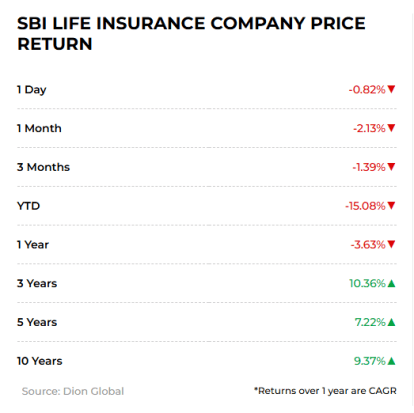
SBI Life share price performance
Nomura on Niva Bupa: ‘Buy’
Niva Bupa starts from a much higher EOM base, but management has indicated that it is comfortable with the proposed limits.
“Management believes that both commission caps and operating leverage will help them record the 25%-20% EOM cap,” Nomura said, referring to the proposed limits that are to be achieved over the next two and five years.
Nomura estimates Niva Bupa’s FY26 EOM at 35.2% and calculates that the company needs a 15.2 percentage-point reduction over five years. Of this, the brokerage estimates that 9.1 percentage points could come from lower commissions, leaving 6.2 percentage points to be addressed through operating-cost reductions.
The company is also comfortable with agency, direct and bancassurance channels in its retail health portfolio, according to Nomura. In group business, management is looking to form new partnerships to offset possible pressure from lower volumes.
On pricing, Niva Bupa plans to maintain prices steady for an extended period rather than continue with its current practice of annual repricing.
“Overall, management indicated that they will maintain prices steady for an extended period of time (vs the current strategy of annual repricing), as a form of passing on the benefit of lower commissions to end customers,” Nomura said.
The brokerage added that Niva Bupa reiterated its target of mid-teens ROE and a 99% combined insurance service ratio by FY29E, although the timeline for achieving the latter is likely to be revised after the 2Q27F results.
Nomura has a ‘Buy’ rating on Niva Bupa. Its estimates show premium CAGR of 23% and EPS CAGR of 30% between FY26 and FY29F.
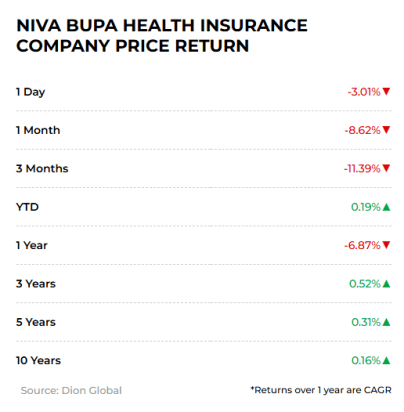
Niva Bupa share price performance
Nomura on Star Health: ‘Buy’
Star Health faces a larger operating-cost task under Nomura’s calculations, even though its FY26 EOM is lower than Niva Bupa’s.
The brokerage estimates Star Health’s FY26 EOM at 32.3% and calculates that the company needs a 12.3 percentage-point reduction over five years. However, the estimated benefit from the proposed commission caps is only 2.9 percentage points.
That leaves Star Health needing to find another 9.4 percentage points through operating-cost reductions, according to Nomura’s analysis.
The brokerage estimates premium CAGR of 16% and EPS CAGR of 30% for Star Health between FY26 and FY29F.
Nomura has a ‘Buy’ rating on Star Health.
Star Health share price performance

Nomura outlines the cost equation
Nomura’s analysis shows a wide gap in the amount of adjustment each insurer may need to make under the proposed EOM framework.
SBI Life has an FY26 EOM of 10.6%, compared with 35.2% for Niva Bupa and 32.3% for Star Health. The required reduction over five years is estimated at 0.6 percentage point for SBI Life, 15.2 percentage points for Niva Bupa and 12.3 percentage points for Star Health. The commission benefit varies based on the kid of insurance play one considers.
Nomura estimates a 9.1 percentage-point benefit for Niva Bupa and 2.9 percentage points for Star Health. For SBI Life, the brokerage’s table shows no commission reduction benefit, against a 0.6 percentage-point EOM reduction required.
For now as the proposed norms suggest, the operating-cost reduction requirement is estimated at nil for SBI Life, 6.2 percentage points for Niva Bupa and 9.4 percentage points for Star Health.
The difference is also visible in their business models. SBI Life enters the proposed framework with a relatively low expense ratio, while Niva Bupa is counting on both commission changes and operating leverage. Star Health, meanwhile, would have to make a larger operating-cost adjustment after taking into account the estimated benefit from the new commission structure.
Reform could also force distributors to rethink models
Nomura’s report points to changes beyond the insurers themselves. PB Fintech management said the proposed changes to the distribution structure would require a rethink of its business model.
The company said it was moving away from a “growth at any cost” approach towards a “rationalised growth” approach. It plans to trim marketing expenses and slow down hiring, although management has indicated that there would be no mass layoffs or radical response.
PB Fintech is also evaluating new products including life insurance savings, credit life and mutual funds. On the business side, it is considering reinsurance broking as well as reinsurance or insurance manufacturing.
“The company is now assigning ‘higher probability’ to become an insurance manufacturer,” Nomura said.
Separately, PB Fintech plans to ask the regulator to introduce the managing general agent format in India, saying this could create “responsible distribution” models.
For SBI Life, Niva Bupa and Star Health, the proposed rules therefore translate into very different cost-adjustment requirements. Nomura’s estimates point to a relatively limited adjustment for SBI Life, a combination of commission savings and operating leverage for Niva Bupa, and a larger operating-cost task for Star Health.
Disclaimer: This article is based solely on Nomura Financial Advisory and Securities’ India Insurance research report. The ratings, estimates, projections and assessments of the proposed insurance reforms are those of Nomura analysts. The EOM and commission changes discussed are based on proposed regulatory rules and may change as the regulatory process progresses. Actual company performance, costs and financial outcomes may differ from the estimates cited in the report. Nomura has also disclosed business relationships and other potential conflicts of interest relating to its research coverage.