


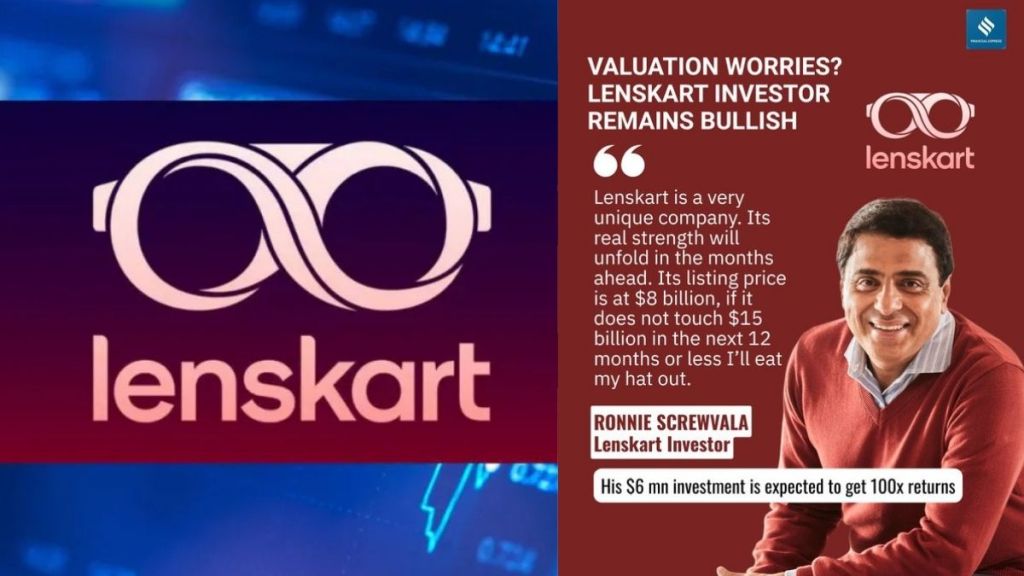

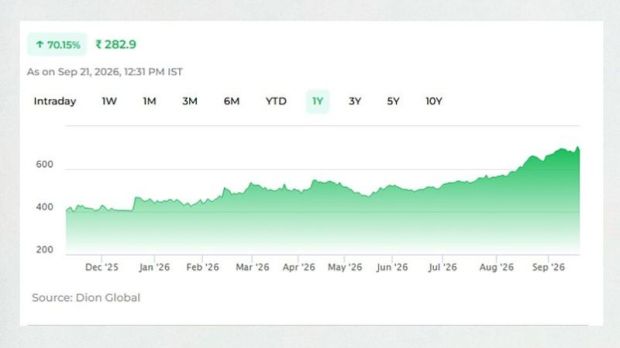
The Lenskart share price has had a dream run since its listing last November. The shares have surged over 70% since debut. With the market cap now well above $14 billion, one cannot but remember Ronnie Screwvala defending its valuation during the IPO. While the street was apprehensive about Lenskart’s IPO pricing , Screwvala famously said he will “eat his hat out” if valuations didn’t surge to “$15 billion in the next 12 months or less.”
Ronnie Screwvala before Lenskart listing
Lenskart’s valuation had raised a storm before its listing. While many market experts had called the valuations expensive, Screwvala, an entrepreneur and one of the early investors in the eye wear brand, had stated that “Peyush Bansal priced the IPO at roughly 20% below the company’s actual intrinsic value.” Elaborating on his argument, he had mentioned that “Lenskart is a very unique company. Its real strength will unfold in the months ahead. Its listing price is at $8 billion, if it does not touch $15 billion in the next 12 months or less, I’ll eat my hat.”
Lenskart: What’s driving the bullish momentum now
Interestingly, 10 months on, there are more backers to the Lenskart story. Not only has the valuation jumped from the $8 billion at listing to close to $15 billion, but the strong earnings performance is also being seen as a key game changer.
Brokerage houses have come up with reports that indicate close to 40% upside from current levels. Analysts are now seeing it as “one to keep for generations” or the “next Rayban.”
They believe that while Lenskart started its operations in 2010, the growth journey has just started and has the potential and visibility to open 10,000 stores over the next 10-15 years. According to most industry observers, “the focus on demand creation, rather than share shift from other players,” makes the stock a strong contender for exponential growth going forward.
Jefferies on Lenskart: ‘Ray-Ban of future’
International brokerage house Jefferies is betting on the strong growth & sharp margin expansion through Q1FY27. It believes that Lenskart’s premium sunglass vertical, “Meller, could be the Ray-Ban of future.”
Given that “market creation remains a top priority, with supply, rather than demand, being a key constraint in India, evidenced by 70,000 daily eye tests. The company now plays at the bottom end with a fully loaded Rs 500 product, while a clear premiumisation trend is visible,” Jefferies added.
According to them, “margin improvement in international should put a key investor concern to rest.” They have revised the price target higher to Rs 680 a share with a ‘Buy’ recommendation. This implies approximately 15% upside from current levels.
They pointed out that Lenskart is India’s largest tech-driven eyewear retailer with just 5% market share and “offers strong growth potential. Its vertically integrated omni-channel model ensures cost efficiency, rapid delivery, and superior customer experience.”
Lenskart is addressing both ends of the price spectrum, and this, they believe, gives it “strong headroom” for growth. On the one hand, the Rs 500 proposition “managed to crack the code on costing. Rs 30,000 progressive lenses,” on the other hand, “generated Rs 2.5 billion annual sales,” on the premium end of the market.
They pointed out that “superior unit economics and a faster payback period of its stores” would help higher EBITDA growth between now and FY29.
Nomura on Lenskart: ‘Keep for generations’
Nomura calls Lenskart “the one to keep for generations.”
Eyewear is a growing category in the Indian context. Nomura estimates that nearly “two-thirds of those needing correction still go without, and 60 optical stores/millon people (vs 400 for footwear) show how thinly the market is covered.”
What makes the Lenskart story striking in this context is that the company “spent a decade building what the fragmented trade could not – centralised manufacturing, remote optometry, and an asset-light store that opens almost anywhere.”
They have initiated coverage with a ‘Buy’ rating and a price target of Rs 888, implying a whopping 40% upside potential from current levels. According to them, the “proven track record looks ahead at the credible path of mapped 10,000+ stores across 6,400 pincodes, of which only 5% is walked.”
“The road further extends to international geographies (scale up in existing and entering new ones), keeping it on track to become a global leader. Above this lies the untapped pool of margin improvement through scale and better mix (progressive lenses),” the Japanese brokerage house added.
As per their estimates, Lenskart has the potential to deliver EPS growth of 49% annually on a compounded basis between FY26-FY29. The stock currently trades at 34x FY28 estimated EV/EBITDA. They believe that Lenskart is likely to maintain a long-term EBITDA margin of 25% Vs 11% in FY26.
| Brokerage | Rating | Target Price | Implied Upside |
| Jefferies | Buy | Rs 680 | ~15% |
| Nomura | Buy | Rs 888 | ~40% |
| Motilal Oswal | Buy | Rs 800 | ~16% |
Motilal Oswal on Lenskart: Strong moats in a difficult-to-scale category
The domestic brokerage house, Motilal Oswal believes that Lenskart “has built strong moats in a difficult-to-scale category.” They have reiterated the ‘Buy’ rating and revised the target price higher to Rs 800 a share. This implies close to 16% upside from the current market price.
They believe some of the factors that have contributed to the optimism surrounding the stock price include –
-A centralised, highly automated manufacturing facility
– Strong backward integration
– Large omnichannel presence
– Leveraging technology to ease constraints in scaling up and
-House-of-brands architecture spanning mass to premium eyewear.
According to the analysis by the brokerage house, “the stock price decomposition suggests that earnings surprises, leading to consensus estimate upgrades, along with roll-forward, have been the key drivers of stock outperformance, rather than multiple re-rating.”
Motilal Oswal analysts pointed out that “Lenskart has among the best-in-class store economics among listed retailers (10 months store payback across India and international operations).”
Moreover, they believe “the store economics has room for further improvement as newer stores hit maturity and benefits of backward integration are reflected in higher product margins (currently impeded by rupee depreciation).”
Despite operating one of the largest retail networks in India, comprising 2,725 stores, in the eyewear retail category, Motilal Oswal is betting on the company’s “large runway for store expansion.” This is primarily on the back of underpenetration and limited organised competition in the category.
Motilal Oswal anticipates that Lenskart can potentially add “over 10,000 stores over the medium term through densification in its existing footprint (1.8k+ pincodes), entry into unserved pincodes within existing cities (2.7k), and foray into new economically viable towns (3.5k+ pincodes).”
The company has been able to generate free cash flow in FY26 as well as Q1 FY27 despite the upfront capex expenses. Over FY26-FY29, Motilal Oswal expects Lenskart’s free cash flow generation to be “significant.” They estimate about “Rs 32 billion cumulative, which the company could use to fund growth through accelerated store additions and expand into new markets internationally.”
Lenskart set to move higher?
The Lenskart share valuation is inching towards the $15 billion that Screwvala had referred to while listing. The management is betting on demand, and with international profitability established and the focus is now shifting toward store additions and healthy same-store sales. While the future earnings would hold the key to long-term potential, the room for growth for the next 12 months appears to be a forgone conclusion.
Disclaimer: This article provides factual analysis only and is not, and should not be construed as, an offer, solicitation, or recommendation to buy or sell securities. Investors must conduct their own independent due diligence and seek advice from a SEBI-registered financial advisor.