


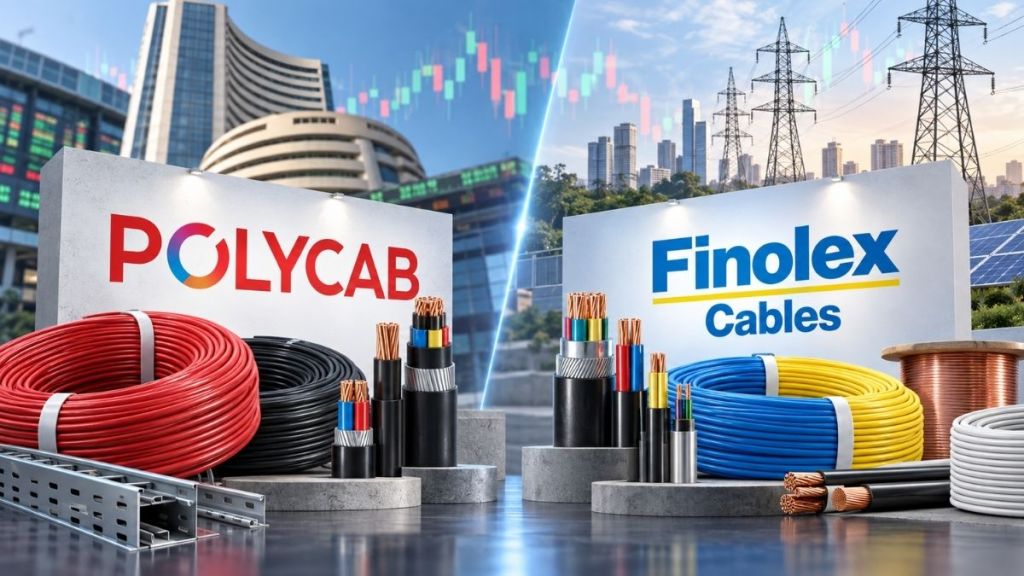

The cable and wire segment is seeing a new challenger. UltraTech Cement’s entry with its Ultravolt brand has raised questions about competition, pricing and market share. But Jefferies believes the new entrant may not be enough to unsettle the leading listed players.
The brokerage has ‘Buy’ ratings on Polycab India and Finolex Cables, with target prices of Rs 8,300 and Rs 1,410, respectively. That implies a potential upside of around 34% for Polycab and 15% for Finolex Cables from current levels.
But the two investment cases are not identical. One is leaning on scale and market share. The other is getting an extra push from a sharp rise in optical fibre prices.
Which stock has the stronger trigger? Let’s take a look at what the brokerage house are saying –
Jefferies on Polycab: Can the new entrant really disrupt the market?
Polycab has come under pressure after Ultravolt’s launch. The stock fell around 10% in five sessions.
But Jefferies believes the correction could have created an opportunity and recommended investors to It , “buy the fall.”
Why is Jefferies relatively comfortable despite the new competition?
The first factor is the size of the market. The Indian cables and wires industry is estimated at around Rs 1 lakh crore in FY26, with nearly 25% still coming from the informal market.
The brokerage estimates UltraTech’s announced Rs 1,800-crore capital expenditure, combined with 4-5 times asset turnover, could translate into only around 5-6% of industry sales by FY30.
There is another advantage for Polycab. Around 70-75% of its cables and wires mix comes from cables, where entry barriers are higher.
Jefferies said, “Polycab is 70-75% Cables mix.” Power transmission and industrial cables can require several years of pre-qualification, which could make it harder for a new entrant to rapidly take share in these areas.
The brokerage expects Polycab’s profit after tax to grow at around 22% CAGR between FY26-29. This is supported by volume growth and better margins in its FMEG business.
Jefferies on Finolex Cables: Fibre prices add another angle
Jefferies expects the company to benefit from its communication business, where optical fibre forms around 75% of the segment.
The sharp rise in fibre prices has already changed the profitability picture. Jefferies noted, “Communication (~75% OFC) drove margin upswing, now at 23% of Jun26Q EBIT.”
Standard optical fibre prices rose sharply from around $5-6 per kilometre in December 2025 to $17-18 per kilometre by mid-2026, according to the brokerage. Prices have since moderated to around $11-13 per kilometre.
How long can that benefit last?
Jefferies expects fibre prices to eventually normalise as supply and demand stabilise.
Finolex is also expanding capacity. It plans to double its fibre draw capacity to 8 million kilometres by December 2026 quarter.
At a fibre price of around $11 per kilometre and full utilisation, Jefferies estimates the additional capacity could generate quarterly sales of around Rs 200-250 crore.
The core business matters too
Electricals contribute around 85% of overall sales, making this its main business. Construction wires account for the largest share within electricals, while auto, agriculture and industrial cables also contribute.
Jefferies believes better capacity utilisation could lift sales without requiring major additional investment.
The brokerage expects Finolex to deliver around 17% sales CAGR and 22% EBITDA CAGR from FY26 to FY29.
It said, “We view Finolex as a play on housing, capex.”
The company is also building newer growth avenues through solar cables and extra-high-voltage cables.
Polycab vs Finolex: What should investors watch?
Polycab’s case is built around market leadership, a large cable mix, distribution strength and a growing industry where Jefferies believes UltraTech can be absorbed without major disruption.
Finolex’s case has a more immediate earnings trigger through optical fibre, alongside its core electrical business and new capacity.
But there are risks on both sides. For Polycab, investors need to watch demand growth, copper prices and how aggressively Ultravolt expands. For Finolex, the bigger question is how long elevated optical-fibre prices can support margins.
Disclaimer: This article is based on research reports from one or more brokerage firms and is for informational purposes only. The views, target prices, and recommendations expressed are those of the respective brokerage firms and do not reflect the official policy or position of Financial Express. This should not be construed as an offer, solicitation, or recommendation to buy or sell securities. Investors must conduct their own independent due diligence and seek advice from a SEBI-registered financial advisor before making any investment decisions.