



A cup of tea, a grocery bill or a large purchase at a retail store — UPI has become a common way to pay. But India’s digital payments story is now moving beyond everyday small transactions. In October, the average daily value of transactions on the Unified Payments Interface (UPI) crossed Rs 1 lakh crore for the first time.
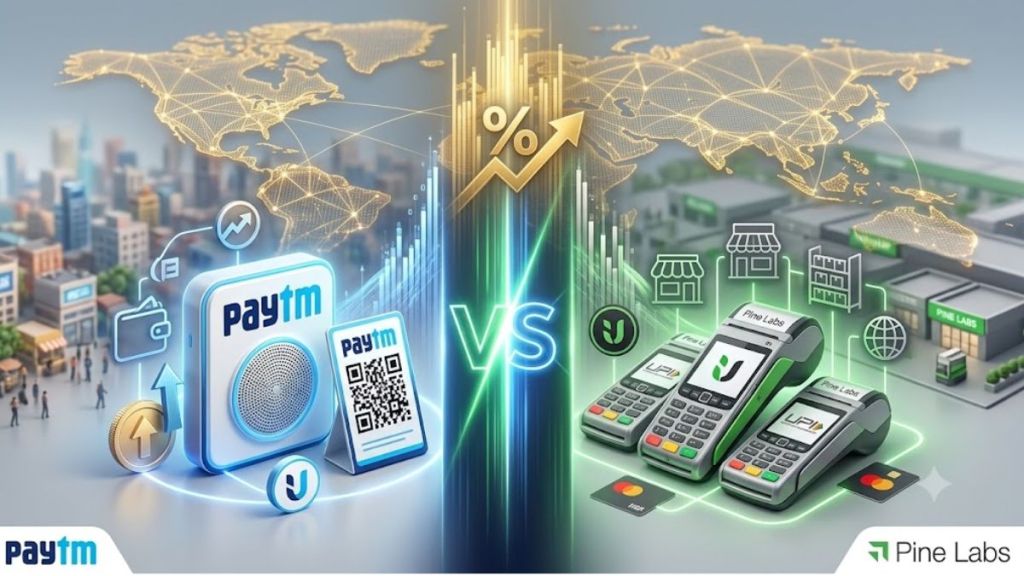
The milestone raises an important question for investors. Can this growing transaction value translate into higher earnings for listed payment companies such as Paytm and Pine Labs? And which of the two could benefit more?
UPI processed transactions worth an average of Rs 1,01,707 crore every day in October, according to data released by the National Payments Corporation of India (NPCI). The total transaction value rose to Rs 31.53 lakh crore from Rs 29.37 lakh crore in September. Transaction volumes also increased from 24.07 billion to 25.47 billion.
On a year-on-year basis, transaction volumes grew 23%, while transaction value increased 16%. The festive season contributed to the increase in digital payment activity.
But higher transaction volumes do not always mean higher profits. The real opportunity for payment platforms will depend on how much revenue they can generate from these transactions.
Financialexpress.com spoke to market experts to understand what the milestone means for Paytm and Pine Labs and what investors should watch.
Paytm’s growth story: Can higher merchant revenue improve profitability?
The increase in UPI activity has brought the revenue potential of payment platforms back into focus. According to Sunny Agrawal, Head – Fundamental Research at SBI Securities, festive demand has supported the rise in daily transactions.
“Daily average transactions have been boosted by healthy festive demand across channels,” Agrawal said.
He remains constructive on Paytm, citing growth in its payments and financial services businesses, market share gains and the possibility of improved operating leverage.
Agrawal said, “We remain constructive on Paytm underpinned by strong execution of growth in payments and financial services, market share gains and operating leverage. Additionally, MDR revenue and revenue optionality from AI services are key levers for revenue growth.”
The brokerage view also pointed to merchant discount rate (MDR) revenue as a potential growth driver.
Agrawal added, “We believe tech and regulatory expenses would lag revenue growth from MDR on P2M UPI transactions, resulting in operating leverage and earnings accretion.”
Paytm vs Pine Labs: Which platform could benefit more?
The benefits of higher-value UPI transactions may differ across payment companies. Their business models, merchant networks and dependence on UPI all play a role.
Sameer Sawant, Research Analyst at Mirae Asset Sharekhan, believes the latest milestone reflects a shift in consumer behaviour, with UPI increasingly being used for larger purchases.
Sawant said, “Crossing Rs 1 lakh crore in average daily UPI value for the first time shows digital payments have become the default for big-ticket spending too, not just small daily purchases.”
He also pointed to the potential revenue opportunity from merchant fees on certain high-value payments.
He noted, “For listed fintechs, the bigger change is that payments above Rs 2,000 to large merchants carry a merchant fee (0.4%, capped at Rs 300) going ahead. Until now, UPI volume grew without adding much to profits. In our view, Paytm benefits more of the two.”
Paytm vs Pine Labs: Which stock has an edge?
According to Sawant, Paytm’s large merchant network, including its QR code and Soundbox devices, could help it capture a larger share of the opportunity. Its processing and technology costs are also largely fixed, which could support margins as revenue grows.
“UPI is its main payments business, it has a large base of merchants on QR codes and Soundbox devices, and its processing and technology costs are mostly fixed. So most of the extra fee income should flow straight into contribution margin,” said Sawant.
Pine Labs could also benefit from the increase in high-value UPI payments. However, its business has a greater focus on card and point-of-sale (POS) payments for large enterprise merchants. As a result, UPI contributes a smaller share of its earnings, Sawant said.
Higher UPI value does not guarantee higher profits
There are also challenges. The fee earned on a transaction is shared among different participants, including banks, payment apps, merchant payment processors and NPCI. Large merchants could also negotiate lower rates, while some customers may shift high-value payments to cards or other modes.
Sawant cautioned, “On margins, record volume does not turn into profit one-for-one. The fee is split between the bank, the payment app, the merchant’s payment processor and NPCI, and large merchants will push hard for lower rates. Some big-ticket payments may also move to cards or other modes.”
Despite these limitations, the shift towards monetising high-value UPI payments could gradually improve the economics of the business.
“Still, payment companies are now earning on high-value UPI payments instead of handling them almost for free, so we expect net payment margins to improve gradually over the next few quarters. Paytm and Pine Labs are the key stocks to watch,” he added.
Disclaimer: This article is based on analyst outlook and is for informational purposes only. The views, target prices, and recommendations expressed are those of the respective analyst and do not reflect the official policy or position of Financial Express. This should not be construed as an offer, solicitation, or recommendation to buy or sell securities. Investors must conduct their own independent due diligence and seek advice from a SEBI-registered financial advisor before making any investment decisions.