



Rising crude oil prices are primarily a concern for a largely oil-importing nation like India. However, for India’s upstream producers, the sharp spike in crude can lead to a direct earnings boost. Oil India and ONGC are among the most prominent upstream companies in focus as a result. But the question is which stock could potentially turn this price benefit into stronger earnings growth?
Oil India has been adding crude volumes faster, while Oil And Natural Gas Corporation has a much larger production base and several projects aimed at lifting output. The difference becomes important if crude stays near or above the $100 per barrel mark for several quarters. A higher realisation on existing production helps both companies, but the company that adds more barrels and gas can capture a larger incremental benefit.
FinancialExpress.com spoke with analysts tracking the upstream oil stocks to understand which upstream player could gain more from higher crude prices.
Higher crude prices are positive for both Oil India and ONGC
The direct benefit for an upstream producer comes from higher crude realisation. Production costs don’t normally rise in line with every move in crude prices, which means a sustained increase in oil prices can flow through to operating profit.
Nilesh Ghuge, Research Analyst at HDFC Securities, said, “Oil price increase is positive for upstream companies because realisation for crude oil will go up. What I have observed is that whenever crude oil price goes up, gas price will also follow the same direction. It may not be this way immediately, but eventually gas price will also go up. So, they will get better realisation, particularly not APM gas but non-APM gas. So, that way it is a good positive for upstream players.”
Both companies entered the June quarter with crude realisations close to $100 per barrel. Oil India’s crude realisation was $98.73 per barrel, while ONGC reported $99.45 per barrel.
The production picture, however, was different. Oil India’s crude production rose more than 11% year-on-year to 0.95 million tonnes in Q1 FY27. ONGC’s crude output fell 6% year-on-year to 4.95 million tonnes.
| Q1 FY27 operating picture | Oil India | ONGC |
| Crude production | 0.95 million tonnes | 4.95 million tonnes |
| Crude production growth | More than 11% YoY | Down 6% YoY |
| Crude realisation | $98.73/bbl | $99.45/bbl |
| Gas production trend | Up 0.4% QoQ | Down 2% YoY |
Oil India’s standalone operating revenue stood at Rs 7,958 crore in Q1 FY27, with EBITDA of Rs 4,605 crore and profit after tax of Rs 2,870 crore. ONGC reported standalone PAT of Rs 17,034 crore for the quarter, compared with Rs 8,034 crore a year earlier.
Ghuge said the benefit for both companies ultimately comes down to production growth.
“Oil India and ONGC, both of them, it’s a positive thing because if there is a rise in crude oil price, it will impact positively for both these companies, depending, of course, on the volume increment. There will be some reduction in volume there; those who make the most out of it. Whenever there is an increase in volume in subsequent quarters, they will benefit more.”
Does Oil India’s rising crude output give it an edge?
Oil India’s recent production trend is one reason some analysts see greater incremental upside in the smaller upstream company.
The company has maintained its FY27 domestic crude production target of around 4 million tonnes, compared with 3.45 million tonnes in FY26. Its daily crude production also reached 11,017 tonnes on August 3, 2026, from 10,921 tonnes on June 27.
During Oil India’s August 10 earnings call, Trailukya Borgohain, Director Operations, said the company was working towards around 4.2 million tonnes of crude production by FY29.
“If you look at our FY29 kind of target, we are targeting around 4.2. Maybe it goes beyond that. But that will also depend a little bit on our own near-field exploration,” Borgohain said.
The company is using workovers, production enhancement, optimisation, hydro-fracturing and radial drilling to increase output. It is also ramping up production in Rajasthan.
Ghuge therefore prefers Oil India when the comparison is based on incremental production. “Between Oil India and ONGC, I think Oil India will gain more because there is an increase in their crude oil production. And, of course, gas production will also increase gradually,” he said.
“I will not say in the next quarter, but it’s increasing over maybe six months, nine months. And then their production every month, they are increasing their production per day volume. That will benefit Oil India.” He added that the comparison isn’t about the absolute size of the two companies. According to the HDFC Securities’ analyst, “If you are saying who will produce more going ahead, who is giving more guidance, then Oil India is the company. So, incrementally, if you ask me, there is a volume growth of crude oil production and gas-based production, then Oil India is the company.”
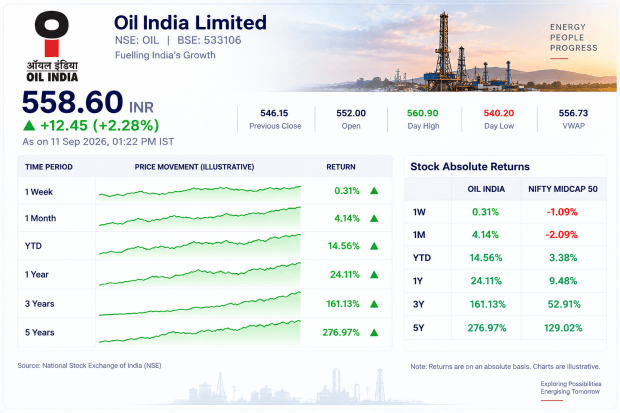
Oil India share price performance
ONGC has scale and a wider production base
The argument for ONGC rests on a different set of factors. Oil And Natural Gas Corporation Ltd. contributes a much larger share of India’s domestic oil and gas production and has several projects aimed at improving output. Its first-quarter crude production was nearly five times Oil India’s production.
Sumit Pokharna, Vice President, Fundamental Research at Kotak Securities, prefers ONGC over Oil India because he believes ONGC’s reserves and production base provide greater visibility.
“Upstream companies will benefit from elevated crude prices. We are positive on ONGC because of its gas and oil production, although there are concerns around potential changes in government policy for upstream companies.
As far as Oil India is concerned, we are not very positive. The company has reserves, but those reserves have not translated into production, which is why we prefer ONGC.”
ONGC management expects production to improve as new projects move ahead. The company is also spending heavily on its Western Offshore assets, including pipeline replacement, reservoir management, water injection and production system upgrades.
UBS expects ONGC’s standalone PAT to reach Rs 50,300 crore in FY27, compared with Rs 32,900 crore in FY26. It has a Rs 305 price target on the stock.
CLSA has an even more positive view. Its September 2 report rated ONGC High-Conviction Outperform with a Rs 405 target. It said management’s confidence about production growth over the next three years, along with a dividend yield of around 6% and valuation below global peers, supports the stock.
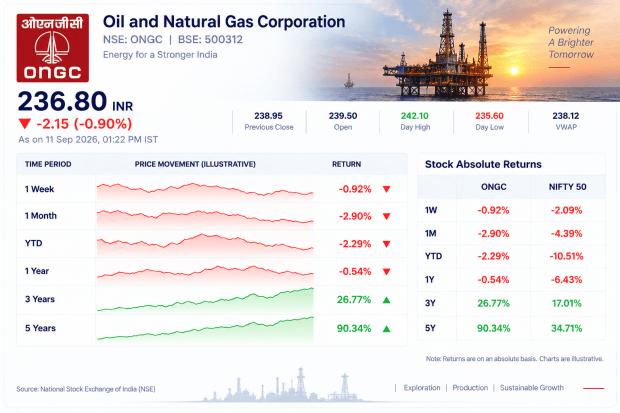
ONGC share price performance
Gas could add another earnings trigger for Oil India
Oil India’s gas business provides another potential source of volume growth. The company expects gas production to reach 3.8 billion cubic metres in FY28. Management has also indicated that 5 billion cubic metres is achievable once additional evacuation infrastructure is available.
The problem so far has been less about the ability to produce gas and more about moving it to customers.
Abhijit Majumder, Director Finance at Oil India, said during the August 10 earnings call, “We have always maintained that ramping up the production by itself is not a challenge. Absence of the network is a challenge which we are trying to address, and once the network is laid, it is ready for evacuation, ramping up production will definitely happen.”
The Duliajan Feeder Line and Duliajan-Numaligarh Pipeline are therefore important to the production plan. Borgohain said the company expects 3.8 billion cubic metres of gas production next year and has enough production potential to move towards 5 billion cubic metres once the evacuation bottleneck is removed.
Another part of the gas opportunity comes from new well gas pricing. Management said incremental production would largely qualify as new gas rather than old administered-price gas.
Oil India Vs ONGC: Weighing the impact of high crude rate
Brokerage reports point to strong cases on both sides.CLSA expects a tighter crude market in the coming months and said this would be positive for ONGC and Oil India. It has an Outperform rating on Oil India with a Rs 550 target and High-Conviction Outperform on ONGC with a Rs 405 target.
For Oil India, CLSA’s case rests on management’s expected increase in oil and gas production and the expanded NRL refinery. It said the company’s production growth depends heavily on the northeastern gas grid and NRL expansion.
JM Financial has a Buy rating on Oil India with a Rs 560 target. Its estimates show how sensitive Oil India’s earnings are to commodity prices. Every $5 per barrel change in FY28 net crude realisation changes its FY28 consolidated EPS estimate by 7.3%. A $0.82 per MMBtu change in gas realisation changes the EPS estimate by 4.7%.
The brokerage also values Oil India’s NRL stake at Rs 204 per share based on an assumed 9 million tonnes of throughput in FY29 and a $25 per barrel GRM.
J.P. Morgan, however, remains more cautious on ONGC, with a Neutral rating and a Rs 230 target. Its concern is that weak production volumes could limit the benefit from higher crude prices after the near-term project ramp-ups.
| Brokerage | Company | View | Target price |
| CLSA | ONGC | High-Conviction Outperform | Rs 405 |
| CLSA | Oil India | Outperform | Rs 550 |
| JM Financial | Oil India | Buy | Rs 560 |
| UBS | ONGC | Buy | Rs 305 |
| J.P. Morgan | ONGC | Neutral | Rs 230 |
4. NRL gives Oil India a refinery-led growth opportunity
Oil India’s position isn’t limited to exploration and production. Its subsidiary Numaligarh Refinery Limited is expanding its refinery capacity from 3 million tonnes per annum to 9 million tonnes per annum.
Ghuge sees this as an important reason to prefer Oil India. “I prefer Oil India over ONGC because of this first reason. Second thing, as you know, Oil India is expanding its refinery capacity from 3 million metric tons to 9 million metric tonne. So, that plant is expected to be commissioned in December this year.
From one year perspective also, I will prefer Oil India over ONGC because with the increase in the refinery capacity, definitely they will give more earnings growth to the company,” he added.
NRL’s management expects the expansion to start contributing from the next financial year. Bhaskar Jyoti Phukan, Managing Director of NRL, said three units were expected to be commissioned by October or November, with the remaining units targeted for commissioning by March 2027. The refinery is expected to reach around 75% utilisation of its 9 million tonnes rated capacity by Q4 FY28.
“Generally our GRM hovers around $7-8, which you may have observed in the last annual reports and all. So now we are clocking in the first quarter around 35,” Phukan added.
NRL also gave discounts to oil marketing companies during the quarter, which affected realised margins. Phukan said the discounts were being calibrated according to the difference between crude and product prices.
Ghuge summed up his preference by pointing to the combination of businesses. “There is definitely good potential in Oil India compared to ONGC. Because, as I said, both upstream and downstream, Oil India is now an integrated player with NRL coming in.”
Which other oil-linked companies could benefit or face pressure
The crude-price move doesn’t affect every oil-linked company in the same way.Upstream producers such as ONGC and Oil India are the most direct beneficiaries because higher crude prices increase their realisations. Analysts also see some other oil-linked companies as attractive despite elevated crude, although the reasons differ.
Maulik Patel, Head of Research at Equirus Securities, said ONGC and Oil India are the most direct beneficiaries of higher crude realisations.
“Upstream players (direct beneficiaries) ONGC and Oil India are the most direct beneficiaries of higher crude realisations, which has not been reflected in valuations yet,” Patel added.
Among other oil-linked stocks, Patel identified BPCL as a preferred OMC in the event of a crude correction because of its refining-to-marketing mix, distillate yield, Bina refinery’s crude flexibility and balance sheet.
“BPCL is our preferred OMC, supported by a better refining-to-marketing ratio and highest distillate yield, which provide a stronger integrated earnings buffer than HPCL,” Patel said.
His assessment of Reliance Industries is also based on its diversified exposure across oil-to-chemicals, digital services and retail.
“Reliance is most balanced oil-linked exposure. Its complex O2C system benefits from strong product cracks, crude-basket diversification and feedstock flexibility, while Jio and Retail provide additional earnings diversification,” Patel said.
He identified sustained O2C recovery, Jio average revenue per user growth, retail margin normalisation and new energy execution as key catalysts.
The more immediate risk from high crude prices sits with oil marketing companies. Sunny Agrawal, Deputy Vice President, Fundamental Research at SBI Securities, said, “If Brent sustains above $100/bbl, the biggest earnings risk remains with India’s downstream fuel retailers: (a) HPCL, (b) BPCL and (c) IOC. In such a scenario, marketing margins can turn negative.”
Agrawal said HPCL has historically shown the highest earnings volatility during crude spikes because of its smaller balance sheet and lower diversification compared with IOC and BPCL.
| Company or sector | Likely impact from sustained high crude | Main reason |
| ONGC | Positive | Higher crude realisation |
| Oil India | Positive | Higher crude and gas realisation plus production growth |
| BPCL | Mixed | Refining buffer, but marketing pressure |
| HPCL | Most vulnerable among OMCs | Higher crude cost and marketing exposure |
| IOC | Negative pressure | Higher crude procurement and marketing costs |
| Reliance Industries | More balanced | O2C exposure plus Jio and Retail |
| Aviation | Negative | Higher aviation turbine fuel costs |
| Tyres | Negative | Higher carbon black and petroleum-linked input costs |
| Paints | Negative | Oil-linked solvents, resins and intermediates |
Pokharna said the pressure extends well beyond OMCs.”Crude oil is a raw material for refineries, while base oil and lubricants are also linked to crude. Companies where crude or crude derivatives are a direct raw material will see their raw material and operating costs rise. This includes oil marketing companies, tyre companies, paint manufacturers such as Asian Paints and Berger Paints, and lubricant companies such as Castrol. How much of this cost they can pass on to consumers will determine the impact on margins.”
He added, “The biggest concern is for oil marketing companies such as BPCL, HPCL and IOC. Their raw material, working capital, interest and operating costs will rise. Among downstream companies, HPCL could be impacted the most. BPCL and IOC could also be impacted.”
Size of the benefit depends on crude’s trajectory
The duration of higher crude prices is as important as the headline price itself.HDFC Securities’ Ghuge said, “Any oil producer or gas producer will benefit out of this. So, whether it is Oil India or ONGC, if suppose your assumption is that oil prices will remain elevated for, let’s say, next three months, six months, then any oil producer will benefit.”
He pointed to the difference between earlier crude realisations below $70 per barrel and current levels around $100.”Because if you ask me, in the December quarter or the March quarter, their realisation was less than $70. Today, they are making $100. And the cost doesn’t change that much on a day-to-day basis.”
That operating leverage is why a sustained crude price increase can have a significant impact on upstream earnings.
CLSA’s September report also expects crude prices to remain supported by supply constraints in the near term. It said a further increase in oil prices over the next two to three months would be positive for ONGC and Oil India and negative for IOC, BPCL and HPCL.
The risk runs in the opposite direction as well. Nomura’s June analysis showed that if the Strait of Hormuz reopened and crude prices fell, OMCs, city gas distributors and Petronet LNG could benefit while ONGC and Oil India would face lower oil and gas realisations.
Oil India or ONGC, which stock gains more
The analyst views point to a clear difference in the nature of the two opportunities.ONGC has the larger production base, stronger scale and a broader portfolio. Pokharna prefers ONGC because he believes its oil and gas production provides greater earnings visibility. CLSA and UBS are also positive on ONGC, although J.P. Morgan remains cautious about production volumes.
Oil India has a smaller base but a faster production growth story. Its crude output has already increased by more than 11% year-on-year, management is targeting around 4.2 million tonnes by FY29, gas production is expected to rise, and NRL is expanding from 3 million tonnes to 9 million tonnes of refinery capacity.
Ghuge’s conclusion is therefore tilted towards Oil India.
“So, definitely there is a trigger in Oil India. So, to answer your question, I will prefer Oil India because of the increase in the gas and production on top of this increase in their realisation.”
Based on the direct crude-price benefit, both companies are positioned well. But if the focus is on incremental earnings growth from higher crude combined with rising production, Oil India currently has the stronger case, while ONGC remains the larger and more diversified upstream play.
Disclaimer
The views, estimates, ratings and price targets cited in this article belong to the respective analysts and brokerage firms. They are based on company disclosures, analyst assessments and research reports available at the time of writing. They shouldn’t be treated as investment advice or a recommendation to buy or sell any security. Crude prices, production volumes, refining margins, government policies, project timelines, currency movements and market valuations can change materially. Investors should review the latest company filings and research reports and assess their own financial circumstances and risk tolerance before making any investment decision. Readers are advised to consult a SEBI-registered investment adviser or other SEBI-registered financial professional before making any investment decision.