


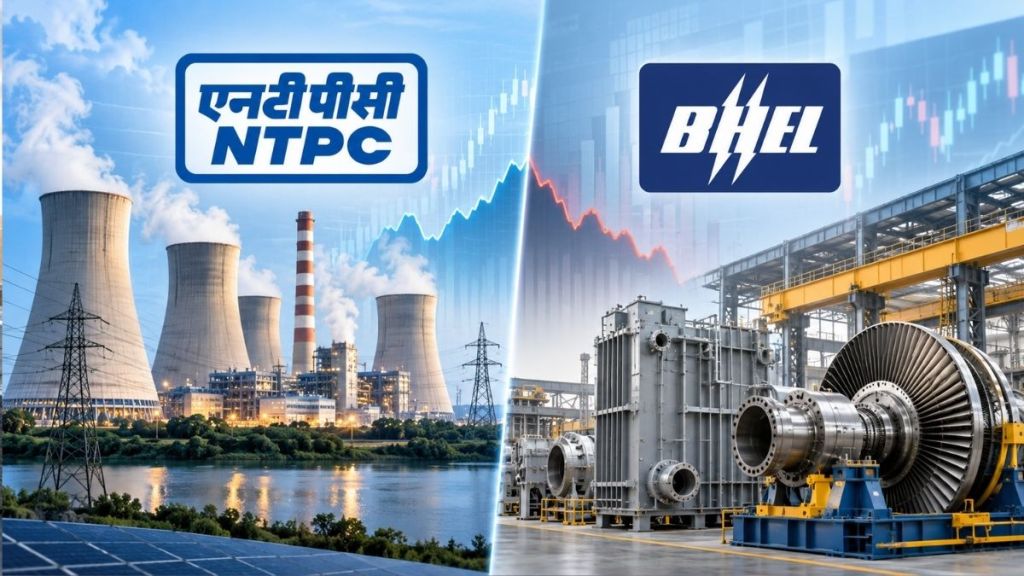

The valuation gap between Bharat Heavy Electricals (BHEL) and NTPC has become difficult to ignore. Over the past six months, the two stocks have taken very different paths.
According to Kotak Institutional Equities, BHEL has outperformed NTPC by around 80 percentage points since the beginning of the West Asia conflict.
Let’s take a look at what the brokerage house says –
BHEL races ahead of NTPC
Kotak said, “The sharp divergence in stock performance of BHEL and NTPC over the past six months suggests that the market is (1) concerned about future thermal capacity addition but (2) comfortable with BHEL’s future prospects from thermal equipment and other smaller businesses.”
In simple words, investors appear worried about the future of thermal power generation, but they seem considerably more comfortable with BHEL’s ability to benefit from equipment orders.
Kotak, however, says the market may be asking too much from BHEL.
NTPC: Why are investors worried?
For NTPC, the concern is not simply its current earnings. Kotak pointed to weaker thermal capacity additions and the rapidly increasing role of renewable power. Solar generation, battery storage and other renewable technologies are becoming more competitive, creating uncertainty around the long-term growth of thermal generation.
The brokerage said, “Market appears to be concerned about NTPC’s future prospects.”
Kotak’s reverse valuation exercise suggests that NTPC’s current valuation assumes the company will add around 42 gigawatts of thermal capacity over time.
The Central Electricity Authority (CEA) expects around 86 gigawatts of cumulative thermal capacity additions between FY27 and FY36 across India. Some of that could come from private companies.
BHEL: Expectations may be too high
Kotak believes the stock price reflects extremely ambitious assumptions about future thermal equipment orders. Even after assigning 25% of BHEL’s value to non-thermal businesses, the brokerage says the implied requirement remains very high.
The brokerage house said, “Market appears exuberant regarding BHEL’s future prospects.”
Its reverse valuation suggests BHEL would need to execute around 150-300 gigawatts of boiler, turbine and generator (BTG) equipment capacity over its lifetime, depending on the profit margin assumption.
At a 10% profit-after-tax margin, the implied requirement is around 150 gigawatts. At a lower 7.5% margin, it rises to around 200 gigawatts.
The cash-flow question
There is another issue Kotak highlighted – BHEL’s historical cash generation.
The company generated around Rs 7,100 crore of free cash flow (FCF) between FY07 and FY26, compared with adjusted profit after tax (PAT) of around Rs 38,300 crore.
Kotak believes the wider thermal-equipment opportunity itself may also be smaller than what BHEL’s valuation implies.
India may add less thermal capacity than expected
The brokerage estimates future thermal capacity additions in India at around 100 gigawatts, arguing that the economics of solar power combined with storage have become increasingly competitive.
“We believe that the aggregate future thermal capacity addition in India may be around 100 GW,” added the brokerage house report.
Even assuming equipment realisations of Rs 10 million per megawatt and a 10% net profit margin, the total undiscounted profit pool for thermal equipment manufacturing would be only around Rs 50,000 crore to Rs 1 lakh crore.
Kotak said, “As such, the current market cap of BHEL implies significantly larger thermal capacity addition in perpetuity, which appears rather optimistic versus the government’s estimates.”
What investors should watch
The contrasting performance of BHEL and NTPC reflects differing market expectations around thermal power and equipment demand. While NTPC faces questions over the pace of future thermal capacity additions, BHEL’s valuation reflects stronger expectations for equipment orders.
Disclaimer: This article is based on research reports from one or more brokerage firms and is for informational purposes only. The views, target prices, and recommendations expressed are those of the respective brokerage firms and do not reflect the official policy or position of Financial Express. This should not be construed as an offer, solicitation, or recommendation to buy or sell securities. Investors must conduct their own independent due diligence and seek advice from a SEBI-registered financial advisor before making any investment decisions.