




The contest between the National Stock Exchange of India (NSE) and BSE is entering a new phase, with Macquarie Research seeing scope for BSE to gain market share while NSE retains a substantial lead in liquidity, products and institutional participation.
In separate initiation reports dated September 24, Macquarie described BSE as “The Challenger” and NSE as “The Dominator”. Both stocks have been initiated with an ‘Outperform’ rating, but the earnings case differs. Macquarie expects BSE to deliver faster revenue growth through market-share gains, while NSE is expected to build on its established franchise through non-transaction businesses and new products.
Macquarie has set a target price of Rs 4,000 for BSE, implying about 22.7% upside, while its target for NSE is Rs 1,965, implying roughly 10% upside.
BSE vs NSE: Key Numbers
| Metric | BSE | NSE |
|---|---|---|
| Macquarie label | Challenger | Dominator |
| Rating | Outperform | Outperform |
| Target price | ₹4,000 | ₹1,965 |
| Reported upside | ~22.7% | ~10% |
| Revenue CAGR, FY26–30 | 16% | 12% |
| EBITDA margin, FY26 | 65.7% | 75.5% |
| EBITDA margin, FY30E | ~69.6% | ~76.7% |
| Cash-market share, FY26 | ~7% | 93% |
| Cash-market share, FY30E | >9% | ~91% |
| Options premium share, FY26 | 25% | ~75% |
| Options premium share, FY30E | ~30% | ~70% |
| Options notional share, FY26 | ~42% | — |
| Trading members | — | 1,300+ |
| Registered clients | — | 129.1 million |
| Listed entities | — | 2,979 |
| Non-transaction revenue growth | ~15% CAGR | ~13% CAGR |
| Main growth driver | Market-share gains | Scale, new products, non-transaction revenue |
| FCF outlook | ~₹14,500 cr cumulative FY27–30 | ₹12,150 cr FY27; ₹13,140 cr FY28; ₹14,880 cr FY29 |
| Key margin opportunity | Own clearing, pricing, business mix | Already operating at high margins |
| Near-term pressure | CAS | CAS |
| Core investment narrative in the report | Faster growth through share gains | Dominant franchise with diversified growth |
Macquarie on BSE: ‘Outperform’
Macquarie has initiated coverage on BSE Ltd. with an ‘Outperform’ rating and a target price of Rs 4,000 implying an upside of 23%. The brokerage expects BSE’s revenue to grow at a 16% CAGR between FY26 and FY30, with EBITDA margin rising from 65.7% in FY26 to nearly 70% by FY30.
The core of the BSE thesis is market-share gains. BSE’s cash-equity market share stood at around 7% in FY26, while Macquarie expects it to cross 9% by FY30. In options, BSE already accounted for about 42% of notional turnover and 25% of premium turnover in FY26.
Macquarie said, “BSE is a share gainer in a structural growth market, supporting a 16% FY26-30E revenue CAGR and margins nearing 70%. CAS may weigh near term, but SOR, P/N and self-clearing upside remains underappreciated.”
The brokerage sees Smart Order Routing, or SOR, as a key opportunity because it can allow brokers to route orders to the exchange offering the best execution. It also expects a higher premium-to-notional ratio and greater use of BSE’s own clearing infrastructure to support revenue and margins.
Macquarie on NSE: ‘Outperform’
Macquarie has initiated coverage on National Stock Exchange of India with an ‘Outperform’ rating and a target price of Rs 1,965, implying roughly 10% upside. The brokerage expects NSE’s revenue to grow at a 12% CAGR between FY26 and FY30, with EBITDA margins remaining in the mid-70% range.
NSE’s advantage remains its scale. It held 93% of the cash market in FY26, 99.8% of equity futures and 74.7% of equity-options premium turnover, according to Macquarie. Its network includes more than 1,300 trading members, 129.1 million unique registered clients and 2,979 listed entities as of FY26.
Macquarie said, “NSE is India’s dominant market infrastructure asset, combining unrivalled liquidity, scale and network effects. We expect 12% FY26-30E revenue CAGR with resilient mid-70s margins, while optionality from new products, non-transaction revenues and a higher P/N ratio remains largely unpriced.”
The brokerage expects NSE to give up some share in cash equities and options to BSE over the next few years. However, it expects market growth, new products and the expansion of non-transaction revenue to partly offset that pressure.
BSE vs NSE: cash market share gap could narrow
The biggest difference in the two reports is Macquarie’s expectation for cash-equity market share.
BSE held around 7% of the cash market in FY26, compared with 93% for NSE. Macquarie expects BSE’s share to rise above 9% by FY30, while NSE’s share is projected to decline to 91%.
The brokerage does not assume a major revenue benefit from SOR or the Common Contract Note in its base estimates for either exchange. But it sees broader SOR adoption as a potential source of additional share gains for BSE.
Macquarie said, “NSE’s scale and established market position create a structural advantage, with brokers and institutions often defaulting to NSE due to infrastructure lock-in. We believe BSE’s opportunity lies in broader adoption of Smart Order Routing (SOR), which enables brokers to automatically route orders to the exchange offering the best execution, and the Common Contract Note (CCN), which provides investors with a single weighted-average execution price across exchanges.”
SOR adoption has been slower than expected, according to Macquarie, but wider broker adoption could make order flow more sensitive to pricing and execution between the two exchanges.
BSE is closing the options gap
The derivatives market is where BSE has made its most visible gains.
Macquarie said BSE’s options growth has been driven by weekly Sensex options, which offer an alternative to NSE’s Nifty index options. BSE’s options premium market share increased to 25% in FY26 from less than 0.1% in FY23.
NSE still held about 75% of the options premium market in FY26. Macquarie expects BSE’s share to rise to 30% by FY30, with NSE’s share falling to about 70%.
BSE’s options notional share was around 42% in FY26, while the exchange’s monthly options currently account for only 5-7% of volumes. Macquarie sees room for these contracts to gain traction as participation broadens.
The brokerage also expects BSE’s premium-to-notional ratio to increase from 0.10% in FY26 to 0.14% by FY30, helped by greater trading activity beyond the nearest weekly expiry.
NSE has a much broader revenue base
While BSE’s growth story is closely linked to gaining transaction share, Macquarie sees NSE’s broader product and service base as an important source of future revenue.
Transaction revenue accounted for 79% of NSE’s FY26 revenue, while non-transaction businesses contributed around 21%. Macquarie expects NSE’s non-transaction revenue to grow at a 13% CAGR through FY30.
These businesses include clearing and settlement, data services, listing fees, licensing, co-location and other services. The brokerage said NSE’s non-transaction business was roughly twice the size of BSE’s in FY26.
Macquarie expects BSE’s non-transaction businesses to grow at a faster 15% CAGR over FY26-30, but transaction revenue is expected to remain the larger growth driver for BSE.
BSE has more margin upside, NSE has higher margins
Macquarie expects both exchanges to maintain strong profitability, but the starting points are different.
BSE’s EBITDA margin expanded from 38% in FY24 to 65.7% in FY26. The brokerage expects it to reach 69.6% by FY30. It sees further potential from pricing, business mix, higher contract sizes and greater use of BSE’s own clearing infrastructure.
NSE, meanwhile, already operates with a 75.5% EBITDA margin. Macquarie expects the margin to remain around 76.7% through FY28-FY29.
For BSE, one potential source of additional margin improvement is clearing. Around 60% of client flow is currently cleared through NSE Clearing, according to Macquarie. Greater use of BSE’s own clearing infrastructure could reduce this cost leakage.
CAS is a near-term pressure for both exchanges
Macquarie expects the recently introduced Closing Auction Session, or CAS, to weigh on trading activity for both BSE and NSE in the near term.
The brokerage has built a two-quarter disruption into its estimates, allowing time for liquidity to deepen in the auction, trading strategies to adjust and the difference between cash and derivatives price discovery to narrow.
For BSE, Macquarie expects temporary pressure on cash equity, derivatives and margin trading facility volumes. The same factors are expected to affect NSE, with the brokerage specifically forecasting pressure on trading volumes in the second and third quarters of FY27.
BSE’s cash generation could support future capital returns
Macquarie expects BSE to remain debt-free and generate substantial free cash flow. The brokerage forecasts cumulative free cash flow of around Rs 14,500 crore between FY27 and FY30, equivalent to an average free-cash-flow margin of about 50%.
NSE also has a sizeable cash position and strong free cash generation. Macquarie forecasts free cash flow of Rs 12,150 crore in FY27, Rs 13,140 crore in FY28 and Rs 14,880 crore in FY29.
The brokerage expects India’s exchange industry to remain highly cash generative as trading activity, data services, listings, index businesses and other market-infrastructure services expand.
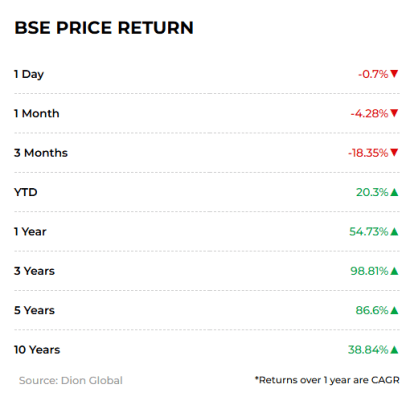
BSE share price performance
NSE listing offers BSE an additional revenue opportunity
Macquarie also examined the potential impact of NSE’s eventual listing on BSE.
Under current regulations, NSE shares can only trade on BSE. Macquarie estimates that the current float would generate less than Rs 10 crore of annual revenue for BSE, or less than 0.5% of its FY27 revenue. However, the brokerage estimates that every additional 5% of NSE’s float coming to the market could add around 1% to BSE’s revenue.
Macquarie has not included wider liquidity benefits, index-related volumes or passive flows from an NSE listing in its estimate.
What Macquarie expects from NSE and BSE
Macquarie’s two reports present different routes to growth for India’s leading exchanges. BSE is expected to grow faster as it takes market share in cash equities and derivatives, while NSE is expected to use its existing scale to expand non-transaction businesses and new products.
For BSE, the brokerage expects 16% revenue CAGR between FY26 and FY30, compared with 12% for NSE. BSE’s EBITDA margin is projected to rise from 65.7% to nearly 70%, while NSE’s margin is expected to remain around the mid-70s.
Both stocks have been initiated with an ‘Outperform’ rating. Macquarie’s target price is Rs 4,000 for BSE, implying 22.7% upside, and Rs 1,965 for NSE, implying roughly 10% upside.
The two reports therefore frame the exchange battle around two different earnings paths: BSE’s potential share gains and margin expansion on one side, and NSE’s scale, liquidity and growing non-transaction revenue on the other.
Disclaimer: This article is based solely on Macquarie Equity Research’s September 24, 2026 initiation reports on BSE and the National Stock Exchange of India and presents the brokerage’s ratings, target prices, estimates and views. The upside figures stated in the article are based on the valuation levels used in the respective reports and are presented as reported or on an approximate basis where required. Revenue, earnings, market-share and margin estimates are Macquarie’s forecasts and may change with trading volumes, regulations, competition and other business conditions. Readers should refer to the original research reports and independently assess the risks before making financial decisions.