




Nomura has cut its March 2027 target for the Nifty 50 to 24,000, lowering its one-year forward valuation multiple to 17 times from 18.5 times earlier as global bond yields rise. At the same time, the brokerage remains positive on financials, information technology services, auto ancillaries, engineering and manufacturing, capital goods and pharmaceuticals, while taking a cautious view on consumption.
The new Nifty 50 target is based on FY28 earnings per share of 1,410 and a 17-times forward earnings multiple. Nomura’s calculation gives a target of 23,970 before rounding, implying a 7% potential return based on the level cited on October 1, 2026.
Why Nomura sees the latest market correction differently
Nomura stated that the latest decline in Indian equities has been driven by more than crude oil and geopolitical tensions. The brokerage compares the August-September correction with the February-March sell-off and points to a different pattern across sectors.
During the first phase, oil-sensitive and domestic-cycle segments such as oil marketing companies, banks, real estate and autos bore the brunt of the decline. In the second phase, information technology services fell the most, while non-banking finance companies and consumer staples also lagged despite solid first-quarter FY27 earnings.
According to Nomura, “The correction, in our view, reflects deeper structural concerns. The correction reflects growing apprehension around long-term growth, rooted in geopolitical realignment and technological disruption and their potential adverse implications for India. Unlike in the first leg of the correction, the AI investment narrative remained firmly intact during the second, reinforcing the relative attractiveness of the US market.”
The brokerage also pointed to policy and regulatory risks in areas such as insurance and hospitals, adding to the pressure on some segments.
Higher US yields are changing the valuation equation
Global bond yields have become another important factor in Nomura’s market assessment. US 10-year and 30-year Treasury yields have risen 74 basis points and 65 basis points, respectively, over three months, moving above 5%. The India-US 10-year yield differential has narrowed to 190 basis points, its lowest level in 22 years.
Foreign institutional investors have also stepped up selling. Nomura put financial-year-to-date net outflows from Indian equities at $12.5 billion, with selling intensifying in September after relative stability during July and August. Healthcare was the only sector to escape the selling, according to the brokerage.
Nomura wrote, “The yield spread between India and the US has declined even further. For 10-year treasury, the difference between India and the US is at 190bp, the lowest in 22 years. The rise in yields in developed markets is driven by strong growth and credit demand, rather than expectations of any long-term inflationary pressures.”
Nomura cuts Nifty March target to 24,000
Nomura has reduced its target multiple for the Nifty 50 to 17 times one-year forward earnings from 18.5 times earlier. Its March 2027 target stands at 24,000, based on FY28 earnings per share of 1,410.
The brokerage’s calculation produces a target of 23,970 before rounding, while its FY26-FY28 earnings-per-share compound annual growth rate is 6.9%. The report puts the potential return at 7% based on the Nifty level as of October 1, 2026.
Nomura said, “We reduce our target multiple to 17.0x 1-year forward from 18.5x previously, and assign a March 2027 target of Rs 24,000 for the Nifty50. The reduction in target multiple factors in higher yields. We do not assume structural headwinds from geopolitics and technological changes to have long-term impact on growth.”
The lower multiple is therefore primarily linked to the higher yield environment rather than an assumption that India’s longer-term growth prospects have permanently weakened.
Valuations have fallen, but reset is uneven
The Nifty 50 is trading at 16.9 times one-year forward earnings, marginally below its 17-22 times post-pandemic range and slightly below its pre-pandemic average. Nomura’s assessment becomes more divided further down the market-cap spectrum.
The Nifty Midcap index trades at 22.9 times one-year forward earnings against a post-pandemic average of 29.4 times. The Nifty Smallcap index, however, trades at 23.7 times, above its post-pandemic average of 22.9 times. Its 39.3% premium over the Nifty 50 is the highest in more than a decade.
Nomura wrote, “The mid caps and the small caps in particular have been relatively more resilient. The segment represents companies with low base, that can adapt to changing dynamics quickly and record much stronger growth vs large caps. Nifty mid caps trade at 22.9x against a post-pandemic average of 29.4x, a meaningful reset.”
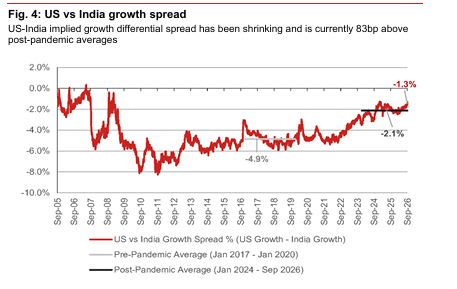
The brokerage also notes that financials, information technology and consumption now trade below pre-pandemic multiples, while auto ancillaries, pharmaceuticals, real estate and defence/capital goods continue to trade at a premium.
| Segment | Nomura’s valuation view | Stance |
| Banks | 1.9x one-year forward price-to-book | Positive |
| NBFCs | 2.5x one-year forward price-to-book | Positive |
| IT services | 14.5x one-year forward earnings | Positive |
| Insurance | 1.48x one-year forward price-to-embedded-value | Positive |
| Consumer staples | 31.7x one-year forward earnings | Cautious |
| Consumer durables | 30x one-year forward earnings | Cautious |
| Consumer discretionary | 42.7x one-year forward earnings | Cautious |
Financials and IT services get support from lower valuations
Financials and information technology services are among the areas where Nomura sees valuation support after the market correction.
Banks trade at an average one-year forward price-to-book ratio of 1.9 times, below one standard deviation of their post-Covid average. Non-banking finance companies trade at 2.5 times, also below one standard deviation of their post-Covid average.
Information technology services trade at 14.5 times one-year forward earnings, below one standard deviation of their post-Covid average and close to levels seen around 2020. Insurance companies trade at an all-time low one-year forward price-to-embedded-value ratio of 1.48 times.
Nomura said, “At a sector level, the valuation multiples have recorded similar divergence. Index heavyweights financials, IT services and consumption have de-rated significantly and are now trading below pre-pandemic levels. In contrast, auto ancillaries, pharma, real estate defense/capital goods are the notable holdouts.”
The brokerage therefore remains positive on financials and IT services, with valuation being a key part of the case.
Auto ancillaries and pharmaceuticals preferred bets
Nomura is constructive on auto ancillaries, engineering and manufacturing, capital goods and pharmaceuticals. It also prefers established exporters, including auto-component, pharmaceutical and power-equipment companies with proven credentials.
The preference does not rest entirely on lower valuations. Auto ancillaries are trading above one standard deviation of their post-Covid average, while pharmaceuticals are also above their post-Covid average. Nomura’s case is based on business characteristics and expected demand as well as valuation.
The brokerage said, “The key themes underpinning our sector stance are: (1) Preference for established exporters, auto components, pharmaceuticals, and power equipment companies with proven credentials; (2) data center and power infrastructure investment, strong structural tailwinds from capacity build-out; (3) AI-driven opportunities for India IT services, expectations of medium-term revenue uplift from AI implementation mandates.”
Nomura also expects data-centre and power-infrastructure investment to support longer-term demand for engineering, manufacturing and capital-goods companies.
Consumption faces pressure from weaker rural demand
Nomura is cautious on consumption as it expects growth to slow and margins to come under pressure.
High-frequency data show that demand has remained reasonably firm, but the recovery is concentrated in urban consumption and credit-financed purchases. Durable consumer goods production and retail and auto credit remain strong, while non-durable consumer goods output has been flatter.
Nomura wrote, “This suggests the upturn is concentrated in bigger-ticket, credit-financed purchases rather than every day mass-market volumes, pointing to soft rural demand, which a poor monsoon is likely to weigh on further. Electricity demand has also picked up, aided by a weak 2025 base and higher cooling needs amid a deficient monsoon.”
The valuation picture adds to the brokerage’s caution. Consumer staples trade at 31.7 times one-year forward earnings, consumer durables at 30 times and consumer discretionary at 42.7 times.
Earnings growth could come under pressure in FY28
Nomura expects first-quarter FY27 earnings to remain resilient, with the direct impact of higher oil prices largely contained within oil and gas. But the brokerage sees greater margin pressure ahead as the WPI-CPI spread widens, commodity prices remain elevated and base effects become less favourable.
For the remaining nine months of FY27, Nomura expects BSE 200-plus earnings to grow 8%. Its FY28 estimate is 18%. Excluding oil and gas, the corresponding figures are 12% and 17%.
Nomura wrote, “For FY28F, the consensus currently factors in high-teens earnings growth. We think this assumes significant de-escalation of macro headwinds and easing of geopolitical tensions, lower crude prices and not a disruptive move in interest rates. Clearly, these assumptions appear optimistic at this stage.”
The brokerage also says India’s corporate earnings-to-GDP ratio has reached cyclical highs. It sees the possibility of mid-single-digit cuts to FY28 earnings estimates if the broad-based investment cycle, manufacturing activity and consumer sentiment fail to strengthen sufficiently.
A selective strategy takes priority over chasing growth
Nomura’s response to the correction is to favour businesses where valuations provide support while remaining selective about higher-growth companies.
The brokerage is constructive on auto ancillaries, engineering and manufacturing, capital goods and pharmaceuticals. It is also positive on financials and information technology services, cautious on consumption and neutral on commodities.
Nomura said, “We continue to recommend a bottom-up approach from a medium- to long-term perspective. Against the backdrop of hardening in yields, our stance prefers stocks that present value, and we recommend being selective in growth. We recommend being valuation conscious and avoiding chasing the narrative.”
The strategy also favours established exporters, data-centre and power infrastructure, and artificial intelligence-related opportunities in Indian information technology services.
What Nomura’s strategy means for the market
Nomura’s latest India equity strategy points to a market where the broad valuation reset has created opportunities in some large sectors, but higher yields and potential earnings pressure make a broad-based re-rating harder to justify.
Nomura’s closing view is, “We are constructive on auto ancillaries, engineering/manufacturing, and pharmaceuticals. We are also positive on financials and IT services, supported by what we view as attractive valuations. We are cautious on consumption.”
Nomura expects higher yields to keep pressure on valuation multiples, while earnings delivery, business quality and reasonable valuations will be important factors to watch.
Disclaimer: This article provides factual analysis only and is not, and should not be construed as, an offer, solicitation, or recommendation to buy or sell securities. Investors must conduct their own independent due diligence and seek advice from a SEBI-registered financial advisor.