




The Nifty has fallen 10.9% so far in 2026, but the benchmark’s weakness is hiding a sharp divergence across the Indian equity market. Goldman Sachs has identified a basket of 42 Indian companies that has gained about 60% this year, while Chris Wood’s GREED & fear note at Jefferies says India’s underlying growth story remains intact, with strong credit growth and continued resilience in mid and small caps.
That divergence comes as investors look beyond the benchmark after a weak year for Indian equities. Goldman Sachs’ basket spans power, data centres and semiconductors, while Chris Wood’s latest note highlights domestic demand, corporate lending and India’s entrepreneurial base. Together, the reports point to parts of the market where earnings and investment activity are holding up better than the headline index suggests.
Chris Wood says India’s structural growth story remains intact
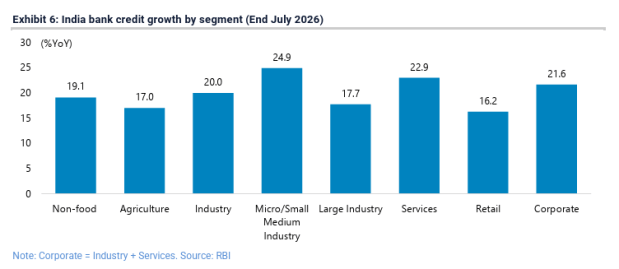
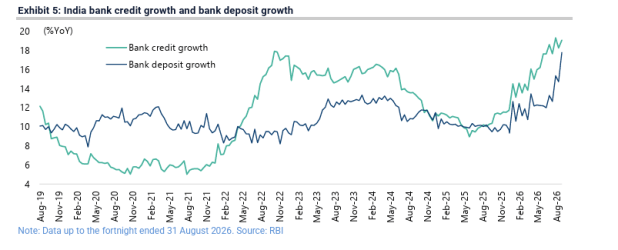
Chris Wood’s GREED & fear note, following the Jefferies India Forum, said India’s economic performance has been much stronger than expected. The note pointed to bank credit growth of 19.1% year on year at the end of August, with corporate loans up 21.6% in July and loans to micro, small and medium industrial enterprises rising 24.9%. Bank deposits also grew 17.8% year on year in August.
“Three and a half years on and in the Indian capital again this week for the Jefferies 5th India Forum, it remains evident to GREED & fear that the structural growth story remains intact with the economic data remarkably resilient given the obvious challenges posed by geopolitics to a country which remains a major consumer of energy,” Chris Wood’s GREED & fear said.
Chris Wood said the strength in lending was visible across segments, with corporate and small and medium enterprise credit showing particularly strong growth. The note also linked the pickup in SME lending to recent GST and labour reforms and the government’s focus on improving ease of doing business.
GDP growth could support a pickup in earnings
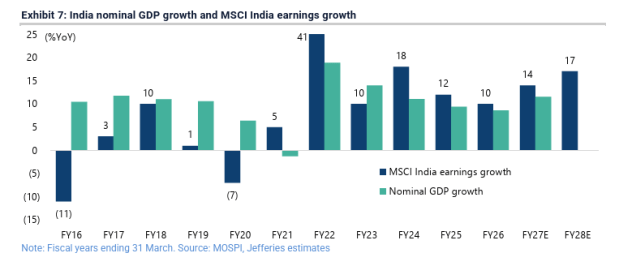
Chris Wood’s GREED & fear said India looks on track for 6.5% to 7% real GDP growth and around 11% to 12% nominal GDP growth in the current fiscal year.
The note cited Jefferies’ head of India research Mahesh Nandurkar, who expects the acceleration in nominal GDP growth to support a rise in MSCI India earnings growth from 14% this fiscal year to 17% next year, beginning April 1.
The pickup in corporate lending is also significant for the investment cycle. Chris Wood’s GREED & fear said stronger corporate credit could indicate that the long-awaited private sector capital expenditure cycle is finally beginning to happen.
Chris Wood sees mid and small caps as a key market pocket
The gap between the Nifty and mid caps has widened sharply in 2026. The Nifty Midcap 100 has risen 1.5% year to date, compared with a 10.9% decline in the Nifty. Since the beginning of 2023, the MidCap 100 has gained 95%, against a 29% rise in the Nifty, according to Chris Wood’s GREED & fear note.
“From a stock market standpoint GREED & fear continues to believe, as previously discussed here, that the mid and small caps are the most interesting part of the market given the huge reservoir of entrepreneurial talent,” Chris Wood said.
The valuation gap is significant as well. The Nifty Midcap 100 was trading at 26.3 times 12-month forward earnings, compared with 17.3 times for the Nifty. Chris Wood’s note said mid and small caps have continued to outperform larger companies despite these higher valuations.
Goldman Sachs finds a 60% rally beneath the weak benchmark
Goldman Sachs has approached the divergence from a different angle. The brokerage screened 1,800 listed Indian companies with a combined market capitalisation of $5 trillion and narrowed the universe to 42 AI Enablers with visible revenue opportunities, order-book pipelines, capital commitments and partnerships linked to the AI supply chain. The 42 companies have a combined listed market value of $670 billion.
Goldman Sachs said these companies operate across three layers of the AI infrastructure chain, power, data centres and semiconductors. The group includes power generation and transmission companies, power equipment makers, data centre developers and operators, data centre hardware companies and semiconductor businesses.
“Beneath the surface of a laggard benchmark, a distinct and rapidly compounding pocket of AI-infrastructure beneficiaries, predominantly mid, small and micro-cap companies, is delivering some of the strongest equity returns in India,” Goldman Sachs said.
Goldman Sachs said the AI Enabler basket was up about 60% in 2026, even as the Nifty had declined 12% over the same period in the brokerage’s September 17 report. It described the divergence as evidence that India’s limited exposure to the global AI theme at the benchmark level does not mean the country lacks AI-linked opportunities.
Most of Goldman Sachs’ AI basket is outside large caps
The composition of the basket is notable. Goldman Sachs identified 12 large-cap, nine mid-cap, 13 small-cap and eight micro-cap companies among the 42 AI enablers. Capital goods account for 21 of the 42 companies, with utilities and technology hardware also having significant representation.
The largest portion of the basket’s $670 billion market capitalisation comes from data centre operators at $398 billion. Power equipment companies account for $95 billion, power generation $47 billion and power transmission $45 billion.
The brokerage said all three broad layers of the AI infrastructure theme have rallied between 40% and 80% year to date. Its analysis also showed that six of the nine sub-layers have gained more than 20% in 2026.
Earnings upgrades are setting this basket apart
The biggest difference between the AI Enabler group and the broader market is visible in earnings revisions. Goldman Sachs said CY27 earnings estimates for the 42 companies have risen 22% year to date, while estimates for the Nifty 500 have been cut 2%.
Data centre hardware has led the upgrades, with earnings estimates up 95%, followed by power equipment at 15% and semiconductor materials at 8%. Goldman Sachs also pointed out that the earnings upgrades have not been uniform, with estimates cut for data centre developers and power generation companies.
“Earnings upgrades are underway. AI Enablers have seen CY27 EPS estimates upgraded 22% YTD in 2026, while the broader Nifty 500 has been cut 2% over the same period,” Goldman Sachs said.
Goldman Sachs expects the AI Enabler group to deliver earnings growth of 53% in CY26, 39% in CY27 and 29% in CY28. By comparison, its estimates for MSCI India earnings growth are 16%, 16% and 14% for the same years.
The brokerage estimates that AI Enablers could contribute around 2 percentage points to NSE 500 earnings growth in CY27 and CY28. It also estimates that the group could account for around 6 percentage points of NSE 500 capital expenditure growth in CY26.
Valuations are high, but growth is also higher
The sharp rally has left Goldman Sachs’ AI Enabler basket trading at 36 times forward earnings, around an 85% premium to the MSCI India index and near the upper end of its own five-year valuation range.
Goldman Sachs said the valuation premium looks less significant when adjusted for earnings growth. The basket’s PEG ratio stands at 1.3 times, slightly below 1.4 times for the broader MSCI India index.
The brokerage also found that the rally since 2025 has been driven predominantly by earnings rather than multiple expansion. Its analysis showed a 53% return for the AI Enabler cohort since 2025, with earnings growth contributing 65 percentage points while valuation compression reduced returns by 12 percentage points.
Domestic flows are another piece of the India story
Chris Wood’s GREED & fear note also highlighted the strength of domestic investment flows. Net inflows into domestic equity mutual funds have averaged about Rs 38,800 crore a month so far in 2026.
At the same time, equity issuance has risen sharply. Jefferies said monthly equity supply reached about $9.5 billion in August, absorbing some of the domestic liquidity and limiting the upside of the benchmark.
This helps explain why the broader Indian market can look weak even when individual segments are attracting substantial capital. Domestic liquidity remains strong, but new equity supply and the concentration of earnings growth can create large differences between the benchmark and individual market pockets.
What Chris Wood and Goldman Sachs are highlighting
The two reports approach India’s market from different directions, but both point towards a broader market than the Nifty alone suggests.
Chris Wood’s GREED & fear focuses on economic resilience, strong bank credit, the potential revival of private sector capital expenditure and the continued performance of mid and small caps. Goldman Sachs focuses on a narrower but rapidly growing group of companies tied to the infrastructure required for artificial intelligence.
The numbers show the extent of the divergence. The Nifty is down 10.9% in 2026, while the Nifty MidCap 100 is up 1.5% and Goldman Sachs’ AI Enabler basket is up about 60%. At the same time, earnings expectations for the AI Enabler group are being revised higher even as broader Nifty 500 estimates have moved lower.
For investors assessing what could drive the next phase of India’s equity market, the reports therefore shift attention away from the headline index and towards the areas where economic activity, capital expenditure and earnings growth are becoming more concentrated.
Disclaimer
This article is based on analysis published by Jefferies’ GREED & fear and Goldman Sachs Global Investment Research. The views, estimates, earnings forecasts and market observations cited are those of the respective research teams and are not independent investment advice. Investors should consider their own financial objectives, risk tolerance and investment horizon before making any investment decision.