


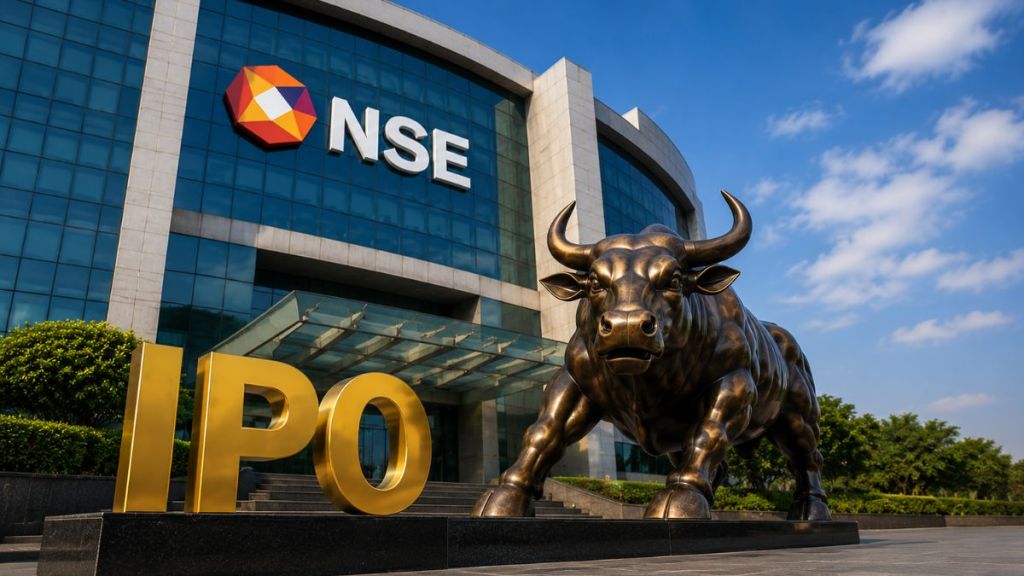

For years, India’s biggest stock exchange stayed on the sidelines while everyone else went public around it. Now, that wait is nearly over. With SEBI finally clearing the runway, the National Stock Exchange (NSE) is set to knock on Dalal Street’s door, and everyone from big fund houses to first-time retail investors wants to know one thing – what will it cost to own a piece of the exchange that runs India’s trading engine?
What could be the price band? When will investors get a chance to bid? And, perhaps the biggest question, how will NSE’s valuation compare with its listed rival, the Bombay Stock Exchange (BSE)?
NSE IPO GMP slips, but interest remains
NSE shares are currently available at a grey market premium (GMP) of Rs 255, according to market indications. That is Rs 18 lower than the previous day’s GMP of Rs 273.
The GMP, however, is only an unofficial indicator. The final IPO price will depend on the exchange’s formal announcement and investor demand.
What price band are analysts expecting?
Sameer Sawant, Research Analyst at Mirae Asset Sharekhan, expects NSE to price the issue below the prevailing unlisted-market levels.
He said, “With NSE’s IPO structured entirely as an offer-for-sale of roughly 14.89 crore shares, about 5–5.5% of equity for an issue size around Rs 24,000-25,000 crore, we’d expect the official price band to be pitched at a modest discount to the grey-market tape (as per media), plausibly in the Rs 1,800–2,000 range.”
The unlisted shares are trading around the Rs 2,000 mark as of now.
Why would NSE price the IPO below the grey market?
Sawant believes large offer-for-sale, or OFS, issues generally leave some room for public investors. In NSE’s case, existing shareholders are selling their shares, rather than the exchange raising fresh capital.
He added, “Large OFS-led issues have historically priced below prevailing unlisted expectations to leave something on the table for public investors and to underwrite institutional and retail appetite.”
NSE vs BSE: How wide is the valuation gap?
This is where the NSE IPO becomes particularly interesting. According to Sawant, NSE’s unlisted valuation is around Rs 5 lakh crore, while BSE’s market capitalisation is around Rs 1.35 lakh crore to Rs 1.4 lakh crore.
That means NSE could be valued at nearly four times BSE despite both exchanges trading at broadly similar earnings multiples.
Sawant said, “On the NSE Vs BSE gap, NSE’s Rs 5 lakh crore unlisted valuation is nearly 3.5–4x BSE’s Rs 1.35–1.4 lakh crore market cap at a broadly comparable 50x earnings base.”
So, is the premium excessive? Not necessarily, according to Sawant. He believes much of the gap can be explained by NSE’s much larger share of India’s cash and derivatives trading activity, along with higher-margin revenue and stronger return ratios.
He said, “We see the bulk of that premium as justified, it reflects NSE’s dominant share of India’s cash and derivatives turnover, a structurally larger and higher-margin revenue pool, and superior return ratios.”
When could NSE IPO open?
The current expectation, as stated by PTI quoting sources, is that the IPO could open on September 18 and remain available for subscription till September 22. Th popular expectation is that the exchange could make its D’Street debut on September 25, although investors will have to wait for the official announcement before treating these dates as final.
NSE IPO: Key stakeholders likely to offload shares
The issue is entirely an offer for sale, meaning existing shareholders will sell their holdings.
Among the listed companies participating are State Bank of India (SBI), Bank of Baroda (BoB), The New India Assurance Company and General Insurance Corporation of India.