


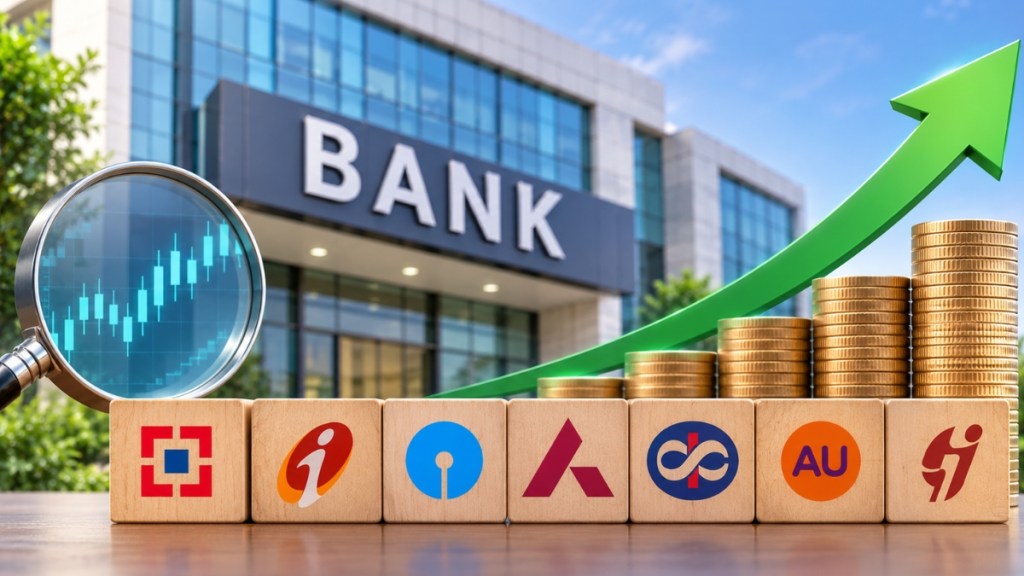

Global investment bank Jefferies analysed the FY26 annual reports of Indian banks, which reveal the sector is on a solid foundation. Asset qualities are at a two-decade best, retail deposit franchises are diverging as loan growth is converging, and investments in technology and artificial intelligence (AI) is taking precedence over branch expansion.
Jefferies said ICICI Bank, Axis Bank, SBI, HDFC Bank, and Kotak Mahindra Bank are among its preferred large cap picks in the banking sector. It chose AU Small Finance Bank and IndusInd Bank among the smaller ones.
FY26 findings
“During FY26, Indian banks’ deposit franchises showed significant divergence. The sector’s retail deposit growth of 11% YoY was in line with total deposit growth of 11%, and share in deposits is stable at ~60%. Growth for large banks (we cover) ranged between 10% and 15% & for smaller banks between 15% and 25%,” it said.
Loan growth was divergent across segments, even as banks’ growth was similar. “Growth for banks we cover improved from 11% in FY25 to 15% for FY26, led by corporate loans, a surge in gold loans and consistent growth in SME loans. Growth in retail loans was moderate, with unsecured loans showing a slight recovery,” Jefferies added.
During FY26, the branch network of banks grew by just 3% YoY, lowest in the last four years, adjusted for the HDFC Bank merger, while overall headcount remained broadly flat.
The attrition level was stable YoY but was near a multi-year low. “Most private banks have generated value through ESOPs granted over the past 3yrs, but there is high divergence. Tech costs form c.10% of opex, reflecting investment in cloud, AI, and cyber-security,” the investment bank said.
ECL, Rate Hikes, and Other Factors to Watch
Jefferies added that the expected rate hikes by the Reserve Bank of India can offset the impact of transition to expected credit loss (ECL) and wage hike costs. The global investment bank has now identified three “sensitives” to keep an eye on in the banking sector.
This includes the transition to ECL-based provisioning from FY28, which will lead to higher stress-loan provisions and a one-time cost. Lenders have indicated this can lead to a 10 to 20 basis point increase in credit costs.
State-owned banks face a higher risk due to lower return on assets and buffer provisions. These banks will also see the next wage settlement that can lift operating expenditure in FY28 and FY29.
“On the positive side, a hike in Repo Rate, we expect 75bps, will be positive for banks, especially for PSU banks and large private banks,” Jefferies said.
Consistent performance or scope to improve?
Jefferies said ICICI Bank and SBI have led stronger growth and profitability than peers while HDFC and Axis have scope to improve with better retail growth and margins. Banks have performed better than the market in 2025, but have underperformed their peers in larger regional markets.
“Hence, valuation premium of Indian banks over well-run global banks has narrowed,” it added.
What lies next for banks?
While FY26 annual reports show a sound foundation, with strong asset qualities, the path from here becomes important for the sector. The transition to ECL provisions remains one of the key factors to monitor.
Disclaimer: This article is based on research reports from one or more brokerage firms and is for informational purposes only. The views, target prices, and recommendations expressed are those of the respective brokerage firms and do not reflect the official policy or position of Financial Express. This should not be construed as an offer, solicitation, or recommendation to buy or sell securities. Investors must conduct their own independent due diligence and seek advice from a SEBI-registered financial advisor before making any investment decisions.