


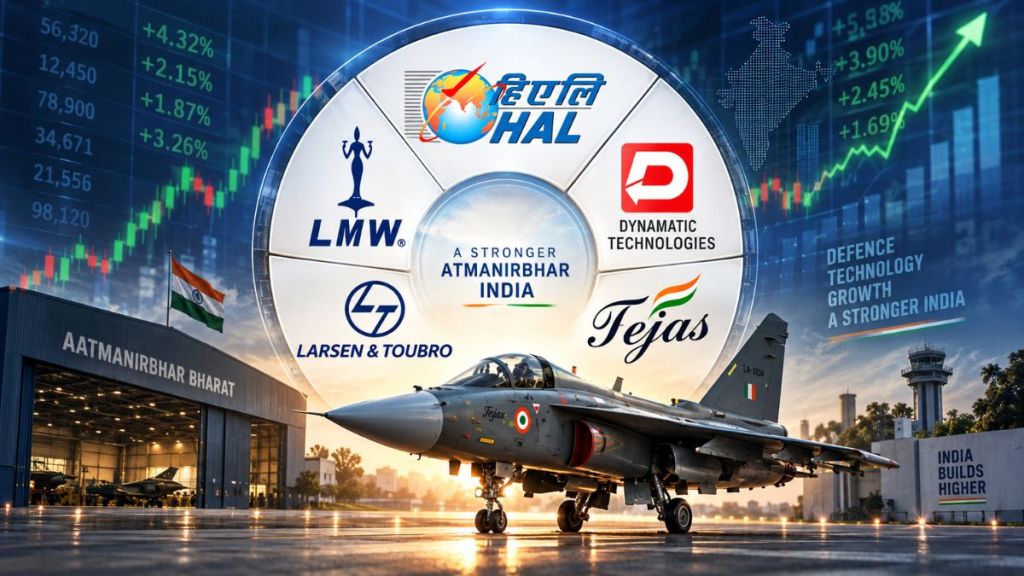

Hindustan Aeronautics (HAL) is in the spotlight after the Defence Acquisition Council cleared $11.5 billion worth capital acquisition proposals, including 138 Advanced Light Helicopters from Hindustan Aeronautics. Interestingly, this also brings the focus on the private-sector manufacturing network around the LCA Tejas Mk1A, with listed companies taking on specialised aerospace manufacturing work that was traditionally concentrated within the state-owned aircraft maker.
FinancialExpress.com spoke to defence and capital-goods analysts to understand how the growing private-sector role in Tejas manufacturing could shape the opportunity for companies such as Larsen & Toubro, Lakshmi Machine Works and Dynamatic Technologies, which have different levels of exposure to the aerospace ecosystem.
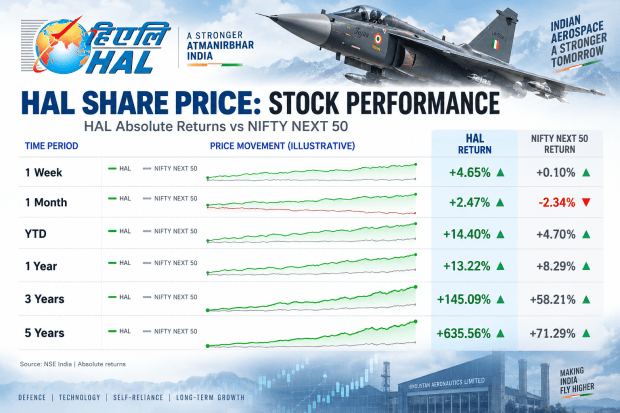
HAL share price performance
India’s aerospace ecosystem: Key stocks in focus
The Ministry of Defence last year announced that Hindustan Aeronautics had built a national aerospace ecosystem by supporting private partners with jigs, fixtures, tools and technical know-how. The government specifically named L&T and Lakshmi Machine Works among companies producing complex sub-assemblies, including wings and air intakes. It also said HAL’s LCA Tejas Division had received structural modules of air-intake assemblies, rear fuselage assemblies, loom assemblies, and fin and rudder assemblies in the Mk1A configuration.
For Dynamatic Technologies, the latest company presentation provides a different link. It identifies HAL as an aerospace customer and describes Dynamatic as a Tier-I supplier delivering complex aerostructures, tooling and precision parts. Aerospace accounted for 48% of its Q1 FY27 revenue.
The three companies are therefore entering the HAL ecosystem through different parts of the aerospace manufacturing chain. L&T has a documented wing-assembly role, LMW is supplying air-intake assemblies, while Dynamatic has an established HAL-linked aerospace and aerostructures business.
Fighter aircraft programs: Growing scope for private-sector ecosystem
Analysts said the private-sector ecosystem could expand further as India’s fighter aircraft programs move from Tejas Mk1A towards Tejas Mk2 and the Advanced Medium Combat Aircraft (AMCA).
“We think this private-sector ecosystem is only going to see a rise as we move from Tejas to Tejas Mk2 to AMCA. Right now, it’s mainly on the component side, and slowly it will also move towards integration,” said Harshit Kapadia, Senior VP – Capital Goods, Defence, Railways, Consumer Durables, Consumer Electrical and EMS.
Ankit Soni, Research Analyst at Mirae Asset Sharekhan, added that the shift represents a broader change in HAL’s manufacturing model.“Our view is that Tejas Mk1 program is evolving from a HAL-centric manufacturing model to an ecosystem model, where private companies increasingly become tier-1 and tier-2 partners, over the next 3–5 years,” Soni added.
Private companies are taking on more of Tejas manufacturing
HAL’s manufacturing model for the Tejas Mk1A is increasingly involving private-sector suppliers for major aircraft structures and assemblies.
The Ministry of Defence said HAL had supported private partners by providing jigs, fixtures, tools and technical know-how, allowing companies including L&T and LMW to manufacture complex sub-assemblies. The government listed centre fuselages, fuel drop tanks, pylons, rear fuselages, wings, fins, rudders and air intakes among the assemblies being produced through this ecosystem.
Dynamatic’s disclosed connection is broader. Its Q1 FY27 presentation lists HAL among its aerospace customers.
Kapadia said the three companies have different roles in the evolving aerospace value chain. “L&T and Dynamatic Technologies would be the two bigger beneficiaries because integration is where the maximum revenue value is sitting. LMW will be more of a component supplier for the aircraft because they are more into precision engineering,” Kapadia pointed out.
Soni explained that HAL’s transition towards a lead-integrator model could allow private companies to move further up the value chain, “Historically HAL manufactured much of the aircraft internally. Now HAL is shifting toward a lead integrator model, outsourcing major aerostructures and fuselage assemblies to private firms while focusing on final integration, testing and certification. ”
According to Soni, the increasing role of private suppliers could also create significant order visibility if Tejas production scales up.
“Imagining delivery of 24-30 aircraft per year to IAF would represent 6-7 years of order visibility for the private players. Currently, 60-65% is the indigenous content, and the target would be a newer batch to incorporate a higher indigenous content. This indicates the private companies can further move up the value chain,” Soni said.
He estimated that if at least 30-40% of the work is outsourced to private players, it could indicate a total addressable market of Rs 30,000-40,000 crore.
Three private companies, three different Tejas exposures
| Company | HAL / Tejas connection | Latest numbers | Business position |
| Larsen & Toubro | Precision Engineering and Systems business is handlingr wing assemblies for LCA Mk1A | Q1 FY27 group revenue: Rs 67,900 crore; group order book: Rs 5.27 lakh crore | Large diversified engineering and manufacturing business |
| Lakshmi Machine Works | Advanced Technology Centre supplies air-intake assemblies for LCA Tejas Mk1A | FY26 ATC revenue: Rs 207 crore; ATC order book: around Rs 360 crore | Aerospace remains a smaller business alongside textile machinery |
| Dynamatic Technologies | HAL is an aerospace customer; company supplies complex aerostructures, tooling and precision parts | Q1 FY27 revenue: Rs 424.81 crore; aerospace revenue: Rs 202.25 crore | Aerospace contributed 48% of Q1 FY27 revenue |
L&T: Tejas wings come from a much larger engineering business
Larsen & Toubro‘s Tejas Mk1A work comes through its Precision Engineering and Systems business, which has handed over wing assemblies to HAL.
The programme is part of a much larger operation. L&T reported group revenue of Rs 67,900 crore in Q1 FY27, while its group order book stood at Rs 5.27 lakh crore at the end of June 2026. Group order inflows during the quarter were Rs 1.08 lakh crore.
The company’s manufacturing and products and services business reported revenue of Rs 679 crore during the quarter, with an EBITDA margin of 9% and PAT of Rs 41 crore.
The size of L&T’s overall order pipeline also came up during its Q1 FY27 earnings call.
“Three, four years order book is a very healthy order book. It gives a lot of stability. It allows us time to build capacity. We can build capability. So, I think it is a good position to be in,” Subramanian Sarma, Deputy Managing Director and President, said during the con call on July 28, 2026.
The Tejas wing work is consequently part of L&T’s wider precision-engineering and defence manufacturing activity rather than a standalone business.
Kapadia said L&T’s position is different from that of companies focused primarily on components, “LMW fits into the second bucket, whereas L&T and Dynamatic fit into the first bucket,” Kapadia said, referring to large-cap integrator companies and small- and mid-cap component suppliers.
Soni also highlighted the difference in scale when assessing the potential earnings impact of aerospace orders on L&T, “A Rs 1000-2000 crore of revenue would not move the needle for base of lakhs crores of revenue for L&T.”
L&T share price performance
Dynamatic: aerospace is already 48% of quarterly revenue
Dynamatic Technologies comes into the story with a much larger existing aerospace business.
Its Q1 FY27 presentation identifies HAL as an aerospace customer and describes the company as a Tier-I supplier to global aerospace customers and HAL. Its disclosed product portfolio includes wings, rear fuselages, ailerons, wing flaps, major airframe structures, ramp structure assemblies and aft pylon assemblies.
Aerospace contributed 48% of Dynamatic’s Q1 FY27 revenue. Segment revenue rose 17% year on year to Rs 202.25 crore, while aerospace EBITDA increased 20.5% to Rs 48.19 crore. The segment EBITDA margin was 23.8%.
Dynamatic’s consolidated revenue rose 14.5% to Rs 424.81 crore. EBITDA increased 45.9% to Rs 55.11 crore, with the margin at 13%, while normalised PAT rose 93% to Rs 20.79 crore.
The company attributed aerospace growth to execution across commercial aerospace and defence programmes, along with the ramp-up of detail parts at its wholly owned Indian manufacturing facility.
“The Aerospace segment continued to be the major contributor to the company’s revenue during the quarter supported by execution across key commercial aerospace programs and an improved product mix supported by sheet metal and detail parts ramp up at our wholly owned subsidiary, Dynamatic Manufacturing Limited,” the company said in its Q1 FY27 results commentary.
Dynamatic’s latest supplied material does not identify a specific Tejas Mk1A component. Its disclosed position is that of an established aerospace supplier to HAL, with a broad aerostructures portfolio and aerospace already accounting for nearly half of quarterly revenue.
Soni said Dynamatic’s existing aerospace exposure makes it one of the companies positioned to benefit from the wider Tejas private-indigenisation ecosystem.
“Few private players names such as Dynamatic Technologies, Data Patterns, Astra Micro, and, in the aerospace theme, Azad and MTAR shall be the real beneficiaries of the whole Tejas private indigenization ecosystem model,” Soni explained.
“For Dynamatic Technologies, 50% of revenue comes from aerospace division and will be a pure play for Tejas structural works. Dynamatic’s order book is also extended to Airbus programs, secured the Dassault Falcon 6X rear fuselage, and has an AMCA partnership already signed with L&T-BEL,” he pointed out.
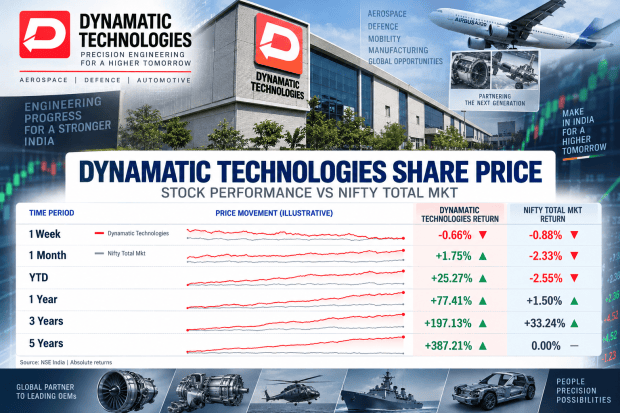
Dynamatic Technologies share price performance
Lakshmi Machine Works: Air-intake assemblies part of smaller aerospace operation
Lakshmi Machine Works is taking a different route into the Tejas production chain. The company’s main business remains textile machinery, but its Advanced Technology Centre has been building capabilities in aerospace and other high-precision manufacturing. The ATC works on engine parts, structural assemblies, sheet-metal components and composite parts.
The Ministry of Defence has named LMW among the private companies supporting HAL’s outsourced Tejas production. Its disclosure specifically includes air intakes among the complex sub-assemblies being produced through the private-sector network, while LMW’s own aerospace business identifies the Tejas Mk1A air-intake programme.
The ATC generated Rs 207 crore of revenue in FY26, up 22% from the previous year, according to the company material. Around 90% of its revenue came from exports. The division also had an order book of around Rs 360 crore as of May 2026, with orders to be executed over the following 18 months.
LMW has planned around Rs 150 crore of investment over five years for a larger ATC campus, with the division targeting an EBITDA margin of around 20%.
The difference in scale between the ATC and LMW’s traditional business is substantial. Consolidated revenue had fallen from Rs 4,696 crore in FY24 to Rs 3,012 crore in FY25 before recovering to Rs 3,207 crore in FY26. Net profit moved from Rs 374 crore in FY24 to Rs 103 crore in FY25 and then Rs 131 crore in FY26.
In the Q1 FY27 earnings call, CFO V. Senthil of LMW said ATC revenue was Rs 60 crore, against Rs 57 crore in the previous quarter and Rs 46 crore in Q1 FY26.
“So, we can take 900 crores in ATC as export for three years. Three and a half years. And 150 crores for immediate delivery,” Senthil said during the con call while discussing the ATC order pipeline.
For LMW, the Tejas air-intake programme is part of the effort to build the ATC into a larger aerospace and advanced-manufacturing business, while textile machinery continues to account for the bulk of the company’s operations.
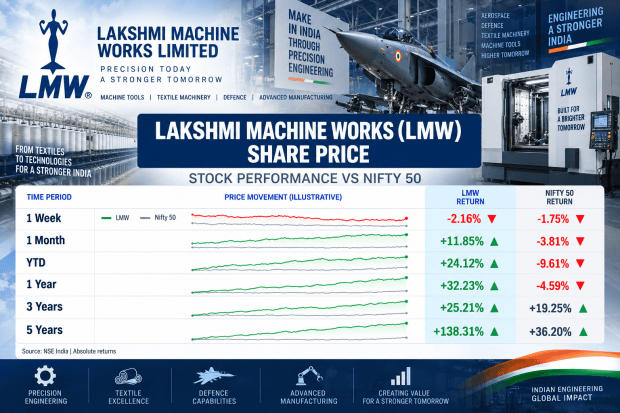
LMW share price performance
Three listed companies, three different exposure levels
The Tejas manufacturing programme sits inside three very different businesses.
L&T has the largest overall scale, with its Tejas wing work forming part of a broad engineering, manufacturing and defence operation. LMW is developing its ATC alongside a much larger textile machinery business. Dynamatic already has a substantial aerospace operation, with HAL among its customers and aerospace accounting for 48% of quarterly revenue.
The numbers from the three companies show the difference.
| Company | Tejas / HAL role | Aerospace or advanced-manufacturing exposure | Latest business indicator |
| Larsen & Toubro | Wing assemblies for LCA Mk1A | Precision Engineering and Systems | Group order book: Rs 5.27 lakh crore |
| Lakshmi Machine Works | Air-intake assemblies for LCA Tejas Mk1A | Advanced Technology Centre | FY26 ATC revenue: Rs 207 crore; order book: around Rs 360 crore |
| Dynamatic Technologies | HAL aerospace customer; broad aerostructures portfolio | Aerospace | Q1 FY27 aerospace revenue: Rs 202.25 crore; 48% of total revenue |
Kapadia said the private-sector opportunity should be viewed across two broad categories as companies take on more work in the defence manufacturing ecosystem.
“We have bucketed it into two categories: large-cap integrator companies and small- and mid-cap component suppliers. LMW fits into the second bucket, whereas L&T and Dynamatic fit into the first bucket. Both will do well, but we think the larger money-making ideas would be in the small- and mid-cap private defence companies or the component manufacturers,” Kapadia added. .
Soni similarly divided the potential beneficiaries into Tier-I and Tier-II companies.“We can divide it into two themes. Tier1 companies to be benefited: Dynamatic Technologies, L&T, BEL and Tata Aerospace. Tier2 companies to be benefited: Data Patterns, Azad Engineering, Centume Electronics and in some MTAR technologies,” Soni said.
The private-sector role in Tejas manufacturing is also growing beyond individual components. HAL has said it plans to extend the outsourcing model to future projects, while its existing ecosystem already covers several complex aircraft structures.
That gives L&T, LMW and Dynamatic an opportunity to participate in a larger domestic aerospace manufacturing base, but the nature of that opportunity is different for each company.
L&T’s wing assemblies add to an already large defence and engineering operation. LMW’s air-intake work gives its ATC another aerospace programme as the division builds capacity and orders. Dynamatic has the most established aerospace exposure of the three, although its latest disclosure does not identify a specific Tejas Mk1A component.
Conclusion
HAL’s decision to involve private manufacturers in the Tejas Mk1A production chain is opening more of the aircraft manufacturing process to Indian engineering companies.
For L&T, the opportunity is tied to wing assemblies and sits within a very large engineering and defence business. For LMW, Tejas air-intake assemblies form part of the Advanced Technology Centre’s push into aerospace. Dynamatic is further along in aerospace, with HAL as a disclosed customer and the segment already contributing 48% of quarterly revenue.
The three companies are therefore participating in the same manufacturing ecosystem from very different positions. The scale of their existing businesses, the size of their aerospace operations and their ability to execute additional programmes will determine how much the Tejas opportunity contributes to their financial performance.
Disclaimer: This article is based on information disclosed by the Ministry of Defence, HAL and the respective companies, including company presentations, financial disclosures and earnings conference calls, as well as comments from industry analysts. The views expressed by analysts quoted in this article are their own and are provided for informational purposes only. They should not be construed as investment advice, a recommendation, or an endorsement to buy, sell or hold any security. Investors should independently verify the information, assess their own financial objectives and risk tolerance, and consult a qualified financial adviser before making any investment decision.