




Investors around the world closely track the US Federal Reserve’s monetary policy decisions for cues on market direction. BlackRock’s latest global market outlook suggests investors might be looking in the wrong direction entirely.
Despite higher borrowing costs, rising bond yields, and the prospect of further Fed rate hikes, BlackRock, managing $15.34 trillion of assets under management, remains bullish on US stocks.
BlackRock cites three reasons for its bullish stance. Firstly, AI-linked earnings growth is strong enough to offset the drag from higher yields.
Secondly, infrastructure and bottleneck plays sit at the intersection of AI demand, energy security and capital scarcity, giving investors exposure that traditional asset-class labels don’t capture well. And lastly, even with the Fed boxed in by sticky inflation and a tightening labour market, corporate profits are doing the heavy lifting that rate cuts usually would.
Why earnings are winning even as bond yields climb
Government bond yields have broken higher this year, as sovereign borrowing competes head-on with the private financing needs of the AI buildout. Normally, that combination would hit equity market investors. This time, it hasn’t.
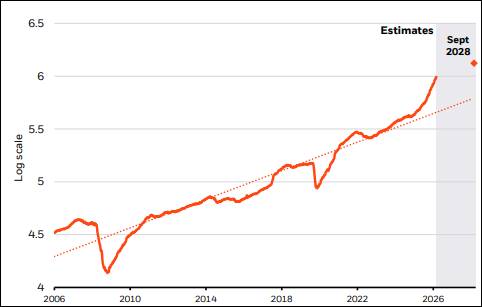
BlackRock says the difference comes down to earnings. S&P 500 profit expectations keep rising, and AI-linked companies account for a large share of that growth. That is the key reason equities have absorbed higher yields far better than they did in 2022, when a similar rate shock hammered stock valuations.
S&P 500 forward 12-month earnings
Source: BlackRock
The asset manager stays overweight US equities on this basis, while keeping its focus on the bottlenecks within the AI trade rather than the trade as a whole.
The debt problem nobody’s fixing anytime soon
Here’s where it gets uncomfortable. The AI investment boom is doing two things at once: lifting growth and earnings, while absorbing enormous amounts of capital, power, materials and balance sheet capacity. Heavy government borrowing is stacking on top of that demand for funding.
The result, in BlackRock’s words, is a higher cost of capital even as AI lifts growth. This translates into competition for capital between US borrowing needs and the AI sector’s financing needs. And it isn’t going away soon.
Jobs data looks fine on the surface, but the Fed isn’t relaxing
US labour supply is tightening. The pace of job creation needed just to hold unemployment steady has fallen. “We think strengthening economic activity is stoking inflationary pressure, just as wages and underlying inflation stay elevated,” says the report.
That leaves the Federal Reserve with less room to cut rates than markets might hope, and BlackRock flags that the risk of renewed tightening stays on the table if price pressures don’t ease.
Oil Price Impact
Inflationary pressure is being driven largely by oil supply disruptions from the Iran war, with prices still holding above $100 a barrel. Any breakthrough in resolving the US-Iran dispute could turn the tables on the outlook, particularly if oil prices dip back toward pre-war levels.
But the report states that the disruption to Middle Eastern energy supplies produced a smaller crude-price shock than feared as various buffers absorbed much of the shortfall. Yet pressure has migrated into refined products, keeping inflation risks alive.
Rising Bond Yields
US Treasury yields across the 10, 20 and 30-year tenures have touched decade-high levels recently and remain elevated. The reason behind this is growing expectations of rates moving higher. Beyond higher oil prices, one key driver is the worsening of US fiscal health.
Investors are still financing historically large borrowing needs for relatively little compensation. A jolt to term premium – the extra reward investors demand for holding long-term government bonds – could spark a further surge in yields, says BlackRock.
According to the report, refinancing is adding pressure of its own. Much of the debt coming due now was issued when rates were far lower, and refinancing at today’s yields is squeezing projects and companies that need cash quickly, including parts of the AI buildout and private markets.
Bottom line
BlackRock isn’t calling this a risk-free environment. Debt issuance, refinancing pressure and a Fed with limited room to manoeuvre are all real headwinds. But the firm bets that AI-driven earnings growth is strong enough to carry US equities through a period of higher borrowing costs, something 2022 didn’t have.
Disclaimer: The article is based on BlackRock’s published Q4 2026 Global Investment Outlook and does not constitute investment advice.