



With the 2026 US midterm elections approaching, investors are once again asking what politics may mean for markets. Can the verdict disrupt this year’s positive momentum?
Midterms have a well-earned reputation for making investors nervous. Stocks have often seen greater volatility and weaker returns during midterm years.
This time, however, it is different. S&P 500 is up by 30% since the day Trump took the oath in 2025, almost 16% annualized compounded returns. History shows that stocks have almost always generated stronger returns in the following year.
What happens to stocks around Election Day?
In the month before Election Day, the S&P 500 has gained an average of 4.5%. Returns were positive 79% of the time, according to a report by Edward Jones based on data from 14 midterm elections since 1970.
The six months after tell a stronger story. The index has averaged a 15.5% return and posted gains after all 14 midterms.
According to a report by Fidelity, the S&P 500 posted price gains 95% of the time in the 12 months after midterm elections, since 1938. Fidelity says stocks have averaged roughly 5% in the second year of a presidential term, though returns vary widely from one cycle to the next. In the following 12 months, the average jumped to 14%.
Performance Around Midterms
| S&P 500 returns | % of time positive | |
| 6 months before Election Day | 0.60% | 57.00% |
| 1 month before Election Day | 4.50% | 79.00% |
| 1 month after Election Day | 1.70% | 71.00% |
| 3 months after Election Day | 7.60% | 86.00% |
| 6 months after Election Day | 15.50% | 100.00% |
Source: FactSet, Edward Jones. Past performance does not guarantee future results.
Since 1930, the S&P has gained almost 6% on average in Q4 of midterm years. That is double the average gain for the whole year, according to the Edward Jones report citing Citadel. The months of October and November have been strongest according to the report.
Edward Jones report says stocks have tended to rally from about one month before the election. They often keep rising once results bring clarity on the policy environment. Improving economic and earnings trends have often played an important role as well.
S&P total return, before and after a midterm election
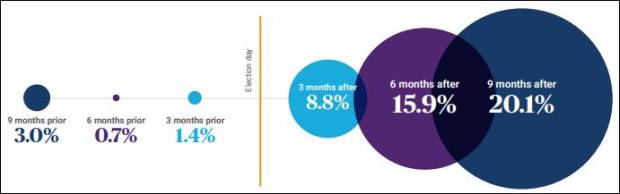
Sources: Ameriprise; Data from Bloomberg, S&P Dow Jones Indices. Past performance is not a guarantee of future results.
Does it matter who wins?
In the past, the control of Congress has often shifted after midterm elections. Market performance, though, has been surprisingly consistent. Since 1970, the S&P 500 has generally gained after midterms. That holds whether the result was unified government, a split Congress, or divided government.
That includes five cases where the ruling party held both chambers and then lost at least one. The S&P 500 averaged approximately 11% over the following six months.
Edward Jones report says the broader lesson is that investors may gain more from focusing on fundamentals than from predicting outcomes. Elections often create short-term uncertainty, it says, but have rarely driven long-term returns. Growth, earnings, inflation and interest rates matter far more.
Post Results
Once midterm election results are known, markets often see stronger-than-average returns over the next year, except during periods of unusual financial stress. Notably, the S&P 500 has gained an average of over 15.4% one year after a midterm election, going back to 1950, says a report by Ameriprise.
A strong market walks into the election
For 2026, the Iran war remains the central point influencing the market. The March peak-to-trough decline was about 9%. That is less than half the 19% average midterm-year drawdown. Moving into the midterm election year, the S&P 500 index is up by 14% YTD.
What kept it going? Edward Jones points to strong earnings, resilient business investment and heavy AI-related capital spending. These have so far outweighed worries about high energy prices, tariffs, inflation and interest rates.
There is a catch. Edward Jones says a strong market may leave less room for the outsized post-election gains that often follow weaker midterm years. Fidelity adds that the outlook has turned cloudier. Investors are reassessing the AI buildout, valuations, and the Fed’s ability to tame inflation.
Could interest rates matter more than the ballot box?
Investors usually focus on taxes and regulation. Yields are at multiyear highs. Strong growth, persistent inflation, rising energy prices and high deficits are all at play, with unemployment historically low. Geopolitics and the Fed’s rate path will likely stay the main drivers, it says, rather than most legislative proposals.
What if the results hold no surprises?
There is no guarantee history will repeat. Edward Jones says the biggest market moves usually come from surprises, not expected outcomes. If results match expectations, reactions may be muted because prices already reflect them. Results that differ meaningfully could trigger a sharper short-term move.
On gridlock, Edward Jones says it may reduce policy uncertainty and ease concerns about big new fiscal expansion. If it limits deficits and Treasury issuance, it could also remove a source of pressure on long-term rates.
A Democratic win in one or both chambers would likely reinforce divided government, says Edward Jones. That would cut the odds of significant new legislation over the next two years. Attention would stay on earnings, growth, inflation and interest rates.
The Takeaway
Edward Jones believes inflation, interest rates, earnings growth and the durability of the AI-driven capital spending cycle will matter far more than election outcomes over the next year. History suggests investors are often rewarded for staying disciplined and long-term, it says, not for reacting to election headlines.
Disclaimer: This article provides factual analysis only and is not, and should not be construed as, an offer, solicitation, or recommendation to buy or sell securities. Investment in foreign securities involves significant risks, including currency fluctuations, different financial reporting standards, and varying regulatory environments. This article is based on reports by Edward Jones, Ameriprise and Fidelity and is for informational purposes only. Past performance does not guarantee future results. It is not investment advice. Financial Express is not responsible for any decisions made based on this information.