



The benchmark 10-year Treasury yield rose to its highest level since 2007 on Tuesday, as a sell-off in US government debt intensified ahead of the Federal Reserve’s interest-rate decision. The big rise in yields should serve as a red flag for investors worldwide.
The 10-year US Treasury yield rose by more than 6 basis points to 5.03% as of 2:30 a.m. EST. On Monday, the 10-year yield briefly crossed above 5% before falling back slightly.
The last time 10-year yields hit 5%, back in 2006, they were already on a downward path, eventually falling to as low as 0.6% by April 2020.
But here’s the twist. For yields to keep climbing after breaching 5%, you’d have to go back to the Credit Crunch of 1966, which shook financial markets that August and September. The yield climbed to as high as 8% before slipping back down.
The yield on the 30-year Treasury bond also increased, rising by over 5 basis points to 5.38%.
What’s Pressuring Yields
The Federal Reserve’s ongoing two-day FOMC meeting has sparked expectations of a quarter-point rate hike, prompted by August’s US CPI data showing inflation stuck at 3.4%, well above the Fed’s 2% target. As of Tuesday, markets are pricing in over a 92% probability of a 25-basis-point increase, according to the CME FedWatch tool.
US 10-year Treasury yields are closely tied to inflation expectations, and if crude oil prices stay elevated, this could push yields even higher, since high energy costs feed into inflation expectations. Brent oil is trading above $107, up over 20% in the past month and 76% year-to-date.
Two-Front Response
The Trump administration is tackling the high-yield problem on two fronts. US Fed chair Kevin Warsh is expected to announce a 25 basis point rate hike on September 16, but his limited guidance on future policy may catch markets off guard.
A rate hike aims to bring down inflation, but how effective it is depends on how long the Iran war drags on. If Warsh raises rates in September, expect further hikes through 2026 and 2027, especially if rising oil prices keep pushing inflation higher.
Scott Bessent, US Secretary of the Treasury, has other plans to tackle rising yields as well. Bond prices and yields move inversely, so when investors sell bonds, yields rise.
The reasons for not holding on to US bonds are multifold. As investors sell off US bonds, Treasury Secretary Bessent has stepped in to counter the pressure. The US Treasury has announced an intervention through a bond buyback, a move meant to signal stability and keep panic from spreading through the bond market.
Essentially, the US Treasury will issue shorter-term securities to raise funds for buying back longer-dated securities, effectively shortening the maturity profile of US debt.
A Global Phenomenon
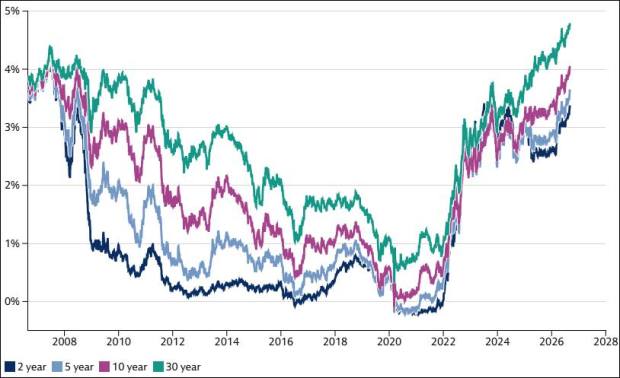
The rise in bond yields isn’t US-centric. Globally, many developed nations are seeing their bond yields climb to multi-decade highs. A Goldman Sachs chart tracking average sovereign yields by maturity across the US, Germany, UK, and Japan shows the same pattern playing out worldwide, as of September 9.
Higher long-end yields are a global phenomenon
Source: Goldman Sachs FICC and Equities, Goldman Sachs Research
According to a Goldman Sachs report titled ‘Why Global Bond Yields Are Expected to Stay Elevated,’ fiscal deficits have grown substantially across many developed economies since the COVID pandemic.
Borrowing to fund investment in artificial intelligence (AI) has also surged, potentially amounting to around 1% of global GDP. With government and AI-related borrowing both climbing, there’s growing competition for the pool of global savings available to fund it all.
While recent inflation data has shown some signs of cooling, energy and food prices remain elevated.
So where do yields go from here? Some of the fundamental drivers behind rising bond yields could ease in the coming quarters. Cole pointed out there will be more visibility into the return on AI investment, which could relieve some of the pressure on bond markets from AI-related borrowing. “But what won’t go away is the fiscal concerns,” Cole said.
Cole and William Marshall, head of US rates strategy, acknowledge the purpose behind Bessent’s intervention plans, but predict that longer-maturity bond yields are likely to stay relatively high compared to shorter-maturity notes.
Bottomline
The 10-year Treasury yield’s climb past 5% isn’t an isolated US story; it’s part of a broader global reset in how markets are pricing government debt. Between sticky inflation, swelling fiscal deficits, and surging AI-related borrowing, the structural pressures on yields look unlikely to fade quickly.
US Treasury’s buyback plan may calm short-term volatility, but as Cole and Marshall note, the fiscal concerns driving long-end yields aren’t going away anytime soon.
The chart below points to a more disturbing pattern. In previous instances, a sizeable rise in the 10-year yield has been followed by a recession, but not necessarily always. Have a close look at the yields in the 70s, 80s and 2020, in particular.
Market Yield on U.S. Treasury Securities at 10-Year Constant Maturity
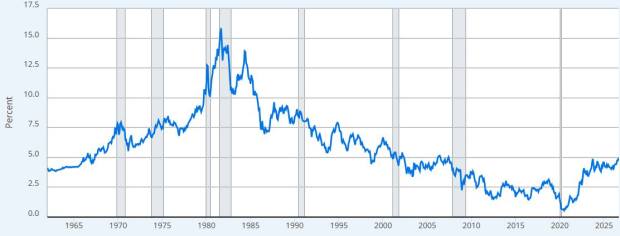
Source: Board of Governors of the Federal Reserve System (US) via FRED: As of Sep 14, 2026.
Disclaimer: This article is for informational purposes only and does not constitute investment advice. Readers should consult a financial advisor before making investment decisions.